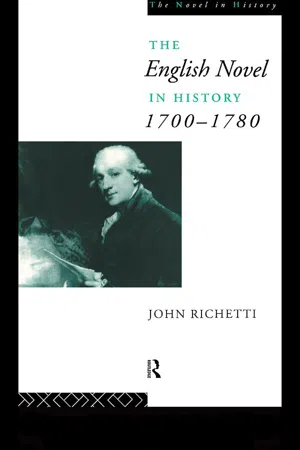
The English Novel in History 1700-1780 provides students with specific contexts for the early novel in response to a new understanding of eigtheenth-century Britain. It traces the social and moral representations of the period in extended readings of the major novelists, as well as evaluatiing the importance of lesser known ones. John Richetti traces the shifting subject matter of the novel, discussing:
* scandalous and amatory fictions
* criminal narratives of the early part of the century
* the more disciplined, realistic, and didactic strain that appears in the 1740's and 1750's
* novels promoting new ideas about the nature of domestic life
* novels by women and how they relate to the shift of subject matter
This original and useful book revises traditional literary history by considering novels from those years in the context of the transformation of Britain in the eighteenth century.
- 304 pages
- English
- ePUB (mobile friendly)
- Available on iOS & Android
eBook - ePub
The English Novel in History 1700-1780
About this book
Information
1
INTRODUCTION
Fiction and society in eighteenth-century Britain
The past recedes very quickly. In old photographs, friends and family look strange, dressed in oddly cut clothing, somehow impenetrable behind the familiar humanity. In their recording of instants that quickly harden into a frozen past, photographs have a distinctive pathos. Reminders of a lost presence, like the figures on Keats’ urn, photographs tease us out of thought. But they come powerfully to life when a voice seems to speak for them. The fairly crude eighteenth-century illustrations that accompany some familiar novels—Crusoe in his costume of animal skins or Pamela writing pensively, for example—are memorable only because of their link with narrative voices. These images satisfy a curiosity for external outline, a curiosity provoked by a resonant or tremulous voice that we have heard in these novels.
The strangeness of the past intensifies if we look back before living memory and before photographs, to the documentary remains of the millions who have preceded us. The eighteenth-century British novel is a unique set of documents by which we can try to hear voices that speak something very like our language. We now recognize that the novel adds up in the long run (and retrospectively) to an unprecedented attempt to project a new sort of particularized presence, and to imagine persons speaking about themselves in their singularity, asserting themselves as unique individuals and thereby breaking with those generalized types and with those communal affiliations that had long served as the primary markers of identity. Such individuals are more than empirical subjects; they are rather what the anthropologist Louis Dumont calls “independent, and autonomous, and thus (essentially) non-social moral being[s]” peculiar to modern ideology.1
Eighteenth-century strangeness has only recently been fully acknowledged. Historians warn us that we have minimized important differences and that the people of only a few centuries ago lived in a world radically distinct from our own. Social historians, especially, have begun the reconstruction of “a world we have lost” which lingered well into the late eighteenth century, and their efforts make that pre-industrial world of the everyday life of ordinary people discontinuous with ours, evoking varieties of eighteenth-century life in the layers below that ruling-class privilege that has come to dominate our images of the period.2 With those powdered wigs, brocaded clothing, and Palladian villas, there intersected another world of incessant labor and minimal material comforts which had changed little over the generations and in which a traditional culture and customs built up through the centuries survived into the early modern age. In this complicated historical moment, cultural and social hierarchy was far from rigid, and the hegemony of the ruling orders was neither absolute nor framed in our own notions of dominance.
Political and intellectual historians have done their part in this revision by arguing that we have distorted the eighteenth century by a reading backwards from our own values and that in fact institutions such as the aristocracy and the Church retained an authority and unmolested ideological domination that lingered well into the nineteenth century. J.C.D.Clark claims, for example, that Lockean, contractarian Whiggism and secular rationality were in fact marginal, confined to an uninfluential intelligentsia. Current understanding of the period is all wrong, says Clark, because “it misses the religious dimension in which all moved, whether Anglican, Roman Catholic or Dissenter. And it misses those traditional, hierarchical, deferential forms which were neither antiquated, tenuous survivals nor mere veneers or superstructures on a reality which was ‘basically’ economic, but substantive and prevalent modes of thought and behaviour in a society dominated still by the common people, by the aristocracy, and by the relations between the two.”3 For Clark, the secular eighteenth century has been to some extent a projection backwards from latter-day values. The “realism” that literary criticism has long attributed to the eighteenth-century novel may also need reconsideration, since the reality that these novels seem to mirror (or to dramatize as real) is decidedly not like our own and the individuals whom such fiction presents may share less with late twentieth-century persons in the developed Western world than we have been led to believe.
The classic exposition of that realism is Ian Watt’s The Rise of the Novel: Studies in Defoe, Richardson and Fielding (1957), a synthesis of the consensus that these three novelists represent the consciousness peculiar to an emerging modern world, marking in their fictions “a developing but unplanned aggregate of particular individuals having particular experiences at particular times and at particular places.”4 In place of the traditional understanding whereby such particulars are subordinate to generalized truth, the novel as Watt evokes it is the realization in narrative of that profound epistemological and ontological revolution announced by philosophers like Locke whereby reality is grounded in sense perception and quotidian experience, which is best rendered by the new emphasis in narrative technique and literary value that Watt labels “formal realism”: “the premise, or primary convention, that the novel is a full and authentic report of human experience, and threrefore under an obligation to satisfy its reader with such details of the story as the individuality of the actors concerned, the particulars of the times and places of their actions, details which are presented through a more largely referential use of language than is common in other literary forms.”5 As Watt describes it, the novel not only locates truth in a newly conceived sociohistorical particularity but effectively narrows that truth to the sensuous particulars of individual experience, which is rendered in a newly accurate referential language that does full justice to the resonantly specific world of historical time.
Realism such as Watt describes may be nothing more than an occasional possibility in eighteenth-century narrative, which lacks a fully established ideological basis for promoting it. What Catherine Belsey calls the “ideology of liberal humanism” underlies realism and “assumes a world of non-contradictory (and therefore fundamentally unalterable) individuals whose unfettered consciousness is the origin of meaning, language and action.” “Classic realism,” says Belsey, denies ideology by presenting “the subject as fixed and unchangeable, an element in a given system of differences which is human nature and the world of human experience.”6 Belsey must be thinking of nineteenth-and twentieth-century realisms, for these premises (especially what constitutes the “world of human experience”) are just what is at issue in many eighteenth-century novels, even those normally considered successfully realistic such as Defoe’s and Richardson’s. The ideology of individualism, with its fixed and positionless subjects of which Besley speaks, is precisely what much of that fiction examines. Obviously, eighteenth-century narrative does not, in the manner of poststructuralist critics like Belsey, consider the subject an ideological illusion, but this fiction’s obsessive theme is nothing less than the contested nature of subjectivity in a world where various possibilities compete for primacy and for simple dominance and where the individual requires support from others, from parents, patrons, friends, lovers, and even from institutions, to continue to exist. The very nature of identity is a recurring philosophical dilemma, and the novel may be said to rehearse that problem at its own level of consciousness and within its particular frame of reference.
Eighteenth-century fiction is an important stage in the fashioning and a key tool for the understanding of this evolving entity, the socially constructed self. Even in the early years of the century, narrative in Britain is increasingly (if implicitly) concerned with the problem of what it means to be an individual, with the value or significance of the particular experience of individuals as they seek to exercise agency, and of course with the related question of what constitutes the best community to support the individual. The novel begins as a heightened, almost obsessive, attention in narratives of various sorts to problems that cluster around issues of self-consciousness and social and moral authority and allegiance. Narratives of all kinds return consistently to that largest of questions: where is the authority that can judge subjectivity? That is, how should domestic and political relationships be constituted? Who rules and who serves and who benefits from the arrangement? Implicit and pervasive, such attention points to a deep, anxious suspicion that life is altering, that things are not now what they once were, that moral standards and individual striving are irrelevant in the face of economic or commercial necessity. Or instead of such fearful nostalgia, much narrative from the eighteenth century voices a progressive, even at times Utopian, conviction that things should be different from the way that they have always been and that the new order is full of opportunity for the hard-working and the meritorious. Perhaps such attitudes are perennial, but they have a recurrent centrality in narrative in English since the early eighteenth century.
Of course, such questions are largely implicit and posed, if at all, only in personal or local terms within particular narratives. Generalized social inquiry is a responsibility shouldered self-consciously only in the nineteenth century by certain intellectually ambitious novelists on the European scene. Thanks to Dickens, Eliot, Conrad, Tolstoy, Balzac, Zola, and others, we assume that novelists often provide a unique imaginative truth about the nature of society. Generalizing from what he calls “panoramic” passages in Dickens’ later novels, Jonathan Arac describes the novelist as a “commissioned spirit” who surveys society from a commanding height and seeks to render “social motion,” to provide thereby “a sense of a coherent social totality, buried but operative, waiting to be diagramed or dramatized in fiction.”7 In one way or another, in the classic nineteenth-century novel, character, author, and reader approach an understanding of sociohistorical necessity and seek to reconcile such necessity with the varieties of individual freedom that seem to be available.
Arac’s analysis seems to fit eighteenth-century novels equally well. Social comprehensiveness, or at least a wide range of social representation, is to some extent one of their distinctive features, what separates for most readers, say, Moll Flanders or Tom Jones from earlier narrative. Yet a commanding overview with its promise of a hidden totality is not quite what the major novels of the period actually provide. What they are about, if looked at closely, is precisely the difficulty of imagining something like the ultimate social and historical coherence that nineteenth-century novelists aspire to reveal. The eighteenth-century novel features an enormous diversity of social representation, and Defoe, Richardson, Fielding, and others present a varied canvas, rather like one of those exuberantly crowded scenes from Hogarth in which the viewer is teased to find a center, in which comic chaos seems a deliberate parody of orderly plenitude. As Ronald Paulson points out, Hogarth’s “is an art of multiple gestalts” whereby the initial and immediately graspable scene becomes “a flickering forest in which the viewer’s eye then roams about without coming to final rest.” Although the intent is to lead the viewer to an ultimate “coherent moral statement of meaning,” the risk is that the rococo richness of it all will prevent the unskilled or uninitiated viewer from grasping such coherence.8
That same ambiguity operates in the most important eighteenth-century fiction, for in their different ways, novelists pretend to cede authority in the search for a center, deferring to correspondents or fictional narrators to make whatever sense they can of social diversity and a multiplicity of relationships and negotiations for power and pleasure. Such deferral, for example, is part of the function of Fielding’s self-depreciating narrative stance in Joseph Andrews and Tom Jones, and the romantic resolutions of his plots are in this sense a declaration that actuality admits of no clear or self-evident ordering principle. So, too, Richardson’s coy invisibility behind his characters’ letters and, in Clarissa at least, his appeal from the legal complications and socioeconomic entanglements of the plot to the heroine’s Christian transfiguration are strategies for avoiding synthesis. Defoe’s various narrators, for all their energy and intelligence, concern themselves with local issues of survival and prosperity. Implicitly, it is only the novelist who has any actual claim to a comprehensive view of society, but that claim is invariably indirect or ironically deferred.
However, this crucial difference between narratives from the two centuries should not surprise us, since, in a strict sense, “society” as the supervising totality that Arac invokes did not fully exist for the eighteenth century, and society appears in its fiction as a constellation of distinct spheres of influence, a loosely federated collection of interests and smaller social units. As Raymond Williams concludes in Keywords: A Vocabulary of Culture and Society, society has come to signify in the most general sense possible “the body of institutions and relationships within which a relatively large group of people live” and in the most abstract sense “the conditions in which such institutions and relationships are formed.” But as Williams shows, those meanings were not prevalent in England until the last third or so of the eighteenth century. Until then the older associations of the word prevailed: from Latin socius= companion, and societas=companionship and fellowship. Society signified something active and immediate, not an institutionalized totality but a decidedly smaller and specifically connected group of people.9 As the social theorist, Anthony Giddens, puts it, Britain in the eighteenth century is not yet a modern nation-state but rather what Giddens calls a “class-divided” society in which large spheres “retain their independent character in spite of the rise of the state apparatus.”10 Earlier societies lack the established boundaries of the nation-state, and in them civil society is located more or less in the countryside “in the spheres of agrarian production and local community life.”11 As in earlier tribal societies, life features what Giddens calls a much smaller “time-space distanciation” than our own, one in which there are “relatively few social transactions with others who are physically absent.”12 It is not until the late eighteenth century that Britain ceases to be such a class-divided society, for it is not until the coming of the railroads in the early nineteenth century that the “characteristics of the nation-state replace the city as the administrative center in European nations.” As Giddens charts its accelerated development in the eighteenth century, the possibilities for that state and its administrative control clearly emerge as writing becomes more and more “a means of coding information, which can be used to expand the range of administrative control exercised by a state apparatus over both objects and persons,” even within the pre-modern state.13
John Brewer has argued that England in the eighteenth century developed the most efficiently administered bureaucratic apparatus in Europe, the nation emerging in a period of nearly continuous warfare with France and its allies from 1689 to 1783 as “a fiscal-military state.” In order to become the dominant European power by the end of the century, England managed “a radical increase in taxation, the development of public deficit finance (a national debt) on an unprecedented scale, and the growth of a sizable public administration devoted to organizing the fiscal and military activities of the state.”14 Brewer argues that such bureaucratic evolution coexisted with traditional private and political interests. The bonds of patronage and kinship were strong but, compared with other European societies, clientage and graft were moderate and in fact seem to have cooperated and certainly coexisted with increasing departmentalization and institutional loyalty. Various shades of political ideology were, naturally, hostile to this emerging entity, but Brewer’s point is that they all gradually reached an accommodation with its salient features: “Placemen were excluded from the commons, but never in their...
Table of contents
- COVER PAGE
- TITLE PAGE
- COPYRIGHT PAGE
- ACKNOWLEDGMENTS
- 1. INTRODUCTION: FICTION AND SOCIETY IN EIGHTEENTH-CENTURY BRITAIN
- 2. AMATORY FICTION: BEHN, MANLEY, HAYWOOD
- 3. DEFOE: MAPPING SOCIAL TOTALITY
- 4. FROM PASSION TO SUFFERING: RICHARDSON AND THE TRANSFORMATION OF AMATORY FICTION
- 5. FIELDING: SYSTEM AND SATIRE
- 6. SMOLLETT: RESENTMENT, KNOWLEDGE, AND ACTION
- 7. WOMEN NOVELISTS AND THE TRANSFORMATION OF FICTION
- 8. SENTIMENTAL NARRATIVE: PHILANTHROPY AND FICTION
Trusted by 375,005 students
Access to over 1.5 million titles for a fair monthly price.
Study more efficiently using our study tools.
Frequently asked questions
Yes, you can cancel anytime from the Subscription tab in your account settings on the Perlego website. Your subscription will stay active until the end of your current billing period. Learn how to cancel your subscription
No, books cannot be downloaded as external files, such as PDFs, for use outside of Perlego. However, you can download books within the Perlego app for offline reading on mobile or tablet. Learn how to download books offline
Perlego offers two plans: Essential and Complete
- Essential is ideal for learners and professionals who enjoy exploring a wide range of subjects. Access the Essential Library with 800,000+ trusted titles and best-sellers across business, personal growth, and the humanities. Includes unlimited reading time and Standard Read Aloud voice.
- Complete: Perfect for advanced learners and researchers needing full, unrestricted access. Unlock 1.5M+ books across hundreds of subjects, including academic and specialized titles. The Complete Plan also includes advanced features like Premium Read Aloud and Research Assistant.
We are an online textbook subscription service, where you can get access to an entire online library for less than the price of a single book per month. With over 1.5 million books across 990+ topics, we’ve got you covered! Learn about our mission
Look out for the read-aloud symbol on your next book to see if you can listen to it. The read-aloud tool reads text aloud for you, highlighting the text as it is being read. You can pause it, speed it up and slow it down. Learn more about Read Aloud
Yes! You can use the Perlego app on both iOS and Android devices to read anytime, anywhere — even offline. Perfect for commutes or when you’re on the go.
Please note we cannot support devices running on iOS 13 and Android 7 or earlier. Learn more about using the app
Please note we cannot support devices running on iOS 13 and Android 7 or earlier. Learn more about using the app
Yes, you can access The English Novel in History 1700-1780 by John Richetti in PDF and/or ePUB format, as well as other popular books in Literature & Early Modern History. We have over 1.5 million books available in our catalogue for you to explore.