eBook - ePub
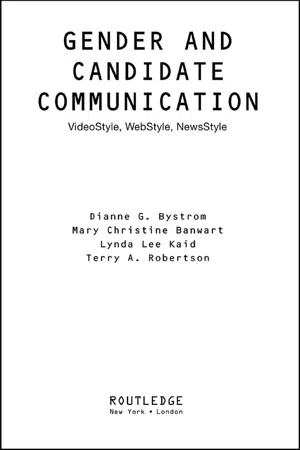
Gender and Candidate Communication
VideoStyle, WebStyle, NewStyle
- 256 pages
- English
- ePUB (mobile friendly)
- Available on iOS & Android
eBook - ePub
Gender and Candidate Communication
VideoStyle, WebStyle, NewStyle
About this book
A poll as recently as 2000 revealed that a third of the population thinks there are general characteristics about women that make them less qualified to serve as president. As the public and the media rely on long-held stereotypes, female candidates must focus even harder on the way they want to define their own image through traditional mass media, such as television, and new forms, such as the internet. Gender and Candidate Communication digs deep into the campaigns of the last decade sifting through thousands of ads, websites, and newspaper articles to find out how successful candidates have been in breaking down these gender stereotypes. Among their findings are that female candidates dress more formally, smile more, act tougher when they can, and prefer scare tactics to aggressive attack ads. Gender and Candidate Communication also presents the most comprehensive, systematic method yet for identifying and understanding self-presentation strategies on the web. The internet may be the medium of the future, but Bystrom has found that coverage on the web tends to draw even more heavily on old stereotypes. No close observer of campaigns, gender, or the internet will be able to ignore their findings.
Information
Part I
Women, Communication, and Politics
1
Women, Communication, and Politics:
An Introduction
In 1982, Virginia Sapiro suggested that a “central research question for those who study women’s political roles is why, given the lack of legal or obvious structural barriers to recruitment of female elites, are women still so underrepresented among political officials” (1982: 61). More than twenty years later, those who study women as political candidates still seek to respond to that question. Although the number of women holding political office has steadily but slowly increased, uncovering the barriers that restrict female candidates from election to public office is important if we seek fair representation.
A poll conducted by Roper-Starch Worldwide and underwritten by Deloitte and Touche provides insight into the public’s perception of female candidates and how these perceptions may serve as potential barriers. The poll, released January 13, 2000, focuses on the viability of female candidates being elected to the presidency. Although such findings should not be applied automatically to the viability of female candidates being elected to gubernatorial and congressional offices, the responses do offer further understanding of the cultural mind-set about female candidates.
In the poll results, one-third of the population surveyed indicated “there are general characteristics about women that make them less qualified to serve as president” (Deloitte and Touche 2000: 2), suggesting that women must still overcome traditional stereotypes. Additionally, a majority of those polled (51 percent) indicated that a man could do a better job than a woman leading the nation during a crisis and in making difficult decisions, the top two qualities believed “very important” in a presidential candidate (Deloitte and Touche 2000).
Due to such public perceptions about female candidates, combined with the added weight of media framing and stereotyping (e.g., Kahn 1993, 1996; Witt, Paget, and Matthews 1995), it remains important for female candidates to define strategically and successfully their own image and issue messages through traditional mass media, such as television, as well as through new forms of mass media, such as the Internet. In addition, as we explore the barriers that face women candidates and generate gender expectations, it is important to consider news coverage of mixed-gender political races to understand how the media shape our attitudes about the viability of female candidates. Finally, once we identify communication styles and strategies utilized by female and male candidates, analyzing how those strategies function to shape candidates’ images and perceptions in voters’ minds remains an area in need of research and analysis.
This book will analyze three aspects of gender and political campaigns: how female and male candidates present themselves to voters through their mass media messages (television spot ads and Web sites), how the media present these candidates through their news coverage, and how voters respond to the candidates’ mass media strategies. The significance of this work stems from our comprehensive examination of the messages as we identify female and male communication styles used in mass media settings, coupled with our research on the news coverage of candidates in mixed-gender races and our study of how voters respond to the strategic messages designed by the candidates. Female and male candidates use similar self-presentation strategies as well as strategies that differ; however, voter perceptions dictate the ultimate success and appropriateness of those candidate images.
Women as Political Candidates
This comprehensive examination of the communication by and about women in federal and statewide political campaigns is possible because of the increased number of women running for Congress and governor beginning in the 1990s. Before the 1990 election, the largest number of women to hold office in the U.S. Congress was twenty-five (Dolan 1997). In the 108th Congress, elected in 2002, that number more than doubled, as seventy-three women served in Congress in 2004 (fourteen senators, fifty-nine representatives). The number of women serving as their state’s governor has also doubled—from three in 1991 to an all-time high of eight in 2004.
The path to women’s election as political office holders has been slow but mostly steady over the past thirteen years. For example, the number of women seeking seats in Congress increased from 77 in 1990 to 117 in 1992, 121 in 1994, 129 in 1996, and 131 in 1998. In 2000, the number of women seeking seats in Congress fell slightly, to 128. But in 2002, a record 135 women ran for Congress (Center for American Women and Politics 2002). In terms of their representation, the number of women serving in the U.S. Senate increased from four in 1991 to seven in 1993, nine in 1995, 1997, and 1999, thirteen in 2001, and fourteen in 2003. The number of women serving in the U.S. House of Representatives has increased from twenty-eight in 1991 to forty-seven in 1993, forty-eight in 1995, fifty-four in 1997, fifty-six in 1999, and fifty-nine in 2001 and 2003 (Center for American Women and Politics 2004).
More women also are seeking their state’s top executive office, though the numbers running for governor have fluctuated over the past decade. In 1990, there were eight female candidates for governor. In subsequent election years, three women ran for governor in 1992, ten in 1994, six in 1996, ten in 1998, five in 2000, and ten in 2002. Similarly, the overall number of women serving as their state’s governor has fluctuated over the past decade, with three women serving as governor in 1991, 1993, 1997, and 1999. In 1995, four women served as governor; in 2001, five women served as governor; in 2003, six women served as governor; and, in 2004, a record eight women served as governor (Center for American Women and Politics 2002).
The women who ran for the U.S. Senate and state governorships—as well as their male opponents—between 1990 and 2002 provide the basis for our analysis of their mass media messages and their media coverage. We chose U.S. Senate and gubernatorial campaigns because they are conducted statewide and thus lead to candidate communication and media coverage that are broader, more consistent, and more comparable across races than local or congressional district campaigns.
Gendered Reactions to Political Candidates
In addition to an examination of how female and male candidates present themselves to potential voters through their television commercials and Web sites, this book considers how the media cover these candidates and how voters react to political candidate messages in presidential and mixed-gender gubernatorial and senatorial campaigns.
Sex stereotyping, which is more fully explained in chapter 2, and the phenomenon known as the “gender gap” provide a rationale for the examination of media coverage and voter reactions to political campaigns. Sex stereotypes have been defined as a “structured set of beliefs about the personal attributes of men and women” (Ashmore, Del Boca, and Wohlers 1986: 89). The act of sex stereotyping, then, refers to a normal cognitive process through which people simplify their perceptions about women and men by drawing inferences based on their beliefs about what members of a particular group are like (Ashmore, Del Boca, and Wohlers 1986: 89).
The gender gap, on the other hand, “refers to differences between women and men in political attitudes and voting choices” (Center for American Women and Politics 1997) but provides no explanation about what causes the difference (Seltzer, Newman, and Leighton 1997). Thus, the gender gap is neutral and can be used to examine the voting behavior, party identification, evaluations of presidential performance, and policy preferences of both women and men. Since the early 1980s, in both presidential and congressional races, women have preferred the Democratic candidate more often than men, whereas men have preferred the Republican candidate more often than women. In terms of party identification, larger proportions of women are Democrats, and larger proportions of men are Republicans. But party affiliation does not always explain the gender gap, as sometimes women voters prefer the Republican female candidate over the Democrat male candidate.
Over the past twenty or so years, the gender gap has expanded or narrowed by race and election year, with the largest gaps recorded in the 1996 and 2000 presidential campaigns. In 2000, the gender gap in the presidential race was of similar magnitude to the record set in the 1996 campaign, with women preferring Democrat Al Gore by twelve points and men favoring Republican George W. Bush by ten points. Women voters provided the margin of victory for U.S. Senate candidates Hillary Rodham Clinton (D-NY) by favoring her twenty-one points over her male opponent and Debbie Stabenow (D-MI) and Maria Cantwell (D-WA) by eight points each. Women also provided the margin of victory for gubernatorial candidates Jeanne Shaheen (D-NH) by twelve points and Ruth Ann Minner (D-DE) by thirty-six points (Center for American Women and Politics 2004).
The largest gender gap previously recorded in a presidential campaign was in 1996, with women favoring Democrat Bill Clinton by eleven points and men favoring Republican Bob Dole. The gender gap was also a factor in thirty-eight of the forty-nine races where the Voter News Services (VNS) conducted exit polls in 1996. That year, there were gender gaps in six of eleven gubernatorial races and twenty-eight of thirty-four senatorial races. Races with the largest gender gaps in 1996 included Democrat John Brennan versus Republican Susan Collins for the U.S. Senate in Maine, with women favoring Brennan by nine points and men favoring Collins by thirteen points, and Mary Landrieu (D-LA), who won her U.S. Senate race with women supporting her by nine points over male voters (Center for American Women and Politics 1997).
In 1994, fifty-one of the sixty-three races with VNS exit poll data showed gender gaps of four or more points; in forty-nine of those races, female voters supported the Democratic candidate more than male voters did. This included the U.S. Senate race of Dianne Feinstein (D-CA), whom women voters preferred by eleven points. In one of two exceptions (the Ohio attorney general’s race), women voters supported the Republican woman candidate more than men did (Center for American Women and Politics 1997).
In 1992, thirty-four of fifty-one races with VNS exit poll data showed gender gaps of four or more points. In thirty of thirty-four races, women voters supported Democratic candidates more than men did. This included the U.S. Senate races of Democrat Barbara Boxer (D-CA) and Democrat Dianne Feinstein (D-CA), where women preferred both by fourteen points, and Democrat Patty Murray (D-WA) and Carol Moseley-Braun (D-IL), both of whom were preferred by women by seven points. In one of the four exceptions, female voters supported a Republican woman candidate more than did male voters (Center for American Women and Politics 1997).
In 1990, forty-three of seventy races with VNS exit poll data showed gender gaps of four or more points. Again, in thirty-nine of those forty-three races, female voters supported Democrat candidates more so than did male voters. This included the gubernatorial races of Dianne Feinstein (D-CA), whom women preferred by sixteen points; Barbara Roberts (D-OR), preferred by women by sixteen points; and Ann Richards (D-TX), chosen by 15 percent more women than men. In three of the four exceptions, female voters supported the Republican woman candidate at a greater rate than male voters (Center for American Women and Politics 1997).
In this book, we include political party affiliation and incumbent/challenger status in our analysis of how these U.S. Senate and gubernatorial candidates present themselves to voters through their television commercials as well as how voters respond to political ads from mixed-gender gubernatorial and senatorial campaigns and presidential campaigns.
Theoretical Underpinnings
The theoretical underpinnings of this book are grounded in research in a variety of disciplines, including sociology, psychology, and communication.
To study how female and male political candidates present themselves through their mass media messaging (political ads and Web sites), we turned to Goffman’s (1973) theory of self-presentation, Kaid and Davidson’s (1986) VideoStyle concept, Bystrom’s (1995) application of Campbell’s (1989) feminine style rhetorical construct to VideoStyle, and Banwart’s (2002) application of these concepts to Web sites, that is, WebStyle.
To study how the media and public perceive and react to female and male political candidates, we applied theories of sex role stereotyping from cognitive psychology (Ashmore, Del Boca, and Wohlers 1986) and gender schema theory (Bem 1993). We call the media’s presentation of female and male candidates to their readers NewsStyle.
Based on these theoretical perspectives, which are explained in chapter 2, the book analyzes differences in female and male candidate advertising and Internet strategies, news coverage of female and male candidates, and female and male reactions to media messages.
Methods
Four research methods—content analysis, experimental, survey, and case study research—are used in this book. The primary method used in our research is a content analysis of media messages from mixed-gender U.S. Senate and gubernatorial races. In excess of thirteen hundred spot ads, forty-eight Web sites, and eighteen hundred newspaper articles are included in the analysis. We use the ads, Web sites, and news coverage of candidates from mixed-gender races (versus those from male/male and female/female races) to control for gender. Our analysis also includes experimental research on responses of male and female voters to political messages as well as survey research responses reporting media use by women and men in political campaigns.
Finally, we employ the constructs of VideoStyle, WebStyle, and News-Style to study the individual campaigns of female and male political candidates in mixed-gender gubernatorial and U.S. Senate races. For these sections of the volume, a case study methodology is used.
Thus, this book analyzes data collected over a number of years to offer a comprehensive study of how female and male candidates present themselves to voters, and how the media and public respond to communication strategies and campaigns. In Parts II, III, and IV, we apply a similar, comprehensive approach to analyze gendered messages and responses to candidate VideoStyle (Part II, chapters 3 through 6), WebStyle (Part III, chapters 7 through 9), and NewsStyle (Part IV, chapters 10 through 12). In each part, we provide an updated overview of female and male U.S. Senate and gubernatorial campaign VideoStyle, WebStyle, and NewsStyle. Next, these constructs are applied to individual campaigns of female and male candidates running for governor and U.S. Senate in 2000 and 2002. Finally, the responses of female and male voters to candidate campaign commercials, Web sites, and media coverage are reported. In Part V, chapter 13, we summarize the theoretical and practical implications of our work for those interested in women’s political campaigns and election to office, including women candidates and students and scholars of communication, political science, sociology, and women’s studies.
2
VideoStyle, WebStyle, and NewsStyle:
A Framework for Gendered Analysis
Our comprehensive look at gender and political communication includes not only an analysis of how female and male candidates present themselves through the candidate-controlled mediums of television ads and Web sites, but also an examination of how the media and voters react to these presentations. The framework for our analysis—VideoStyle, WebStyle, and NewsStyle—is based on theories from communication, sociology, and psychology that have been specifically applied to gender studies. This chapter explains these theoretical frameworks, the results of previous research relevant to our lines of inquiry, and the methods used in our analyses.
Analyzing Gendered Candidate Messages
The theoretical basis for our research on gender and candidate messages is drawn primarily from the concept of VideoStyle, initially introduced by Kaid and Davidson (1986). VideoStyle builds on the concept of “self-presentation” as discussed by Goffman (1973), providing a systematic method of analyzing the verbal content, nonverbal content, and production techniques in television spot ads. Since Kaid and Davidson’s inaugural work, VideoStyle has been advanced to study the self-presentation of female and male candidates in political spot ads adding Campbell’s construct of feminine style (Bystrom 1995; Bystrom and Kaid 2002; Bystrom and Miller 1999; Miller 1996) and adapted to the interactive features of the Internet and labeled “WebStyle” (Banwart 2002).
Goffman’s Theory of the Presentation of Self
In explaining his dramaturgical theory of the “presentation of self,” Goff-man (1973) uses the metaphor of the theater to describe interpersonal communication. He describes people as actors who structure their performances to make impressions on their audience:
When an individual appears in the presence of others, there will usually be some reason for him to mobilize his activity so that it will convey an impression to others which it is in his interests to convey. (1973: 4)
He may wish them to think highly of him, or to think that he thinks highly of them… he may wish to ensure sufficient harmony so that the interaction can be sustained, or to defraud, get rid of, confuse, mislead, antagonize, or insult them. (1973: 3)
Regardless of the actor’s motives or objectives, his or her ultimate interest, Goffman argues, is to “control the conduct of othe...
Table of contents
- Cover Page
- Title Page
- Copyright Page
- Part I: Women, Communication, and Politics
- Part II: Campaign Advertising: Gendered Messages, Gendered Reactions
- Part III: Candidate Web Sites: Gendered Messages, Reactions
- Part IV: Media Coverage of Candidates: Gendered Messages, Gendered Reactions
- Part V: Gender and Political Communication in Future Campaigns
- Notes
- References
Trusted by 375,005 students
Access to over 1.5 million titles for a fair monthly price.
Study more efficiently using our study tools.
Frequently asked questions
Yes, you can cancel anytime from the Subscription tab in your account settings on the Perlego website. Your subscription will stay active until the end of your current billing period. Learn how to cancel your subscription
No, books cannot be downloaded as external files, such as PDFs, for use outside of Perlego. However, you can download books within the Perlego app for offline reading on mobile or tablet. Learn how to download books offline
Perlego offers two plans: Essential and Complete
- Essential is ideal for learners and professionals who enjoy exploring a wide range of subjects. Access the Essential Library with 800,000+ trusted titles and best-sellers across business, personal growth, and the humanities. Includes unlimited reading time and Standard Read Aloud voice.
- Complete: Perfect for advanced learners and researchers needing full, unrestricted access. Unlock 1.5M+ books across hundreds of subjects, including academic and specialized titles. The Complete Plan also includes advanced features like Premium Read Aloud and Research Assistant.
We are an online textbook subscription service, where you can get access to an entire online library for less than the price of a single book per month. With over 1.5 million books across 990+ topics, we’ve got you covered! Learn about our mission
Look out for the read-aloud symbol on your next book to see if you can listen to it. The read-aloud tool reads text aloud for you, highlighting the text as it is being read. You can pause it, speed it up and slow it down. Learn more about Read Aloud
Yes! You can use the Perlego app on both iOS and Android devices to read anytime, anywhere — even offline. Perfect for commutes or when you’re on the go.
Please note we cannot support devices running on iOS 13 and Android 7 or earlier. Learn more about using the app
Please note we cannot support devices running on iOS 13 and Android 7 or earlier. Learn more about using the app
Yes, you can access Gender and Candidate Communication by Dianne G. Bystrom,Terry Robertson,Mary Christine Banwart,Lynda Lee Kaid in PDF and/or ePUB format, as well as other popular books in Languages & Linguistics & Political Campaigns & Elections. We have over 1.5 million books available in our catalogue for you to explore.