1 The environment of computing
A systems approach
Topics
- Business and information technology
- Information systems
- Systems thinking
- Systems analysis
- Technical systems: hardware and software
- Social systems
- Technology and social systems
This chapter has three main themes. First, the nature of modern information technology (IT) and its impact on modern business. Next, the idea of how thinking in terms of systems of different sorts helps us to understand the nature of IT and its impact on society. Finally we focus upon theme of technology change and IT management.
For less technical readers the section on technical systems gives a brief explanation of how hardware and software systems operate and interrelate.
Business and information technology
What is information technology?
Linking together definitions of ‘information’ and ‘technology’ from the Shorter Oxford English Dictionary, ‘information technology’ means ‘the systematic study of the industrial arts relating to the communication of instructive knowledge’. This definition includes studying printing, or, for that matter, smoke signals. However the general usage today, followed in this book, is more like the definition employed by Flowers (1988, 284) ‘the application of computers and telecommunications to the collection, processing, storage, and dissemination of voice, graphics, text, and numerical information’.
One notable development in recent years has been the convergence of communications and computer technology, with both becoming intensive users of data embodied in binary digital form and processed by microprocessors on silicon chips. In this book therefore ‘IT’ is normally used in the broad modern sense to encompass both computing and telecommunications technologies. In some books, IT is used more narrowly to refer principally to computing and ‘ICTs’ to refer to information and communication technologies more generally.
Industrial and commercial implications
If we consider the industrial and commercial implications of the employment of the new information technologies then we must take on board that the computer is a general purpose machine which mechanizes human brain-powered operations just as the Industrial Revolution mechanized human and animal muscle-powered operations. The impact of such a broadly applicable technology is inevitably widespread and far-reaching. Computers have become a pervasive technology applied in all sectors of life, including industry, commerce, government, education and leisure activities.
In succeeding chapters we shall see the impact of computers in the creation of new products and services, new methods of production, and in transforming information processing and communication. A brief summary of some of the obvious uses of information technology is given in Box 1.1 and will be elaborated upon in later chapters.
Information systems
For businesses, information technology is only a means to an end – which is the use of knowledge to make and implement commercial decisions. Efficient organizations require established systems to enable them to make the best possible decisions in the situations they are likely to meet. Thus an organizational information system should collect data, analyse and present this as useful information that can be retrieved as the basis of expert knowledge at the point of decision. Once decisions are made they must be passed on to those who implement them, carried out, and the success or failure of the operation monitored. Increasingly decisions can be automatically implemented using the technology, thus enabling organizational objectives to be achieved with maximum efficiency.
Box 1.1 The uses of computers in business
- Storage and easy retrieval of information: databases
- Analysing information: spreadsheets, accounts packages
- Internal communications (within business): networks
- External communications (with other businesses and customers):
e-mail, booking systems, etc. - Presentation of information: word processing and desktop publishing
- Computer-aided design (CAD)
- Computer-aided manufacture (CAM): robots, process control
- New and better products: video recorders, washing machines, etc.
Information is a – perhaps the – major resource of modern businesses. Consider the importance of the sorts of business information listed in Box 1.2.
In many cases businesses could even profit from having their physical plant destroyed, but could never recover from losing their information resources. This was graphically illustrated in post-Second World War Germany/Japan when bombed industries recovered dramatically with new plant and inherited know-how.
Hence some economists argue that information is a fourth major factor of production (in addition to land, labour and capital), which is of increasing importance.
However, an important point not so far stressed, is that the business information we have been describing is not just a series of isolated lists but is all interrelated. If one piece of information alters (e.g. the specification of a product) then many other items will be affected (e.g. how to produce it, suppliers required, potential customers, etc.). In other words a business’s information is a system and should be organized accordingly.
A related, but not identical, point is that it is misleading to think of business information as a static list of useful things to know; rather, it should be considered as a dynamic flow. Thus information will be acquired by one department and used. This then creates new information, which is vital for a second department. Computer people usually talk in terms of ‘data input’, ‘processing’ and ‘output’, to describe what goes on within a department or part of the work process. In these terms what we are saying is that one man’s output is the next woman’s input!
Box 1.2 Key types of business information
- Lists of customers: actual or potential, their needs, financial status, etc. (Frequently bought and sold as ‘good will’, etc.)
- Information on the business’s products: legal standards they must conform to, how to manufacture them, product designs, etc. – often protected by patents, registered trademarks, copyright, etc. Firms must often pay quite large licence fees to produce other manufacturers’ products (for instance Coca-Cola!).
- Information on potential and actual suppliers: capabilities, financial status, etc.
- Information on stocks and flows: orders, stocks of materials in hand, production levels, finished goods in the warehouse, etc.
- Accounting information: production costs, money owed by customers, to suppliers, etc. (debts can be sold to factors, and if not pursued may become losses).
- Information as a business product: many businesses are selling information for a living – e.g. publishers, stockbrokers, schools and colleges, computer software houses, advertising agencies, etc.
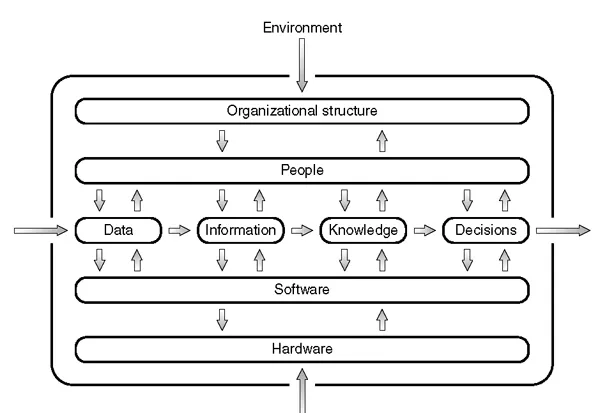
Few, if any, existing information systems are completely automated – indeed, people normally play a key role at each stage of the process, collecting data, analysing and presenting information, and using knowledge to make decisions (see Figure 1.1). The behaviour of people in organizations is usually profoundly modified by the structures, incentives and ‘culture’ of the organization. Older forms of information technology such as paper files, newspapers and letters frequently are also employed.
The quality of an information system will thus depend not only upon the excellence of the hardware and the subtlety of the software employed, but also on the accuracy and relevance of the data collected, plus the quality of the human professionals who use the system, This, in turn depends upon the extent to which the organization succeeds in coordinating and motivating employees to achieve corporate objectives.
From all of this, and a measure of common sense, some preliminary principles of good information management may be suggested. The contribution which modern information technology (particularly through a centralized database system or an Intranet) can make to this will be discussed in Chapter 5.
Figure 1.1 An organizational information system
Box 1.3 Criteria for a good management information system
Good information management will ensure that information available to decision makers is:
- Appropriate
- Accurate
- Timely
- Easily accessed
- Economically provided
- Consistent
- Safeguarded
- Of high quality
To understand the nature of information systems requires an understanding of terms such as ‘information work’, ‘information technology’ and ‘information processes’.
‘Information work’ refers to any kind of work involving information (see Box 1.4). Within an enterprise it is likely that effort spent on information work is an order of magnitude greater than effort spent on computer-based information technology applications. For example, high IT spenders in the economy are enterprises such as financial institutions and government agencies. They may spend up to 8–9 per cent of total enterprise expenditure on computer-based IT applications. Such enterprises are likely to spend in the order of 70–80 per cent of total expenditure on information work. Examples of relatively low computer-based IT spenders are manufacturing and oil companies. They may spend 1–2 per cent on IT, and 35–40 per cent on information work. More information on this topic is available in Vincent (1990).
Usually the term ‘information work’ refers to formal activities with information. In an enterprise it is also likely that other kinds of information activities are performed, such as informal information work, or even ‘information play’.
Formal information work is usually performed to carry out required procedures or produce the information component of required enterprise outputs. This includes results such as:
- the essential transactions carried out by the enterprise, such as purchases, sales or the provision of services, hiring employees or contractors, or handling calls within or to the enterprise
- taking and implementing decisions
- monitoring and controlling activities
- deciding and implementing enterprise objectives and strategies
- designing products and services
- marketing and selling products and services
- training and development
- reporting activities, results and reviews
- handling calls, enquiries and problems
- contemplating alternatives.
Box 1.4 Examples of information work
- Management
- Administration
- Planning
- Design
- Learning
- Problem-solving
Informal information work includes all information work that does not appear in any deliverable of the information work (but it may have been crucial in creating the deliverable), or it is work necessary to the deliverable but for one of various possible reasons cannot be written down. For example, in taking a decision various people may be consulted about alternatives and consequences, but what is eventually represented in a formal way is just the decision actually taken. An example of informal information work where the result may not be written down would be considering who might be good at doing a piece of work, and who might not be good at it. The formal result would just be the decision about who is to do the work.
Information play includes activities such as general discussion, watching television, listening to music, reading a newspaper, or some surfing of the web.
Information processes are the things that may be done to information. This can be analysed initially in terms of a life cycle of information:
- Create: information must be invented, brought into existence, created, or some such similar concept.
- Use: when information exists it will be used for one or more purposes (if information is never used to inform someone, or to affect a decision, it is useless and might as well not exist).
- Maintain: many pieces of information become out of date and must be corrected to take relevant changes into account.
- Archive or retire: many pieces of information become out of date or are used very rarely. In this case, the information is likely to be archived. Some information will be destroyed (such as old newspapers, or old commercial documents) when it is no longer needed, and some information will reside in archives such as libraries, micro-form, or electronic storage where it can be retrieved and used if desired.
This life cycle – create–use–maintain–retire – represents a minimum list of information processes. There are many more, most of which are examples of these four basic processes. Other such common processes are:
| Collect | Send | Calculate |
| Analyse | Communicate | Report |
| Store | Correct | Consider |
| Read | Discover | |
Technology is the study or science of the use of artefacts to help achieve an objective. Therefore ‘information technology’ is strictly the study or science of the use of artefacts to support purposeful information processes (Darnton and Giacoletto, 1992).
A very common bias in business literature today when discussing information technology is to restrict the discussion to computer-based information technology. However, this definition means that it is not appropriate to think of IT in terms of only computer-based artefacts. In fact, given these definitions, IT is several thousands of years old. Table 1.1 sets out a possible sequence of generations.
Today, as we shall see shortly, these second and third generations are intimately connected in most existing information systems. Examples of third-generation information systems that are purely information or communications technology are very rare.
We now have some of the key building blocks for a basic understanding of information systems.
A ‘system’ is usually considered as an ordered collection of components that interact together and behave as though the collection is pursuing one or more objectives. There are many possible formal characteristics of a system (for a more detailed discussion of the use of the terms ‘system’, ‘technology’, ‘information’, and so forth, related to information systems, see Darnton and Giacoletto, 1992). These include boundary, purpose, components, behaviour, possible states, extensive and intensive properties. This means that the idea of an information system is not straightforward. In common usage, the term often means a configuration of just a computer (or network of computers) along with all related hardware, software, and applications. However, by itself such a configuration would never do anything. The definition of a system requires the identification of one or more purposes. The people who use a computer configuration usually provide these, o...