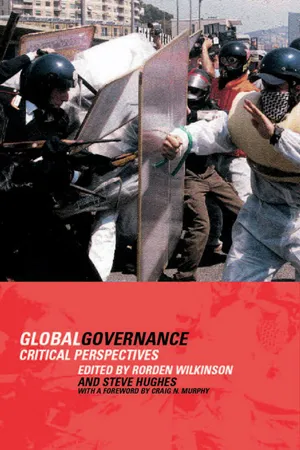
In recent years, the role of global institutions such as the United Nations, World Trade Organization, International Monetary Fund and the World Bank has never been more important to the lives of individuals throughout the world. This edited book provides critical perspectives on the role of these institutions and how they use their policies, procedures and practices to manage global political, socio-economic, legal and environmental affairs. In contrast to previously published books on this subject, Global Governance is organized thematically rather than by institution. Each chapter examines core issues such as labour, finance, the environment, health, culture, gender, civil society, poverty and development. It should be essential reading for undergraduate students of international politics, international political economy and international economics.
- 264 pages
- English
- ePUB (mobile friendly)
- Available on iOS & Android
eBook - ePub
About this book
Information
1
Global governance
A preliminary interrogation1
Rorden Wilkinson
Images of violent clashes between drum-beating protestors and robocop-style police in Seattle; water-cannon, firecrackers and tear gas in central Prague; and the crumpled body of a demonstrator shot dead by police in Genoa, have combined vividly and tragically to bring home the tensions underlining globalisation and its system of governance. Though attempts have been made to dismiss the demonstrations out of hand and depict the participants as nothing more than a ‘global rent-a-mob’, the case for conducting a rigorous interrogation of contemporary global governance has not been weakened. Global inequalities in income and wealth, information provision, education, and life experiences continue to grow; environmental degradation continues to accelerate and appears unlikely to be met with appropriate political solutions; and there remains a marked deficit in the efficacy, democratic accountability and levels of transparency across the broad array of world institutions.
Yet, although the reasons for conducting a wholesale interrogation of global governance are compelling, it is poorly understood in the literature. With the exception of a small, but significant, group of scholars,2 the disciplines of international relations and international political economy have largely avoided engaging with a phenomenon that appears to challenge the foundations of existing wisdom. Global governance is variously treated as a fad, an oxymoron, or it is dismissed out of hand. The discipline's realist orthodoxy remains wedded to an understanding of world politics that perceives states as the most significant actors, and attributes little to the role of international organisations or non-state actors. Through these lenses, global governance can be understood only as a function of the international distribution of power, or as a result of behavioural practices, norms, rules and decisionmaking procedures that have developed over time. Even those liberal institutionalists that have sought to qualify realist assumptions by suggesting that international institutions can, at particular junctures, have a significant impact on international interaction, are wary of suggestions that a system of global governance has emerged and is taking form.
In those few instances when global governance is taken seriously, it is commonly deemed synonymous with the development of international organisation: that process of institutionalisation which, since at least the middle of the nineteenth century, has sought to establish moments of authority designed to co-ordinate activities across state boundaries. Here, the emergence of a series of institutions during the nineteenth century is said to have provided the platform for the establishment of two world organisations: the League of Nations and the International Labour Organisation (ILO). From this point onwards, albeit with the odd institutional funeral, the process of international organisation is understood to have evolved through time in a largely linear fashion producing an increasing number of world and regional bodies. The result has been the emergence of a constellation of bodies, many of which are invisible from public view, but which are nevertheless deemed to be largely peripheral to the natural rhythms of world politics.
Though there is much that can be learnt about global governance by exploring developments in international organisation, the synonymity with which these two phenomena are treated does not enable the qualitative dimensions of contemporary global governance to be fully captured. Global governance is distinct in at least two ways. The first is a recognition that it comprises an array of actors, not only those visible aspects of world politicaleconomic authority such as the United Nations (UN), the World Trade Organisation (WTO), the International Monetary Fund (IMF) and the World Bank, but also quasi-formal intergovernmental gatherings such as the Group of 7 (G7) and the World Economic Forum (WEF); combinations of state and non-state actors such as the UN's Global Compact and the ILO; private associations such as the International Chamber of Commerce (ICC); mercenary groups such as Sandline International and Executive Outcomes; nongovernmental organisations (NGOs) like the World Wide Fund for Nature (WWF), the World Development Movement (WDM) and Oxfam; transnational religious bodies; international terrorist organisations (however loosely associated); transnational political movements; financial markets; global accountancy and law firms; and transnational business.
The second distinguishing feature is the way in which varieties of actors are increasingly combining to manage—and in many cases, micro-manage—a growing range of political, economic and social affairs. In this way, global governance can be thought of as the various patterns in which global, regional, national and local actors combine to govern particular areas. Global governance, then, is not defined simply by the emergence of new actors or nodes of authority; instead it comprises a growing complexity in the way in which its actors interact and interrelate. Most certainly, some of the agents of global governance are newly emerged; others, however, are much longer established. Nevertheless, key to understanding contemporary global governance is the capacity to identify the range of actors involved in the act of management, as well as to uncover the variety of ways in which they are connected to one another.
That said, it is premature to speak of the existence of a complete and fully coherent system of global governance. Global governance is better understood as emerging. The intensification of global political, economic and social interaction has generated pressures for a concomitant system of governance. Where the demand for such a system is greatest, and where there is a corresponding political-economic will, coherent and effective patterns of global governance have emerged. In other areas, and often in spite of considerable demand, systems of governance are inadequate, ineffectual, wanting, or nonexistent.
Understanding that a coherent system is emerging is, in large part, key to appreciating the way in which global governance is currently articulated. As the remainder of this volume demonstrates, contemporary global governance is highly uneven. Some of its dimensions, particularly in the field of economic governance, are highly developed; whereas others, especially in the fields of health, environment and human rights, are underdeveloped, barely existent or wholly absent. Nevertheless, the evolving character of global governance brings with it moments of opportunity— moments in which pressure can be brought to bear on the emerging patterns of governance. In such moments, alternative possibilities have the potential to emerge, thus altering the way in which global governance is constituted. In this way, identifying the potential for alternative possibilities becomes an intrinsic part of any interrogation of global governance.
This volume aims to build on that small but significant body of literature that has begun to take global governance seriously. In doing so, we seek to contribute to the development of a more complete understanding of this emerging phenomenon. Our contribution is to explore the role of those world organisations that lie at the core of contemporary global governance. These bodies represent, as Craig Murphy has put it, ‘what world government we actually have’.3 It is these bodies that have developed, and are developing relationships with other actors to enable greater control to be exercised in given areas. And it is these bodies that have so far been called into question by the absence of coherent and plausible answers to the problems of growing inequalities. It is for these reasons that we choose to begin our examination by exploring the patterns of governance centred around the authority of particular world organisations. By concentrating on the core, we aim to better understand one piece of the wider mosaic that constitutes contemporary global governance. Our aim, then, is not to offer an examination of global governance in its entirety; rather, we offer a series of critical reflections on some of its most significant aspects. In doing so, we highlight the problems of the way in which global governance is currently articulated and identify areas wherein fundamental change is required. Throughout we place emphasis on understanding how patterns of governance have evolved (or not, as the case may be) in the areas of finance, commerce, development, environment, health, human security, labour and civil society. In doing so, we identify the key actors and mechanisms involved; the way in which global governance is articulated; the reasons for, and pressures behind, particular developments; and, perhaps most importantly, the most prominent oversights.
The backdrop for this book, then, is provided by an acute need to develop a better understanding of contemporary global governance; to advance a more comprehensive account of the relationship between the institutions of global governance and the areas they seek to govern; to explore the tensions thrown up by the way in which governance is exercised; to develop a better understanding of the evolution of global governance; and to explore alternative strategies and possibilities for a more inclusive and representative form of global governance. It is to these tasks that the remainder of this volume turns.
The organisation of the book
Global financial and developmental governance
The first part of the book explores recent developments in global financial and developmental governance. The two chapters comprising this section centre on the operations of the IMF and the World Bank respectively— organisations that are dealt with here specifically, but whose significance runs throughout the volume.
In the first of these chapters, Randall Germain charts what he sees as a radical change in the decision-making structures of the global economy. This change, he argues, has seen the locus of international financial decisionmaking move away from a system centred around the US, to one wherein a greater role can now be assumed by states not previously privy to the corridors of power. He suggests, in turn, that this movement has begun to broaden the boundaries of accountability and legitimacy to which the international financial architecture—his term for the constellation of financial decision-making bodies—is exposed. Germain argues that this movement is not the result of a conscious effort to reform the democratic credentials of the international financial architecture. Rather, he suggests, it began as a technical response to a series of financial crises in the global economy, principally, though not exclusively, associated with the Asian financial crisis of 1997–8. It has, nevertheless, begun to acquire a distinctly political dimension designed to incorporate emerging market economies into international financial governance.
Germain argues that the crises of the late twentieth century brought with them a realisation that international finance was not of secondary importance to the global economy, and that the artificial separation of the spheres of politics and economics had to be redressed. He suggests that a key part of the process of reform has required that developing countries accept primary responsibility for crisis prevention; but this ownership could only come about with concomitant changes in the decision-making structures of the international financial architecture—changes which better reflect the new role of emerging markets in financial decision-making. He argues that the creation of a new international grouping of non-G7 countries—the Group of Twenty (G20)—has generated a potentially new and radical alteration to the way in which financial decisions are made. The newness and radicalism of this action lies in the extension, for the first time, of the international financial decision-making structure beyond the industrial core of the G7 generally, and the US more particularly.
Germain argues that this reform process has been further enhanced by the creation of the International Monetary and Financial Committee (IMFC). This new body, he contends, though unable to stop the IMF from engaging in poor policy decisions, enables all members to raise issues relating to the Fund's role in the global financial system without being hampered by the legendary asymmetries in the Organisation's voting system. Germain's examination of these developments enable him to offer an image of an emerging consensus-based international financial decision-making structure.
In spite of these more inclusive moves, the picture Germain paints is of a system of governance that remains firmly centred around the financial decision-making power of states. In the main, it is representatives of national banks and ministries of finance that populate the bodies of the financial decision-making architecture; and it is only by extending the invitation to their counterparts in emerging markets that any expansion in the representative credentials of the international financial architecture has come about. In reality, then, it remains a system of international financial governance, one wherein the sanctity of state sovereignty is maintained. Certainly, there is a complex system of relationships between banking institutions and national ministries that ensures private sector views filter through to the corridors of power. It is, however, the absence of a corresponding counter to private and state influence that ensures the international financial architecture remains unbalanced, albeit that its decision-making inevitably has global consequences. That said, given the history of international financial decision-making, the developments Germain details are nevertheless significant.
Paul Cammack switches the focus away from the IMF and the international financial architecture to explore the World Bank's role in global governance. Paralleling Germain, Cammack explores recent efforts by the World Bank to promote ‘ownership’ among its membership, particularly from developing countries. However, unlike Germain's account of inclusion through ownership, Cammack suggests instead that the Bank's efforts belie a more authoritarian approach to development. In further contradiction to Germain, Cammack argues that institutions such as the Financial Stability Forum (FSF) and the Global Corporate Governance Forum (GCGF) are essential tools through which the disciplinary dimensions of this system are exercised.
Cammack's focus is on the World Bank's Comprehensive Development Framework (CDF) and its corresponding system of governance. He argues that the World Bank has attributed the problems of development to the failure of developing countries to embody the social and structural dimensions of neoliberalism. The Bank's response has been to require that developing countries accelerate the liberalisation process by promoting a sense of ownership in global developmental governance. More than that, while states appear to be have been ‘invited’ to assume ownership of the CDF, they are in reality required to assume ownership of all the elements of the development framework.
Cammack argues that the means by which the World Bank can ensure states assume ownership of the CDF is through a matrix—a co-ordinated approach involving the international development community, governments, civil society and the private sector. The purpose of the matrix, Cammack suggests, is to enable the World Bank to move away from the micro-management of operational aspects of development programmes to an assumption of responsibility for overall strategic control. Such a movement requires that the policies of all recipient states become more transparent and accountable to the World Bank. In making his claims, Cammack takes issue with the World Bank's assertion that the matrix is not a clandestine attempt to dominate the international development arena. Moreover, and again contrary to its own denials, the World Bank is seeking to bring about strategic co-ordination across the international development community.
Cammack's vision of global governance is, then, markedly different from Germain's. Rather than the emergence of a meaningful process of reform, Cammack sees in the CDF the consolidation of a finely tuned, multifaceted system of governance that extends from the corridors of the World Bank down to the nooks and crannies of local life. In this system national governments act as important conduits, and a host of other actors assume strategic importance. They are, nonetheless, subordinate to the wishes and desires of the World Bank—something that leads Cammack to suggest that the World Bank aspires to be the ‘Mother of All Governments’. Cammack's vision of developmental governance, then, is of a system co-ordinated by the World Bank that is intimate in its intrusion and acutely hierarchical in its structure.
Global environmental, cultural and health governance
The section on environmental, cultural and health governance moves away from the terrain of global economic governance. It is not, however, a wholesale departure. Economic governance is by far the most advanced and comprehensive dimension of emerging global governance, and it pervades and indeed dominates other dimensions, as we see in the next three chapters as well as in the remainder of the volume.
Lorraine Elliott begins this section with a critical examination of global environmental governance. In doing so, she argues that an apparently well populated institutional terrain masks a lack of substance in global environmental governance. She begins by examining the demand for global environmental governance, exploring something of the rate of environmental degradation as well as the tensions between sovereignty and the environment, questions of justice, and the place of the ‘local’ in the face of growing global inequality. The demand for global environmental governance is then contrasted with its supply. Here Elliott argues that while a global institutional framework exists, it is far from global in operation. There is an absence of sub...
Table of contents
- Cover
- Half Title
- Full Title
- Copyright
- Contents
- List of illustrations
- Notes on contributors
- Foreword: ‘Why pay attention to global governance’
- Acknowledgements
- List of abbreviations
- 1 Global governance: a preliminary interrogation
- PART I Global financial and developmental governance
- PART II Global environmental, cultural and health governance
- PART III Human security and global governance
- PART IV Organised labour and global governance
- PART V Civil society and global governance
- Index
Trusted by 375,005 students
Access to over 1.5 million titles for a fair monthly price.
Study more efficiently using our study tools.
Frequently asked questions
Yes, you can cancel anytime from the Subscription tab in your account settings on the Perlego website. Your subscription will stay active until the end of your current billing period. Learn how to cancel your subscription
No, books cannot be downloaded as external files, such as PDFs, for use outside of Perlego. However, you can download books within the Perlego app for offline reading on mobile or tablet. Learn how to download books offline
Perlego offers two plans: Essential and Complete
- Essential is ideal for learners and professionals who enjoy exploring a wide range of subjects. Access the Essential Library with 800,000+ trusted titles and best-sellers across business, personal growth, and the humanities. Includes unlimited reading time and Standard Read Aloud voice.
- Complete: Perfect for advanced learners and researchers needing full, unrestricted access. Unlock 1.5M+ books across hundreds of subjects, including academic and specialized titles. The Complete Plan also includes advanced features like Premium Read Aloud and Research Assistant.
We are an online textbook subscription service, where you can get access to an entire online library for less than the price of a single book per month. With over 1.5 million books across 990+ topics, we’ve got you covered! Learn about our mission
Look out for the read-aloud symbol on your next book to see if you can listen to it. The read-aloud tool reads text aloud for you, highlighting the text as it is being read. You can pause it, speed it up and slow it down. Learn more about Read Aloud
Yes! You can use the Perlego app on both iOS and Android devices to read anytime, anywhere — even offline. Perfect for commutes or when you’re on the go.
Please note we cannot support devices running on iOS 13 and Android 7 or earlier. Learn more about using the app
Please note we cannot support devices running on iOS 13 and Android 7 or earlier. Learn more about using the app
Yes, you can access Global Governance by Steve Hughes,Rorden Wilkinson in PDF and/or ePUB format, as well as other popular books in Politics & International Relations & Political Economy. We have over 1.5 million books available in our catalogue for you to explore.