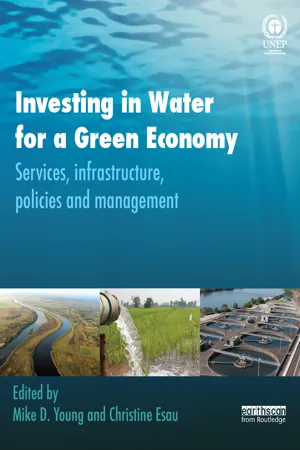
In the context of the economies of the world becoming greener, this book provides a global and interdisciplinary overview of the condition of the world's water resources and the infrastructure used to manage it. It focuses on current social and economic costs of water provision, needs and opportunities for investment and for improving its management. It describes the large array of water policy challenges facing the world, including the Millennium Development Goals for clean water and sanitation, and shows how these might be met. There is a mixture of global overviews, reviews of specific issues and an array of case studies. It is shown how accelerated investment in water-dependent ecosystems, in water infrastructure and in water management can be expected to expedite the transition to a green economy. The book provides a key source of information for people interested in understanding emerging water issues and approaches that are consistent with a world that takes greater responsibility for the environment.
eBook - ePub
Investing in Water for a Green Economy
Services, Infrastructure, Policies and Management
- 296 pages
- English
- ePUB (mobile friendly)
- Available on iOS & Android
eBook - ePub
Investing in Water for a Green Economy
Services, Infrastructure, Policies and Management
PART 1
Overview
1
INVESTING IN WATER SERVICES INFRASTRUCTURE POLICIES AND MANAGEMENT
Key messages
Water, a basic necessity for sustaining life, goes undelivered to many of the world’s poor. Nearly 1 billion people lack access to clean drinking water; 2.6 billion lack access to improved sanitation services; and 1.4 million children under 5 die every year as a result of lack of access to clean water and adequate sanitation services. At the current rate of investment progress, the Millennium Development Goal for sanitation will be missed by 1 billion people, mostly in sub-Saharan Africa and Asia.
The existing inadequacies in provision of water and sanitation services generate considerable social costs and economic inefficiencies. When people do not have access to water, either large amounts of their disposable income have to be spent on purchasing water from vendors or large amounts of time, in particular from women and children, have to be devoted to carting it. This erodes the capacity of the poor to engage in other activities. When sanitation services are inadequate, the costs of water-borne disease are high. Cambodia, Indonesia, the Philippines and Vietnam, for instance, together lose about US$9 billion a year because of poor sanitation – or approximately 2 per cent of combined GDP. Access to reliable, clean water and adequate sanitation services for all is a foundation of a green economy.
Continuing current practices will lead to a massive and unsustainable gap between global supply and demand for water withdrawal. This is exacerbated by failure to collect and treat used water to enable subsequent uses. With no improvement in the efficiency of water use, water demand is projected to overshoot supply by 40 per cent in 20 years time. Historical levels of improvement in water productivity, as well as increases in supply (such as through the construction of dams and desalination plants, as well as increased recycling) are expected to address 40 per cent of this gap, but the remaining 60 per cent needs to come from investment in infrastructure, in water-policy reform and in the development of new technology. The failure of such investment or policy reform to materialize will lead to the deepening of water crises.
The availability of an adequate quantity of water, of sufficient quality, is a service provided by ecosystems. The management of, and investment in, ecosystems is therefore essential to address water security for both people and ecosystems in terms of water scarcity, the over-abundance of water (flood risk) and its quality.
Accelerated investment in water-dependent ecosystems, in water infrastructure and in water management, can be expected to expedite the transition to a green economy. Modelling suggests that, under the green investment scenario, global water use can be kept within sustainable limits and all the MDGs for water achieved in 2015. With an annual investment of US$198 billion on average over the next 40 years, water use can be made more efficient, enabling increased agricultural, biofuel and industrial production. By 2030, the number of people living in a water-stressed region is 4 per cent less than under business-as-usual (BAU) and up to 7 per cent less by 2050.
When investment is coupled with improvements in institutional arrangements, entitlement and allocation system, the expansion of payments for ecosystem services (PES), and the improvement of water charging and finance arrangements, the amount that needs to be invested in water can be reduced significantly. Moreover, a significant proportion of water management policies and measures in other sectors such as input subsidies are undermining opportunities to improve water management. Resolving global water supply problems is heavily dependent upon the degree to which agricultural water use can be improved. Irrigated land produces 40 per cent of the world’s food and, as populations grow, a significant proportion of this water will need to be transferred to urban, commercial and industrial uses.
Introduction
The aim of this chapter
Drawing upon the chapters presented in this book, this chapter has three broad aims. First, it highlights the need for providing all households with sufficient and affordable access to clean water supplies as well as adequate sanitation.
Second, it makes a case for early investment in water management and infrastructure, including ecological infrastructure. The potential to make greater use of biodiversity and ecosystem services in reducing water treatment costs and increasing productivity is emphasized.
Third, the chapter provides guidance on the suite of governance arrangements and policy reforms, which, if implemented, can sustain and increase the benefits associated with making such a transition.
Scope and definition
The scope of this chapter is restricted to freshwater ecosystems, the water supply and sanitation2 sectors and the government and market processes that influence how and where this water is used.
The crucial contribution water makes to agriculture, fisheries, forestry, energy and industrial production is discussed in other chapters.
The perspective offered in this chapter is one that looks forward 20 years to 2030 and, where possible, to 2050. During the next 20 years, a considerable rise in demand for water of sufficient quantity and quality is expected and changes in local supply conditions are forecast.
Structure of the chapter
This chapter identifies the contribution that water can play in assisting a transition to a green economy. We first present a vision of the role that water ecosystems can play in the transition to a green economy and then provide an overview of the world’s water resources and the services offered by the water supply and sanitation sector. After highlighting some of the more unique characteristics of water, we identify challenges and opportunities to make better use of water and water-dependent ecosystems. Building on this knowledge base, the benefits of investing in the water supply and sanitation sector, as a means to assist with a transition to a green economy, are quantified. The chapter closes by identifying institutional reforms, which, if implemented, would increase the returns that could be gained from a commitment to a transition to a green economy.
Water in a green economy – a vision
In a green economy, there is emphasis on the pursuit of opportunities to invest in sectors that rely upon and use natural resources and ecosystem services. At the same time, there is a transition to a suite of policy and administrative arrangements that neither degrade the environment nor impose costs on others. The interests of future generations are considered carefully. In the case of water, many of the potential gains are achieved simply by deciding to invest in the provision of water and sanitation services. Where water is scarce, this scarcity is acknowledged and managed carefully. Progress towards the pursuit of green objectives can be accelerated through the redesign of governance arrangements, the improved specification of property rights, the adoption of policies that reflect the full costs of use, including the costs of adverse impacts on the environment, and improved regulation to ensure that use is kept within sustainable limits.
In green economies, the role of water in both maintaining biodiversity and ecosystem services and in providing water is recognized, valued and paid for. The use of technologies that encourage efficient forms of recycling and reuse is encouraged.
Measuring progress towards a green economy
In many countries, there is a lack of reliable data on the water-storage capacities of river basins, the condition of built infrastructure and the performance of the water supply and sanitation sector. One of the more significant opportunities to improve investment and management is to assemble data in a manner that enables water to be managed effectively and the performance of one region to be accurately compared with other regions.
Signposts of success in terms of progress towards a greener set of economic arrangements include:
• recognition of the value of the benefits provided by good water management and costs (negative value) of not doing so;
• evidence of increased investment in the water supply and sanitation sector that gives consideration to the environment;
• the formal definition of rights to use water and its allocation to users and the environment;
• legislative recognition of the important role that ecosystem services can play in supporting an economy;
• investment in the development of institutional capacity to manage ecosystems, including water, on a sustainable basis or using an ecosystem approach;
• the removal of policies that discourage ecosystem conservation and/or have perverse effects on water use and investment;
• progress towards arrangements that reflect the full costs of resource use in ways that do not compromise the needs of disadvantaged people in a community; and
• addressing ecosystem degradation by increasing efforts for restoring and protecting ecosystems critical to supply of water quantity and quality.
Indicators to be tracked include data on:
• the number of people without access to reliable supplies of clean water and adequate sanitation;
• the volume of water available per person in a region;
• the efficiency of water supply in the urban sector and water use;
• the efficiency of water use in the agricultural and industrial sectors; and
• the water use and water-related impacts of companies and countries.
The world’s water resources
Access to the world’s water resources is heavily dependent upon the nature of the water cycle. While a massive amount of water reaches the earth’s land surface, much less, around 40 per cent, makes its way into creeks, rivers, aquifers, wetlands, lakes and reservoirs, before cycling back into the atmosphere (see Plate 1.1). Of the water that is extracted for human purposes, on average, approximately:
• 70 per cent is used for agricultural purposes;
• 20 per cent is used by industry (including power generation); and
• 10 per cent is used for direct human consumption.
Given that the vast majority of usable fresh water is channelled towards agriculture, any global consideration of water allocation must consider the factors that determine the efficiency of water use in the sector. Irrigated land produces around 40 per cent of the world’s food (Hansen and Bhatia 2004; Tropp Chapter 3). One of the biggest challenges facing water managers is to find a way to significantly increase the productivity of irrigated agriculture so that water can be transferred to other sectors without adversely affecting the environment or food security. In many parts of the world, there are few opportunities to enhance supplies at reasonable cost.
But general observations can be misleading. No two water bodies are the same. Managing large, complex, transboundary water systems typically requires a different approach to overseeing smaller water systems, where local issues are often all that need to be considered. In developing countries, water management and investment are typically geared towards reducing poverty and enabling economic development; the priority for developed nations tends to be maintaining infrastructure and supplying access to water at reasonable cost. In both cases, there is a need to focus more on long-term sustainability of the systems and services provided. Demand and supply also vary greatly. In Sing...
Table of contents
- Cover Page
- Half Title page
- Title Page
- Copyright Page
- Contents
- List of plates
- List of figures
- List of tables
- List of contributors
- List of abbreviations
- Acknowledgements
- Part 1 Overview
- Part 2 The macro-economic case for investment in water
- Part 3 Policy guidelines for investment in water
- Part 4 Regional experience
- Index
Trusted by 375,005 students
Access to over 1.5 million titles for a fair monthly price.
Study more efficiently using our study tools.
Frequently asked questions
Yes, you can cancel anytime from the Subscription tab in your account settings on the Perlego website. Your subscription will stay active until the end of your current billing period. Learn how to cancel your subscription
No, books cannot be downloaded as external files, such as PDFs, for use outside of Perlego. However, you can download books within the Perlego app for offline reading on mobile or tablet. Learn how to download books offline
Perlego offers two plans: Essential and Complete
- Essential is ideal for learners and professionals who enjoy exploring a wide range of subjects. Access the Essential Library with 800,000+ trusted titles and best-sellers across business, personal growth, and the humanities. Includes unlimited reading time and Standard Read Aloud voice.
- Complete: Perfect for advanced learners and researchers needing full, unrestricted access. Unlock 1.5M+ books across hundreds of subjects, including academic and specialized titles. The Complete Plan also includes advanced features like Premium Read Aloud and Research Assistant.
We are an online textbook subscription service, where you can get access to an entire online library for less than the price of a single book per month. With over 1.5 million books across 990+ topics, we’ve got you covered! Learn about our mission
Look out for the read-aloud symbol on your next book to see if you can listen to it. The read-aloud tool reads text aloud for you, highlighting the text as it is being read. You can pause it, speed it up and slow it down. Learn more about Read Aloud
Yes! You can use the Perlego app on both iOS and Android devices to read anytime, anywhere — even offline. Perfect for commutes or when you’re on the go.
Please note we cannot support devices running on iOS 13 and Android 7 or earlier. Learn more about using the app
Please note we cannot support devices running on iOS 13 and Android 7 or earlier. Learn more about using the app
Yes, you can access Investing in Water for a Green Economy by Mike Young,Christine Esau in PDF and/or ePUB format, as well as other popular books in Economics & Infrastructure. We have over 1.5 million books available in our catalogue for you to explore.