- 432 pages
- English
- ePUB (mobile friendly)
- Available on iOS & Android
eBook - ePub
About this book
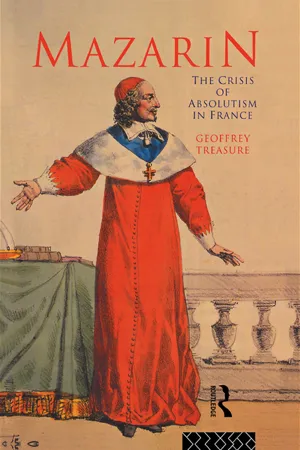
Mazarin was the model statesman of the early modern period in French history. This book follows his career from pupil of the Jesuits, through legate in Paris and Avignon, to service for Louis XIII and beyond. Mazarin's role in the survival of absolute monarchy during the upheavals of the Fronde and his guidance of the young Louis XIV are given full weight. His crucial part in many diplomatic exchanges, and in particular those which brought an end to the Thirty Years War and the Franco-Spanish War, is examined in detail. His life is placed in the context of a study of the times, highlighting the rapidly changing nature of government.
Part I
GIULIO MAZARINI, PAPAL DIPLOMAT
1
THE YOUNG ROMAN
One day in 1915 the peace of the mountains and wooded valleys of the Abruzzi was shattered by an earthquake which killed more than 30,000 people. Among the ancient villages of the worst affected area was Pescina: among the houses reduced to rubble was one that had once belonged to the Bufalini family. There, on Saint Bonaventura’s day, 14 July 1602, Hortensia Mazarini, born Bufalini, gave birth to her eldest son. Giulio Mazarini was destined to become an eminent statesman in the service of France and to play a significant part in re-aligning the map of Europe. Again it was 14 July, in 1789, when another kind of earthquake shook Paris as the Bastille fell to a revolutionary mob, demonstrating to the world the collapse of the old absolutist regime. To the early shaping of that regime no one had contributed more than Giulio Mazarini’s predecessor, Cardinal Richelieu: to its preservation during the crisis of the Fronde, no one more than Mazarini himself.
The career of the Italian who became First Minister of France does not stand out in bold profile like that of Richelieu. Comparisons with Richelieu have tended to stress the lack, in Mazarini, of those heroic and ruthless traits that made the Frenchman the object of profound respect, tinged often with a certain awe. Mazarini could not have accomplished what he did without the exertions and example of Richelieu. With the opportunities bequeathed by the master in 1642 went, however, grave dangers. When Mazarini died, in 1661, France had been enlarged by two great treaties, her king was loved and generally obeyed: the regime looked secure. Even when allowance has been made for a generous measure of good fortune, it can be argued that Mazarini was as important in his way as the man whom the French have always called ‘the great Cardinal’ – and no less worthy of study.
Hortensia Mazarini had retreated to the family estate for her first confinement, seeking relief from Rome’s torrid summer in the calm and fresh air of the hills. Her family was noble, originally from Umbria. One of her brothers was a Knight of Malta1 who had written a treatise on duelling: a witness to nobility and to noble concerns. Her godfather was the Constable of Naples, Filipo Colonna,2 and her marriage had been arranged to reward Pietro Mazarini for services to the Colonna family, one of the oldest and grandest in Italy. It brought her five more children after Giulio, severe suffering in their births and, subsequently, much disquiet and domestic turmoil; there was little harm to her reputation for beauty and goodness, but little happiness either, at least, it seems, until later years and her virtual separation from her husband. She was to live long enough however (till 1644) to hear of Giulio’s becoming First Minister of France. His remarkable career, bringing vicarious glory to the casa, may have done something latterly to palliate the vexatious experience of a life on the fringe of grandeur, living in a series of houses too big to be adequately maintained.
La casa! recurring constantly through the family correspondence, the word signifies both house and family. Its history, during the years when the favoured son was rising to fame, was one of constant moves: three in one year, 1629, between houses in the fashionable Trevi quarter of the city, in the heart of Papal Rome, where, in 1640, he was to buy his own palazzo. The poverty of the Mazarinis was relative, but real enough, in the form of unpaid bills and the chronic dependence on a patron’s whims; these are recorded in Pietro’s letters and must have figured largely in the conversation of the household. The uneasy life of a nobleman’s client, in which there was more of makeshift than of achievement, more of promises than of rewards, would not have been what Pietro would have expected when he came from his native Sicily to take up the post of major-domo to Colonna. It had been secured for him by his brother, Giulio Mazarini, a Jesuit,3 renowned beyond Italy for his sermons which appeared in a French edition in 1612. He was the first member of the family to have attracted public notice, and he surely eased the path of his namesake. Giulio could perhaps have done more for Pietro if the latter had been more competent. The post was in itself neither demeaning nor undemanding. Having a leading position in the Constable’s clientele. Pietro was responsible at different times for the administration of estates and the collection of taxes. He complained however that he was undervalued and under-paid. He was much praised by the Colonnas, he wrote in a letter of 1629, but ‘I never see any fruits of this good will’.4 His grievances can only have sharpened his son’s ambition to excel.
As the family grew faster than his means, Pietro came to fix his hopes on Giulio, the prize pupil, popular companion of young nobles, favoured client of grandees and rising star of Papal diplomacy. There is indeed some pathos in the garrulous father’s eagerness for his son’s fame, besides his share in any pickings that came the young man’s way. So opportunistic a view of his son’s career is not surprising, for Pietro’s difficulties were compounded by the needs of his other children. Besides the younger son Michele5 there were four daughters for whom husband or convent had to be found. Giulio was apparently a devoted son; he was certainly a good brother. He was required to find various finances – Michele for education with the Dominicans at Bologna, then promotion: the four girls for board and teaching at convents, then for sufficient dowries to make suitable marriages, or, in the case of Anna Maria,6 her permanent place at the convent of Santa di Campo Marzo in Rome - all depended on Giulio’s ability to raise funds and secure an influential patron. With the exception of Anna Maria, unless indeed she wanted to remain in the convent of which she eventually became prioress, they were not disappointed. For several children of the next generation, Giulio’s nieces, there was to be a future beyond the dreams of any of his sisters.
An eldest son’s duty to maintain the casa was complemented by the prompting of Giulio’s own ambition and sustained by a robust physique, pleasing looks and a fine instinct for exploiting any favourable opportunity. In one respect, to the discomfiture of historians, he failed lamentably to respond to his father’s chiding: ‘watch your handwriting’.7 More significant traits of the mature statesman can also be detected in early Roman days, inspiring affection in those who enjoyed his companionship and zest for life, but a certain wariness perhaps too in those who thought that they might suffer from his ambition, or wondered what lay behind the relaxed and agreeable manner. Of one thing they could be sure: he was clever.
Giulio was taught, from the customary starting age of seven, at the Roman college of the Jesuits, a vast building designed to house nearly two thousand pupils. Already acknowledged leaders of reformed, militant Roman Catholicism, renowned for their schools, favoured instruments of Papal power, strong in discipline but flexible in methods as in theology, the Society of Jesus offered exciting prospects for those wanting to serve Christ, yet remain in the world. Giulio was one of their most talented pupils excelling in the Latin, theology, logic, geometry and rhetoric of their rigorous curriculum. Charmed by ‘his fine spirit, capacity and gracious manners’ they strove to win him for the Society. Indeed what a Jesuit he would have made!
So much of the character of this age is illuminated by the ideals and style of the Jesuits. They were faithful to the stern precepts and vaulting ambition of their founder, the Basque soldier and visionary Ignatius Loyola.8 They worked eagerly on the frontiers of missionary enterprise, from the forests of Canada to the court of the Chinese Emperor, courting, sometimes receiving martyrdom for Christ. They did not frown however upon elegant manners nor assume that a wordly style detracted from a spirit of devotion. So Giulio remained persona grata to the fathers of the Colegio Romana. He was chosen to play the part of Ignatius in a pageant of 1622 to celebrate the canonisation of the founder and he performed to great acclaim. But his learning and expertise were soon to be put to other uses.
The galantuomo9 moved with assurance in the palazzi of wealthier friends, a favourite at their card tables, displaying a talent for friendship that reflected good nature and a willingness to take trouble that went beyond the claims of self-interest. It was surely those qualities that evoked in Giulio’s patrons an interest in his career that they would not have shown to a mere toady. It was as well – for he would not have relished the discipline required of Jesuit novices: for such committed souls there were no short-cuts to eminence: but, for a privileged few of those who sought preferment in the hierarchy of the church, there were. This secular-minded young Roman would in future keep his distance from the Jesuits and he would never have a Jesuit confessor; he would become a Cardinal without ever being ordained priest and would serve the church in ways that suited his gifts. Diplomacy would be his métier.
Idolised son and brother, clever place-hunter from impoverished casa, impressionable but wary pupil of the Jesuits: the clues to Giulio’s personality are assembling, but they do not reveal enough. The setting is all-important. He was the child of Baroque Rome, in the efflorescence of the style that was making the Holy City a place of such exhilarating beauty. The Baroque10 has been seen as an essentially theatrical style: to please the masses at a time of growing tension in overcrowded cities, subordinating accepted canons of taste to the search for the spectacular; again, as a mechanism employed by absolutist rulers to condition the masses to accept a hierarchical society; again as the spontaneous product of a society suffering from insecurity and chronic pessimism. The reader may be challenged by such theories; it is unlikely that the young Mazarini would delve far below the surface of the art and architecture that was transforming the face of Rome. Yet the physical setting of life is important: in this case it enables us to envisage the Roman world that could nurture and inspire an ambitious young cleric, and to come to terms with the mentality of such a man.
At its best there is a satisfying balance in Baroque art between the power of the architectural form and the drama that belongs to what was special about the style, the expression of movement in complex patterns and daring artifice. The artist may have aimed at illusion but the message was plain enough. In Carlo Maderna’s glorious nave of St Peter’s or in the masterpiece of Vignola and Della Porta,11 their exuberant church of the Gesù, fortunate Romans could not fail to see an optimistic spirit. Behind the startling impact of plastic imagery, the brilliance of colour and the riotous vitality of the whole design, there was an unmistakable strength derived from the artists’ confidence in what they were doing to please their patrons. They sought not merely to attract but to astonish the pilgrim; to induce a mood appropriate to the claims of a reformed Papacy still imperial in aspiration and to express through their art the sense of the Tridentine decrees which had confirmed and defined traditional teaching.12 The inherent conflict of humanist values and theocentric dogma had been resolved. In the citadel of the church, which saw the burning of the humanist Giordano Bruno and was soon to see the censure of Galilei Galileo,13 there were clear limits to what man could be allowed to think. In figures of the saints, in sumptuous reliquaries and vaulting baldacchinos the artists of the Baroque witnessed to the feats, not of the unfettered individual, l’uomo universale, of Renaissance aspiration but of the servant of God, mindful only of His call: for his edification they celebrated the efficacy of prayers for the dead, the mediation of saints, the grace and power of Our Lady, the mystery of transubstantiation and the recurring miracle of the Mass.
The city to which Claude Lorrain and Poussin came from France to perfect their craft was gripped by a frenzy of building. Rome was full of artisans, stucco workers, masons, marblers, modellers. Among them, when Mazarini was studying with the Jesuits, was the young craftsman who had run away with his architect father and taken humble employment as a mason. Francesco Borromini: another was the Neapolitan, Giovanni Bernini.14 These two artists were rivals in architecture as in career: together they did more than anyone to give to Rome its exalted character as capital of the Baroque. Every quarter had its cupola, St Peter’s being only the grandest amongst the cluster of domes that make the distinctive Roman view. The Romans were busy adapting classical Rome to the needs of the new spiritual imperialism. They moved columns and obelisks to suit their grandiose plans; they crowned them with crosses to mark the triumph of the church over old pagan and new humanist alike.
Nor was the activity confined to churches. Ornate palazzi, fine streets and squares witnessed to the wealth of patrons for whom the Eternal City was the cynosure of the artistic world. Rome provided both a true perspective and, as presented in some of the devices of its characteristic art, a false one. There was abundant wealth and an incorrigibly extravagant mood with it. There were benefits for all. The beautiful fountains were fed by new aqueducts, providing the most abundant water supply, 180,000 litres a day, of any great city. In some respects though, with its rapidly expanding population, of 50,000 nearly doubled by mid-century, it was a parasitic growth. Leading Romans preferred living on interest from the monti, the bills with which the Papacy financed much of its work, to any commercial or manufacturing venture; many of the people were lazy, living off charity; some paupers, some brigands, many poor. Rome had no monopoly of urban squalor, or of the criminality remarked in the stormy life of the low-born Caravaggio,15 but they were highlighted by the grandeur of its patrician class and the lofty assumptions of those who served the heir of St Peter at the summit. All went to provide the kind of contrast which Caravaggio, master of light and shade, evokes in works like the Madonna of Loretto, painted in the Jubilee year of 1600. Two old men, pilgrims, kneel before the Virgin: radiating faith and awe they well represent the ordinary men for whom, as well as for their patrons, the artists worked.
In the city of the seven hills it was still possible, among the thronging pilgrims, to luxuriate in the sense of being at the heart of the civilised world. If, however, it proved that real power lay elsewhere, in the burgeoning courts and chanceries of Madrid, Paris, Vienna, London, now even Amsterdam and Stockholm, was there not, in all this magnificence, an element of pretence? If so it was surely reinforced in Giulio’s experience, by his domestic life – his father’s clinging to the coat-tails of the mighty, whose palazzi of marble and stucco were financed by the rents of a depressed peasantry and the contributions of the faithful. Even in cultural life there was a hint of decadence in the reckless buying, commissioning and entertaining, characteristics of a pampered plutocracy.
2
THE POLITICS OF ROME
The Pope from 1623 to 1644 was Maffeo Barberini, Urban VIII.1 His elder nephew Francesco enjoyed the largest share of his patronage with the post of vice-chancellor and the control of four abbeys as the basis of a large fortune. Such endowment appeared to flout Tridentine prohibitions of pluralism and nepotism. But Cardinal Francesco Barberini, erudite, a discerning patron of the artists who employed their talents to serve the faith, somewhat given to melancholy, was a hard-working, if maladroit politician of blameless private life. His younger brother, Antonio, by contrast, Cardinal at the age of twenty, another grand pluralist, was, for all his charm and generosity, an embarrassment to his father and brother. Though he would eventually bestir himself to lead the Papal army in an unfortunate war against Parma (1642–4) he was disinclined to serious business. Contemporaries might shrug their shoulders at stories of his infatuation with Leonora Baroni, the celebrated singer. Posterity should not complain that he had a major hand in the building of the palazzo Barberini. He fostered the growth of opera and encouraged experiments in production which his client was later to introduce to the French. But the influence which this engaging aesthete could exert on Papal policy, soon to be exploited by Mazarini, who was to find in him a more manageable patron than Francesco, illustrates the critical flaw in the Papacy at this time.
A twentieth-century Pope described the Vatican in words which would not have displeased Urban VIII. ‘The Vatican is not only a visible entity. The realisation of an idea, a design, its intention is to unite mankind … Over the centuries it has spoken of the everlasting rather than [that] which is fleeting … In contrast to the repeated faultiness of human institutions, an indelible rule holds sway here …’ Mazarini’s Roman upbringing gave him the criteria, the claim to ...
Table of contents
- Cover Page
- Half Title page
- Title Page
- Copyright Page
- Dedication
- Contents
- Family Tree
- Maps
- Preface
- Part I Giulio Mazarini, Papal Diplomat
- Part II French Service
- Part III The Fronde
- Part IV War and Peace
- Part V Money Matters
- Part VI Conscience and Policy
- Glossary
- Notes
- Bibliographical Note
- Select Bibliography
- Index
Trusted by 375,005 students
Access to over 1.5 million titles for a fair monthly price.
Study more efficiently using our study tools.
Frequently asked questions
Yes, you can cancel anytime from the Subscription tab in your account settings on the Perlego website. Your subscription will stay active until the end of your current billing period. Learn how to cancel your subscription
No, books cannot be downloaded as external files, such as PDFs, for use outside of Perlego. However, you can download books within the Perlego app for offline reading on mobile or tablet. Learn how to download books offline
Perlego offers two plans: Essential and Complete
- Essential is ideal for learners and professionals who enjoy exploring a wide range of subjects. Access the Essential Library with 800,000+ trusted titles and best-sellers across business, personal growth, and the humanities. Includes unlimited reading time and Standard Read Aloud voice.
- Complete: Perfect for advanced learners and researchers needing full, unrestricted access. Unlock 1.5M+ books across hundreds of subjects, including academic and specialized titles. The Complete Plan also includes advanced features like Premium Read Aloud and Research Assistant.
We are an online textbook subscription service, where you can get access to an entire online library for less than the price of a single book per month. With over 1.5 million books across 990+ topics, we’ve got you covered! Learn about our mission
Look out for the read-aloud symbol on your next book to see if you can listen to it. The read-aloud tool reads text aloud for you, highlighting the text as it is being read. You can pause it, speed it up and slow it down. Learn more about Read Aloud
Yes! You can use the Perlego app on both iOS and Android devices to read anytime, anywhere — even offline. Perfect for commutes or when you’re on the go.
Please note we cannot support devices running on iOS 13 and Android 7 or earlier. Learn more about using the app
Please note we cannot support devices running on iOS 13 and Android 7 or earlier. Learn more about using the app
Yes, you can access Mazarin by Geoffrey Treasure in PDF and/or ePUB format, as well as other popular books in History & World History. We have over 1.5 million books available in our catalogue for you to explore.