- 288 pages
- English
- ePUB (mobile friendly)
- Available on iOS & Android
eBook - ePub
About this book
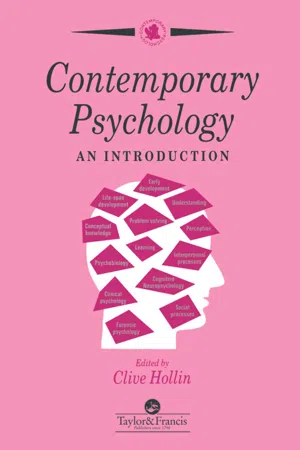
This text provides a state-of-the-art summary of current issues in psychology, introducing the reader to contemporary thinking and research. The book discusses topics from areas as wide as cognitive, developmental, physiological, social and applied psychology, as well as individual differences and learning. The chapters provide an overview of current theory, research methodologies and research findings, covering how research is done and the problems researchers are actively engaged in solving, as well as pointing to areas for future research.; This text is intended to be of use as a companion to more traditional texts for students embarking on psychology courses and as a resource to the general reader with an interest in current issues in psychology.
Information
Publisher
Taylor & FrancisYear
2006Print ISBN
9780748401925
9780748401918
Edition
1eBook ISBN
9781135793814
Part I
Cognitive Psychology
Chapter 1
Perception
Mike G.Harris
Since this is intended as an introductory chapter, it begins with the assumption that you have either never thought much about perception or, if you have, that you don’t consider it a particularly difficult or interesting problem. Perhaps, like most people, you think that the main problems of vision, for example, are essentially those of forming a faithful image and then transmitting it directly to the brain. The aims of this chapter are to show you why this view is wrong and to offer alternative, more appropriate and much more interesting ways to think about perception. It consists of a broad introduction to perception and a general description of the main contemporary approaches to its study, followed by specific examples of each of these approaches. These examples are taken from vision because that is the sense that we know most about. However, the principles illustrated are equally relevant to the other perceptual modalities.
The problem of perception
Imagine a group of children throwing things into a pond. As each object lands it creates a characteristic pattern of expanding circles on the surface: large objects create large waves with considerable distances between them, while small objects create small, closely packed ripples. When several objects land at once, their ripples intermix to form a complex, ever-changing, two-dimensional pattern on the pond. Now imagine that you are blindfolded and deafened so that you cannot see or hear the pond and your only contact with it is through your two index fingers, which you can hold a few inches apart and dip into the water to feel the ripples drifting past them. Given only this tenuous contact with the pond, how would you go about recognizing what the objects were and where they had landed upon the surface? Are these tasks even possible?
This imaginary situation offers a simplified analogy with hearing. Sound sources are just mechanical disturbances that set up waves of pressure variation in the air, rather like the pattern of ripples on the pond, except, of course, that they are three-dimensional spheres rather than two-dimensional circles. Instead of fingers, your only contact with these pressure variations is through two small membranes, one in each ear, which vibrate as the -waves drift past. Yet, from this impoverished stimulation, you recognize and locate, apparently effortlessly, all the complex and different sounds around you.
The first point of this analogy is to emphasize the important fact that perception is very difficult—it just seems simple because we are very, very good at it. The second point has to do with why perception is so difficult. Distance senses, like sight and hearing, have no direct contact with the world. Instead, information is brought to them indirectly, by things like light or pressure variation, and the pattern that actually reaches the sense organs is nothing like the objects that produced it. Yet we perceive a world of things, not a world of ripples, so somehow, from this unpromising start, the brain reconstructs the rich perceptual world in which we live.
You may at this point suspect that I have cheated by deliberately offering an analogy with hearing, rather than, say, vision. After all, the visual equivalent of our pattern of ripples is an image, or rather a continuous stream of images, formed upon the light-sensitive retina in each of our eyes. Unlike patterns of ripples, images seem a rather good representation of the external world and, indeed, they are used as a powerful means of communication in our everyday lives. But light is really just like the water in our analogy. Objects may stamp their imprint upon it but, ultimately, images are just patterns of light like the ripples on a pond. They seem like direct representations of the world only because we each have a visual system that is very good at making sense of them. This point is illustrated by Figure 1.1, which presents an image in an unusual form.

Figure 1.1 The image as a pattern of ripples
Note: The amount of light at each point in the image is represented by the height of a surface. Although this representation contains the same information as a conventional black-and-white photograph, our visual systems are not equipped to make sense of it in this form and we have great difficulty in working out what the image depicts. (It is actually part of the Mona Lisa.)
To emphasize the indirectness of images, try comparing a simple object like a cube with the image that it creates. It may help actually to write down a brief definition of a cube and, alongside it, a simple sketch. If an image is a good representation of reality, then a single description should apply to both these examples. Put another way, if images are easy to perceive, then we should be able to derive a description from the sketch that immediately captures the defining characteristics of the cube that it represents. The most obvious problem in doing this is that the two representations are in different languages— one in words, the other in terms of spatial relationships. Fortunately, translation between the two languages looks fairly simple: the verbal description uses terms like ‘edges’, ‘corners’ and ‘surfaces’ and, for each of these, there is a simple graphical equivalent— ‘lines’, ‘junctions’ and ‘regions’, respectively. So, perhaps all we have to do is to derive a verbal description of the sketch, and then substitute the appropriate terms: ‘edges’ for ‘lines’, and so forth.
Unfortunately, you will quickly find that this just doesn’t work. A cube consists of six square surfaces joined at eight corners, each consisting of three surfaces at right angles to each other. The important terms here are ‘square’ and ‘right angles’ since these are really what define a cube. Yet your sketch does not consist of squares and, depending on how you’ve drawn it, may not contain even one right angle. Images are not good representations of the world because they don’t preserve even the most obvious defining characteristics of the objects that they depict.
Different approaches
How do we derive a world of objects from a world of light? In recent years there have been two different approaches to this problem, each stemming from a different view of the complex relationship between objects in the world and the patterns of light that they produce.
The first approach is called Direct Perception and stems from the work of J.J.Gibson (e.g. 1950, 1979). It is impossible to convey the subtlety of Gibson’s arguments in just a few sentences but the central theme is that, although patterns of light are obviously not the same as the objects that produce them, they none the less contain all the information needed to account for our visual perception. In terms of the pond analogy, every perceivable feature of an object has some effect on the pattern of ripples and so, in principle, a complete description of the pattern of ripples contains within it a complete description of the perceivable features of the object. This approach thus views perception as essentially a direct process of ‘picking up’ the relevant information from the environment.
Again in terms of the pond analogy, Gibson shifted attention away from the instantaneous arrival of a fragment of the pattern at the fingertips towards the whole evolving pattern of ripples upon the surface of the water. Thus, rather than thinking about a single image, Gibson thought about the ‘optic array’, which is the complete three-dimensional bundle of light rays that impinges on any given point in the world and which has, imprinted upon it, information about the physical layout of the world from that viewpoint. Since there is a slightly different optic array at each point in the world, the observer can move about and sample these different arrays, so building up a picture of the complete pattern of light in the environment. In doing this, the observer will find correlations between the light and the external world that reliably signal the useful properties of objects. Gibson termed the relevant properties of the light ‘invariants’ and the properties that they signalled ‘affordances’. Since invariants reliably stand for affordances, visual perception can be regarded as a direct process conducted through the medium of light.
Gibson made great contributions to the study of perception by emphasizing the amount of information potentially available from light and by stressing the role of the perceiver as an active participant, able to control the pattern of stimulation by moving round the world. But the approach has two important limitations. First, Gibson saw the ‘pick up’ of information from light as a straightforward matter and was not interested in the neural processes that underpin it. So, traditionally, strong Gibsonians neither learn from nor tell us anything about how the brain physically works. Second, since all the information is available in the light, Gibson saw no need for any form of internal representation of that information. Yet it is clear that human beings do generate and manipulate internal representations of the world, for what else is thought? And it is equally clear that perception often goes well beyond what is immediately available from the senses; when we hear a voice, for example, we have immediate access to all kinds of knowledge about the speaker and about our previous experiences of people in general. The Gibsonian approach gets us no closer to the important links between perception and this more general kind of cognition.
The alternative approach to that of Gibson, popularized most recently by Richard Gregory (e.g. 1972), is called ‘Indirect Perception’ and regards perception as a much more active and difficult set of processes. It maintains that much of perception inherently requires some matching of the immediate stimulus with a pre-stored internal representation of the world, a process implied by the very word re-cognition (i.e. knowing again). Perception, according to this approach, is best thought of as two stages, the first providing a description of the stimulus, and the second requiring active inference to work out what kind of object could have produced the stimulus. The final result of all this—the percept—is a hypothesis that accounts for the stimulus data.
There are really two flavours of the indirect approach. The first ‘top-down’, or ‘concept driven’, approach is more obviously different from Gibson’s because it holds that our knowledge of the world is deployed at a very early stage in the perceptual process. The second ‘bottom-up’, or ‘data driven’, approach is much more like Gibson’s, holding that perception does not require such expectations, at least in the early stages. The distinction between top-down and bottom-up processing is like solving a jigsaw, where the initial data are fragmentary and do not provide enough information for useful perception, and where there are two possible strategies. You can look at the picture on the box and then use the knowledge of what you are looking for to try to find pieces that might fit in with these expectations. This would be a top-down approach. Alternatively, you can try to group similar pieces together, for example all the green ones, and then try to join together just the resulting sub-set. This is a bottom-up approach because it makes no use of expectations but simply uses physical descriptions of the individual pieces, in this case their colour. Having solved a small part of the jigsaw by this bottom-up approach, new descriptions will emerge, like the shape of the resulting cluster or its texture, which are not available from the individual pieces and which are potentially much more useful for working out what the jigsaw depicts.
Although the distinction between top-down and bottom-up processing is useful in thinking about perception, it does not really make much sense to claim that perception is generally either a bottom-up or a top-down process because, according to the indirect approach, both types of processing are clearly involved. In fact, their relative importance will depend upon the precise context and stimulus. When faced with a new and unexpected stimulus, for example, you may need to derive a rich and sophisticated description before you can make much sense of things, relying in this instance heavily on bottom-up processing. But when entering a familiar room, you have detailed expectations of its contents and may need only a cursory description to confirm them. Here perception would be predominantly top-down.
The distinction between top-down indirect perception and Gibson’s direct perception is fairly clear in that the former is all about storing and using internal representations of the world, while the latter denies their very existence. However, the distinction between direct perception and bottom-up indirect perception is much less obvious. Gibson regards the extraction of information from the stimulus as the ultimate goal of perception, while the indirect approach regards this only as an intermediate stage, but both are centrally concerned with understanding the relationships between light and objects in the world and, in particular, in deciding which aspects of the light are useful for solving specific perceptual problems. In fact, however, there are at least two practical differences between the two approaches. First, whereas Gibsonians are generally happy if they understand the solution to a problem in principle, those working on bottom-up perception tend also to be concerned with how these principled solutions are actually implemented within the brain. Second, because Gibsonians emphasize the active role of the perceiver in manipulating a visual stimulus that is both very complex and very subtle, they believe that perception can only be studied by observing people or animals moving freely in their natural environment. In contrast, those favouring a bottom-up, indirect approach maintain that useful information can be gained by studying perception using simple, and often very unnatural, stimuli in a carefully controlled laboratory environment.
An overview
Is perception a direct or an indirect process? You will be in a better position to answer this question to your own satisfaction when you have read through the specific examples that follow. But you may well decide that the direct/indirect debate is rather like the top-down/bottom-up debate. For some perceptual tasks, like navigational guidance, sufficient information is directly available from the stimulus so that there is no need to propose any additional knowledge. For other tasks, such as object recognition, it is difficult to explain the richness of our perceptual experience without recourse to some form of indirect inferencebased or internal knowledge. A more promising question may be first to decide what would constitute a good account of perception and then to ask which of the various approaches is most ...
Table of contents
- Cover Page
- Title Page
- Copyright Page
- List of Tables and Figures
- Preface
- Part I Cognitive Psychology
- Part II Developmental Psychology
- Part III Individual Differences and Learning
- Part IV Physiological Psychology
- Part V Social Psychology
- Part VI Applied Psychology
- Epilogue
- Notes on Contributors
Trusted by 375,005 students
Access to over 1.5 million titles for a fair monthly price.
Study more efficiently using our study tools.
Frequently asked questions
Yes, you can cancel anytime from the Subscription tab in your account settings on the Perlego website. Your subscription will stay active until the end of your current billing period. Learn how to cancel your subscription
No, books cannot be downloaded as external files, such as PDFs, for use outside of Perlego. However, you can download books within the Perlego app for offline reading on mobile or tablet. Learn how to download books offline
Perlego offers two plans: Essential and Complete
- Essential is ideal for learners and professionals who enjoy exploring a wide range of subjects. Access the Essential Library with 800,000+ trusted titles and best-sellers across business, personal growth, and the humanities. Includes unlimited reading time and Standard Read Aloud voice.
- Complete: Perfect for advanced learners and researchers needing full, unrestricted access. Unlock 1.5M+ books across hundreds of subjects, including academic and specialized titles. The Complete Plan also includes advanced features like Premium Read Aloud and Research Assistant.
We are an online textbook subscription service, where you can get access to an entire online library for less than the price of a single book per month. With over 1.5 million books across 990+ topics, we’ve got you covered! Learn about our mission
Look out for the read-aloud symbol on your next book to see if you can listen to it. The read-aloud tool reads text aloud for you, highlighting the text as it is being read. You can pause it, speed it up and slow it down. Learn more about Read Aloud
Yes! You can use the Perlego app on both iOS and Android devices to read anytime, anywhere — even offline. Perfect for commutes or when you’re on the go.
Please note we cannot support devices running on iOS 13 and Android 7 or earlier. Learn more about using the app
Please note we cannot support devices running on iOS 13 and Android 7 or earlier. Learn more about using the app
Yes, you can access Contemporary Psychology by Clive Hollin. in PDF and/or ePUB format, as well as other popular books in Psychology & History & Theory in Psychology. We have over 1.5 million books available in our catalogue for you to explore.