- 288 pages
- English
- ePUB (mobile friendly)
- Available on iOS & Android
eBook - ePub
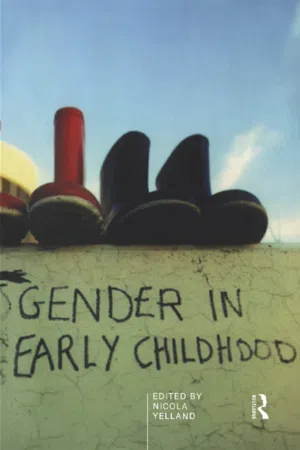
Gender in Early Childhood
About this book
This book will explore the ways in which young children perceive themselves and are viewed by others in terms of their gendered identities as individuals and as members of society. It considers research from a variety of perspectives in the context of home/family and school. Topics covered include:
* the construction of gender from the time the child is conceived
* the politics of category membership
* analyses of play and art making
* young children's experiences with technology
* the influence of popular culture on the body image
* gender equity policies in early childhood education
* understanding sexual orientation.
An examination and reflection of the issues will enable educators to improve their practice and have a greater understanding of the families and the children whom they teach. The diverse range and content of the research will make this book a valuable resource for all those interested in the education of young children. This book covers the issue of gender expectations of children with disabilities, and also discusses young childrens' experiences with technology and the ways in which they feel about their bodies.
This book will be of great interest to all early childhood educators who are concerned about the ways in which the home and school impact on the lives of young children in terms of how they view themselves and how others view them. Trainee teachers will find this book helpful in developing their own attitudes, understandings and behaviours in relation to gender equity and young children.
Information
Chapter 1
Blurring the edges
Nicola Yelland and Susan Grieshaber
Gendering occurs as an integral part of the routines of everyday life. The construction of gender is a systematic process that begins at birth and is continually shaped, moulded and reshaped throughout life, according to the sex of the newborn. Lorber and Farrell (1991) consider gender as the major status indicator. While this may be so for some groups in society, for others the major status indicator may be race or ethnicity. However, gender retains its significance, and Lorber and Farrell (1991) argue that the reason for having gender categories that are constantly constructed and reconstructed in terms of their difference occurs because, in any social group, gender is a fundamental component of the ‘structure of domination and subordination and division of labour in the family and the economy’ (pp. 1–2). This conceptualisation is similar to Sawicki’s libidinal economy, in which women and men:
are not automatically compared; rather gender categories (female-male, feminine-masculine, girls-boys, women-men) are analysed to see how different social groups define them, and how they construct and maintain them in everyday life.
(Lorber and Farrell, 1991, p. 1)
The construction and maintenance of gender categories therefore permeates all aspects of everyday life.
According to West and Zimmerman (1991), the process of ‘doing gender’ is the basis on which judgements about persons are made. For example, the competence of men and women as gendered beings is determined in accordance with how well they demonstrate those qualities that have become associated with femaleness and maleness. It is at a very young age that we learn what girls and boys should be and what they should do. Institutional forces play a major role in constituting bipolar maleness and femaleness, because children learn that they must be readily identifiable through the gender characteristics they present. Individuals are immersed in modes of operation and values inherent in institutions such as the school and family and their associated social practices. These institutions seek to maintain their modes of operation and values as ‘true’, ‘natural’ or ‘good’. However, Weedon (1987) cautions that appealing to the ‘natural’ is ‘one of the most powerful aspects of commonsense thinking, but it is a way of understanding social relations which denies history and the possibility of change for the future’ (pp. 3–4). Appealing to commonsense understandings of gendered social practices as normal and natural tends to blur any distinction between gender as a social construction and understanding gender as an effect of biology or nature.
Alloway (1995) has highlighted the fact that adopting an explanation of nature or biology as being responsible for differences between males and females relies on an understanding of gender that ranges from:
genetic differences between the sexes, to gendered organisation or leftright brain hemispheres, to ‘brain sex’…suggest[ing] that male domination of the public sphere and women’s relegation to the domestic is somehow genetically justified.
(p. 14)
Indeed, many people use the term gender synonymously with sex. However, gender is a social construct that is constantly under modification via human interactions that occur in the myriad social contexts in which we engage.
In Western societies, we tend to have two categories of gender, male and female, which are based on biological features pertaining to genitalia/ sex organs. However, other societies (Lorber, 1994) have more categories that include variations of ‘male women’ and ‘female men’. These are people who are biologically categorised into one sex, but enact their lives according to the social/behavioural characteristics of the other, as predetermined by the ‘norms’ of the group. An important feature here is that members of all categories created are accepted by their society. Western societies do not seem to have achieved the same conditions with regard to the transvestites who do not ‘fit’ into either of our existing categories.
For the benefit of both the individual and the culture, it is vital that children get their gender right, because getting it right means being seen as normal, and also allows others to interpret ‘themselves in relation to it [gender]’ (Davies, 1989, p. 20). In many western societies, those who adopt identities outside the dominant versions of gender, that is those who do not perform within the socially accepted boundaries of masculinity and femininity, risk marginalisation. In the case of young children, socially constructed gender boundaries are closely monitored and maintained by children themselves (Boldt, 1997; Lloyd and Duveen, 1992), as well as by teachers (Davies, 1989, 1993; Kamler, Maclean, Reid and Simpson, 1994), family members (Casper et al., Chapter 5, this volume; Davies, 1989, 1993; Grieshaber, Chapter 2, this volume), and the media (Grace and Tobin, 1997).
Reliance on discourses of psychology to understand child development has privileged certain ways of thinking about young children and gendering. For example, understanding the construction of gender as sex-role stereotyping tends to reinforce biological understandings of being female and being male. Any deviation from the established standard of ways in which girls and boys should behave (the authoritative versions of it mean to be female and male) is therefore treated as questionable. So within the paradigm of child development, children who are able to move between the binary categories of what girls and boys are supposed to do, or who haven’t got their gender quite right according to these categories, are often treated with suspicion by peers, teachers, family and society. Davies (1989) and Boldt (1997) have documented cases of gender bending by young children in institutional settings such as pre-schools and schools, and the subsequent responses by their peers and teachers.
Despite the importance of ‘getting gender right’, children learn to move between and adopt different gender positions for purposes of strategic advantage. This suggests that the concept of gender identity encompasses multiple relational and reflexive texts and discourses, a kind of ‘heteroglossia’ (Volosinov, 1986). For example, Davies (1989) talks about how children use different gender positions when they are in the presence and absence of adults; and how positions may change when in the presence of peers. Selection from the multiplicity of available discourses and positions is relational because there are different things at stake in each situation. Each identity therefore needs to be constructed appropriately in order to ‘get it right’ for that particular context.
Another way of understanding the adoption of different gender identities at distinct points in time is through Butler’s (1990; 1993) notion of gender as performance. Butler (1990) understands the creation of truths or commonsense understandings attached to gender to be illusions that are the product of specific circumstances in space and time. The illusions create immutable truths about gender that are then performed on a regular basis. This is reason enough for Butler (1990) to argue that ‘gender is always a doing’ (p. 25). If gendered identities are always being created and recreated, then opportunities must invariably exist for alternative ways of doing gender to flourish. However, commonsense assumptions about how gendering should be done can obstruct the adoption of positions that differ from what is considered normal.
The employment of males to work with young children and their families in early childhood educational settings is not always considered normal. Male teachers are often treated with scepticism and sometimes distrust because they are seen as not having got their gender right. Doing gender outside the boundaries of how it should be done creates doubts about the suitability of such people for employment with young children. Domination of the early childhood field by women, and societal positioning of children as innocents to be nurtured and protected, help to reinforce such doubts. Silin (1997) has argued that it is women who are ‘charged with protecting the child’s (and their own) innocence from those who seduce them away from their “natural” heterosexuality’ (p. 219). Thus, those considered as likely to seduce children away from their natural heterosexuality are those who haven’t got their own gender right: the perverts. Silin (1997) identifies this homophobic stereotype as the pervertchild dyad. Linking perversion with the innocence of children perpetuates stereotypes of, for example, ‘gay men as sex-obsessed child molesters’ and ‘preserves the belief in family innocence. It enables us to locate potentially unregulated and unruly desires outside the home [and therefore with the pervert]’ (p. 219). Those involved with young children and their families need to be aware of such stereotypes and the potency with which they permeate early childhood services and settings.
What are regarded as socially acceptable, idealised gender identities are dynamic and do change, albeit slowly. Over the last twenty years, for example, we have seen evidence of this, whereby fathers have taken a more active role in the parenting process, women now work in professions that have been traditionally considered as male occupations, and we dress our children in ‘unisex’ outfits such as jeans and sweatshirts. The gendering process is validated by institutions such as the government and the Church and is embedded in complex value systems. Bem (1981) has noted the salience of gender as a powerful cognitive organiser, and her work highlights the need for us to ensure that we do not passively accept stereotypical gender roles in terms of what is acceptable behaviour but actively challenge them. In school contexts, for example, we can challenge the notion that girls cannot do science as well as boys and that boys are less adept in the humanities, and promote the idea that gender typing of curriculum areas is a nonsense.
While acknowledging that gender is a major characteristic of western society and the focus of this book, we also endorse the notion that gender is but one of the aspects contributing to the multiple identities of persons. Many of the chapters in this book lend weight to the idea that contextual factors such as immediate environmental circumstances are significant. Similarly, we acknowledge the importance of other major characteristics such as race, class, ethnicity and age, and the ways in which these factors are actively involved in constructing the gendered identities of young children and those with whom they interact. We endorse the notion that the construction of gender occurs in concert with other aspects of personal identity and that the process of gendering is an integral part of the politics of everyday life (Connell, 1995). However, in this volume we seek further understanding of those parts of children’s lives that relate specifically to the process of gendering.
As previously stated, societies tend to prescribe behaviours according to the gender of the individual, and those who do not get it right are often marginalised. The seemingly tacit acceptance of such behaviours by the majority of members of the society as being the norm for males and females has resulted in the creation of separate and distinguishable groups who have been assigned corresponding roles and responsibilities. What is apparent, however, is that the status of the groups is not equal. In our society, what men do tends to be valued more highly than the occupations of women, not only in terms of power and prestige but also in relation to economic rewards. (For a more detailed explanation of the notion of hegemonic masculinity, see Connell, 1995.) Many tend to adhere to societal mandates for gender roles, as they want to fulfil the norms and expectations of their group to feel a sense of worth. More recently, however, we have come to challenge traditional notions of gender with the aim of creating a society based on equality of opportunity, irrespective of gender.
It has been nearly two decades since the first gender equity programmes were conceptualised and implemented (Cohen and Martin, 1976; Davis, 1979). The effect of such programmes coupled with social change during the period would seem to indicate that we have made significant advances in terms of providing girls with opportunities to participate in activities that had hitherto been considered as inappropriate for girls. Indeed, more recently there has been a call for equivalent programmes for boys, because we seem to have been so successful in improving the academic performance of girls at the secondary school level. It is interesting to note that what started as the provision of equality of opportunity for boys and girls has since shifted focus to equality of outcomes in debates where girls are achieving more success in terms of higher scores at the end of schooling. This was highlighted in New South Wales, Australia, at the end of 1996, when girls continued to outperform boys by achieving the highest scores in the High School Certificate, as they had done for a number of years since the results of humanities subjects were included in the overall calculation of scores and the impact of gender equity programmes, such as all-girl science classes, began to take effect. Reports in newspapers at the time contended that there should be equivalent programmes for boys to achieve equality of outcomes for both genders. In fact, in Australia, as a result of such public outpourings in the media, a parliamentary inquiry was set up in 1994 with a mandate to investigate the situation. The report, entitled Challenges and Opportunities: A Discussion Paper, recommended that it was not necessary to create a specific policy related to educational opportunities for boys, but rather encouraged that concern for boys should be incorporated into gender equity policies.
The education of boys in Australian schools is currently the subject of ongoing controversial debate, set within the recent spate of literature about men, boys and masculinity (for example, Connell, 1995, 1996; Lloyd and Wood, 1996; May, Strikwerda and Hopkins, 1996). According to Kenway (1997, p. 57), the current debate often produces ‘more heat than light’. Much of the argument is about educational opportunities for boys in the context of wider gender reform agendas (see, for example, Connell, 1996; Fitzclarence, Hickey and Matthews, 1997; Kenway, 1997; Kenway, Watkins and Tregenza, 1997; Kenway, Willis, Blackmore and Rennie, 1997; Mclean, 1997; Pallotta-Chiarolli, 1997). As the debate is framed within the years of secondary schooling, the issue of gender in the early childhood years is not confronted. A similar situation has existed in relation to national policy and the early years. Alloway (1995) has shown that national policies provide implementation strategies that relate mostly to the secondary and upper primary years of schooling. Despite the exclusion of the early years from policy implementation, the significance of young children and their families, and institutional services such as childcare centres, pre-schools, kindergartens and schools, in the social construction of gendered identities cannot be underestimated.
At the same time, the situation of females both in schools and universities remains a concern. A national survey of students aged 9 to 15 years, sponsored by the American Association of University Women (AAUW), found that, as girls reach adolescence, they experience a dramatic drop in self-esteem, and are systematically discouraged from particular academic subjects, most notably mathematics and science. The report, entitled How schools shortchange girls (1992), concluded that girls received an inferior education to boys in America’s schools. This was based on evidence that girls receive less attention in the classroom than boys and were still not pursuing careers in areas related to mathematics and science. Furthermore, African American girls were more likely than Caucasian girls to be rebuffed by teachers, ignored in curricula and stereotyped. Another major finding pertains to the issue of sexual harassment, reports of which are increasing and therefore helping to contribute to the undermining of girls’ self-esteem and their confidence to pursue non-traditional roles and job opportunities.
The debate has continued to focus on the impact of gender equity programmes in secondary education, when patterns and practices pertaining to gender have been firmly entrenched in the minds of all the players in students’ lives. However, it is also apparent that girls’ success at the end of secondary school has not been reflected in corresponding opportunities to excel in life after school. For example, a recent study of the lifetime earnings of men and women graduates from the Northern Illinios University maintains that women will earn over $300,000 less than their male counterparts in their lifetime (Campus Review, 1997). There still seems to be an expectation that men and women will take on certain types of employment, based on their gender, and that women will take off time to ‘stay at home’ as the primary caregiver of children. Such expectations mean that women frequently experience interruptions to their careers that correspond to a decrease in financial recompense during the time period as well as the lack of opportunity to build equivalent experience to a male counterpart who has been working continuously. However, the study also shows that women are still not seeking the same kinds of jobs that men are interested in (that is, those valued by society as being important and thus tend to be accompanied by high [corporate] salaries). The researchers concluded that they thought that many young women tended to think that ‘judgements are based on merit and qualifications, but in reality, gender plays a huge role in employment opportunity, financial stability and future savings’ (Campus Review, May 1997, p. 13). It would thus seem that we still have not achieved the status of equality of opportunity for both genders in our society, and that media complaints about equality of outcomes are relevant only to secondary schools contexts, where girls are performing better than boys in terms of academic scores. Additionally, it would seem that although gender equity programmes have had an effect in improving attitudes and academic performance at the secondary school level, we still have problems with conceptualisations of positions and personal/power relations that are disadvantageous to girls in subtle and unequal ways. What would seem to be necessary is a change of mind set about the construction of gender so that, from the beginning of their lives, children are exposed to social contexts that enable them to develop as human beings irrespective of their sex. Where better to start to look critically at how we interact with children than in the early childhood years?
This volume presents research that invites the reader to examine practices that occur with youn...
Table of contents
- Cover Page
- Title Page
- Copyright Page
- Illustrations
- Contributors
- Chapter 1
- Part I Family, community and society
- Part II Aspects of gender in school contexts
Trusted by 375,005 students
Access to over 1.5 million titles for a fair monthly price.
Study more efficiently using our study tools.
Frequently asked questions
Yes, you can cancel anytime from the Subscription tab in your account settings on the Perlego website. Your subscription will stay active until the end of your current billing period. Learn how to cancel your subscription
No, books cannot be downloaded as external files, such as PDFs, for use outside of Perlego. However, you can download books within the Perlego app for offline reading on mobile or tablet. Learn how to download books offline
Perlego offers two plans: Essential and Complete
- Essential is ideal for learners and professionals who enjoy exploring a wide range of subjects. Access the Essential Library with 800,000+ trusted titles and best-sellers across business, personal growth, and the humanities. Includes unlimited reading time and Standard Read Aloud voice.
- Complete: Perfect for advanced learners and researchers needing full, unrestricted access. Unlock 1.5M+ books across hundreds of subjects, including academic and specialized titles. The Complete Plan also includes advanced features like Premium Read Aloud and Research Assistant.
We are an online textbook subscription service, where you can get access to an entire online library for less than the price of a single book per month. With over 1.5 million books across 990+ topics, we’ve got you covered! Learn about our mission
Look out for the read-aloud symbol on your next book to see if you can listen to it. The read-aloud tool reads text aloud for you, highlighting the text as it is being read. You can pause it, speed it up and slow it down. Learn more about Read Aloud
Yes! You can use the Perlego app on both iOS and Android devices to read anytime, anywhere — even offline. Perfect for commutes or when you’re on the go.
Please note we cannot support devices running on iOS 13 and Android 7 or earlier. Learn more about using the app
Please note we cannot support devices running on iOS 13 and Android 7 or earlier. Learn more about using the app
Yes, you can access Gender in Early Childhood by Nicola Yelland in PDF and/or ePUB format, as well as other popular books in Education & Education General. We have over 1.5 million books available in our catalogue for you to explore.