Researching Life Stories critically and pragmatically reflects upon the use of life stories in social and educational research. Using four life stories as examples, the authors apply four different, practical approaches to demonstrate effective research and analysis.
As well as examining in detail the four life stories around which the book is written, areas covered include:
* Method and methodology in life story research
* Analysis
* Reflections on analyses
* Craft and ethics in researching life
* Policy, practice and theory in life story research.
Throughout the book the authors demystify the issues surrounding life story research and demonstrate the significance of this approach to understanding individual and social worlds.
This unique approach to life story research will be a valuable resource for all social science and education researchers at undergraduate and postgraduate level.
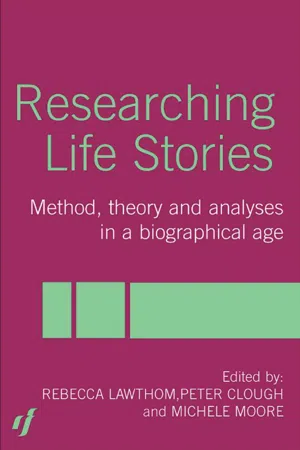
eBook - ePub
Researching Life Stories
Method, Theory and Analyses in a Biographical Age
- 224 pages
- English
- ePUB (mobile friendly)
- Available on iOS & Android
eBook - ePub
Researching Life Stories
Method, Theory and Analyses in a Biographical Age
About this book
Information
Part 1
Four life stories
The four stories presented in the first part of this book will form the focus of subsequent discussions. For now, we invite you to put this book by the side of your bed for some late night reading. Alternatively, take this book away for a holiday read or a long train journey. Or, you might just want to dip in and out of these stories at odd times, here and there. Whichever way you read this book, we hope you read the stories before any of the other chapters.
Chapter 1
Gerry O’Toole
A design for life
Dan Goodley
Here are some of my precious stories. Events that shaped me. You won’t have heard of them. It’s time to start listening to what we have to say. Sooner or later, you’ll listen. You will have to.
It’s difficult to explain to you about places you may have never experienced. You have seen people like me, though. In shopping malls, in fast food restaurants, in minibuses with steamed-up windows. In small groups, shadowed by senior, more competent adults; middle-aged women or young trendy blokes with goatee beards. Our cultures sometimes cross swords. You have words for people like me. Retard, Joey, defective, idiot, spaz, mong. You might not use these words now but if pressed you would shamefully recall a childhood vocabulary that flourished with such insults.
‘Frog’, Paul shouted, ‘Frog’. The gang fell about, giggling. (‘Frog’ was all Paul said, that and ‘I love Jonny Vickers’, much to Jonny’s embarrassment. Paul once spent the day spray painting ‘I love Vickers’ on lampposts around the town. He was one of only two lads in our secondary school who had support workers with them at all times including bus trips as well as class time. He was a minor celebrity in this sense but a celebrity for people to laugh at. We kidded ourselves we were laughing with him.)
Then Paul pulled down his pants and asked us, ‘Do you want to see it wee?’ ‘Yeah – ha, yeah – I want to see it wee!’ shouted Tez.
And so Tez did – Paul neatly peeing into the drain. And we all laughed, all eight of us in Litton Close, a cul de sac near our primary school – recalling a place where our prejudices weren’t so vicious.
Then Paul pulled down his pants and asked us, ‘Do you want to see it wee?’ ‘Yeah – ha, yeah – I want to see it wee!’ shouted Tez.
And so Tez did – Paul neatly peeing into the drain. And we all laughed, all eight of us in Litton Close, a cul de sac near our primary school – recalling a place where our prejudices weren’t so vicious.
Now, I guess, things are more subtle. You will feel it inappropriate to catch my eye, to smile or to acknowledge me. And if you do clock me, you’ll probably wonder afterwards if it was the right thing to do. You can’t win and neither can I. We are – how do they put it? – always batting for different sides.
I am a resident. You reside.
I am admitted. You move in.
I am aggressive. You are assertive.
I have behaviour problems. You are rude.
I am noncompliant. You don’t like being told what to do.
When I ask you out for dinner, it is an outing. When you ask someone out, it is a date.
I don’t know how many people have read the progress notes people write about me. I don’t even know what is in there. You didn’t speak to your best friend for a month after they read your journal.
I make mistakes during my cheque-writing program. Someday I might get a bank account. You forgot to record some withdrawals from your account. The bank called to remind you.
I wanted to talk with the nice-looking person behind us at the grocery store. I was told it was inappropriate to talk to strangers. You met your spouse in the produce department. They couldn’t find the bean sprouts.
I celebrated my birthday yesterday with five other residents and two staff members. I hope my family sends a card. Your family threw a surprise party. Your brother couldn’t make it from out of state. It sounded wonderful.
My case manager sends a report every month to my guardian. Its says everything I did wrong and some things I did right. You are still mad at your sister for calling your mom after you got the speeding ticket.
After I do my budget program tonight, I might get to go to McDonalds if I have enough money. You were glad the new French resturant took your charge card.
My case manager, psychologist, occupational therapist, nutritionist and house staff set goals for me for the next year. You haven’t decided what you want out of life.
Someday I will be discharged . . . maybe.
You will move onward and upward. *
What do you feel when you see us? When you saw that ‘mongey guy’ in the street? Is it pity, sadness, a sense of fortune? Well, you might be right in having those feelings of concern. But the reason you feel like you do is less to do with my ‘condition’ and more down to the world that creates me in its own vision. In spite of or because of these difficulties we have in relating to one another, people like me – my comrades and I – we have been quietly getting on with changing things. You just never knew anything about my story and all the others that have come from this new burgeoning, exciting, radical movement called People First. But our successes are never easily achieved. Some difficult terrain has been tread.
It was freezing. As usual I hadn’t worn a coat. As a boy, my mother often told me that I had a strange little body. I became sweaty after the lightest of walks on the coldest of days. But today it was sub zero. As I entered the outdoor market, Gerry was, as always, conspicuous. Red, white and black bobble hat that just hid his long, straggly thinning hair. A greying stubble made him look 10 years older than the 39 that he actually was, though warm, piercing green Irish eyes ensured that you were charmed. A beige canvas bag full to bursting with papers and documents weighed down Gerry’s left shoulder to the point that he walked with an uneven gait. Scruffy green combat jacket, brown waistcoat, cream shirt, brown trousers and new white trainers completed the ‘vision’.
‘How are you, Gerry?’
‘Fine. There is this chap who wants to come to the People First meetings.’
‘Who is he?’
‘I don’t know.’
‘Is he a member of staff from the centre?’
‘I don’t know.’
‘Is he a researcher wanting to find out about self-advocacy?’
‘I dunno.’
‘Is he a person with learning difficulties?’
‘Dunno – didn’t ask him.’
‘How are you, Gerry?’
‘Fine. There is this chap who wants to come to the People First meetings.’
‘Who is he?’
‘I don’t know.’
‘Is he a member of staff from the centre?’
‘I don’t know.’
‘Is he a researcher wanting to find out about self-advocacy?’
‘I dunno.’
‘Is he a person with learning difficulties?’
‘Dunno – didn’t ask him.’
My background? What? Oh . . . family. Ha! You’ve opened a can of worms there! I come from a large Irish Catholic family. Three brothers, two sisters. My father moved over from Galway on the West coast of Ireland in the 1950s. He met my mother at a ceilidh in Manchester. She was born in Blackburn. They were only together for a while before my mother got pregnant with my brother Jack. A quick wedding was organised and they managed to get themselves a small terraced house in Rusholme in Manchester. My mother and I, my brother Kevin and his wife Julie, we still live in that very house. My auntie lives next door. My Dad passed away six years ago. I remember his funeral as if it were yesterday. The coffin was laid open in the front room and neighbours, friends and folk from the church paid their respects. I stood by my Dad throughout the day. His skin was waxy and his hair looked thicker than it was when he was alive. He would have liked that – the hair bit, I mean. Only my mother, Jack, Michele and I could bear to look at Dad. Colleen, Kevin and Callum never went near Dad’s coffin. They wanted to remember him as he was.
My father was a tall, strong, vocal man. He smoked Woodbines and loved a pint in the local working men’s club. He was funny and imposing. When I was 18 he took me and my older brothers to the club to celebrate. I am now a paid-up, card-carrying member. The Friday after my Dad died I went in. At the bar, Clive the secretary tells me that I need to pay for my membership. ‘You’re a member in your own right now Gerry. Now your Dad has gone, God rest his soul, you can’t be his guest, you need to be a proper member.’ I asked him how much it was. ‘85 to you.’ 85 quid, I thought, ‘can I pay in instalments like me Mam does with the washing machine?’ ‘85 pence, you daft bugger!’ laughed Clive. They often get me like that.
Somehow, there was always someone around. If my Mam and Dad were at work then there was an older sister there to make my tea, run my bath, tickle me until I burst with frustration. Every morning when I was young my Dad walked me to school. We would stop at the dual carriageway across from the special school and watch as my schoolmates were ferried past in ambulances. When they finally arrived at school they were travel sick from the rough journey. Jeremy would make me laugh, telling me how they’d hang onto the stretcher that was kept between the rows of seats. Of course, when they went round a corner the stretcher would move and they’d be pulled to the back of the bus, scattering those who stood up, kids flying into one another. Once in school, things were never so bad for me. I have friends now who never had a family, a safe haven. Sophie’s mother couldn’t cope. Sophie was ordered off to hospital when she was young. She never said much about her time there but I know from others that she was made to wear weighted boots in institutions and they used to drug and hit her.
A zillion dormitory keys held menacingly by his side. My brave face as Mogadon kicks in. On to avant-garde dance troupes and loud meetings of comrades. But always one of them, at the day centre or at Main House, my new ‘home’. Waiting for failure, ready to punish.
I was in and out of special school and eventually left at 15. They were strange places, funny buildings, you were labelled as soon as you got there. Lessons were boring, colouring-in books that were already covered with the crayon scribbles of previous years’ students. Class after class with the headmaster playing piano. Asking us which piece of classical music he was murdering. Keen, lively, young teachers joining us straight from teacher training college only to promptly leave by the end of their first or second term. Broken people. Students sound asleep in class, drooling onto the desks where they rested their heads. My mother would complain, ‘Why can’t Gerry be taught proper mathematics and English,’ she would tell the teachers. They told her I was struggling so much that I wouldn’t be able to do the things my brothers and sisters were doing. Daft really, because when I worked with my Dad on the markets I was really good at counting up the change people needed. One teacher said to my mother that I would never be able to read and write. I did, though. At home. It wasn’t the best of places. One day, I broke into the caretaker’s office. I nicked a spade. Some time later, the teachers caught me trying to dig myself out of the school – I was trying to escape under the fence. I got into trouble a lot at school for talking or having a laugh in class. The school was eventually burnt down by some big lads off the estate.
After I had left, some of my mates managed to get themselves into the ‘normal schools’. They told me that they had loads of parties, drinking with the other kids in the pubs in town.
The sixth form had some new members – 12 people with learning difficulties from the Day Centre. Kevin – Down’s syndrome lad – was the only one who was school age. Kevin followed Bant around, much to the amusement of Bant’s fellow sixth-formers. Bant was popular – stupid but popular. And then when Bant got bored he would play to the crowd.
‘Whose your favourite, Kev?’
‘Bant.’
‘Who do you love?’
‘Bant.’
‘Course yer do.’
And then Bant would run out of the classroom for a ciggie. Too quick for Kevin, who would bury his face in the seat – sobbing his heart out.
‘Whose your favourite, Kev?’
‘Bant.’
‘Who do you love?’
‘Bant.’
‘Course yer do.’
And then Bant would run out of the classroom for a ciggie. Too quick for Kevin, who would bury his face in the seat – sobbing his heart out.
Others joined the special needs group at the tech. I was never going to be packed off to some ‘life skills class’. As a teenager, school meant little to me. Well, I was on the market stalls at the time, so it wasn’t really interesting. I really started to get into the market stall work. Some of my mates either went to the day centre full time or, if they were lucky, got a job (if that’s what you can call not being paid to work) farming, T-shirt printing or decorating old people’s houses. My brother jokes that we are part of the Irish Catholic mafia. A job was always going to be there for me.
The boys’ toilets. Lunchtime. Brid [18 years, small in stature, long hair, eyes too small for his face], Jano [20 years, large frame, shorthaired, piercing brown eyes] and David [short, overweight, mouse-like, scared, thick-rimmed glasses].
Brid: So, twatter – is it true? Is it true, then? 12 toes, ’ave ya? Ya freak.
[Brid pushes David into the cubicle, David covers his face with his lower arms.]
David: No . . .
Brid: Jano shut door, man.
[Jano firmly closes the door and rests against the door. He is laughing.
Brid punches David hard in the stomach, and struggles with David’s shoes, eventually prising them off, as he forces David to sit on the toilet seat. David is howling. Awful screams echo.]
Brid: Fucking hell (laughs) look at this Jano, look – it’s the elephant man! Jesus, that’s horrible [laughs].
[Jano moves into the cubicle and squeals with delight. Brid and Jano catch each other and run out of the toilet, their laughter echoing in the toilet while ringing out over the factory floor.
David pulls himself up from the seat by the door and stoops down to collect his shoes and socks. As he moves out of the toilet we catch a reflection of him in the mirror. We can make out the mirror image of chalk marks scrawled on the back of his long grey coat ‘I am a knobhead. Kick me!’
Brid: So, twatter – is it true? Is it true, then? 12 toes, ’ave ya? Ya freak.
[Brid pushes David into the cubicle, David covers his face with his lower arms.]
David: No . . .
Brid: Jano shut door, man.
[Jano firmly closes the door and rests against the door. He is laughing.
Brid punches David hard in the stomach, and struggles with David’s shoes, eventually prising them off, as he forces David to sit on the toilet seat. David is howling. Awful screams echo.]
Brid: Fucking hell (laughs) look at this Jano, look – it’s the elephant man! Jesus, that’s horrible [laughs].
[Jano moves into the cubicle and squeals with delight. Brid and Jano catch each other and run out of the toilet, their laughter echoing in the toilet while ringing out over the factory floor.
David pulls himself up from the seat by the door and stoops down to collect his shoes and socks. As he moves out of the toilet we catch a reflection of him in the mirror. We can make out the mirror image of chalk marks scrawled on the back of his long grey coat ‘I am a knobhead. Kick me!’
David was bullied for two years. He had a meeting with his mother, his keyworker, an occupational therapist and the work supervisor. The occupational therapist asked him if he wanted to take a holiday. He said yes. He hasn’t worked since, that was 12 years ago. I heard that David has spent the last three years at home. He never leaves the house, even though his Mum and sister want him to get out, to make friends. He stays in bed, all day, every day.
For me work has always been a laugh with my cousins, my brothers, our pals. Five a.m. start, breakfast in the market café at eight and back in time for the punters. Lots of craic. Weekends we get off somewhere different – York, Newcastle, Glasgow, Rotherham, all the different markets. I am well known, always asked if I need more work. From time to time I collect glasses in Mulligans which is a really cool Irish pub. A trio play rebel songs every Friday night and it is packed with regulars as well as students nursing a pint or two. One Saturday night, Trevor the landlord asks if anyone knows of a right wing-back who could play for the pub football team. I overheard him. So did my brother Callum. ‘Our Gerry’s got a sweet right foot, you want to ask him.’ I am now a regular. Scored two last match. Somewhere in all of this I got drawn into People First.
‘Dear Editor
I am writing on behalf of Partington People First group, as we were shocked to see in your magazine that someone showed us on 1st September 1988, with four people who you called mentally handicapped people. Those people were at the International Conference in London where they and others from all over the world were fighting to get rid of labels like ‘mental handicap’. We feel very upset because you have done the opposite to what you want. You do not see...
I am writing on behalf of Partington People First group, as we were shocked to see in your magazine that someone showed us on 1st September 1988, with four people who you called mentally handicapped people. Those people were at the International Conference in London where they and others from all over the world were fighting to get rid of labels like ‘mental handicap’. We feel very upset because you have done the opposite to what you want. You do not see...
Table of contents
- Cover Page
- Title Page
- Copyright Page
- Acknowledgements
- Dedication
- Preface
- Part 1: Four Life Stories
- Part 2: Doing Life Story Research
- Part 3: Making Sense of Life Stories
- Part 4: The Age of Biography: Personal and Political Considerations
- References
Trusted by 375,005 students
Access to over 1.5 million titles for a fair monthly price.
Study more efficiently using our study tools.
Frequently asked questions
Yes, you can cancel anytime from the Subscription tab in your account settings on the Perlego website. Your subscription will stay active until the end of your current billing period. Learn how to cancel your subscription
No, books cannot be downloaded as external files, such as PDFs, for use outside of Perlego. However, you can download books within the Perlego app for offline reading on mobile or tablet. Learn how to download books offline
Perlego offers two plans: Essential and Complete
- Essential is ideal for learners and professionals who enjoy exploring a wide range of subjects. Access the Essential Library with 800,000+ trusted titles and best-sellers across business, personal growth, and the humanities. Includes unlimited reading time and Standard Read Aloud voice.
- Complete: Perfect for advanced learners and researchers needing full, unrestricted access. Unlock 1.5M+ books across hundreds of subjects, including academic and specialized titles. The Complete Plan also includes advanced features like Premium Read Aloud and Research Assistant.
We are an online textbook subscription service, where you can get access to an entire online library for less than the price of a single book per month. With over 1.5 million books across 990+ topics, we’ve got you covered! Learn about our mission
Look out for the read-aloud symbol on your next book to see if you can listen to it. The read-aloud tool reads text aloud for you, highlighting the text as it is being read. You can pause it, speed it up and slow it down. Learn more about Read Aloud
Yes! You can use the Perlego app on both iOS and Android devices to read anytime, anywhere — even offline. Perfect for commutes or when you’re on the go.
Please note we cannot support devices running on iOS 13 and Android 7 or earlier. Learn more about using the app
Please note we cannot support devices running on iOS 13 and Android 7 or earlier. Learn more about using the app
Yes, you can access Researching Life Stories by Peter Clough,Dan Goodley,Rebecca Lawthom,Michelle Moore in PDF and/or ePUB format, as well as other popular books in Education & Education General. We have over 1.5 million books available in our catalogue for you to explore.