African-American Literacies is a personal, public and political exploration of the problems faced by student writers from the African-American Vernacular English (AAVE) culture.
Drawing on personal experience, Elaine Richardson provides a compelling account of the language and literacy practices of African-American students. The book analyses the problems encountered by the teachers of AAVE speakers, and offers African American centred theories and pedagogical methods of addressing these problems. Richardson builds on recent research to argue that teachers need not only to recognise the value and importance of African-American culture, but also to use African-American English when teaching AAVE speakers standard English.
African-American Literacies offers a holistic and culturally relevant approach to literacy education, and is essential reading for anyone with an interest in the literacy practices of African-American students.
- 192 pages
- English
- ePUB (mobile friendly)
- Available on iOS & Android
eBook - ePub
African American Literacies
About this book
Information
1
Literacy, language, composition, rhetoric and (not) the African American student: sick and tired of being sick and tired
I was sitting here with a bad case of writer’s block wondering how to arrange my arguments in the most persuasive manner. Hoping not to lose you, my K-12 language arts teachers, or you, my composition and rhetoric colleagues, or you, my fellow sociolinguists, or you, my new literacy studies family. And I sure couldn’t stand to lose my African American generalists or anyone who is sick and tired of being sick and tired of the decades long struggle to stamp out our failure in the literacy education of African American students.
At first I started out with a chart that I replicated from the National Assessment of Educational Progress (NAEP), which detailed the disparate writing achievement of Black, Hispanic, White, and Asian students from fourth grade through twelfth grade. I decided to background that1 when I, while rambling through a bookstore bag, saw this bookmark (see Figure 1.1). And that just got me burning. “He is in the eighth grade but he’s reading at the fourth grade level. Will you change this?” The young Black male body is foregrounded in the picture of the bookmark—he symbolizes illiteracy—in need of only a helping hand. The target audience for the ad is recent college graduates. We realize that the founder of the organization intends to make a difference with her life and encourage others to do the same by encouraging young graduates to dedicate their time to a worthy cause. And to be fair, a small percentage of children might improve with the extra help, but we also know that this program cannot significantly stem the tide of literacy underachievement.
Recent college graduates are offered loan forgiveness in addition to salaries if they commit to teach in the public schools in urban and rural communities for two years, as if fresh graduates could actually change something rotten that’s been going on for decades. We do the same thing at the university level by initiating teaching assistants into the freshman composition classroom and bidding them to learn on the job. The bookmark exhorts young graduates to “Teach for America.” That’s basically what we all are doing—Teaching for America. I want my student loans forgiven too!
For the most part, America continues to teach us to accept the status of lower achievement for Black students as the norm. Under the present system, we are set in motion to replicate the paradigm and the results. The old folks used to say,“If you keep doing what you always did, you gone keep gettin’ what you always got.”
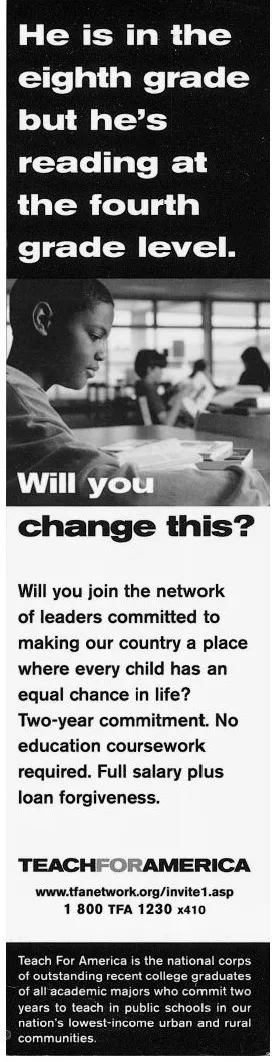
Figure 1.1 Teach for America bookmark
Research has presented evidence which suggests that certain factors correlate with lower literacy achievement (and overall academic achievement) such as low parent educational level, low social economic status, poor school resources, no writing of successive drafts, or non use of portfolios, to name a few. Of course poverty and a host of other social problems hinder some students from coming to school every day and excelling in their work.
Community and family literacy programs have been instituted to counteract the problem of parents’ educational level and family involvement to promote higher levels of literacy and to help “at risk” students of color to excel academically. To address the problem of low social economic status and poor school resources, movements such as school vouchers, charter schools, and school choice have become attractive to some. The theory behind these movements is that access to well funded schools, with lower teacher–pupil ratios and highly skilled teachers, will provide teachers with adequate resources to help students. In an effort to improve student writing, teaching writing as a process involving revision, audience accommodation, critical reflection, and portfolio evaluation are commonly thought of today as requirements in writing pedagogy.
Highly funded schools, highly trained teachers, Teach for America volunteer-paid teachers, community and family literacy programs, and open access to the latest technological advancements are a start in the right direction, yet these solutions evade a deeply rooted problem. We must face the facts. Most of us know that the majority of Black students are not cognitively deficient. So what’s the real deal?
Background
One of the basic goals of the Civil Rights and Black Liberation Movements of the 1950s and 1960s was to gain access to institutions and begin the project of a multicultural America. I use the term multicultural to signify equal opportunity beyond the point of allowing people of color access to historically White studies and institutions. Multicultural in this usage means instituting Black, Latino/a, Native American, and Asian peoples, studies, and pedagogies into the center of the educational curriculum and traditional institutions, in a way that expands upon and critiques received knowledge. Yet, we are still replicating the unequal educational and literacy paradigm.
One of the major roots of African American literacy underachievement is the ideology of White supremacist and capitalistic-based literacy practices that undergird curriculum construction and reproduce stratified education and a stratified society, that reproduce the trend of African American literacy underachievement.
White supremacist ideology is insidious because it is entangled with the dis course of American meritocracy, which says that individuals are responsible for their own success. The value of individualism is consonant with White supremacy when large groups of students of color fail to achieve under its account. White supremacy in my usage refers to practices that confer privileges to white-skinned Anglo Americans at the expense of disprivileging people not of white skin, a form of racism. The percentage of students suffering under this paradigm is far beyond that of a smattering of lazy or cognitively deficient individuals who can’t measure up. The failure is not individual, but ethnic and cultural groups are underachieving under the present (decades long) practices. This indicates that the problem is structural.
Characteristics of the ideology of White supremacist and capitalistic-based literacy include consumption, consent, obedience, fragmentation, singularity (as opposed to multiplicity), and positivism. The educational practices associated with this conception of literacy are naturalized in the system and taught to students as a set of isolated skills divorced from social context, politics, culture, and power (Street, 1993). Teaching standardized English, a narrowly conceived academic discourse, and their cousin, the “academic essay,” are examples of the “neutral skills” needed to succeed in the corporate educational system and the market driven capitalistic society (J. Berlin, 1996). The viewpoint of official educational sites and institutions is that students/good citizens need these skills to function in society.
No matter how neutral the autonomous skills approach strives to be, many African American students detect the cultural bias early on in their school experiences, and many do not respond favorably. What many of these students see, and what many African Americans have seen down through the years is attempts to erase them culturally, word by word, from the literacy experience.
Writing on the mis-education of “the Negro,” in 1933, Carter G. Woodson (1990: 3–4) articulated the problem like this:
When a Negro has finished his education in our schools, then, he has been equipped to begin the life of an Americanized or Europeanized White man, but before he steps from the threshold of his alma mater he is told by his teachers that he must go back to his own people from whom he has been estranged by a vision of ideals which in his disillusionment he will realize that he cannot attain.
There is confusion in the literature on African American students and achievement concerning why some African American students reject their high-achieving African American peers as acting the role of a White supremacist. Carter G. Woodson identified this same phenomenon in the 1920s and 1930s. As discussed by Woodson, the culturally biased education that most African Americans experience trains them to sever ties with Black communities and cultural activities. It trains us to have no interest in making a commitment to the uplift of other African Americans less fortunate than ourselves for we have pulled ourselves up by our own bootstraps. Black community people see this as “thankin’ that you betta than somebody.” When this occurs, “the educated” Black person is ostracized from Black communities. This is the phenomenon of “sellin’ out” or “acting white” as students in Fordham and Ogbu’s 1986 workattest. It appears that many readers of Fordham and Ogbu’s analysis overlook the concept of White supremacy. And that omission is crucial to understanding student rejection of so-called achievement. In this sense, achievement equals assimilating to something that is anti-Black. Students can’t give us the critical historical explanation, that African Americans who have internalized White supremacist ideologies are those who have been “educated” away from the communities of their nurture. People are rejected in Black communities when their behaviors are seen as self-serving. We all have to play the game to some extent and are complicit or co-opted from jump street if we are to survive and if we need the system. The question is one of commitment to a community.
Woodson (1990: 37) noted that one of the problems with the educational system is that it teaches “too many [African Americans] to go to school to memorize certain facts to pass examinations for jobs. After they obtain these positions they pay little attention to humanity.” This type of education trains students to fit into the status quo. It is a problem that is true across ethnic groups, and is supported by the ideology of American individualism. It is easy for people to buy into it as people are generally selfish; however, it really works against Black people, as lower-class White people, owing to skin privilege, are likely to have more opportunities for economic advancement.
Education that encourages students to reject the struggles of their cultures and their histories is what literacy theorist Donaldo Macedo (1994) has labeled “literacy for stupidefication.” And as Fordham’s (1999) work shows, this is still happening today. Research like Fordham’s shows that it is not so much that academic achievement is despised but that standardized achievement qualifies one to become a sell out.
The African American struggle was always about getting education, bettering the condition of other African Americans, and changing society. That much was explicit and common knowledge in most African American families down through the years. But as we “progress” through the system many of us become inundated with ideas that those who are stuck in poverty or other urban traps deserve to be there. Let’s look at the dominant literacy “success story” of an individual like Supreme Court Justice Clarence Thomas as an example. The struggle of African Americans of all class backgrounds afforded him the opportunity to reap the benefits of Civil Rights, Affirmative Action, and an American education. But his mind became so full of anti-Black propaganda in the process, that when he achieved a position within the dominant system in which he could be of service to the culture of his foremothers, he feels compelled to adopt positions that are anti-African American. He low-rates his own Gullah language background, silences himself, and perpetuates stereotypes about African Ameri cans for self rather than community advancement.2. This is the type of role model of educational achievement that many African American students reject.
Some people have run with the idea that African American students are anti-intellectual. Nothing could be further from the truth. Some young people manage to excel academically despite being disrespected (by the educational system) from Kindergarten through the college curriculum anyway, retaining a positive Afrocentric sense of self and still identifying with their home communities and peers (Spencer, Noll, Stoltzfus, and Harpalani, 2001).
Ogbu’s work (1992) shows that the history of mistrust and dominance and subordination between European Americans and caste-like minorities such as African Americans produces oppositional attitudes and behaviors among African American students toward dominant literacy education. Other caste-like “minorities” such as Native Americans and Latino(a) heritage students also resist this type of education and their achievement trends are similar to African Americans’ (see table in note 1).
Black noise
Through the early 1900s, the scholarly thinking about the language and culture of Black Americans reflected the common prejudices of the time: Blacks were inferior and culture-less and so was their speech. Since the 1940s, scholars such as Lorenzo D. Turner (1949) and Melville Herskovits (1941/1958) presented information confirming the systematicity, the West African background, the history and development of “African American Vernacular English.” From an historical perspective, then, the study of the language and literacy education of African Americans has turned traditional thinking about this subject on its head. The African American tradition, that continuum ranging from oral—to literate— to post-literate creativity has been documented by many scholars of African American culture as being a rich reservoir of the cultural thought of African American people from field hollas to folksongs, to blues lyrics, to sermons, to poetry, to jazz, to treatises and on and on. African Americans have a valuable and significant world-class culture complete with its own language and literacy traditions.
African American language and culture at the crossroads of the educational system
Labov’s (1972) groundbreaking investigations, reported in Language in the Inner City, investigated whether or not “dialect differences” had anything to do with reading failure: and if so, could educator knowledge of the differences between African American Vernacular English and standardized American English be useful in curricula design and delivery of services to AAVE speakers? Labov thought that teachers could be more effective with AAVE-speaking students if teachers used their knowledge about potential interference between “standard” English and AAVE in their instruction. He concluded that the conflicts between AAVE and standardized American English were symbolic of the cultural conflict and racism that is inherent in the society at large, and played out in the classroom. Though Labov’s work helped to validate AAVE as a rule-governed systematic manner of communication, it did not help to endorse the implementation of curricular strategies designed to improve literacy by applying comparative dialectology or comparative cultural studies (AAVE and standardized American English) to literacy education.
From the late 1970s, compositionists such as Shaughnessy (1977) began to think about culturally different writers and speakers differently, that is, in terms of the logic of their “errors.” Shaughnessy’s work, pioneering the field of basic writing, complemented Labov’s work in language and literacy. She makes the following inferences about students who did not master a basic level of writing before college—“basic writers”:
[T]hey have never written much, in school or out … they have come from families and neighborhoods where people speak other languages or variant, non-prestigious forms of English and … while they have doubtless been sensitive to the differences between their ways of speaking and their teachers’, they have never been able to sort out or develop attitudes toward the differences that did not put them in conflict, one way or another, with the key academic tasks of learning to read and write and talk in standard English.
(Shaughnessy, 1987: 179)
This is Shaughnessy’s definition of the basic writer. Basic writing is now a subfield of English studies. The crux of the phenomenon as she described it centers on difference, “differences between their ways of speaking and their teachers’,” and the sorting out and development of “attitudes toward the differences” and “conflict.” Shaughnessy also observes, and rightly so, that the closer one’s mother tongue is to standardized Academic English or to academic discourse, the easier it is to develop the dominant code. Thus, Shaughnessy underscores the cultural conflict factor.
Shaughnessy (1987: 179) offers a description of so-called basic writers and their writing to illuminate the conflict:
First, they tend to produce, whether in impromptu or home assignments, small numbers of words with large numbers of errors (roughly from 15 to 35 errors per 300 words) that puzzle and alarm college teachers when they see them for the first time, errors with the so-called regular features of standard English (the past tense of regular verbs, for example, or the plural inflections of nouns), misspellings that appear highly idiosyncratic, syntactic errors that reflect an unstable understanding of the conventions … Second, they seem to be restricted as writers, but not necessarily as speakers, to a very narrow range of syntactic, semantic, and rhetorical options, which forces them into either a rudimentary style of discourse that belies their real maturity or a dense and tangled prose with which neither they nor their readers can cope.
Shaughnessy captured a critical aspect of the problem. The problem is (and was) that African American discourse is entangled with dominant and European American discourse. Shaughnessy saw this conflict as central, but her approach to the problem was to conflate the basic and culturally different writer and focus on error.
Shaughnessy’s thinking was revolutionary in many ways and deserves the respected place that it has in the field of composition studies. However, other thinkers in language education, such as Smitherman (1977), put more weight on the language and cultural background of the learner than did those who followed Shaughnessy’s error approach. In this respect, it appears that Shaughnessy took the path of least resistance. She helped to create a discipline, emphasizing logic rather than deficit, and my point here is not to discredit her in any way. In any case, the pattern of over-representation of African American students in basic writing courses (Rose, 1990; McNenny and Fitzgerald, 2001) and their general underachievement in literacy has not been resolved by the “error” approach or by other approaches that do not exploit the language and culture students bring with them to the classroom. I believe that Shaughnessy approached the situation in such a way as to deal with the middle ground and not single out any one cultural group, in order to service as many students as possible.
Smitherman’s (1977) Talkin and Testifyin: The Language of ...
Table of contents
- Cover Page
- Title Page
- Copyright Page
- Figures and tables
- Foreword
- Acknowledgments
- Introduction
- 1 Literacy, language, composition, rhetoric and (not) the African American student: sick and tired of being sick and tired
- 2 The literacies of African American-centered rhetoric and composition: freestylin' or lookin' for a style that's free
- 3 To protect and serveo: African American female literacies
- 4 African American-centered rhetoric, composition, and literacy: theory and research
- 5 Composition in a fifth key: rhetorics and discourses in an African American-centered writing classroom
- 6 Dukin' it out with the powers that beo: centering African American-centered studies and students in the traditional curriculum
- Notes
- References
Trusted by 375,005 students
Access to over 1.5 million titles for a fair monthly price.
Study more efficiently using our study tools.
Frequently asked questions
Yes, you can cancel anytime from the Subscription tab in your account settings on the Perlego website. Your subscription will stay active until the end of your current billing period. Learn how to cancel your subscription
No, books cannot be downloaded as external files, such as PDFs, for use outside of Perlego. However, you can download books within the Perlego app for offline reading on mobile or tablet. Learn how to download books offline
Perlego offers two plans: Essential and Complete
- Essential is ideal for learners and professionals who enjoy exploring a wide range of subjects. Access the Essential Library with 800,000+ trusted titles and best-sellers across business, personal growth, and the humanities. Includes unlimited reading time and Standard Read Aloud voice.
- Complete: Perfect for advanced learners and researchers needing full, unrestricted access. Unlock 1.5M+ books across hundreds of subjects, including academic and specialized titles. The Complete Plan also includes advanced features like Premium Read Aloud and Research Assistant.
We are an online textbook subscription service, where you can get access to an entire online library for less than the price of a single book per month. With over 1.5 million books across 990+ topics, we’ve got you covered! Learn about our mission
Look out for the read-aloud symbol on your next book to see if you can listen to it. The read-aloud tool reads text aloud for you, highlighting the text as it is being read. You can pause it, speed it up and slow it down. Learn more about Read Aloud
Yes! You can use the Perlego app on both iOS and Android devices to read anytime, anywhere — even offline. Perfect for commutes or when you’re on the go.
Please note we cannot support devices running on iOS 13 and Android 7 or earlier. Learn more about using the app
Please note we cannot support devices running on iOS 13 and Android 7 or earlier. Learn more about using the app
Yes, you can access African American Literacies by Elaine Richardson in PDF and/or ePUB format, as well as other popular books in Languages & Linguistics & Linguistics. We have over 1.5 million books available in our catalogue for you to explore.