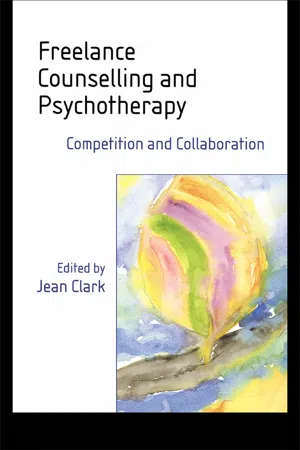
There are far more qualified counsellors and therapists than there are salaried posts, so many recently qualified practitioners face the challenges of working freelance. Freelance Counselling and Psychotherapy is an excellent guide on surviving and flourishing in a highly challenging field. Written by practitioners with extensive experience of the practical and emotional aspects of working independently, it covers the range of issues and choices which confront newly qualified practitioners, for example:
* Regulation, registration and accreditation
* Supervision
* Financial issues in freelance therapy
* The dynamics of competition and collaboration
This highly readable book provides an 'insider's' view of the field, and will be essential reading for trainers, established practitioners and newly qualified therapists alike.
- 224 pages
- English
- ePUB (mobile friendly)
- Available on iOS & Android
eBook - ePub
About this book
Information
Part I: Some facts and tensions
There has been an immense growth in the practice of freelance counselling and psychotherapy since the early 1980s and 568 training courses were listed in the BAC Training Directory (2000). For those who are considering the possibility of training for work, which can be viewed as personally satisfying, flexible and free from the demands of bureaucratic institutions, it can be important to be aware of the broad context, and some of the issues that are involved in working freelance—practical and emotional as well as professional.
For those who are in the process of training there are likely to be a number of unspoken concerns and anxieties, and it can be healthy if these are acknowledged, explored and discussed while there is still the support of a training group. To work freelance, whether by choice or necessity, is at times lonely, and it can be hard to know how to deal with the confusions and challenges of competition while still finding support from colleagues, and to gain a realistic view of the practical and emotional challenges ahead.
Chapter 1: The development and growth of freelance counselling
Gabrielle Syme
Introduction
All the psychological or talking therapies owe their origins to Freud, psychoanalysis and Vienna in the 1880s. In 1886 Freud went into private practice in Vienna as a neurologist and over the next 10 years developed a method of treating hysterical patients, which he called psychoanalysis. Many of his original analysands moved away from Vienna and also had profound disagreements with Freud. These disagreements led to new theories and methods of working, which have become the basis of the different theories of psychotherapy and counselling. These many theories can be fitted under three main headings: psychodynamic, person centred and behavioural. The first two can be clearly linked to Freud and his followers; psychodynamic owes its origins to Freud, Jung and Adler and person centred to Adler and Rank.
Coincidentally working in private practice as a psychological therapist also links back to Freud. At the time that he was working medicine was rarely free, so inevitably he and his followers were all private practitioners. In the UK medicine became free at the point of need in 1948, so from then on there was the possibility of some psychological therapists being salaried and all having some choice about whether to seek a salaried job or to work in private practice or voluntarily, or become freelance and mix the three.
Psychoanalysis developed very differently in Britain from the USA. In the latter almost all psychoanalysts are medically qualified, whereas in the UK most psychoanalysts, psychotherapists and counsellors are lay. A possible reason for this acceptance of a lay training in the UK is that Ernest Jones, one of Freud’s analysands, brought psychoanalysis to Britain in 1913, subsequently founding the British Psychoanalytic Society in 1924. Although medically qualified himself he was very loyal to Freud and did not break away from him. He wrote the first biography of Freud (Jones, 1953). Freud vigorously supported the lay analyst, analysing a number of lay people, his daughter Anna being one. He did not consider a medical education essential for an analyst; what was needed was a ‘special training necessary for the practice of analysis’ (Freud, 1927), Another reason for the preponderance of lay people in the psychological therapies in Britain may also be that Freud and his daughter Anna escaped to London in 1938. Freud died in 1939 but his daughter, a distinguished and influential lay psychoanalyst in her own right, remained in the UK for the rest of her life.
Another difference in the USA is that counselling is a graduate entry profession, with psychology being an essential part of the undergraduate degree. In the UK psychotherapy is a graduate entry profession whereas counselling is not. Nonetheless in a survey of its members conducted in 1997 the British Association for Counselling (BAC) found that 61% were graduates and another 28% had diplomas, a number of which were of degree standard and indeed would be degrees nowadays. Neither counsellors nor psychotherapists need a psychology degree, though psychotherapists must have a degree in a human or social science. A degree in psychology is not common among members of BACP, maybe because counsellors with a psychology degree have the option of joining the British Psychological Society and becoming a Chartered Counselling Psychologist. There is one other significant difference between counselling in North America and the UK. This is that counselling in Great Britain has become focused on emotional and social development whereas in North America it is commonly in a school setting and is mainly directed towards vocational guidance and social action.
This prejudice against lay analysts and therapists in the USA may well be behind the development of a separate discipline of counselling and its focus on vocational work and social action. The actual word ‘counseling’ was first used in 1908 by a radical social activist called Frank Parsons (1854– 1908). He set up a Vocational Bureau in the North End of Boston where there were many immigrants, with a ‘counseling center’ where ‘interviews, testing, information and outreach’ were offered (Bond, 2000). This tradition of counselling being very closely linked with social action has continued to this day in the USA. It seems that the word ‘counseling’ coined by Parsons was taken up by Carl Rogers to describe his work when as a psychologist and therefore ‘lay’ he was not permitted by the psychiatric profession in the USA to call himself a psychotherapist (Thorne, 1984). Another reason for Rogers choosing the word ‘counseling’ may have been that his background was an initial training as a Christian minister and pastoral care and counselling were being practised by some ministers.
The start of counselling in the UK
Counselling first appeared in the UK in the voluntary sector. In 1948 David Mace, the general secretary of the National Marriage Guidance Council (NMGC, nowadays known as Relate), wrote a book entitled Marriage Counselling: The First Full Account of the Remedial Work of the MGC. The NMGC had been set up 10 years earlier to offer some pre-marriage education. From this Mace had become aware that something akin to a Child Guidance Clinic, where doctors, clergy and other professionals were available for consultation, was also necessary for people with marriage problems. In 1946 counsellors started to be selected using interview techniques developed by the War Office Selection Boards. These counsellors were trained to ascertain in a single session the client’s main source of difficulty and then make a referral to professionals such as psychiatrists, GPs, ministers of religion or family-planning advisers. In a sense they were first aid workers backed by consultants. Gradually counsellors wanted to be the main source of help and not merely to act as a referral agency. This indeed happened during the 1950s; marriage guidance counselling changed so that well-trained volunteer counsellors worked with their clients regularly over a period of time and maintained a relationship for a number of weeks (Tyndall, 1993). This has become the ‘way’ counsellors work.
At the same time counselling training was being given to some youth workers and clergy and the first university counselling courses were being set up specifically to offer counselling as part of in-service training for teachers. This proliferation of counselling during the 1950s and 1960s started to cause concern because counselling was being offered in some settings without the necessary safeguards and constraints. Under the auspices of the National Council of Social Service a new association was formed in 1970, named the Standing Conference for the Advancement of Counselling (SCAC), membership being drawn from the voluntary sector, such as the Albany Trust, NMGC and the Pregnancy Advisory Service, from a number of groupings of counsellors, such as the Association for Student Counselling (ASC, founded in 1970) and the Association for Pastoral Care and Counselling (APCC, founded in 1972) and from the youth workers (National Association of Young People’s Counselling and Advisory Services). Of particular interest is that SCAC did not have any individual members initially despite the fact that there was already a small number of private practitioners and some people were asking for individual membership. In 1977 SCAC was disbanded and the British Association for Counselling (BAC) formed. It had 1400 individual members in the first year and also organisational members from the start. This association exists to the present day, although it was renamed the British Association for Counselling and Psychotherapy (BACP) in 2000. It is the biggest association of counsellors in the UK and in terms of membership as a percentage of the population it is the biggest counselling association in the world. Many of the interest groupings based round work setting or client groups, which were instrumental in the founding of BAC, still exist within BACP as divisions, though a number have changed their name. ASC has changed its name to the Association for University and College Counsellors (AUCC), and APCC has changed its name to the Association for Pastoral and Spiritual Care and Counselling (APSCC). The other divisions are Faculty of Healthcare Counsellors and Psychotherapists (FHCP) formerly known as Counselling in Medical Settings (CMS), Counselling in Education (CIE), Association for Counselling at Work (ACW), Race and Cultural Education in Counselling (RACE) and Therapists in Private Practice (TIPP) formerly, Personal, Relationship and Groupwork.
The growth of private practice
It was probably inevitable that as people became trained by voluntary organisations as counsellors they would start to use a skill learned in one setting in another and thus become freelance. Marriage guidance counsellors wanted to be paid for their skills and so started working privately as well; pastoral counsellors were asked for help by people who were neither their church members nor Christians; some university counsellors eked out a low salary with a small amount of private work. Perhaps all were also doing a small amount of private work partly because of the pressure from friends and acquaintances asking for counselling, which was not freely available, and partly as a form of insurance in case they became redundant. This was particularly necessary as counselling has grown during a period when there have been two economic recessions.
In my research conducted partly by letter, partly by scouring the BAC archives and partly by word of mouth, I found the first person to offer counselling in his own free time and using his own premises but charging no fee did so in 1956. The first person to charge a fee did so in 1960. The first real indication of the existence of a number of freelance counsellors is from the first referral directory published by BAC in 1979/80. In this directory there are 127 names registered. The membership of BAC at that time was 1858 (Syme, 1994).
It is important to attach a caveat to all the numbers given for freelance counsellors; all they can do is indicate trends. There are a number of reasons for both overestimates and underestimates:
- Counsellors, psychotherapists and psychoanalysts have registered in the directories.
- Some people registered their names at least twice because of working in two places.
- The first BAC directory only included names of BAC members; later ones were more catholic and accepted entries from anyone who would pay the entry fee.
- There are a number of other directories, such as the Association of Sex and Marital Therapists.
- Some people registered ‘just in case they ever needed to work privately’ but they never did so.
- Until 1990 entrants into the directory did not have to belong to a professional body and thus anyone could register simply on their own assertion that they were a counsellor, psychotherapist or psychoanalyst.
- Not all people in the private sector choose to pay to have their name in a directory.
- An increase in numbers in a directory could simply be related to better publicity of the directory.
Despite these provisos there is no doubt that the number of freelance counsellors has increased dramatically. By 1990 there were 1270 names in BAC’s Counselling and Psychotherapy Resources Directory, a 10-fold increase from the first referral directory in 1979/80, and in the United Kingdom Counselling and Psychotherapy Directory published by BAC in 2000 there are 2755 individual entries, over double the number in 1990. Over this same time span BAC grew in membership from 7218 in 1990/91 (a fourfold increase from 1979/ 80) to approximately 16,300 at the beginning of 2000. In this 10-year span the increase in membership of BAC and the number of entries in the directory have roughly paralleled one another.
This large increase in the number of entrants to the BAC published register and therefore presumably in private or freelance counsellors overall is partly a reflection of the number of training courses, but also a result of the current economic climate, which encourages both individualism and entrepreneurship. At the same time there has not been an increase in paid posts as full-time counsellors, but an increase in sessional work leaving many counsellors needing to do some additional private counselling to have an adequate income. Of course this increase in numbers of private practitioners brings with it increased competition for work, particularly in the large conurbations. In most of the large cities, for instance London, Manchester and Leeds, it is increasingly difficult to find sufficient clients to be able to work full time as a private practitioner. This is also true of some smaller cities such as York and Norwich. This leads to more counsellors becoming freelance and doing some private or independent work, some work for Employee Assistance Programmes (EAPs) and possibly some sessional work for a GP Practice. On the other hand there are places where the current BACP directory has very few counsellors listed: examples are Cumbria, Devon, Cornwall and North Yorkshire. This under-provision brings a different set of problems in its wake for counsellors. With a very small number of counsellors it is difficult to find supervisors and therapists without creating dual relationships. There also appears to be an under-provision in Scotland, Northern Ireland and Wales. However, this may be because counsellors choose not to put their name in a register that is perceived to be English.
In many respects working in private practice is the most difficult setting and this is reflected in the United Kingdom Register of Counsellors (UKRC), where the Independent Counsellors have to be accredited counsellors, either with BACP or the Confederation of Scottish Counsellors Associations (COSCA) or with one or two other organisations whose standards have been recognised as of equivalence by the UKRC. It is for similar reasons that BACP insists that inexperienced trainee counsellors on BACP Accredited Training Courses should not be in private practice except in unusual circumstances (BAC, 1996). I would recommend that this should be the approach taken by all courses. The particular demands of private practice are that, apart from the counselling work, there is a business to be set up and run, which demands organisational and entrepreneurial skills (see Chapters 3 and 13). In addition there is the danger of isolation and loneliness (Syme, 1994), the need to contain clients without any institutional support and often without a secretary or a receptionist, possibly the necessity of earning sufficient money, which could lead to overworking, and if working from home there may also be the management of the practice so that it does not intrude into the private life of other people living in the house (see Chapters 8 and 13).
Training
There has been a considerable increase in the number of training courses during the 1990s so that there are more counsellors being trained than there are salaried posts. With no regulation the standard varies enormously from course to course. This is a minefield for a student, who will often have no idea what would constitute a ‘good’ course. A further problem for potential students is that the standard cannot necessarily be deduced from the title of the course. There are certificate courses, diploma courses, undergraduate and Masters degrees in counselling and some may be of a similar standard, though some training organisations offer a graduated training starting with an introductory course followed by a certificate course and then a diploma or advanced diploma (for example, Westminster Pastoral Foundation). Some courses in counselling studies and others in research methods may not have any requirement for students to have undertaken client work in the past, to be a practising counsellor during the course, or to have to undertake supervised client work to complete the course. A further complication is that at one time no differentiation was made between counselling and counselling skills courses. This is not now true: a counselling skills training is recognised as being different from a counselling course.
In 1987 BAC endeavoured to clarify the confusion by introducing a recognition scheme, later renamed an accreditation scheme, for courses. This scheme outlines the basic requirements of a satisfactory training. It should have a minimum of 400 hours staff/student contact and is unlikely to last less than one year full time or 2–3 years part time. Nine basic elements are expected of any training course. These are outlined in considerable depth. Briefly they are as follows:
- Admission procedures that are transparent and directed towards selecting students who will have sufficient maturity to become counsellors and not to use the course as a substitute for personal therapy.
- A component of the course focused on self-development throughout the course.
- A minimum of 100 hours of supervised work with ‘real’ clients.
- Skills relevant to the theoretical model should be practised with regular opportunities for observation and feedback.
- Regular supervision of at least one hour to every eight hours client work.
- There should...
Table of contents
- Cover Page
- Title Page
- Copyright Page
- Contributors
- Foreword
- Acknowledgements
- Introduction
- Part I: Some facts and tensions
- Part II: Setting up as freelance
- Part III: The dynamics of survival
- Part IV: Survival in practice
- Postscript
- Recommended reading
Trusted by 375,005 students
Access to over 1.5 million titles for a fair monthly price.
Study more efficiently using our study tools.
Frequently asked questions
Yes, you can cancel anytime from the Subscription tab in your account settings on the Perlego website. Your subscription will stay active until the end of your current billing period. Learn how to cancel your subscription
No, books cannot be downloaded as external files, such as PDFs, for use outside of Perlego. However, you can download books within the Perlego app for offline reading on mobile or tablet. Learn how to download books offline
Perlego offers two plans: Essential and Complete
- Essential is ideal for learners and professionals who enjoy exploring a wide range of subjects. Access the Essential Library with 800,000+ trusted titles and best-sellers across business, personal growth, and the humanities. Includes unlimited reading time and Standard Read Aloud voice.
- Complete: Perfect for advanced learners and researchers needing full, unrestricted access. Unlock 1.5M+ books across hundreds of subjects, including academic and specialized titles. The Complete Plan also includes advanced features like Premium Read Aloud and Research Assistant.
We are an online textbook subscription service, where you can get access to an entire online library for less than the price of a single book per month. With over 1.5 million books across 990+ topics, we’ve got you covered! Learn about our mission
Look out for the read-aloud symbol on your next book to see if you can listen to it. The read-aloud tool reads text aloud for you, highlighting the text as it is being read. You can pause it, speed it up and slow it down. Learn more about Read Aloud
Yes! You can use the Perlego app on both iOS and Android devices to read anytime, anywhere — even offline. Perfect for commutes or when you’re on the go.
Please note we cannot support devices running on iOS 13 and Android 7 or earlier. Learn more about using the app
Please note we cannot support devices running on iOS 13 and Android 7 or earlier. Learn more about using the app
Yes, you can access Freelance Counselling and Psychotherapy by Jean Clark in PDF and/or ePUB format, as well as other popular books in Psychology & Mental Health in Psychology. We have over 1.5 million books available in our catalogue for you to explore.