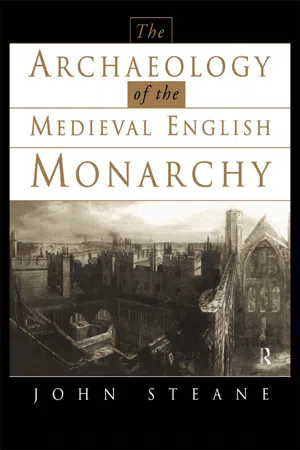
The Archaeology of the Medieval English Monarchy looks at the period between the reign of William the Conqueror and that of Henry VIII, bringing together physical evidence for the kings and their courts.
John Steane looks at the symbols of power and regalia including crowns, seals and thrones. He considers Royal patronage, architecture and ideas on burials and tombs to unravel the details of their daily lives supported with many illustrations.
- 224 pages
- English
- ePUB (mobile friendly)
- Available on iOS & Android
eBook - ePub
The Archaeology of the Medieval English Monarchy
About this book
Information
CHAPTER ONE
Symbols of power
The European Middle Ages are dominated by the concept of kingship. The Norman, Angevin, Plantagenet, Capetian and Hohenstaufen dynasties lend their names to periods in English, French and German history. The politics of the period are virtually synonymous with the attempts of rulers to fulfil monarchical ambitions by means of marriage, diplomacy or war. Kings were also constantly expanding their influence into the spiritual sphere and thus conflicting with churchmen as well as barons. The ideal medieval king meant different things to different sections of the people who made up the kingdom (Barraclough 1957). He was a leader of his magnates in war; a priest-king protecting the interests of the church, appointing bishops and abbots; an administrator and tax-gatherer upholding and supported by the interests of the class of royal officials, the ministeriales. He was also a judge, the fount of law, and was likely to satisfy his more lowly subjects if he was prepared to distribute justice, however sternly, with an even hand.
This irradiation of monarchy throughout society was helped in England by a number of circumstances. Historical accident produced three ‘strong’ kings in succession: William I, William II and Henry I, who created or improved institutions too powerful to be destroyed by the 20 years’ anarchy of Stephen’s reign. Henry I, by begetting 30 bastards and systematically slotting them into positions of political importance in his dominions consolidated his family’s grip on widely scattered possessions (Given-Wilson 1988, 61). Henry II cemented alliances by marrying his children to other ruling houses throughout Europe. The concept of primogeniture, the unresisted acceptance of the heir to the throne, usually the king’s eldest son, had become the norm as far as England was concerned by the end of the thirteenth century. Edward I succeeded his father almost immediately in 1272 although he was absent on crusade; he was sufficiently assured of the succession to postpone his coronation until 1274. Edward II was the first king to date his regnal years from the day after his father’s death. In this way continuity was assured; a close bond was forged between the royal dynasty and the royal office. This was demonstrated symbolically by the fact that the arms of the Plantagenet dynasty (Latin plantagenista= broom), ‘Gules three lions passant guardant or’ became the arms of the kingdom of England. The identification of the king with the nation meant that his achievements became the achievements of England—Edward I’s conquest of Wales, and Edward III’s military victories over the French at Crécy, 1346, and Poitiers, 1356. Similarly, the symbol of the French nation, the Fleur de Lys, bonded the separate parts of France together (Beaune 1991, 201–26).
The rapid development of effective departments of government meant that strong monarchical administration was carried on despite periods of royal weakness and crisis. Royal government could survive minorities such as Henry III’s (1216–27), and baronial revolts (those of Simon de Montfort 1258–65 and Thomas of Lancaster 1321–2). Kingship as an institution emerged unscathed through the reigns of such flawed characters as Henry III and Edward II.
Archaeology provides a window into the contemporary perceptions of monarchy. Kingship was surrounded and bolstered by ceremonies and symbols, many of which have left structural and artifactual vestiges. The most significant was the ceremony of coronation whereby the king was invested by the Archbishop of Canterbury with spiritual power as God’s anointed, like the kings of Israel before him. Hence forward the anointed king was set apart from his subjects, at least on a par with, and to some extent superior to, churchmen. His periodic crown wearings reminded recalcitrant subjects of this divine stamp of approval. The effect of such ceremonies was strengthened by the dissemination of the royal coinage and of seals attached to documents, carrying images of the royal persona to every part of the land. Palaces were painted and churches filled with glass and images, further powerful projections of royal power. Apart from the crown and sceptre the third most potent symbol of royal power was the sword (Fig. 1). Kings were recorded on a number of occasions as giving the sword from their own sides as a mark of special favour. With the sword the king knighted his followers. The chivalric code was reflected in the ‘Matter of England’, the tales of King Arthur and his Round Table. The cult of personality which backed their political pretensions was further fostered by the fact that medieval kings spent their lives in progresses throughout their dominions, characterized by conspicuous consumption; and when they died their obsequies were carried out on a magnificent scale and their bodies buried under tombs of great splendour. This chapter will survey four main aspects of these symbols of power: portraits and images, seals and regalia.

1 A royal sword now in the British Museum. This is northern German in manufacture and dates to the mid-fifteenth century. It was carried before the Prince of Wales and bears the royal arms on the principal side of the grip and the pommel as well as those of Wales, Cornwall, and St George. On the other side are those of Mortimer quartering Burgh. It may have been used by the eldest son of Edward IV, created Prince of Wales and Earl of Chester in 1471. Alternatively, it may have been used by the son of Richard III, Prince Edward, 1473–84, invested as Prince of Wales and Earl of Chester in 1483.
Portraits of kings
If by portraits we mean realistic and recognizable representations of the faces of people, then this genre can hardly be said to have started before the medieval period had largely run its course. For one thing, only the rulers in the twelfth and thirteenth centuries were represented in art in any numbers; they were shown, monarchs and bishops, loaded with the symbols of their office—crowns, sceptres and so on. Their faces lack personal features, and without their beards, sceptres and crowns could easily be mistaken for those of saints; yet by means of the symbols the identifications are made clear. It seems that at this time the symbols of power were more potent than the idea of portraiture. There are, however, qualifications to be made. Some kings acquired attributes which were taken up by artists and repeated. Such is the long beard which is found in representations of Edward the Confessor. He is depicted on his coins, on his great seal and on the Bayeux Tapestry with a long beard, unlike any of his predecessors or successors (Whittingham 1974, 99). Even in the fifteenthcentury glass at Great Malvern he is shown with flowing white hair and a beard (Rushforth 1936, 123–4).
The Norman conquerors, however, are shown as clean-shaven in the near-caricatures of their rulers stamped on their coins and embroidered on the Bayeux Tapestry. Some full-face coins of William I show him with long moustaches. The impression of his great seal is unfortunately too indistinct to settle the question of whether the Bayeux Tapestry or these coins are correct in this detail (Wyon and Wyon 1887, 5–7). Clearly, if we are not even sure whether the Norman kings were bearded or shaven we are not going to get very much nearer to solving the question of their personal appearance.
During the twelfth century the idea of the portrait had still hardly germinated in western Europe. The image of the ruler, on the other hand, was strongly rooted in the visual scene; rulers had themselves been interpreted by artists in wall paintings, sculptures, bronzework and manuscripts as incarnations of justice. They are shown very much as Christ was depicted on the sculptured tympana over the doorways of great churches, seated in judgement on thrones, bearded, crowned, holding swords and sceptres. Their icons demonstrate little humanity and less individuality. The last thing one would call these solemn and soulless representations of monarchy is portraiture. Towards the middle of the century funeral monuments began to take the form of sculptured effigies. The first of these to survive in Italy were the papal effigies. It is possible that Henry I and Stephen were similarly commemorated but their monuments have been destroyed. The earliest monumental effigies in England are those of Roger and Jocelyn, bishops of Salisbury (d. 1139 and 1184 respectively) (Shortt 1958–9, 217–19). Those of the Angevin kings and queens at Fontévrault followed soon after. They are shown as gisants, stretched out as in death, remote, statuesque and withdrawn; surrounded by and clothed with the symbols of earthly power, devoid of individuality.
The thirteenth century, however, saw a move in two directions: the monuments to the dead begin to be idealized, and there is a tendency towards realism, though hardly naturalism, before the end of the century. One reason for this in England must be the great increase in artistic patronage during the reign of Henry III. There are no less than 19 references in royal records to the making of royal portrait images (this includes king, queen and members of the immediate royal family in stone, glass and met-alwork) during his reign, 1216–72 (Whittingham 1974, Appendix 2). Three instances may be cited of the idealization of royal portraits. Eleanor of Castile’s effigy in Westminster Abbey shows her as a considerably younger woman than the matron who had born Edward I’s 15 children. Edward II’s alabaster effigy at Gloucester is another idealized version. It is an example of a very common feature of the midfourteenth century—that men had to be represented at the perfect age of about 33 (the supposed age of the crucified Christ)—as they hoped to appear at the General Resurrection (Gardner 1940, 24). Edward III, when commemorating the death of his children, Blanche of the Tower and William of Windsor (Fig. 2), had effigies made of well-grown striplings of the age of 10 despite the fact that both had died as babies (Tanner 1953, 34). An example of the somewhat uncertain move towards realism is the generalized portrait effigy of Henry III at Westminster—its rather lack-lustre handling may be due to the clumsiness of the bronze-founder (Plenderleith and Maryon 1959, 87–8).
Royal portraiture took a marked step forward in the latter part of Edward III’s reign, with the French effigy of Queen Philippa of Hainault, who died in 1369 (Noppen 1931). This is no idealized woman but the realistic portrayal of a plain, rather stout, middle-aged lady, whose alabaster image still succeeds in arousing our sympathies.
The advent of realism coincides with the use of the death-mask. This has been first traced in the case of Edward III, whose death-mask it is thought was employed to make the head of the king’s effigy used for the funeral celebrations (Howgrave-Graham 1961, 160–1). Henceforward there is a real possibility that when we are looking at a royal monument or a royal portrait we are gazing at a more or less accurate delineation of royal features. At this stage, however, portraiture was only regarded as an additional means of identification. It still took second place to heraldry and nomenclature. The male members of the royal family depicted in the fourteenth-century St Stephen’s Chapel wall paintings (see Fig. 89) were shown wearing heraldic surcoats, and all the figures were labelled with their names; portraiture functioned here only as a kind of ‘belt and braces’ means of identifying figures represented on large-scale public paintings. The famous Westminster Abbey portrait of Richard II is in a sense labelled by means of the crowned letter Rs patterning the royal robe (Hepburn 1986, 91).

2Effigies of William and Blanche, children of Edward III in Westminster Abbey, London. These children were still babies when they died but are portrayed in idealized form as ten-year-olds. (Photograph: RCHM England.)
While the funeral effigy of Edward III may give us an accurate delineation of his face, the icon which the bronze founder made of his royal visage is shown wrapped in an enormous beard which inevitably obscures some of the lower features of his face. It may well be that epochs of beardlessness went with periods of realistic portraiture (Whittingham 1974). Certainly, we have a clearer idea of Richard II’s face because he chose to sport a comparatively meagre forked beard which is combined with a long narrow nose and hooded eyes on the Westminster picture and the tomb effigy.
The unsigned and undated panel portraits of the later Plantagenets have recently been subjected to dendrochronological analysis (Fletcher 1974, 250–8) which provides a date, c. 1518–23, for the painting of the portrait in the Royal Collection at Windsor Castle of Henry V and confirms that it was painted at the same time as the two other portraits in the Royal Collection showing Henry VI and Richard III (Hepburn 1986, 27). They are all identical in size and a comparison of the patterns of the tree rings from the boards which make them up indicates that the main board of all three panels was cut from the same tree.
Despite the fact that Henry V’s portrait was painted nearly a hundred years after his death it is thought to be a close copy of a contemporary Gothic votive painting. The king’s face may be slightly stylized but it comes through as recognizably youthful, firm and determined; he is 25 years old, long-featured, handsome, and with more than a touch of the dévot. The Royal Collection portrait of Henry VI, on the other hand, tends to bear out contemporary observations that as an adult the king looked naive and childlike; it shows a ruler whose mental health was precarious. In fact ‘the Kyng was simple and lad by covetous counseylle…the quene with such as were of her affynyte rewled the reaume as her lyked’ (quoted by Wolffe 1981, 20).
Dr Fletcher suggests that alone among the works of the later medieval rulers which have survived in the Royal Collection the portrait of Edward IV’s queen, Elizabeth Woodville, is an original work dating from c. 1471–80 (Fletcher 1974, 256). Other lines of evidence, however, such as the costume, the jewellery and the composition suggest that it was a later copy (Hepburn 1986, 56–7). A more likely contemporary representation of Elizabeth and her husband is the excellent stained glass kneeling figures in the north window of the north-west transept of Canterbury Cathedral (Caviness 1981, 251–61). Here are accurately portrayed the same high forehead, large eyes, straight nose and small pointed chin which so captivated
Edward IV that he was prepared to set half his kingdom in an uproar in order to marry this bewitching (widowed) commoner. The fact that they are kneeling is significant. The royal family is seen as a human group, taking part in an act of worship. This is far from the God-like figures of royal judges seen three hundred years before.
Edward himself was reckoned to be a handsome man, if somewhat corpulent in his later years. The best of a group of three surviving portraits from the so-called ‘Cast Shadow Workshop’ shows the king wearing a richly brocaded cloth-of-gold gown; this painting was dated by tree-ring analysis to 1520–35 (Fletcher 1974, 256, 257, Table 2). The oriental-looking cast of the eyes, the straight nose, the small pinched mouth, bear a close resemblance to the standard facial type which appears in late fifteenthcentury English alabaster figures. No likeness survives of little Edward V. Richard III, on the other hand has been the subject of a plethora of portraits; he is the first English king for whom there is evidence to suggest that two panel-portraits of him were produced during his lifetime (Tudor Craig 1973, 80–95). Both are known now through later copies, the most important being that in the Royal Collection at Windsor. It is clear that this picture has been tampered with; the right shoulder has been raised in order to suggest that the subject was crookbacked. The eye similarly has been straightened to give it a sinister glint; both doubtless to reflect Tudor smear campaigns. It seems from verbal descriptions that King Richard was a short man, ‘of bodily shape comely enough, only of low stature’; he also very likely suffered from an overwhelming sense of anxiety. His face in the portraits shows strain but is toughly determined in contrast to the bland self-confidence of his brother Edward. The body beneath the face is lean, with a thin neck: insofar as both the shoulders are rather drawn up and the head juts forward slightly, the image also reflects Richard’s alleged round-shoulderedness (Hepburn 1986, 84–5).
There are a number of paintings of Henry VII but the most celebrated image is that sculptured in bronze for his funeral effigy in Westminster Abbey by the Florentine master, Pietro Torrigiano. This fine posthumous portrait was possibly based on that of the funeral effigy modelled in turn on a death mask. The effigy in
Westminster Abbey when repaired after the Second World War, was noted as having ‘an open, bold and commanding face, entirely without the crafty and unpleasant expression seen in many inferior portraits’ (Howgrave-Graham 1961, 167). When Torrigiano came to work on his other commission, that of a monument to Henry VII’s mother, Lady Margaret Beaufort (the great educational benefactress, founder of St John’s College, Cambridge), he was separated from his subject by two years and had to work from drawings prepared by the court painter. On 22 June 1513 payment was made ‘to Maynarde paynter for makinge the picture and image of the seide ladye…33s 4d’. His contract mentions ‘A Tabernacle of copper with an ymage lying at the fote of the same…with like pillars’ (Scott 1914–15, 365–76). The result is a beautiful gothic effigy of an austere, veiled widow, her hands joined in prayer, in black and gold (RCHM 1924, 68).
Despite the m...
Table of contents
- Cover Page
- Title Page
- Copyright Page
- Illustrations
- Foreword
- Preface
- Acknowledgements
- Chapter one: Symbols of power
- Chapter two: Burials of the medieval royal family
- Chapter Three: Royal accommodation
- Chapter four: Palace and castle gardens
- Chapter five: The peaceful activities of court life
- Chapter six: Formalized violence: hunting, hawking and jousting
- Chapter seven: The monarchy, religion and education
- References
Trusted by 375,005 students
Access to over 1.5 million titles for a fair monthly price.
Study more efficiently using our study tools.
Frequently asked questions
Yes, you can cancel anytime from the Subscription tab in your account settings on the Perlego website. Your subscription will stay active until the end of your current billing period. Learn how to cancel your subscription
No, books cannot be downloaded as external files, such as PDFs, for use outside of Perlego. However, you can download books within the Perlego app for offline reading on mobile or tablet. Learn how to download books offline
Perlego offers two plans: Essential and Complete
- Essential is ideal for learners and professionals who enjoy exploring a wide range of subjects. Access the Essential Library with 800,000+ trusted titles and best-sellers across business, personal growth, and the humanities. Includes unlimited reading time and Standard Read Aloud voice.
- Complete: Perfect for advanced learners and researchers needing full, unrestricted access. Unlock 1.5M+ books across hundreds of subjects, including academic and specialized titles. The Complete Plan also includes advanced features like Premium Read Aloud and Research Assistant.
We are an online textbook subscription service, where you can get access to an entire online library for less than the price of a single book per month. With over 1.5 million books across 990+ topics, we’ve got you covered! Learn about our mission
Look out for the read-aloud symbol on your next book to see if you can listen to it. The read-aloud tool reads text aloud for you, highlighting the text as it is being read. You can pause it, speed it up and slow it down. Learn more about Read Aloud
Yes! You can use the Perlego app on both iOS and Android devices to read anytime, anywhere — even offline. Perfect for commutes or when you’re on the go.
Please note we cannot support devices running on iOS 13 and Android 7 or earlier. Learn more about using the app
Please note we cannot support devices running on iOS 13 and Android 7 or earlier. Learn more about using the app
Yes, you can access The Archaeology of the Medieval English Monarchy by John Steane in PDF and/or ePUB format, as well as other popular books in Social Sciences & Archaeology. We have over 1.5 million books available in our catalogue for you to explore.