- 268 pages
- English
- ePUB (mobile friendly)
- Available on iOS & Android
eBook - ePub
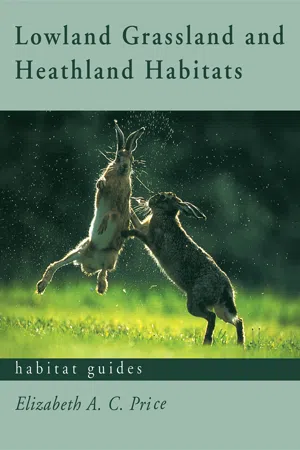
Lowland Grassland and Heathland Habitats
About this book
Grasslands are everywhere: agricultural land, playing fields and road verges; but while species-poor, intensively managed grasslands are widespread, colourful semi-natural grasslands and heathlands, buzzing with life, are scarce. These semi-natural habitats are ancient, cultural landscapes, which are of considerable, if not international importance for biodiversity. However, despite targets for the conservation and restoration of these valuable grasslands and heathlands, these habitats continue to decline before our eyes. Lowland Grassland and Heathland Habitats contrasts the uniformity of intensively managed grassland with the diversity of traditionally managed grasslands and heathlands. It examines topics of concern to the ecologist or habitat manager such as causes of the loss and deterioration of these habitats, including inappropriate management, eutrophication and climate change. It then evaluates opportunities for positive change, such as conservation, restoration and creation. A series of case-studies illustrates the pressures on some lowland grassland and heathland habitat types and looks at ways to enhance them for biodiversity. This habitat guide features illustrated species boxes of typical plants and animals, as well as a full species list, a series of projects on the ecology of grassland and heathland species, a colour plate section, up-to-date references and information, and a full glossary. It will provide students and environmentalists with a deeper understanding of the nature and importance of lowland grasslands and heathlands.
Information
1
INTRODUCTION
SOME DEFINITIONS
Grasslands and heathlands may be classed together as habitats or ecological communities with several factors in common. Grasslands and heathlands are open habitats, dominated by grasses and dicotyledonous herbs or dwarf shrubs, where trees are usually sparse. In the UK some are natural, occurring where abiotic environmental conditions such as poor soils and harsh climate prevent tree growth, but they can also develop where trees are removed and their regeneration is prevented (Gimingham, 1975; Crofts and Jefferson, 1999). Prehistoric clearance of woodland enabled native grassland and heathland species to spread, and centuries of traditional management allowed the characteristic vegetation of semi-natural grassland and heathland to develop (Duffey et al., 1974; Webb, 1986). More recently the extent of semi-natural grasslands and heathlands has declined dramatically and they are now recognised as priority habitats for conservation (UK Biodiversity Group, 1998a, b).
Grasslands and heathlands occur over a wide altitude range, from sea level to the uplands, but this book examines the ecology and management of heathlands and grasslands in lowland Britain, below about 300 m in altitude and often below the upper level of agricultural enclosure (UK Biodiversity Group, 1998b; Crofts and Jefferson, 1999). The ecology and management of upland heaths and grasslands are described in Upland Habitats in this series (Fielding and Haworth, 1999). Lowland grasslands are communities that are dominated by species of grasses and herbs. The vegetation usually forms a closed sward or turf, which may be short or fairly tall and tussocky, but is usually less than 1 m in height (Plate 1). Grasslands can be categorised on the basis of their soil - acidic, mesotrophic or calcareous - and drainage status: wet or dry. The use of terminology is not always consistent, and acidic grasslands are also termed calcifugous grasslands, mesotrophic grasslands may be called neutral grasslands, and calcareous grasslands are also described as calcicolous grasslands. Grasslands can also be grouped according to the intensity of agricultural improvement of the community, i.e. improved, semi-improved or unimproved (semi-natural; Chapter 2) (Rodwell, 1992; Ausden and Treweek, 1995; Crofts and Jefferson, 1999). Areas of good-quality lowland grassland usually support a number of specialist species, and often have high species richness (UK Biodiversity Group, 1998b). Lowland heathlands are communities that are dominated by ericaceous dwarf shrubs such as heather (Plate 1.1, Plate 2) . The terms ‘heathland’ and ‘moorland’ are often used interchangeably, but ‘heathland’ is a broader term that refers to both lowland (i.e. below 300 m) and upland communities, whilst ‘moorland’ usually refers to particular communities that occur most extensively in the uplands on deep peat substrates. Heath communities may be categorised on the basis of their drainage status: dry, humid (moist) or wet (Dolman and Land, 1995; Thompson et al., 1995). Good-quality lowland heathland typically consists of areas of dry and wet heath, bogs, open water, areas of bare ground and some scattered trees and scrub (UK Biodiversity Steering Group, 1995).

Plate 1.1: Dorset heathland
EXTENT AND LOCATION OF LOWLAND GRASSLANDS AND HEATHLANDS IN THE UK
The areas of the UK covered by grassland and dwarf shrub heath habitats (upland and lowland) in 1998, based on field survey data from the Countryside Survey 2000 (CS2000), are shown in Table 1.1. It is estimated that dwarf shrub heath occupies 6.1 per cent of the UK, while grassland of different types occupies 33.9 per cent.
The extent and location of UK grasslands and heathlands in 1998 are shown in Plate 3. Comparison of Plate 3 with the altitude map, Fig. 1.1, indicates that large blocks of seminatural grassland (i.e., neutral, calcareous, acid) and heathland are concentrated in the uplands, and in the lowland fringes, below 300 m, bordering the uplands. Elsewhere in the lowlands, surviving semi-natural grasslands and heathlands have become increasingly scarce and fragmented. In contrast, improved grasslands are generally restricted to the lowlands. Grasslands are the most widespread habitats in the UK (Haines-Young et al., 2000) and even in towns and cities large proportions of urban land may be grassland (Carr and Lane, 1993; Baines, 1995) (Plate 1.2). However, the majority of UK grassland is species-poor improved mesotrophic grassland (24.7 per cent of the UK). In contrast, semi-improved and unimproved neutral (mesotrophic) grasslands combined occupy 3.5 per cent (Table 1.1) and the actual value for unimproved lowland mesotrophic grassland is really much less (11,600 ha, 0.05 per cent of the UK) (Jefferson and Robertson, 1996) (Table 1.2). Acid grasslands are an extensive semi-natural habitat in Britain (Table 1.1), although the majority (over 1.2 million ha) are in the uplands. Acid grassland in the lowlands probably covers less than 30,000 ha (0.12 per cent of the UK). Calcareous grassland in the lowlands covers between 33,000 and 41,000 ha of the UK (0.14–0.17 per cent of the UK) (Rodwell, 1992; UK Biodiversity Group, 1998b). The area of lowland acid grassland is intermediate between that of lowland unimproved mesotrophic grassland and lowland calcareous grassland (UK Biodiversity Group, 1998b) (Table 1.2). The UK has approximately 58,000 ha of lowland heathland (UK Biodiversity Steering Group, 1995), which is about 0.24 per cent of the UK (Table 1.2). These values are rather crude estimates, but they clearly show that, whilst improved grasslands are widespread, seminatural lowland heaths and grasslands are scarce.
Table 1.1: Estimated stock of grassland and heathland (upland and lowland) in the UK, 1998 (area, 000 ha)

Figure 1.1: Approximate distribution of land over 300 m in altitude in the UK, indicated by dark shading
WHY LOWLAND GRASSLANDS AND HEATHLANDS?
If the majority of lowland grasslands and heathlands are man-made habitats, what is their value? Many are ancient habitats, composed of native species, which are of considerable, and in many cases international, ecological importance. For example, despite lowland heathland losses of about 80 per cent since 1800, 20 per cent of the international total survives in the UK (UK Biodiversity Steering Group, 1995; English Nature, 2000). In addition, some lowland grassland and heathland types, such as the crested dog’s-tail–common knapweed grassland community, are largely confined to the British Isles, and the UK therefore has a special responsibility for their conservation (Jefferson et al., 1999). In the absence of trees, grassland and heathland species flourish in the climate of the UK, and regional differences in the climate and in soils create conditions suitable for a range of distinctive heathland and grassland community types (Rodwell, 1991, 1992, 2000). Maritime conditions (in particular the effects of salt spray) can also influence the composition of coastal grassland and heathland (Mitchley and Malloch, 1991). Superimposed on this pattern, caused by variation in soils and climate, is the influence of different management practices, which can further affect the character of these communities. Thus, although grasslands and heathlands share some fundamental characteristics, the differences within and between these habitat types are probably just as significant as their similarities. Within the large range of lowland grassland and heathland community types found in the UK, some are now extremely restricted in extent, for example unimproved lowland mesotrophic grasslands, which total about 11,6000 ha (Table 1.2), can be divided into a number of types, some of which cover less than 100 ha in total (Jefferson and Robertson, 1996).

Plate 1.2: Urban grassland, Manchester
Table 1.2: Estimates of the stock of lowland grassland and heathland in the UK (area in 000 ha)
Following the Earth Summit in Rio de Janeiro in 1992, the UK government published its Strategy for Sustainable Development and pledged to conserve and enhance biological diversity in the UK (DOE, 1996a). One of the main approaches to this was the launch of ‘Biodiversity: the UK Action Plan’ in 1994, which involved the preparation of action plans for key or priority habitats and species. Priority habitats include lowland heathlands and semi-natural grasslands, because the UK has an international obligation to protect them, they are at risk or rare, and they contain important species (DOE, 1996a; UK Biodiversity Group, 1998a, b). UK Biodiversity Action Plan targets for semi-natural grasslands and heathlands include habitat conservation, restoration and expansion (UK Biodiversity Group, 1998b) but, despite these targets, the extent and quality of semi-natural grasslands continue to decline. For example, the stock of calcareous grassland in the UK declined in the 1990s by 18 per cent (Haines-Young et al., 2000). Similarly, while the majority of lowland heathland is now notified as SSSI (Sites of Special Scientific Interest, DOE, 1996a), the habitat is still affected by factors that lead to a decline in heathland quality, such as lack of appropriate management, nutrient enrichment, fragmentation and disturbance from development (UK Biodiversity Steering Group, 1995).
At a time when the role of land management practices in rural and urban areas is being increasingly questioned (e.g. Hindmarch and Pienkowski, 2000), lowland grasslands and heathlands provide ideal systems to examine the significance of human activity in shaping habitats. What is the range of grassland and heathland types in the UK? What are the factors that account for the differences? What are the interactions between organisms in these communities? What are the impacts of natural factors such as climate and substrate, and anthropogenic influences such as disturbance, agricultural improvement, fragmentation, pollution and neglect on grasslands and heathlands? Why is the information important? Can economic and environmental objectives be reconciled in managing these habitats? These are some of the questions this book addresses.
THE STRUCTURE OF THE BOOK
This volume has the same structure as other books in the series, first presenting background material that supports information in later chapters. Chapter 2 describes the ecology of UK lowland grasslands and lowland heathlands and examines the range of communities that exist today. The variety of grasslands and heathlands is enormous and they are described on the basis of their vegetation characteristics (Rodwell, 1991, 1992, 2000) because this is probably the most widely adopted method of habitat classification in the UK. Characteristic animals are also described, and rare species associated with each habitat are used to illustrate the range of species present and threats to biodiversity. Chapter 3 evaluates the management of grasslands and heathlands, including maintenance, improvement, restoration and creation, in relation to problems and opportunities that are especially relevant to these habitat types. Considerable attention is paid to past management and economic factors and protection measures because these have a huge bearing on the management of grasslands and heathlands today. In Chapter 4, a number of current issues such as climate change, nitrogen deposition and ecological mitigation are illustrated in greater detail through case studies. Finally, in Chapter 5, some practical projects are suggested to encourage readers to become involved in examining ecological responses to environmental factors for themselves. Having read the book, I hope that you will be able to understand the important issues facing grasslands and heathlands. Habitat ecology is a broad topic, and it has been difficult to decide what should be included. On the whole, I have selected information that students have found particularly interesting or useful. All the topics covered in this book are interrelated, and subheadings allow you to read selectively and cross-reference with other relevant sections. Some aspects are covered only briefly, but references and sources of additional information are given at the end of the book.
2
LOWLAND GRASSLAND AND HEATHLAND HABITATS
The combined effects of different environmental conditions and management practices have created a wide range of grasslands and heathlands in the UK. This chapter explains the importance of climate and soils, outlines general characteristics of grasslands and heathlands, and examines the range of grassland and heathland communities that exists today. Relevant management is mentioned where appropriate, but the role of historical and current management practices is examined in detail in Chapter 3.
THE IMPORTANCE OF CLIMATE AND SOILS
Climate
Heathland
There are several parts of the world where the climate is suitable for the development of dwarf shrub communities, and in north-west Europe heathland communities occur primarily in the areas bordering the North Sea, the English Channel and the Atlantic. The distribution of heathland in north-western Europe coincides with the area that experiences a temperate, oceanic (or maritime) climate, lacking temperature extremes, but with abundant rainfall throughout the year (Gimingham, 1972; Webb, 1986). Although the whole of the British Isles falls within the climatic region suitable for heathland formation, around 6,000 years ago most of lowland UK was covered by woodland (Godwin, 1975). Heathland occurred naturally only in a few locations where poor soils, climate and wind exposure prevented tree growth (Putwain and Rae, 1988). The expansion of heathlands began in the Atlantic period, about 5,000 years ago, when the climate of the British Isles became cooler and wetter (more oceanic) and less favourable for tree growth, and woodland clearance began (Chapter 3) (Gimingham, 1975; Webb, 1986; Read and Frater, 1999). Although the shift in climate may have facilitated heathland expansion, the majority of lowland heathland is predominantly a man-made landscape (Gimingham, 1975; Webb, 1986).
Grassland
Similarly, there are several parts of the world where the climate is suitable for the development of temperate grassland, but grassland usually occurs as the natural vegetation type where the seasonal climate favours the dominance of perennial grasses and is too dry or cold to support woodland (...
Table of contents
- COVER PAGE
- HABITAT GUIDES
- TITLE PAGE
- COPYRIGHT PAGE
- ACKNOWLEDGEMENTS
- SERIES INTRODUCTION
- 1: INTRODUCTION
- 2: LOWLAND GRASSLAND AND HEATHLAND HABITATS
- 3: MANAGEMENT AND CONSERVATION OF GRASSLANDS AND HEATHLANDS: PROBLEMS AND OPPORTUNITIES
- 4: CASE STUDIES
- 5: PRACTICAL WORK
- GLOSSARY
- SPECIES LIST
- FURTHER READING
- REFERENCES
Trusted by 375,005 students
Access to over 1.5 million titles for a fair monthly price.
Study more efficiently using our study tools.
Frequently asked questions
Yes, you can cancel anytime from the Subscription tab in your account settings on the Perlego website. Your subscription will stay active until the end of your current billing period. Learn how to cancel your subscription
No, books cannot be downloaded as external files, such as PDFs, for use outside of Perlego. However, you can download books within the Perlego app for offline reading on mobile or tablet. Learn how to download books offline
Perlego offers two plans: Essential and Complete
- Essential is ideal for learners and professionals who enjoy exploring a wide range of subjects. Access the Essential Library with 800,000+ trusted titles and best-sellers across business, personal growth, and the humanities. Includes unlimited reading time and Standard Read Aloud voice.
- Complete: Perfect for advanced learners and researchers needing full, unrestricted access. Unlock 1.5M+ books across hundreds of subjects, including academic and specialized titles. The Complete Plan also includes advanced features like Premium Read Aloud and Research Assistant.
We are an online textbook subscription service, where you can get access to an entire online library for less than the price of a single book per month. With over 1.5 million books across 990+ topics, we’ve got you covered! Learn about our mission
Look out for the read-aloud symbol on your next book to see if you can listen to it. The read-aloud tool reads text aloud for you, highlighting the text as it is being read. You can pause it, speed it up and slow it down. Learn more about Read Aloud
Yes! You can use the Perlego app on both iOS and Android devices to read anytime, anywhere — even offline. Perfect for commutes or when you’re on the go.
Please note we cannot support devices running on iOS 13 and Android 7 or earlier. Learn more about using the app
Please note we cannot support devices running on iOS 13 and Android 7 or earlier. Learn more about using the app
Yes, you can access Lowland Grassland and Heathland Habitats by Elizabeth Price in PDF and/or ePUB format, as well as other popular books in Biological Sciences & Environmental Science. We have over 1.5 million books available in our catalogue for you to explore.