- 198 pages
- English
- ePUB (mobile friendly)
- Available on iOS & Android
eBook - ePub
About this book
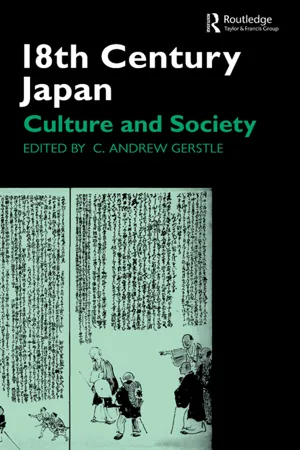
The period of Japanese history before the advent of industrialisation and modernism is of tremendous interest. The essays in this collection show a fascination with the social context behind the development of aesthetics, drama, language, art and philosophy, whether it be the world of the pleasure quarters or the Shogun's court.
PART I
PLEASURE QUARTERS AND THEATRE
1
The pleasure quarters and Tokugawa culture
In the Tokugawa era (1603–1868), courtesans were of two kinds: those who were under licence by the government and those who were not. The licensed courtesans were confined within a thick-walled enclosure, while the unlicensed ones were found scattered throughout the cities, the object of constant police surveillance and crackdowns. In contrast to ‘unofficial’ brothel areas, the Yoshiwara quarter in Edo (Tokyo), the city of the Shogun, was dubbed ‘the licensed ward’ (go-men no ochō) or just ‘the ward’; in Kyoto and Osaka, the Shimabara and Shinmachi wards were also called ‘the ward’, signifying pride in being the quarters of higher-class courtesans rather than of common prostitutes.
Among the many licensed pleasure quarters under the Tokugawa, those in these three large cities certainly mirror the rise and fall of merchant culture and economic power. The aesthetics born from this high class merchant world—Kyoto and Osaka’s sui (savoir-faire, gentleness and elegance as contrasting with force, money and coarseness) in early Tokugawa and Edo’s tsū (connoisseurship) in its latter years—represent an era comparable with the elegance (miyabi) of the aristocratic Heian court of the ninth to twelfth centuries. Popular fashion in such things as hairstyles and clothes was also based on the aesthetics emanating from the licensed quarters, which became cultural centres as both the setting and the source for the urban arts of literature, theatre and music. First, let us trace their development in the three main cities.
The development of pleasure quarters
Until the end of the sixteenth century, prostitutes plied their trade freely wherever demand arose, such as in Kyoto, other urban centres and along the crossroads of important thoroughfares. Under Toyotomi Hideyoshi’s regime in the late 1500s, prostitution was brought under control for the first time, mainly in the interest of military security, by gathering the dispersed brothels into a single area of Kyoto. In 1589 Hara Saburōemon, a retainer of Hideyoshi, set up the first licensed quarter in Kyoto. It was called Yanagimachi and was located in the three hectare area of Made no Kōji-dōri and Sanjōoshi no Kōji-dōri. Hideyoshi is known to have frequented this quarter himself in disguise with his retainers, as recorded in The Great Mirror of the Way of Love (Shikidō ōkagami, 1678).
Thirteen years later, in 1602, the year before Tokugawa Ieyasu officially established the seat of his government in Edo, Kyoto had grown greatly and the Yanagimachi quarter was moved to Muromachi Rokujō. Since this two-hectare area had three roads (suji), it was called Misujimachi, remaining lively for 40 years until 1639. Only one source shows us how Misujimachi quarter looked, the picture scroll The Tale of Tsuyudono (Tsuyudono monogatari, 1620s).
In 1640 the Kyoto magistrate was ordered to move the quarter to Shimogyoku Nishi Shinyashiki, where traces of it are still extant today. It was a block of 120 square yards, with a canal running through the middle. As for its name ‘Shimabara’, the most likely explanation is that its ‘great gate’ (?mon)—the only entrance—was thought to have resembled the gate of the Shimabara castle in Bizen which had been retaken from rebels two years earlier. The renowned Osaka Shinmachi quarter (present day Shinmachi-dōri, Shinmachi Nanbo-ku-dōri), like Kyoto’s Misujimachi, had a predecessor. Before 1620, the Hyōtanmachi quarter had been in the Dōtombori district under the control of Kimura Matajirō, a Fushimi rōnin employed by Hideyoshi. In 1631, it was moved to the present site under an order from the Tokugawa government, and called Shinmachi. Gradually the courtesans from Sadoshimamachi, Tenma’s Yoshiharamachi, and Kawaguchi’s Sankenya were gathered together in the new quarter, which was completed by 1657. In contrast to Kyoto’s Shimabara, which served upper-class and well-educated gentlemen, Shinmachi’s guests were the local wealthy merchants or those from all over Japan who came on business to Osaka, the hub of national commerce. Even the novelist Ihara Saikaku, an Osaka native, found it too bustling and noisy as recorded in his Great Mirror of Love (Shoen ōkagami, 1684). Situated near the many daimyo storehouses and the bustling commercial port where wealthy merchants gathered, the facilities at Shinmachi were unrivalled throughout the land. As Saikaku says in Life of an Amorous Man (Kōshoku ichidai otoko, 1682), summing up the ultimate in a playboy’s dream, ‘A Kyoto courtesan with some Edo spirit (hari), meet up with her in Shinmachi, what could be better.’
This hari—the pride or stubbornness in not submitting to any force, whether physical, official or monetary—was a particularly important attribute for Yoshiwara courtesans in the ‘rough’ Bakufu city of Edo, with its population of more than half a million samurai, most of whom were transients from the provinces on the alternate-attendance system (sankin kōtai). There was also constant tension between city ruffians and lower-ranking officials.
The year 1618 is the accepted date for the opening of the Yoshiwara official quarter. The site selected by the Bakufu was Fukiyachō no Shita (present day Chūō-ku, Horidome 2 chōme). Between 1603 and 1618 there were several brothel areas in the new city of Edo: fourteen or fifteen houses in Kōjimachi 8 chōme, the same in Kamakura Kawagishi, and more than twenty in the Yanagimachi area of the castle gate at Jōbanbashi. The master of the Yanagimachi, one Shōji Jin’emon (rumoured to have been a descendant of the Odawara Hōjō family), in 1612 presented the following reasons to the government for the creation of an official pleasure quarter. These were to control:
1 thieves who steal their master’s money in order to enjoy themselves;
2 villains who kidnap young girls and sell them into prostitution, or who get adopted by a good family and force their wives into prostitution; and
3 unemployed samurai of ill repute, ruffians or vagabonds.
The prime reason given was ‘security’ in this newly-established frontier city; the brothel owners pledged their support in the control of unruly elements. Five years later, in 1617, the Bakufu granted conditional permission for the building of the Yoshiwara pleasure quarter, with Shōji Jin’emon as head officer. The most important conditions were the following:
1 Prostitution is only to be allowed in the quarter. (Hereafter unlicensed prostitution became illegal and survived as a clandestine activity.)
2 Courtesans are not to leave the quarter.
3 Suspicious loiterers are to be questioned and their addresses checked. If suspicion remained, the city magistrates office must be informed.
These were recorded by the sixth head of Yoshiwara, the grandson of Shōji Jin’emon, Matazaemon Katsutomi, who was ordered by the city magistrates to compile a history of Yoshiwara (Shin-yoshiwarachō yuisho sho), later published in the book Writings from the Bedroom (Dōbō goen, 1721).
The Yoshiwara quarter remained at Chūō-ku Horidome from 1618 until 1657, the year of the Great Fire of Meireki. It is termed ‘old’ (moto) Yoshiwara; the post-1657 Yoshiwara, which was moved to the outskirts of Edo in the Nihon Tsutsumi area of Asakusa, is called the ‘new’ (shin) Yoshiwara to distinguish the two. We have only one source for the street names, houses, top-class courtesans (tayū), second-to-top courtesans (kōshi), courtesans’ poetic names (genjina), ages, etc. This is Tales of the East (Azuma monogatari) published in 1642. Though it is a guide to a local district of the new city of Edo rather than an appraisal of courtesans (yūjo hyōbanki), when it was reissued the following year, four pages of reviews were added of the eighteen new tayū who had had their debut during the year. This second edition aimed to appeal to the massive increase of samurai entering Edo due to the previous year’s (1642) order of alternate attendance for all Tokugawa vassal daimyo; it was unmistakably a guide to the Yoshiwara pleasure quarter and the forerunner of the courtesan critique (yūjo hyōbanki) genre.
The revised Tales of the East was, however, published to fill a sudden demand and did not have immediate successors, perhaps because the ‘old’ Yoshiwara had no outstanding courtesans of lasting fame. Only with the creation of Shin Yoshiwara after 1657 did Yoshiwara really become the cultural centre of Edo.
The rise and role of tayū
The crowning jewels of urban culture were the first-class courtesans, or tayū, a term used originally for theatrical performers. Next came the second-class tenjin (termed kōshi in Edo). Tenjin were back-ups or trainees; especially talented tenjin could become tayū, the most exalted rank in the quarter, and tayū might occasionally lose favour and drop down to the tenjin class.
Early seventeenth-century references to life in Kyoto suggest how the term tayū came to be used for courtesans. In the Tales of Tsuyudono, Tsuyudono is taken on a tour of Kyoto by the proprietor of his inn:
Along Shijō Kawara, resthouses, small sideshows, and theatricals abounded, each behind drawn curtains. At one, where the customer-enticing-drums were pounding, Tsuyudono approached to have a look at the notice board: ‘From this coming fifteenth, Kanze Nō will be performed here. The tayū (performers) are Yoshino, Tsushima, Tosa, Teika, Onoe, Takashima, all famous actresses. Everyone is welcome to the show.’ At another place was a sign for the ‘Sadoshima Kabuki’ where it said: ‘A performance of Nō and puppets will be held. The tayū is Kawachino Kami.’
This work is referring to the Kanze Nō performances at Shijō Kawara by Misuji courtesans in the early decades of the seventeenth century. The ‘Yoshino’ (Yoshino II, became tayū in 1620, retired from quarter in 1632) and others mentioned are later listed in the Tales of Tsuyudono as famous performers of the Misuji quarter. Since all were acting leading (shite) roles, they were called tayū, short for nō-tayū (actor).
Further, the Sadoshima Kabuki mentioned above also was a troupe of Misuji courtesans led by the girls of the Sadoshima House who performed shibai nō, a kind of song and dance courtesan Kabuki, at Shijō Kawara. The most talented actresses were called tayū. However, though the names were for stage acting and though it was called ‘No’ or ‘courtesan Kabuki’, the day performances were primarily advertisements (kao-mise) for the evening business. Women were eventually banned from the stage in 1629. Due to this quirk of fate, ‘young boys’ Kabuki, which had been driven into obscurity by the women troupes, w...
Table of contents
- Cover
- Halftitle
- Title
- Copyright
- Contents
- Contributors
- Illustrations
- Acknowledgements
- Preface
- Introduction
- PART I. Pleasure Quarters and Theatre
- PART II. Edo Language
- PART III. High Culture
- Index
Trusted by 375,005 students
Access to over 1.5 million titles for a fair monthly price.
Study more efficiently using our study tools.
Frequently asked questions
Yes, you can cancel anytime from the Subscription tab in your account settings on the Perlego website. Your subscription will stay active until the end of your current billing period. Learn how to cancel your subscription
No, books cannot be downloaded as external files, such as PDFs, for use outside of Perlego. However, you can download books within the Perlego app for offline reading on mobile or tablet. Learn how to download books offline
Perlego offers two plans: Essential and Complete
- Essential is ideal for learners and professionals who enjoy exploring a wide range of subjects. Access the Essential Library with 800,000+ trusted titles and best-sellers across business, personal growth, and the humanities. Includes unlimited reading time and Standard Read Aloud voice.
- Complete: Perfect for advanced learners and researchers needing full, unrestricted access. Unlock 1.5M+ books across hundreds of subjects, including academic and specialized titles. The Complete Plan also includes advanced features like Premium Read Aloud and Research Assistant.
We are an online textbook subscription service, where you can get access to an entire online library for less than the price of a single book per month. With over 1.5 million books across 990+ topics, we’ve got you covered! Learn about our mission
Look out for the read-aloud symbol on your next book to see if you can listen to it. The read-aloud tool reads text aloud for you, highlighting the text as it is being read. You can pause it, speed it up and slow it down. Learn more about Read Aloud
Yes! You can use the Perlego app on both iOS and Android devices to read anytime, anywhere — even offline. Perfect for commutes or when you’re on the go.
Please note we cannot support devices running on iOS 13 and Android 7 or earlier. Learn more about using the app
Please note we cannot support devices running on iOS 13 and Android 7 or earlier. Learn more about using the app
Yes, you can access 18th Century Japan by C. Andrew Gerstle in PDF and/or ePUB format, as well as other popular books in History & Languages. We have over 1.5 million books available in our catalogue for you to explore.