eBook - ePub
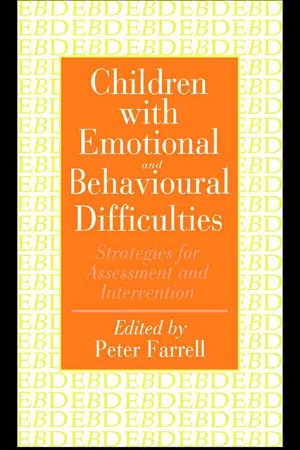
Children With Emotional And Behavioural Difficulties
Strategies For Assessment And Intervention
- 168 pages
- English
- ePUB (mobile friendly)
- Available on iOS & Android
eBook - ePub
Children With Emotional And Behavioural Difficulties
Strategies For Assessment And Intervention
About this book
Blending academic theory with policy guidelines and practical suggestions, this book provides a review of current approaches to assessment and Intervention For Children With Emotional And Behavioural Difficulties. It incorporates a discussion of government guidelines on policy and provision with schools and LEAs and reviews a range of successful innovations in intervention. Specific areas are covered, including Exclusion, Integration And Emotional Abuse.; Five Recurring Themes permeate the whole book, these being: the effects of government legislation on all aspects of EBD assessment and provision; the recognition that children with EBD come from economically and socially disadvantaged families and the implication that this has for assessment and provision; the problems of agreeing on an acceptable definition of EBD; the fact that children labelled as EBD do not have an equal opportunity to assessment and provision; and the belief that schools can make a substantial contribution to the prevention of EBD.
Information
Chapter 1
Emotional and Behavioural Difficulties: Causes, Definition and Assessment
Peter Farrell
Introduction
As stated in the preface to this volume, pupils with emotional and behavioural problems continue to pose a challenge for teachers, support services, the community and for their parents. There is evidence that the number of pupils being referred to educational psychologists is increasing, McCall and Farrell (1993) and that more are being excluded from schools, Upton (1992). Scarcely a week goes by without sections of the media reporting on incidents of disruption in schools and these reports are usually accompanied by suggestions about various ways of improving the situation. These range from exhortations to bring back corporal punishment, to ban children from obtaining copies of so called video nasties, to reduce the amount of violence shown on television, to sack incompetent teachers, to improve the quality of training and many others. Interest in this area is also evidenced by the number of training packages for teachers which are designed to improve their skills in managing disruptive children. Many of these are based on principles of behavioural psychology, for example BATPACK (Wheldall and Merrett, 1989a and 1989b); Assertive Discipline (Canter and Canter, 1992). Others emphasize a whole school approach, for example, Preventative Approaches to Disruption, (Chisholm et al., 1985), Building a Better Behaved School, (Galvin et al., 1990). Finally the government has issued six circulars on pupils with problems which offer guidance to schools and LEAs on the education of children with EBD (DFE, 1994).
It has been argued by McCall and Farrell (1993) and Upton (1992) that one major consequence of the 1988 Education Act has been an increase in the referral of children with EBD for special educational provision. This legislation has introduced a ‘market led’ philosophy in which schools compete with each other for children, where exam results are published and where ‘excellence’ in education is measured solely in terms of academic criteria. In this climate it is hardly surprising that schools are tempted to direct their resources towards meeting the needs of their more able pupils with less help being offered to the more vulnerable particularly to pupils whose behaviour is likely to disrupt the smooth running of a school. Hence these children are referred to support services, in particular educational psychologists, in the hope and expectation that they will be removed to a special school or unit. It is unlikely that mainstream schools will resist this trend by aiming to become centres of excellence in the education and treatment of unruly and disturbed children. However laudable that aim, it will not impress prospective parents who, on the whole, would prefer their children to be educated alongside a well behaved, motivated and highly achieving peer group.
This last point leads us on to one of the key issues facing parents and professionals who work with children with EBD. If we contrast the public’s response to this group when compared with, for example, children with physical difficulties or Down’s syndrome, we often find for these latter groups that there is a feeling that we as a society have a responsibility to care and to help. Consequently if a mainstream school prides itself in offering support, for example, to children with physical difficulties, its reputation is unlikely to be damaged and may even be enhanced. The same could not be said for pupils with EBD or even perhaps for children with moderate learning difficulties. If the ‘blame’ for the disorder does not lie with the child or family and may be genetic or due to a birth injury or a road traffic accident, then we all feel we should help as no one is responsible for causing the problem. However with EBD the ‘blame’ is often levelled at someone, frequently the parents or the child, and teachers may be less inclined to offer help and sympathy.
It is also the case, as will be discussed later in this chapter, that pupils with EBD tend to come from economically and socially disadvantaged families. Typically their parents may themselves have disliked school and feel uneasy in the company of other more educated professionals such as teachers and psychologists. These parents may find it difficult to articulate their hopes and fears for their children and to form pressure groups for better services. This is in marked contrast to families of children with, for example, dyslexia or autism. Without the support of similar pressure groups there is a danger that services for children with EBD will suffer, that they will be denied access to integrated education and that resources will be directed elsewhere.
It is against this background of increasing concern about children with emotional and behavioural problems that it is important to discuss some of the key issues which underpin our work with this group. Firstly, what are the causes of EBD; secondly, is it possible to arrive at an accepted definition of the term and thirdly how can we assess the extent of the problem and how does our assessment inform intervention? The Code of Practice for identifying SEN came into force in September 1994 and a new circular on EBD has just been issued. These provide a useful starting point for considering these issues in greater depth. In this chapter I shall briefly review the causes of EBD before moving on to a more lengthy discussion on definition and assessment.
Causes of Emotional and Behavioural Difficulties
When discussing the causes of emotional and behavioural difficulties it is important to recognize that there are likely to be a number of interrelated factors to consider. Indeed, Cooper (1993) suggests that problem behaviours are a result of a complex ‘interaction between contextual factors and aspects which the individual brings to the situation’ (p. 9). In particular the home environment and the school can play a large part in shaping the social and emotional adjustment of children. These two factors interact with the child’s own genetic predisposition.
Home Environment
As mentioned in the introduction to this chapter, it is well known that children in EBD schools tend to come from socially and economically disadvantaged families. Cooper (1993) has summarized some of the evidence which shows that such children are likely to have experienced:
- lack of parental interest in schooling;
- inconsistent and ineffectual parental discipline;
- lack of overtly displayed parental affection;
- parental indifference, hostility or rejection;
- violent displays of temper from the parents;
- parental use of corporal punishment;
- parental cruelty or neglect;
- parental absences;
- rejecting and violent parents.
(See Reid, 1987; Herbert, 1993; and many others for a more thorough review of research evidence.)
It is tempting when reading through the above list to place all the blame on parents for their children’s problems. However these parents may themselves have experienced problems in childhood and as adults they may have problems in coping with day-to-day life to the extent that there is little space left to devote to being an effective and loving parent. Their child’s school problems may be insignificant when set against the mountain of other more pressing concerns. In this environment children can model themselves on the culture of their community accepting and embracing its norms and patterns of behaviour which may be contradictory to the academically orientated and conformist value system of the school. In this atmosphere parents’ apparent unwillingness to cooperate with schools should not be seen as a sign of indifference and it is important for teachers and other agencies to try to work with and support families so as to help them overcome any feelings of indifference or even hostility that they may have.
School Factors
There is now a great deal of evidence to suggest that schools can play a vital role in causing and therefore preventing EBD. Early work by Reynolds and Sullivan (1981) and Rutter et al. (1979) shows that schools from similar catchment areas experience different rates of truancy, and behaviour problems. This was confirmed by a recent HMI report entitled Education for Disaffected Pupils (DFE, 1993) which focused on pupils’ behaviour in thirty-one primary and eighteen secondary schools. In this survey satisfactory standards of behaviour were associated with the following features:
- most teachers enjoyed the company of other pupils and were interested in them;
- classrooms were orderly places;
- pupils were punctual and attended regularly;
- a wide range of formal and informal rewards were used and applied consistently by the majority of staff;
- sanctions were fair, understood by pupils and parents, proportionate to the offence and were applied flexibly and constructively;
- the curriculum was generally matched to the pupils’ needs, abilities and aptitudes;
- lessons were well prepared and clearly delivered through an appropriate range of teaching styles;
- teachers were secure in the knowledge of their subject;
- the marking of pupils’ work was constructive with regular feedback being given on both the quality of its presentation and on the attainment;
- standards of achievement were either satisfactory or better;
- there was a programme of extra curricular activities which was effective in building up the confidence of pupils, their self esteem and in promoting cooperative relationships.
Unsatisfactory standards of behaviour were associated with the following:
- lessons had staggered beginnings because of late arrivals and unauthorized departures;
- few staff had the skills to defuse potentially difficult situations and on occasion fuelled them by an inappropriate confrontational stance;
- some teachers made threats which they couldn’t carry out;
- many pupils were critical of the capacity of staff to control them;
- standards of achievement were unsatisfactory;
- pupils and staff attendance were poor and morale was at a low ebb.
How schools reach the positions outlined above is a complex question. As discussed earlier in this chapter, there can be no doubt that the home background plays a part in establishing the attitude and motivation towards school of many pupils. If the pupils’ attitude to school is indifferent or even negative, this clearly makes the teachers’ task more difficult and without a great deal of support and further training, they may become demoralized and feel undervalued. This can lead to them putting less into the job than they might do in different circumstances and as a result their schools display the factors identified by HMI in the ones whose behaviour was less satisfactory. As a result a vicious circle can become established with the best teachers being promoted to schools in ‘better’ areas and those who remain struggle to cope as well as they can being additionally disadvantaged in the competitive climate engendered by the 1988 Education Act. In this way it is easy to see how the ‘good’ schools can get better and the ‘bad’ schools become worse. Fortunately this gloomy scenario is countered to some extent by the findings of the studies by Reynolds and Sullivan (1981) and Rutter et al. (1979) which clearly indicate that even with schools in extremely poor catchment areas the attainment and behaviour of the pupils can vary considerably. Schools therefore make a difference and the factors highlighted by the HMI survey give clear guidance on the steps they can take to improve the behaviour of their pupils.
Within Child Factors
Although the home environment and the school can play a large part in causing EBD, we have all met children who come from families where the parents are supportive and where the school is well thought of, who nevertheless display serious emotional and behavioural difficulties. In these cases there may be a significant inherited or constitutional explanation for their problems. Indeed within child causes of EBD tend to be associated with the most serious forms of emotional disturbance. Such children may be labelled as being ‘mentally ill’ and receive treatment in psychiatric hospitals; they tend to form only a tiny minority of children with emotional and behavioural difficulties.
However, even when the cause is largely ‘within child’ there are likely to be other factors in the home and the school which have influenced the nature of the problem. Indeed, as suggested throughout this brief review of the causes of EBD, it is virtually impossible to attribute them to one factor alone as there is almost always a large interaction between them. It is also important to remember that our own perceptions of what might cause EBD can influence the development of a pupil’s behaviour. If we expect children from ‘poor’ areas to have behaviour problems then, quite unknowingly, we may interact with them in a way which will validate our predictions. This is sometimes referred to as a self-fulfilling prophecy. As professionals we should always be aware of the potential effects of our beliefs and prejudices on the behaviour of children.
It can be seen that the issue of what causes EBD is by no means a simple question and that in order to understand a child who has problems we need to keep an open mind, be aware of our prejudices and how they can effect our judgment and be sensitive to the way in which the various factors within the child’s the home background and the school may influence his or her behaviour.
Defining Emotional and Behavioural Difficulties
The term emotional and behavioural difficulties is similar to all types of SEN in that there is no hard and fast cut-off point between a child who is or is not perceived as EBD. This continuum of need is enshrined in government legislation and by the guidance emanating from the 1993 Act. The Circular on EBD (DFE, 1994) reinforces the point about EBD being on a continuum but even so it suggests that there are three ‘types’ of EBD.
The first could be described as problems that are a response to recent stresses and strains in a child’s life, for example the death of a parent or a recent change of school. Such problems are usually short lived and with sensitive and...
Table of contents
- Cover Page
- Title Page
- Copyright Page
- Preface
- Chapter 1 Emotional and Behavioural Difficulties: Causes, Definition and Assessment
- Chapter 2 Different Perspectives of Parents and Educational Psychologists when a Child is Referred for EBD Assessment
- Chapter 3 Emotional and Behavioural Difficulties: The Primary School Experience
- Chapter 4 Emotional Abuse: Identification and Assessment in an Education Setting
- Chapter 5 Integrating Children with Emotional and Behavioural Difficulties: The Effect on Self-esteem
- Chapter 6 Placement and Progress in Residential Special Schools for Children with Emotional and Behavioural Difficulties
- Chapter 7 Get Them Young: The Impact of Early Intervention on Social and Emotional Development
- Chapter 8 Guidelines for Helping Children with Emotional and Behavioural Difficulties
- Chapter 9 A Whole School Approach to the Management of Pupil Behaviour
- Chapter 10 Exclusion: Failed Children or Systems Failure?
- Chapter 11 Pastoral Care and Black Pupils: an Uneasy Relationship
- Chapter 12 Developing an LEA Strategy for Meeting Emotional and Behavioural Difficulties: Policy and Practice
- Notes on Contributors
Trusted by 375,005 students
Access to over 1.5 million titles for a fair monthly price.
Study more efficiently using our study tools.
Frequently asked questions
Yes, you can cancel anytime from the Subscription tab in your account settings on the Perlego website. Your subscription will stay active until the end of your current billing period. Learn how to cancel your subscription
No, books cannot be downloaded as external files, such as PDFs, for use outside of Perlego. However, you can download books within the Perlego app for offline reading on mobile or tablet. Learn how to download books offline
Perlego offers two plans: Essential and Complete
- Essential is ideal for learners and professionals who enjoy exploring a wide range of subjects. Access the Essential Library with 800,000+ trusted titles and best-sellers across business, personal growth, and the humanities. Includes unlimited reading time and Standard Read Aloud voice.
- Complete: Perfect for advanced learners and researchers needing full, unrestricted access. Unlock 1.5M+ books across hundreds of subjects, including academic and specialized titles. The Complete Plan also includes advanced features like Premium Read Aloud and Research Assistant.
We are an online textbook subscription service, where you can get access to an entire online library for less than the price of a single book per month. With over 1.5 million books across 990+ topics, we’ve got you covered! Learn about our mission
Look out for the read-aloud symbol on your next book to see if you can listen to it. The read-aloud tool reads text aloud for you, highlighting the text as it is being read. You can pause it, speed it up and slow it down. Learn more about Read Aloud
Yes! You can use the Perlego app on both iOS and Android devices to read anytime, anywhere — even offline. Perfect for commutes or when you’re on the go.
Please note we cannot support devices running on iOS 13 and Android 7 or earlier. Learn more about using the app
Please note we cannot support devices running on iOS 13 and Android 7 or earlier. Learn more about using the app
Yes, you can access Children With Emotional And Behavioural Difficulties by Peter Farrell in PDF and/or ePUB format, as well as other popular books in Education & Education General. We have over 1.5 million books available in our catalogue for you to explore.