eBook - ePub
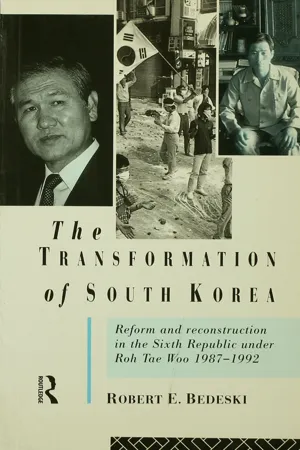
The Transformation of South Korea
Reform and Reconstitution in the Sixth Republic Under Roh Tae Woo, 1987-1992
- 208 pages
- English
- ePUB (mobile friendly)
- Available on iOS & Android
eBook - ePub
The Transformation of South Korea
Reform and Reconstitution in the Sixth Republic Under Roh Tae Woo, 1987-1992
About this book
South Korea underwent rapid economic development under a semi-military, virulently anti-communist government which banned trade unions and kept close checks on the economy. President Roe Tae Woo has, however, since 1987, introduced electoral and social reforms. Strikes and wage rises have followed, leading to a loss of competitive edge, and the growth of opposition parties has resulted in political stalemate.
Robert E. Bedeski provides a thorough analysis of the institutions of government in South Korea and how they have been transformed by the introduction of political pluralism, and of the attempt to liberalize without undermining economic success. He also examines the new political parties and their role within the framework of the South Korean political system, as well as their social context. State reforms are compared with developments in Taiwan, the Phillipines, North Korea, China and the former Soviet Union. The major themes of state-building an deconomic development are thoroughly explored. The author also deals with South Korea's international environment and changing foreign policy.
Information
1
State reform in South Korea
Introduction
Of all modem trends, equality has been the most dominant tendency in social and political relationships. Class differences have become weaker in industrializing societies – confounding the inheritors of the Marxist tradition. Male and female educational and income differentials become smaller as more women enter the work force. From the nineteenth century, the rights of citizenship were expanded to an ever-widening circle of inhabitants, and denial of rights and entitlements to aliens is increasingly regarded as unfair. Political equality has become the modem standard of performance for the modem state.
Internationally, diversity has been the rule, and any trend towards uniformity and equality has been only maintained in various international organizations, such as the United Nations. This has not, however, dictated a permanent hierarchy. The collapse of the USSR and other socialist regimes has radically altered the distribution of international power, while economic growth in East Asia has shifted expectations to this area for greater global influence. Disparities in national power are not growing smaller, but are radically redistributed almost every generation. Wars have certainly contributed to the emergence of new powers and the destruction of old empires. Equally, the combination of effective national strategies with fortuitous opportunities has permitted some societies to consolidate domestic cohesion and welfare, while amplifying their influence abroad.
Robert Tucker has written that the ‘history of the international system is a history of inequality par excellence’. What has made it so have been various disparities in natural endowments and uneven development, but also ‘the condition of society marked by the absence of effective collective procedures, competitive rather than co-operative, and lacking commitment to a common good that has ensured that differences in power and wealth will be employed to perpetuate inequality’.1 In the early 1990s, however, these words require qualification – the perpetuation of general inequality remains, but the specific cases of inequality are changing rapidly. Power and wealth – at least outside the Western industrialized states and Japan – ave not been self-sustaining and self-preserving. The Soviet Union’s dissipation of its national power may provide the classic illustration of twentieth-century defeat without war.
The international system does make a contribution to inequality, and, as Tucker notes, is structured in a way which may help to preserve that inequality. But this structure does not rule out the possibility of nations moving from weak to strong, or vice versa.2 One major motivation in contemporary arms races has been the perception that arms build-up is a short cut to national power. It is also recognized that unlimited arms spending leads to instability and bankruptcy.
The questions remain. Why are some societies poor and others relatively well-off? What can communities do to overcome poverty and a backward economy and to improve their lot? Is there a conspiracy among the industrialized states to prevent the emergence of new members of the chosen few? Must democracy be set aside or postponed for the achievement of modernization?
The South Korean phenomenon of rapid economic growth followed by a successful movement towards democracy poses some hard questions to those who may overestimate the permanence of power. Korea is a society which had been subjected to colonial repression for over a third of this century, and its two halves were formed by division of the peninsula. South Korea was practically destroyed in the peninsular war, and was threatened by the renewed outbreak of war until recently. Despite these monumental handicaps, the South Koreans have built a dynamic industrial economy, and moved towards greater democracy during the 1980s. A preliminary evaluation of this progress indicates a few key factors which include:
- A talented and resourceful population, able to draw on bonds of familial solidarity, and historical memories of a unique national identity with past major achievements as a source of inspiration. The Confucian heritage strongly reinforced family values and stressed education both as a means of upward social mobility and as an agent of moral improvement.
- The relatively good fortune of alignment with the United States has provided a wealthy and eager market for Korean manufactures at a time of industrialization. The US patronage has also enhanced the viability of the Republic of Korea (ROK) by reinforcing the defence shield against North Korean threats. While the United States has remained in Korea for its own strategic reasons, and has been a source of domestic and international tensions, the net effect has been to preserve the security of the ROK against North Korea and its allies. The pan-Pacific Pax Americana has also enabled South Korea to maintain its autonomy vis-à-vis its former colonizer – Japan.
- Strong leadership has forcibly established and preserved South Korean sovereignty, and guided the country’s economic development. Under a firmly entrenched presidency, now under a fully civilian leadership, the country has been moving towards greater democracy.
These same factors had a negative side which cannot be overlooked. While giving due credit to Korean talents, Korea has also been a quarrelsome society, from leaders down to interest groups, and to individuals. Mutual animosity among top leaders has its counterpart in the regions of the country, as well as between labour and management, or between students and government. Compromise and accommodation often take secondary priority in Korean society. Regarding the pro-US alignment, many in South Korea deny it much positive value. The US military presence, according to critics, hardens the division of the Korean peninsula, and made the ROK a front-line state in the Cold War. Critics argue that access to the US market has been of dubious value because that market only tolerates products not in competition with domestic American producers. Strong leadership has meant dictatorship and repression under harsh authoritarianism, causing many Koreans to attack their government as a creature of military and police brutality.
These two sides of the South Korean phenomenon present a painful dilemma. If democracy and economic improvement are possible only with long years of hard work, sacrifice and repression, then are the benefits worth the exertion? The Korean developmental story certainly testifies to the difficulties which accompany economic growth. Rights and democracy were restrained to maintain internal order and to prevent premature distribution of the benefits of growth to the working class. If there was a less painful road of development – under the existing international circumstances – the alternatives were not obvious. The North Korean path of development has resulted in stagnation and bankruptcy, and virtually no respect for diversity and freedom.
Another option has been revolutionary socialism, with its even more intense concentration of political power and attendant abuses. The collapse of the USSR and its client states has been a clear signal that the modem totalitarian state has become a near-extinct species. The machinery of central planning abhors free markets and has not come anywhere near the efficiency of capitalism in generating wealth. While capitalism often fails in the short-term equitable distribution of benefits, it has at least demonstrated an ability to produce an increasing quantity of goods to distribute. Capitalism combined with democracy has also offered opportunity to the many to improve their class status – a phenomenon whose possibility was denied by Marxism, which sees class as a static condition. The failure of Soviet and Chinese communism has been economic as well as political, and their attractiveness as models for developing societies has practically disappeared.
South Korea represents a third option for developing societies. It is a society characterized by high growth and movement towards a more liberal and possibly more equitable society during the Sixth Republic. Instead of rigorous central planning, the state practises some ‘guidance’ through administration and legislation. Coercion has played a part in state techniques to ensure compliance with goals and plans, but there is little or no effort or ability to subordinate all of society to a single orthodox ideology, as in totalitarian states. It is perhaps this combination of state power and pluralist diversity that gives it viability and dynamism. It is a process of state-building I will call ‘piecemeal socio-political engineering’, borrowing from Karl Popper.3
In the first decade of its existence after World War II, the ROK was an unlikely candidate for successful political and economic development. The Korean peninsula had been subjected to a harsh colonial regime for half a century, then divided into two mutually hostile regimes at the end of World War n. From 1950 to mid-1953, South Korea bore the brunt of a most destructive war. Yet today it has become one of the most dynamic economies in the modem world, despite its insecure borders and a paucity of natural resources.
Critics charge that US patronage has been a major factor in this ‘artificial’ success, and some use a ‘dependence’ framework to explain the Korean case. United States aid, defence guarantees, and market access have been important, but would have meant little without South Korean determination to strengthen a sovereign state and to embark on rapid economic growth, which averaged 8.9 per cent from 1962 to 1987. To explain some of this success in economic development, we will examine how the formation of a strong state has been the crucial ingredient in South Korean development. With the strong state in place, authority has been decentralized, with major movement towards full democracy. This movement occurred hesitantly in the Fifth Republic, and more rapidly in the Sixth Republic under Roh Tae Woo.
The authoritarian state that emerged under Syngman Rhee and Park Chung Hee acquired a capacity to maintain the Republic against international threats. The Third Republic mobilized human and economic resources for rapid industrialization. One dilemma of modem South Korea is that the bureaucratic-authoritarian regime – which has sustained economic development – is less able to liberalize without undermining some of the strengths leading to its success. A more liberal policy towards labour unions, for example, has tolerated hundreds of industrial strikes, raised workers’ wages, and has made South Korea less competitive in the world economy of low-cost labour. Dismantling the chaebol conglomerates has been a popular demand, but if carried out as government policy, it could endanger the steady growth of the economy in competition with international giant corporations.
The present study will examine the interrelationship between the bureaucratic-authoritarian state and South Korea’s political economy, in order to understand the new challenges of the Republic as it moves from the status of ‘developing’ to ‘developed’ nation. One major challenge is to maintain the characteristics which fuelled its rapid development, while responding to a changing domestic and international environment. The Sixth Republic has also been notable for two additional achievements – establishing a sound basis for democracy, and expanding international contacts.
South Korea, a society which has already experienced a multitude of changes, has been undergoing unprecedented political transformation since June 1987, when Roh Tae Woo announced a major reform programme for the country. Until then, the country was an example of how a poor, undeveloped society could concentrate its human and material resources to industrialize. The Sixth Republic has continued this push for economic growth, but has added democratic development to its priorities – even on occasion risking economic growth for expansion of democracy. It would be premature to pronounce the experiment a success, but there has been a major effort to introduce more democratic institutions into the Korean political system. In this, South Korea’s political reform is an important precedent for many developing countries, as they achieve higher economic growth. The South Korean example shows that economic growth can be a priority and can be achieved with perseverance and the right inputs. Beyond well-being, there is a universal sentiment for freedom that drives a civilization forward.
Recent political reform in South Korea has brought liberalization of state institutions – a reduction of reliance on state force as the major instrument for exacting compliance from citizens. The original state institutions evolved to concentrate power to maximize government ability to exercise the powers of sovereignty, achieve rapid economic growth, and maintain national security. Dissent from these goals has been present in Korean society since the Korean War, and concessions were made before 1987. With the Roh reforms, a new era of limited democracy was inaugurated. Some would argue that formerly explicit controls have been replaced by more subtle restrictions – including the dominance of money in relatively free elections.
Domestically, a new generation is emerging – one which did not know the repressive Japanese colonial regime or the tragic suffering of the Korean War. To a few in this generation, the nationalism of Kim II Song in North Korea has had a certain attractiveness, despite the anti-communist indoctrination in South Korean schools and despite the overwhelming evidence that North Korean communism is economically stagnant and continues to sustain one of the most repressive regimes in the world. The south has a large middle class which wants social stability, economic growth, and greater democracy. The generals and coup-makers were often waiting in the wings if liberalization went too far, or if radical disruptions undermined South Korean security.
The South Korean state is a stepchild of the international system which dominated the Cold War period, and its existence was denounced by communist countries for decades. Through a combination of persistent diplomacy and good fortune, the Sixth Republic has, however, expanded diplomatic and commercial contacts with the communist world. Military and economic support from the United States has been a positive factor in South Korean viability and success, although trade disputes and popular discomfort with the US military presence – as well as American budget-cutters’ enthusiasm to reduce foreign entanglements – have softened this relationship. Propinquity to Japan suggests much greater co-operation in that direction, but this is tempered by residues of anti-Japanese feeling among many Koreans, and potential rivalry for the future.
In addition to the importance of domestic political reforms for the South Korean state, there is a comparative dimension of analysis to be explored. Events on the Korean peninsula have been overshadowed by reforms elsewhere – notably in China and the ex-Soviet Union. Political reform has also successfully occurred in Taiwan as the mainland power elite increasingly shares power with the native Taiwanese, and has proceeded to the point where the ruling Guomindang has voluntarily changed election rules to permit intensifying challenges to its rule. These examples will illustrate the larger context of South Korean reforms – one in which democratization has vied with renewed nationalism as the dominant theme in the non-Westem world for the remainder of the millennium.
The category of ‘developing nation’ may refer to subjective aspirations in the sense of goals of progress – as well as to an objectively measurable set of characteristics. ‘Development’ reflects progress, industrialization, democracy and improved health and living standards. Developing countries are characterized by lower economic and social indicators in comparison with the ‘developed’ countries. (In an age of language inflation, countries are called ‘developing’ even when they are stagnant or moving away from progress.) Political structures are usually less efficient in executing and co-ordinating government policy, and identification between citizens and government is sporadic, non-existent, or mutually suspicious. This condition is often correlated with governments which rely largely on a combination of patronage and coercion. The ideal of government accountability and citizen participation remains alien to many, if not most, developing countries.
Within this category of developing countries, South Korea belongs to a select group of ‘Newly Industrializing Countries’ (NICs).4 These are characterized by successful modernization in economic growth, political stability, governments which support (or, in the case of Hong Kong, at least do not interfere with) private property and capitalist enterprise, and social development. The frequent expectation of economists has been that the process of modernization will be accompanied by increasing inequalities in the distribution of wealth, which may be necessary for capital accumulation. Two important variations have been (1) communist states, which have forcibly expropriated most private wealth, and claim to work for radical egalitarianism; and (2) a few societies, such as South Korea and Taiwan, where economic benefits have been distributed more equally than anticipated.
A major question in this study is the extent to which democracy is compatible with rapid development. One argument for the postponement of democracy is that pluralist interest groups inhibit economic growth because of parochial loyalties which slow the growth of a centralized state. Moreover, they are a distraction from material accumulation in that their reliance on pre-industrial modes of production limits efficiency, which in turn keeps surpluses low. The state must be able to mobilize significant resources to ensure economic growth. The free play of vested interests may interfere with the efficient allocation of inputs and outputs of the economy. The multi-party system of democracy may aggrega...
Table of contents
- Cover Page
- Half Title page
- Title Page
- Dedication
- Copyright Page
- Contents
- Preface
- List of abbreviations
- 1 State reform in South Korea
- 2 The institutions of government
- 3 Political parties and South Korean politics
- 4 The economic context of reform
- 5 The social context of Korean politics
- 6 State reform in a comparative context
- 7 South Korea's international environment and foreign policy
- 8 Conclusions
- Appendix Roh Tae Woo's declaration of 29 June 1987
- Notes
- Selective bibliography
- Index
Trusted by 375,005 students
Access to over 1.5 million titles for a fair monthly price.
Study more efficiently using our study tools.
Frequently asked questions
Yes, you can cancel anytime from the Subscription tab in your account settings on the Perlego website. Your subscription will stay active until the end of your current billing period. Learn how to cancel your subscription
No, books cannot be downloaded as external files, such as PDFs, for use outside of Perlego. However, you can download books within the Perlego app for offline reading on mobile or tablet. Learn how to download books offline
Perlego offers two plans: Essential and Complete
- Essential is ideal for learners and professionals who enjoy exploring a wide range of subjects. Access the Essential Library with 800,000+ trusted titles and best-sellers across business, personal growth, and the humanities. Includes unlimited reading time and Standard Read Aloud voice.
- Complete: Perfect for advanced learners and researchers needing full, unrestricted access. Unlock 1.5M+ books across hundreds of subjects, including academic and specialized titles. The Complete Plan also includes advanced features like Premium Read Aloud and Research Assistant.
We are an online textbook subscription service, where you can get access to an entire online library for less than the price of a single book per month. With over 1.5 million books across 990+ topics, we’ve got you covered! Learn about our mission
Look out for the read-aloud symbol on your next book to see if you can listen to it. The read-aloud tool reads text aloud for you, highlighting the text as it is being read. You can pause it, speed it up and slow it down. Learn more about Read Aloud
Yes! You can use the Perlego app on both iOS and Android devices to read anytime, anywhere — even offline. Perfect for commutes or when you’re on the go.
Please note we cannot support devices running on iOS 13 and Android 7 or earlier. Learn more about using the app
Please note we cannot support devices running on iOS 13 and Android 7 or earlier. Learn more about using the app
Yes, you can access The Transformation of South Korea by Robert Bedeski in PDF and/or ePUB format, as well as other popular books in Politics & International Relations & Political Economy. We have over 1.5 million books available in our catalogue for you to explore.