Ethnicity and racial relations are almost universally seen as a prime motivating force behind social conflict and change. Often volatile and complex, racial interaction resonates through all aspects of contemporary society. Social issues which appear to have little connection to race often become entagled with ethnic friction to create far more complex problems. Race is often used by individuals and political organizations to further their own objectives.
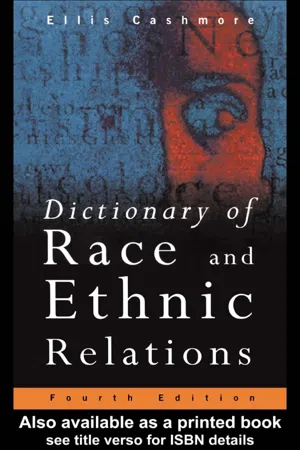
Since the 1994 publication of the third edition of this acclaimed reference book there have been enormous changes in the area of race and ethnic relations throughout the world. The Dictionary of Race and Ethnic Relations deals with these changes through in-depth articles which both define and analyze the terms. For this edition, there has been a total revision of existing entries and many new entries that take account of developments in society and intellectual trends.
Features include: * Fully updated lists of further reading and cross-references.
* New entries include: Black feminism, Causes celebres, Environmental racism, Hybridity, Postcolonialism
* Invaluable teaching and reference tool for students at all levels
- 432 pages
- English
- ePUB (mobile friendly)
- Available on iOS & Android
eBook - ePub
Dictionary of Race and Ethnic Relations
About this book
Information
A
Aboriginal Australians
The original Aboriginal Australians have been called “intellectual aristocrats” of early peoples by Claude Lévi-Strauss because of the rich cultural heritage these hunter-gatherers evolved in Australia since at least 50,000 B.C.E. These people were among the first mariners, artists, and religious thinkers.
1770–1930: Assimilation
In 1770, the sovereignty of the 250 distinct Aboriginal cultural-linguistic groups was contested by Lt. James Cook, when he claimed the eastern half of the Australian continent for the British. Cook took possession without negotiation or treaty since he judged the indigenous people to be few and not to have blended their labor with the land in an agricultural manner. Colonialism in Australia was born with his unilateral and incorrect declaration that the land was terra nullius or waste—a perception still in dispute today.
The 300,000 Aborigines (Noel Butlin suggests a precontact figure of 800,000 in his book on smallpox, Our Original Aggression: Aboriginal Populations of Southeastern Australia, 1788–1850, Allen & Unwin, 1983) were pressured by a pastoral and mining frontier that spread in spurts from southeast and coastal areas across Australia in the century after 1788. A sporadic frontier guerrilla war was waged over the land in most areas causing about 2,000 settler and possibly 20,000 Aboriginal deaths. There was no policy of genocide, but at times government forces supported the settlers in local killing actions. However, the clash between a hunter-gatherer economy and the pastoral arm of British industrial capitalism created unintended relations of genocide. Within a generation many Aboriginal groups had been reduced by over 80 percent while others totally disappeared through the action of introduced diseases, economic disruption, white and inter se killings, and a reduced birth rate through infertility and some cultural fatalism.
Many Aborigines took a vital attitude to contact and were not passive victims of colonial expansion despite this death toll. They defended their land and resources, tried to control settlers through reciprocity and kinship, and sought out Europeans by way of curiosity or to extend their cultural opportunities and traditional power. Some material items such as glass and steel were valued but only as adjuncts to their own cultural imperatives. Many Aborigines, particularly in the north, worked in the pastoral industry which supplanted their own traditional economy. They provided cheap, servile, and essential labour, but their nearness to traditional lands and the indifference of their employees to their culture, enabled the maintenance of the old ways.
The gaining of responsible government by the Australian colonies after the 1850s put the settlers, not the British Colonial Office, in charge of Aboriginal policy. This led to a century of restrictive and racist controls supported by social developmentalist and Social Darwinist rationalizations. In southeastern Australia where two or three generations of contact and miscegenation had left an Aboriginal population of mixed decent, policy after 1886 sought to end the “Aboriginal problem” through assimilation and absorption. People of mixed descent were forced from reserves formed earlier, and children were removed from their families for so-called neglect, into orphanages, training homes, apprenticeships, and white foster care. The real reason for the removals that took an estimated 8,000 children from this region alone in sixty years and affected most Aboriginal extended families, was the children’s Aboriginality. Such removals lasted into the 1970s and only now are welfare placements made after consultation with the Aboriginal community.
In the north and southwest, where people remained mainly of full decent, the policy was to confine them on reserves under petty and strict controls and in practice half were moved to reserves. Thereafter they could be consigned to white employers as domestics or as pastoral laborers. The Aboriginal Acts removed many civil rights including freedom of movement, rights over property, freedom of marriage especially across racial lines, power over one’s family, and the right to practice cultural activities. A dozen Christian missions carried out a similar but more benignly paternal role.
From the 1930s: Self-sufficiency
Aboriginal activism from the 1930s, belated white Australian receptiveness by the 1950s to Aboriginal demands, and federal government leadership, led to a dismantling of state discriminatory legislation in the 1960s. A landmark referendum in 1967 voted overwhelmingly to include Aborigines in the census with other Australians and to allow the federal government to legislate on Aboriginal affairs. Policy moved from assimilation to integration. The reformist federal Labor government in 1972 introduced a policy of self-determination, transformed to self-management by the succeeding Liberal-Nationalist government. Aboriginal community organizations mushroomed with federal finance, empowering people. The Northern Territory Lands Rights Act (1976) and South Australian legislation led to a handback of a quarter of those states’ lands— mostly arid—to Aboriginal people. These people had then to face difficult negotiations with an aggressive mining industry. At this time a plethora of welfare officers and social scientists “found” the Aborigines, adding to the outside pressures.
The great optimism of the 1970s in Aboriginal affairs was tempered by growing political and economic difficulties in the 1980s which pushed Aboriginal concerns off the major political agenda. An Australian-wide land rights push was stymied by a white backlash in the 1980s. Also the self-managed reserves often fell to a new welfare colonialism—as white and black federal bureaucrats set overall funding and community development priorities, leaving local Aboriginal communities to decide about trivia within imposed frameworks.
Aboriginal people, less than 2 percent of the Australian population, continue to suffer marginalization and disadvantage despite antidiscrimination laws. Some of this social closure is due to the desire for cultural solidarity by Aboriginal people but white prejudice plays a large part. Their life expectancy, health, income and educational levels, and political power are still dramatically below that of other Australians despite considerable funding programs. Their drug abuse and imprisonment rates are ten times as high. Recent opinion polls show two-thirds of Australians agree that Aborigines lack social and economic equality. Almost 100 Aboriginal deaths in custody over seven years led to a Royal Commission (1987–91). While it found little official criminality in the deaths, it condemned indifferent and racist treatment of Aborigines by prison officers, police, and the community. This has led to new regimes of prison treatment and $4 billion spending on Aboriginal drug rehabilitation, education and job programs. This Commission, which received enormous daily publicity, also alerted the public to the extent of the removal of Aboriginal children since 1900.
This Royal Commission and the Bicentennial celebrations of white settlement in 1988 revived earlier calls for a compact between white and Aboriginal Australians. A government commission representing both sides is to create a strategy for reconciliation by 2001, which many hope could include the treaty or compact never made in 1788. A High Court ruling in the Mabo Case (1992) over land claims at Murray Island in the Torres Strait finally overturned the notion of terra nullius. After a year of fierce controversy, the Keating Labor government passed the landmark Native Title Act in late 1993; this gave Aboriginal people with traditional links to vacant crown land an opportunity to seek communal native title. However, legal wrangles and High Court decisions deadlocked claims for over two years, creating anxiety among Aborigines, mining companies and white pastoral leaseholders alike.
However, the 1995 Federal Court decision on the Wik people’s native title claim (Cape York Peninsula), upholding that pastoral leases extinguished native title, led to a novel reconciliation agreement in early 1996 between local pastoralists and Aborigines to avoid any further High Court action. The parties mutually recognized leasehold and native title and agreed to forge voluntary access agreements. The federal government has agreed to fund environmental management by both parties and to sponsor World Heritage listing for half of Cape York Peninsula—an immense 17 million hectares of rain forest and wetlands.
Traditional Aboriginal culture which was forced underground in the century of paternalist control is now flourishing in rural areas and many urban Aborigines are reclaiming their Aboriginal heritage. An Aboriginal artistic renaissance, touching remote communities and youths in custody alike, won much international interest and fostered pride.
Reading
Aboriginal Australians 2nd edition by Richard Broome (Allen & Unwin, 1994) is an overview of two centuries of cultural contact.
Australians for 1788 edited by J.Mulvaney & P.White (Fairfax, Syme & Weldon, 1987) is an account of the diversity of traditional hunter-gatherer in Australia and may be read in conjunction with Economics and Dreamtime by Noel Butlin (Cambridge University Press, 1993).
Koori. A Will to Win by J.Miller (Angus & Robertson, 1985) is the first Aboriginal writer’s view of black-white history since 1788.
Annual Bibliography (1975/76), Australian Institute of Aboriginal and Torres Strait Islander Studies, is a guide to sources.
See also: GENOCIDE; NATIVE AMERICANS; NATIVE PEOPLES
Richard Broome
Affirmative action
This policy is directed toward reversing historical trends that have consigned minority groups and women to positions of disadvantage, particularly in education and employment. It involves going beyond trying to ensure equality of individual opportunity by making discrimination illegal, by targeting for preferential benefits members of groups that have faced discrimination.
Employment
In the United States, the Civil Rights Act of 1964 was the initial important legislative effort that has served as a basis for later affirmative action efforts regarding employment. Title VII of this Act forbade employment discrimination on the basis of race, sex, religion, and national origin. This legislation also established the Equal Employment Opportunity Commission (EEOC) to investigate complaints of employment discrimination. Although initially the EEOC had to refer cases to the Civil Rights Division of Department of Justice for litigation, in 1972 Congress amended Title VII by passing the Equal Employment Opportunity Act. This legislation authorized the EEOC to file lawsuits in federal district courts against private employers if attempts at voluntary conciliation failed. It also authorized the Justice Department to bring local and state governments to court to challenge their hiring practices. Although many saw Title VII as merely a protection against discrimination, it has been interpreted in several court decisions as justifying affirmative action programs.
A significant early decision in the area of employment was United Steelworkers of America v. Weber, 1979. This was the first Title VII case to come before the Supreme Court in which the plaintiff charged “reverse discrimination.” The Court ruled that an affirmative action plan that was agreed upon by both the company and the union, and which included preferential promotions for blacks working for the company, was an acceptable policy designed to enhance the job opportunities for minorities, and did not constitute “reverse discrimination.” The Court accepted this plan even though the company had not been found guilty of past discrimination. The Supreme Court ruled that, at least in this voluntary plan, Title VII does not forbid race-conscious affirmation action plans.
In Johnson v. Transportation Agency, Santa Clara County, 1987, the Supreme Court again approved a voluntary affirmative action plan as legitimate under Title VII. The Court noted that the plan can be acceptable even when the racial or sexual hiring imbalance is due to societal forces beyond the employer’s control, rather than to discrimination by the employer.
The Supreme Court also has upheld court-ordered affirmative action challenges under Title VII (e.g., Sheet Metal Workers Local 28 v. EEOC, 1986, United States v. Paradise, 1987), although it has made clear that it will accept court-ordered plans under more limited circumstances than voluntary plans. For example, in Sheet Metal Workers, the Court ruled that affirmative action must be a remedy for past discrimination, although the majority agreed that affirmative relief was not confined to actual victims of discrimination.
Although the 1964 Civil Rights Act did not originally apply to federal employees, Presidents Kennedy, Johnson, and Nixon all supported affirmative action efforts during their administrations. In 1961, Kennedy said it was the policy of the executive branch to encourage “positive measures of equal opportunity for all qualified persons within the government.” This was reaffirmed by Johnson in 1965 in Executive Order 11246. Nixon issued an executive order in 1969 that required each federal agency to develop an affirmative action program to overcome past discrimination. Then, the 1972 Amendments to Title VII extended to federal employees the same protections as private employees and gave the EEOC jurisdiction over enforcement efforts regarding the federal service.
Disparate impact and consent decrees
An important issue facing the Supreme Court has been what constitutes the bases for proving discrimination, which then can serve as a basis for affirmative action agreements. In Griggs v. Duke Power Company, 1971, the Court held that Title VII forbids ostensibly neutral employment practices that are unrelated to job performance. The Court accepted the doctrine of disparate impact as a basis for affirmative action remedies. Instead of a plaintiff having to show a discriminatory intent on the part of an employer, the Court ruled that the plaintiff had to present information showing that women or members of a minority group were disproportionately underrepresented in a firm or job category within that firm. In this case, a group of African-American employees had charged job discrimination against the company under Title VII, arguing that the requirement that applicants have a high school diploma made it less likely that blacks would be hired. The Court ruled that the burden of proof rested on the employer to prove that the criteria that were the bases for hiring were a legitimate business necessity and were clearly related to successful performance on the job. Even if the employer were successful in showing this, the plaintiff could still prevail by presenting other valid practices were available to the employer that had less disparate impact. However, in Wards Cove Packing Company v. Atonio, 1989, the Supreme Court, which by then included several appointees of President Ronald Reagan, placed a greater share of the burden of proof on the plaintiff to demonstrate that particular job performance criteria specifically discriminate against minorities or women. Further, when the plaintiffs contended that several employment practices created a disparate impact, they had to show the disparity created by each separate practice. The Court also lessened the employers’ burden in justifying the hiring practice. Congressional liberals quickly initiated legislative action to overturn Wards Cove and return to the Griggs criteria. This was accomplished in the Civil Rights Act of 1991.
During the same session in which the Supreme Court ruled on Wards Cove, it decided several other cases that had implications for affirmative action programs. One of the most significant was Martin v. Wilks. It had generally been assumed that “consent decrees” that resulted in affirmative action programs were not subject to court challenges based upon claims of reverse discrimination by those who had not been a party to the case. In Martin, the Supreme Court accepted the legitimacy of a suit filed by several white firefighters in Birmingham, Alabama, against a consent decree that had been accepted by the city, the black firefighters, and the federal government. It held that those who claimed reverse discrimination could challenge consent decrees as long as they were not participants in the original proceedings where the decrees were accepted. This decision was also overturned by the Civil Rights Act of 1991.
Government contracts
The federal government has focused affirmative action efforts on recipients of federal contracts. President Lyndon B.Johnson issued executive order 11246 in 1965 that prohibited federal contractors from discriminating on the basis of race, religion, or national origin. The Office of Federal Contract Compliance (OFCC) in the Department of Labor (reorganized in 1978 to become the Office of Federal Contract Compliance Programs) was established in 1966 to monitor these contractors. In 1968, OFCC mandated that all contractors with more than fifty employees and with contracts over $50,000 write affirmative action plans and in 1969 it required some contractors in the construction industry to set goals and timetables for minority hiring. The policy became known as contract compliance.
The Public Works Employment Act of 1977, which amended the Local Public Works Capital Development and Investment Act of 1976, was an important legislative step regarding affirmative action in minority contracting. It required that at least 10 percent of the federal funds that are grants for local public works projects must be used by the local or state government to purchase supplies or services from minority business enterprises. The Supreme Court in Fullilove v. Klutznick, 1980, rejected a challenge to this Congressional action.
The Court, however, in Richmond v. J.A.Croson, 1989, narrowed the grounds upon which local and state governments could establish set-aside programs for minorities in the absence of a federal legislative mandate. In this case, the Court invalidated a set-aside program of the city of Richmond for minority contractors. Richmond had reserved 30 percent of its public works money for minorityowned construction firms after a study had shown that only a small percentage of its construction contracts had been awarded to...
Table of contents
- Cover Page
- Title Page
- Copyright Page
- Contributors
- Introduction
- A
- B
- C
- D
- E
- F
- G
- H
- I
- J
- K
- L
- M
- N
- O
- P
- R
- S
- T
- U
- V
- W
- X
- Z
Trusted by 375,005 students
Access to over 1.5 million titles for a fair monthly price.
Study more efficiently using our study tools.
Frequently asked questions
Yes, you can cancel anytime from the Subscription tab in your account settings on the Perlego website. Your subscription will stay active until the end of your current billing period. Learn how to cancel your subscription
No, books cannot be downloaded as external files, such as PDFs, for use outside of Perlego. However, you can download books within the Perlego app for offline reading on mobile or tablet. Learn how to download books offline
Perlego offers two plans: Essential and Complete
- Essential is ideal for learners and professionals who enjoy exploring a wide range of subjects. Access the Essential Library with 800,000+ trusted titles and best-sellers across business, personal growth, and the humanities. Includes unlimited reading time and Standard Read Aloud voice.
- Complete: Perfect for advanced learners and researchers needing full, unrestricted access. Unlock 1.5M+ books across hundreds of subjects, including academic and specialized titles. The Complete Plan also includes advanced features like Premium Read Aloud and Research Assistant.
We are an online textbook subscription service, where you can get access to an entire online library for less than the price of a single book per month. With over 1.5 million books across 990+ topics, we’ve got you covered! Learn about our mission
Look out for the read-aloud symbol on your next book to see if you can listen to it. The read-aloud tool reads text aloud for you, highlighting the text as it is being read. You can pause it, speed it up and slow it down. Learn more about Read Aloud
Yes! You can use the Perlego app on both iOS and Android devices to read anytime, anywhere — even offline. Perfect for commutes or when you’re on the go.
Please note we cannot support devices running on iOS 13 and Android 7 or earlier. Learn more about using the app
Please note we cannot support devices running on iOS 13 and Android 7 or earlier. Learn more about using the app
Yes, you can access Dictionary of Race and Ethnic Relations by Professor Ellis Cashmore,Ellis Cashmore in PDF and/or ePUB format, as well as other popular books in Social Sciences & Social Science Research & Methodology. We have over 1.5 million books available in our catalogue for you to explore.