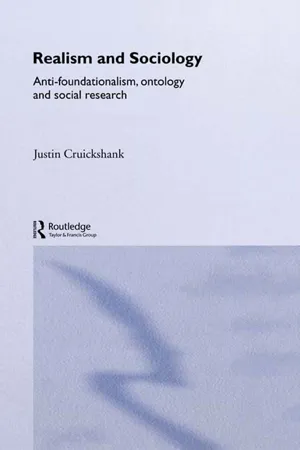
In recent years, methodological debates in the social sciences have increasingly focused on issues relating to epistemology. Realism and Sociology makes an original contribution to the debate, charting a middle ground between postmodernism and positivism.
Critics often hold that realism tries to assume some definitive account of reality. Against this it is argued throughout the book that realism can combine a strong definition of social reality with an anti-foundational approach to knowledge. The position of realist anti-foundationalism that is argued for is developed and defended via the use of immanent critiques. These deal primarily with post-Wittgensteinian positions that seek to define knowledge and social reality in terms of 'rule-following practices' within different 'forms of life' and 'language games'. Specifically, the argument engages with Rorty's neo-pragmatism and the structuration theory of Giddens. The philosophy of Popper is also drawn upon in a critically appreciative way.
While the positions of Rorty and Giddens seek to deflate the claims of 'grand theory', albeit in different ways, they both end up with definitive claims about knowledge and reality that preclude social research. By avoiding the general deflationary approach that relies on reference to 'practices', realism is able to combine a strong social ontology with an anti-foundational epistemology, and thus act as an underlabourer for empirical research.
eBook - ePub
Realism and Sociology
Anti-Foundationalism, Ontology and Social Research
- 184 pages
- English
- ePUB (mobile friendly)
- Available on iOS & Android
eBook - ePub
About this book
Information
1 The philosophical logic of immediacy The epistemic fallacy and the genetic fallacy
Introduction
The philosophical logic of immediacy is a term that refers to positions that hold that truth is knowable with immediacy. The temporal aspect of this is that truth is known ‘immediately’, meaning that the truth can be recognised ‘straight away’: the manifest truth is immediately recognisable as such. The corollary of this is that the truth is known without any conceptual mediation: it is not that the truth is mediated via this or that perspective through which we (may) gain (some) access to a reality beyond perspectives, but that the manifest truth presents itself as such without any mediating — or interpreting — factors. The philosophical logic of immediacy may be thought to underpin foundationalist epistemologies, such as empiricism, especially in the guise of the Vienna Circle’s logical positivism. This is true, but the philosophical logic of immediacy also underpins what we may refer to as truth-relativism. The reason for this is that in making truth wholly relative to perspectives, such relativism reduces truth to perspectives, and the consequence of this is that to know the norms of a community, or to know the concepts that constitute, say, a scientific perspective, or paradigm, is to know the truth. In this case ‘truth’ becomes a synonym for the contents of the perspective.
Both foundationalism and relativism are therefore anthropocentric in the sense that the world is ‘made for us’. In the former case, the world is defined to fit a philosophy that explains how the mind will get knowledge, and in the latter case, the world becomes socially constructed through the norms or concepts that constitute perspectives. With foundationalism we therefore have the epistemic fallacy whereby ontological questions concerning the definition of reality are framed and answered according to epistemological terms of reference; and so ontology is reduced into epistemology. Once ontological questions have been posed in epistemological terms of reference, a possible next step is to alter the epistemological terms of reference, from foundational terms of reference concerning how the mind may know reality, to anti-foundational terms of reference, concerning the use of perspectives to know reality. Such an anti-foundationalism would answer ontological questions using the epistemological argument that knowledge was situated within a perspective.
The result would be that what was real was what we knew to be real, and what we knew to be real would be constituted by the norms or concepts of the perspective in which we were situated. Such a position commits the genetic fallacy because the truth of a concept, or belief, or norm, etc., is derived from its origin within a perspective and not from its relationship to reality. If reality is defined in terms of the contents of a perspective, then it follows that the concepts within the perspective must be self-referential, as there can be no way to refer to a reality external to those terms of reference.
It may be objected that no names (other than that of the Vienna Circle) have been linked to the positions outlined above, which may be referred to as the foundationalist philosophical logic of immediacy, and the relativist philosophical logic of immediacy. This (initial) omission is deliberate because my purpose is to show how positions end up being predicated upon the philosophical logic of immediacy, rather than to list positions under headings. That is to say, my concern is with developing an immanent critique of positions whose terms of reference appear to be tenable, in the sense that they appear to say how our knowledge is neither foundational nor relative. This immanent critique aims to see how the tensions and problems that arise with such terms of reference arise because the said terms of reference lack the philosophical resources to support the claims being made. As a consequence of this lack, the positions criticised end up being predicated upon the logic of immediacy. The logic of immediacy therefore pertains to philosophical systems whereby the underlying logic is one which compels the argument into a foundationalist and/or relativist view of truth, and the epistemic and genetic fallacies, even though the explicit argument, or rhetoric, runs counter to this. So, whilst some positions may be clear examples of the logic of immediacy (as with logical positivism, for instance), my main concern is with developing immanent critiques to show how some philosophical arguments are predicated upon the logic of immediacy due to an absence of conceptual resources, as opposed simply to rejecting positions that clearly argue for immediacy (such as the positivist adherence to foundational immediacy or, arguably, some postmodern arguments which hold that everything is a construct within discourse).
The above points are developed in relation to the philosophies of Popper and Putnam. Rather than focus on Popper’s arguments about deductive methods, I focus on Popper’s general post-Kantian approach to epistemology and argue that whilst this avoids the foundationalism associated with logical positivism, it still ends up committing the epistemic fallacy and, ultimately, the genetic fallacy. So, Popper ‘opens the door’, so to speak, to relativism, with his post-Kantian alternative to positivism. The issue of relativism is then pursued in a discussion of Putnam’s internal realism. Putnam, like Popper, takes Kant as a starting point, but Putnam argues that Kant’s transcendental idealism may lead to questions about ‘reality-in-itself’ that are to be rejected because they lead us back to the questions posed by, according to Putnam, metaphysical realists who, he contends, seek a master-ontology of being (or God’s-eye view). His alternative is to turn to the work of the later Wittgenstein, and to argue that truth about reality is always situated within a perspective that helps us ‘go on’ in the world.
Whereas Popper takes up a post-Kantian view and opens the door to relativism by failing to complement this anti-foundational epistemology with a metaphysical realist ontology, Putnam starts with Kant and then moves on to argue that the later Wittgenstein asked better questions than Kant, viz. practical questions concerning how we go on within a form of life, with meaning being connected to the activities within a form of life, rather than philosophical questions about the condition of possibility of knowledge. The upshot of Putnam’s internal realism is relativism and the genetic fallacy as truth is reduced to the contents of a ‘language game’. One conclusion to draw from this is that Popper asked the better questions, concerning how we may have knowledge without empiricist immediacy, but he failed to develop the right answers, because he remained concerned with epistemology (albeit in an anti-foundational form), and neglected ontology. Another, and directly related, conclusion to draw from this is that anti -foundationalism needs to be complemented by a metaphysical realist ontology, giving us realist antifoundationalism.
Popper and the critique of positivism
Popper responded critically to the logical empiricism, or logical positivism, advocated by the Vienna Circle. According to such positivism, meaningful propositions and science were to be demarcated from meaningless propositions, pseudo-science and empty metaphysical speculation, by the verification principle. A proposition was meaningful if it could be verified by sensedata/empirical observation. So, the proposition that the faster an engine runs, ceteris paribus, the more fuel it will consume, is meaningful, whereas propositions about art being beautiful, or not, God existing, or not, etc., would be meaningless. In searching for causal laws in nature, the verification principle was operationalised via an inductivist methodology. A causal law was said to exist if there was a constant conjunction between two observed events. From observing one event following another, it was assumed that one could derive a relationship of natural necessity. Scientific knowledge was thus based on the certainty that in observing regularities, causal laws, or relations of necessity, were being observed; whilst any proposition which could not be grounded in certainty, by being empirically verifiable, was held to be meaningless.
One problem with trying to ground knowledge on empirical certainty, by arguing that meaningful propositions can be open to verification, is that the verification principle itself cannot be verified. As Trigg argues, ‘[t]he starting-point of logical-positivism cannot itself be justified and indeed by its own lights should be regarded as meaningless’ (1993: 20). As Trigg notes though, Ayer argued that the verification principle should be treated as an axiom rather than a criterion of meaning. However, Trigg continues, this failed to explain why we should retain the failed criterion (1993: 20). If the verification principle failed to do its job, it seems rather arbitrary to redefine its job, so that it can do some limited ‘guiding’ work.
If we move from the verificationist criterion of meaningfulness, to the inductivist search for empirical regularities, we meet another problem. The logical problem with induction is that from a limited set of observations one cannot say that one has observed a relationship of natural necessity, whereby the observed regularity will necessarily obtain in the future. As Popper argues,
it is far from obvious, from a logical point of view, that we are justified in inferring universal statements from singular ones, no matter how numerous; for any conclusion drawn in this way may always turn out to be false: no matter how many instances of white swans we may have observed, this does not justify the conclusion that all swans are white.
(1972a: 27; emphasis in original)
Popper argues that this logical ‘problem of induction’ was first recognised by Hume, but that Hume drew the wrong conclusion (1975: 96). Hume argued that even though induction is logically wrong, we still use it in practice, with habit and repetition being used to locate ‘causal’ relations, or constant conjunctions. We may only locate constant conjunctions which habit and custom pick out, but this is all we can do according to Hume. Popper though rejects this view, on the grounds that as induction is based on a logical fallacy, an alternative methodology is required; as we will see.
In addition to criticising the logical-positivist conception of scientific methodology, Popper also criticised the empiricist philosophy of mind, upon which positivism was premised. For Popper, the very attempt to define knowledge in terms of the mind is a fallacious endeavour.1The problem is that reality ends up being defined in terms of the mind: what exists is defined as what can be known, and what can be known is defined by how the mind knows via sense experience. We have certainty in knowledge because what the mind can know, meaning what exists, is defined to fit the conception of how the mind can know the world. Popper argues that
The empiricist philosopher’s belief ‘that all knowledge is derived from sense experience’ leads with necessity to the view that all knowledge must be knowledge of either our present sense experience (Hume’s ‘ideas of impressions’) or of our past sense experience (Hume’s ‘ideas of reflection’). Thus all knowledge becomes knowledge of what is going on in our minds. On this subjective basis, no objective theory can be built: the world becomes the totality of my ideas, of my dreams.
(1996: 82; emphasis in original)
The problem with the empiricist philosophy of mind therefore is that what is known is what is experienced, and all we can experience are our ideas of sensation, and not a material realm beyond those ideas of sensation. Therefore
we are never ‘justified’ or ‘entitled’ to claim the truth of a theory, or of a belief, by reason of the alleged immediacy or directness of the belief. This, in my view, is putting the cart before the horse: immediacy or directness may be the result of the biological fact that a theory is true and also (partly for this reason) very useful for us. But to argue that immediacy or directness establishes truth, or is a criterion of truth, is the fundamental mistake of idealism.
(1975: 68; emphasis in original)
So, we may think that having burnt our hand on a fire we will avoid such contact again, and the belief that the fire caused the pain will be true. Nonetheless, we cannot infer from this the conclusion that a belief is true because we immediately recognise the truth, through sensation. Sensation refers to ideas of sensation and not to the mind seeing an external reality as it really is.
Against the view that we have an immediate access to a manifest truth via sense-data, Popper argues that our experience of the external world is mediated via concepts and beliefs. Popper argues that
According to my view, observations (or ‘sensations’ or ‘sense-data’, etc.) are [ … ] not the raw material of knowledge. On the contrary, observations always presuppose previous dispositional knowledge. An observation is the result of a stimulus that rings a bell. What does this mean? The stimulus must be significant, relative to our system of expectations or anticipations, in order to ring a bell, and thus to be observed.
(1996: 99; emphasis in original)
If knowledge came from sense-data alone then we would be overwhelmed by a constant barrage of data. This is avoided because the incoming data are interpreted and filtered by a set of interests and concepts which may be either unreflective or explicitly formulated. Access to the world is always via a ‘prejudice’, ‘[y]et we proceed perfectly rationally: we learn, we extend our knowledge, by testing our prejudices; by trial and error rather than by induction through repetition’ (Popper 1996: 100; emphasis in original). All of which brings us to Popper’s distinction between the bucket and the searchlight.
Popper on post-Kantian epistemology, falsifiability and metaphysical realism
Discussing the ‘bucket theory of science’, or the ‘bucket theory of mind’ (1975: 341), Popper states that
The starting point of this theory is the persuasive doctrine that before we can know or say anything about the world, we must first have had perceptions — sense experiences. It is supposed to follow from this doctrine that our knowledge, our experiences, consists either of accumulated perceptions (naive empiricism) or else of assimilated, sorted, and classified perceptions (a view held by Bacon and, in a more radical form, by Kant). [ … ] According to this view, then, our mind resembles a container — a kind of bucket — in which perceptions and knowledge accumulate.
(1975: 341)
Against this bucket theory of the mind, Popper thus argues that scientists have to construct theoretical searchlights which, if well constructed, will at best only illuminate a small proportion of reality, until a better searchlight is constructed. Popper argues that
In science it is observation rather than perception which plays the decisive part. But observation is a process in which we play an intensely active part. An observation is a perception, but one which is planned and prepared. We do not ‘have’ an observation [ … ] but we ‘make’ an observation [ … ]. An observation is always preceded by a particular interest, a question, or a problem — in short, by something theoretical.
(1975: 342)
What we know of the world is therefore dependent upon the searchlight that scientists construct, and so the ‘facts’ accumulated by science will be relative to this or that searchlight, as opposed to being akin to unchanging pebbles placed into a previously empty bucket (as tabula rasa mind).
The general epistemological position here is that of post-Kantianism. In Popper’s words, ‘Kant argued that knowledge is not a collection of gifts received by the senses and stored in the mind as if it were a museum, but that it is very largely the result of our own mental activity’ (1962: 214). For Kant, knowledge was a matter of actively imposing our ‘categories’ upon the noumenal realm, with knowledge of reality being ‘filtered’ through the categories. Instead of the rationalist emphasis on ...
Table of contents
- Cover
- Half Title
- Routledge Studies in Critical Realism
- Full Title
- Copyright
- Contents
- List of figures
- Acknowledgements
- Introduction
- 1 The philosophical logic of immediacy: the epistemic fallacy and the genetic fallacy
- 2 The influence of empiricism on social ontology: methodological individualism and methodological collectivism
- 3 Post-Wittgensteinian pragmatism: Rorty, anti-representationalism and politics
- 4 Post-Wittgensteinian sociology: Giddens' ontology of practices
- 5 Social realism: overcoming the sociological logic of immediacy
- 6 Social realism and the study of chronic unemployment
- Notes
- Bibliography
- Index
Trusted by 375,005 students
Access to over 1.5 million titles for a fair monthly price.
Study more efficiently using our study tools.
Frequently asked questions
Yes, you can cancel anytime from the Subscription tab in your account settings on the Perlego website. Your subscription will stay active until the end of your current billing period. Learn how to cancel your subscription
No, books cannot be downloaded as external files, such as PDFs, for use outside of Perlego. However, you can download books within the Perlego app for offline reading on mobile or tablet. Learn how to download books offline
Perlego offers two plans: Essential and Complete
- Essential is ideal for learners and professionals who enjoy exploring a wide range of subjects. Access the Essential Library with 800,000+ trusted titles and best-sellers across business, personal growth, and the humanities. Includes unlimited reading time and Standard Read Aloud voice.
- Complete: Perfect for advanced learners and researchers needing full, unrestricted access. Unlock 1.5M+ books across hundreds of subjects, including academic and specialized titles. The Complete Plan also includes advanced features like Premium Read Aloud and Research Assistant.
We are an online textbook subscription service, where you can get access to an entire online library for less than the price of a single book per month. With over 1.5 million books across 990+ topics, we’ve got you covered! Learn about our mission
Look out for the read-aloud symbol on your next book to see if you can listen to it. The read-aloud tool reads text aloud for you, highlighting the text as it is being read. You can pause it, speed it up and slow it down. Learn more about Read Aloud
Yes! You can use the Perlego app on both iOS and Android devices to read anytime, anywhere — even offline. Perfect for commutes or when you’re on the go.
Please note we cannot support devices running on iOS 13 and Android 7 or earlier. Learn more about using the app
Please note we cannot support devices running on iOS 13 and Android 7 or earlier. Learn more about using the app
Yes, you can access Realism and Sociology by Justin Cruickshank in PDF and/or ePUB format, as well as other popular books in Social Sciences & Epistemology in Philosophy. We have over 1.5 million books available in our catalogue for you to explore.