Categorical and Nonparametric Data Analysis
eBook - ePub
Available until 25 Jan |Learn more

Categorical and Nonparametric Data Analysis

Choosing the Best Statistical Technique

  1. 506 pages
  2. English
  3. ePUB (mobile friendly)
  4. Available on iOS & Android
eBook - ePub
Available until 25 Jan |Learn more

Categorical and Nonparametric Data Analysis

Choosing the Best Statistical Technique

About this book

Featuring in-depth coverage of categorical and nonparametric statistics, this book provides a conceptual framework for choosing the most appropriate type of test in various research scenarios. Class tested at the University of Nevada, the book's clear explanations of the underlying assumptions, computer simulations, and Exploring the Concept boxes help reduce reader anxiety. Problems inspired by actual studies provide meaningful illustrations of the techniques. The underlying assumptions of each test and the factors that impact validity and statistical power are reviewed so readers can explain their assumptions and how tests work in future publications. Numerous examples from psychology, education, and other social sciences demonstrate varied applications of the material. Basic statistics and probability are reviewed for those who need a refresher. Mathematical derivations are placed in optional appendices for those interested in this detailed coverage.

Highlights include the following:

  • Unique coverage of categorical and nonparametric statistics better prepares readers to select the best technique for their particular research project; however, some chapters can be omitted entirely if preferred.
  • Step-by-step examples of each test help readers see how the material is applied in a variety of disciplines.
  • Although the book can be used with any program, examples of how to use the tests in SPSS and Excel foster conceptual understanding.
  • Exploring the Concept boxes integrated throughout prompt students to review key material and draw links between the concepts to deepen understanding.
  • Problems in each chapter help readers test their understanding of the material.
  • Emphasis on selecting tests that maximize power helps readers avoid "marginally" significant results.
  • Website (www.routledge.com/9781138787827) features datasets for the book's examples and problems, and for the instructor, PowerPoint slides, sample syllabi, answers to the even-numbered problems, and Excel data sets for lecture purposes.

Intended for individual or combined graduate or advanced undergraduate courses in categorical and nonparametric data analysis, cross-classified data analysis, advanced statistics and/or quantitative techniques taught in psychology, education, human development, sociology, political science, and other social and life sciences, the book also appeals to researchers in these disciplines. The nonparametric chapters can be deleted if preferred. Prerequisites include knowledge of t tests and ANOVA.

Frequently asked questions

Yes, you can cancel anytime from the Subscription tab in your account settings on the Perlego website. Your subscription will stay active until the end of your current billing period. Learn how to cancel your subscription.
At the moment all of our mobile-responsive ePub books are available to download via the app. Most of our PDFs are also available to download and we're working on making the final remaining ones downloadable now. Learn more here.
Perlego offers two plans: Essential and Complete
  • Essential is ideal for learners and professionals who enjoy exploring a wide range of subjects. Access the Essential Library with 800,000+ trusted titles and best-sellers across business, personal growth, and the humanities. Includes unlimited reading time and Standard Read Aloud voice.
  • Complete: Perfect for advanced learners and researchers needing full, unrestricted access. Unlock 1.4M+ books across hundreds of subjects, including academic and specialized titles. The Complete Plan also includes advanced features like Premium Read Aloud and Research Assistant.
Both plans are available with monthly, semester, or annual billing cycles.
We are an online textbook subscription service, where you can get access to an entire online library for less than the price of a single book per month. With over 1 million books across 1000+ topics, we’ve got you covered! Learn more here.
Look out for the read-aloud symbol on your next book to see if you can listen to it. The read-aloud tool reads text aloud for you, highlighting the text as it is being read. You can pause it, speed it up and slow it down. Learn more here.
Yes! You can use the Perlego app on both iOS or Android devices to read anytime, anywhere — even offline. Perfect for commutes or when you’re on the go.
Please note we cannot support devices running on iOS 13 and Android 7 or earlier. Learn more about using the app.
Yes, you can access Categorical and Nonparametric Data Analysis by E. Michael Nussbaum in PDF and/or ePUB format, as well as other popular books in Psychology & Probability & Statistics. We have over one million books available in our catalogue for you to explore.

Information

Publisher
Routledge
Year
2014
eBook ISBN
9781136335631
Edition
1

Chapter 1
Levels of Measurement, Probability, and the Binomial Formula

Categorical and nonparametric data analysis is designed for use with nominal or ordinal data, or for metric data in some situations. This chapter therefore reviews these different levels of measurement before turning to the topic of probability.

Levels of Measurement

In statistics, there are four basic types of variables: (a) nominal, (b) ordinal, (c) interval, and (d) ratio.
A nominal variable relates to the presence or absence of some characteristic. For example, an individual will be either male or female. Gender is a dichotomous nominal variable. In contrast, with a multinomial nominal variable, cases are classified in one of several categories. For example, ethnicity is multinomial: Individuals can be classified as Caucasian, African American, Asian/Pacific Islander, Latino, or Other. There is not any particular ordering to these categories.
With an ordinal variable, there is an ordering. For example, an art teacher might look at student drawings and rank them from the most to the least creative. These rankings comprise an ordinal variable. Ordinal variables sometimes take the form of ordered categories, for example, highly creative, somewhat creative, and uncreative. A number of individuals may fall into these categories, so that all the drawings classified as highly creative would technically be tied with one another (the same for the moderately creative and uncreative categories). With ranks, on the other hand, there are typically few if any ties.
With an interval or ratio variable, a characteristic is measured on a scale with equal intervals. A good example is height. The scale is provided by a ruler, which may be marked off in inches. Each inch on the ruler represents the same distance; as a result, the difference between 8 and 10 inches is the same as between 1 and 3 inches. This is not the case with an ordinal variable. If Drawing A is ranked as more creative than Drawing B, we do not know if Drawing A is just slightly more creative or significantly more creative; in fact, the distances are technically undefined. As a result, we need to use different statistics and mathematical manipulations for ordinal variables than we do for interval/ratio variables. (Much of this book will be devoted to this topic.)
As for the difference between an interval variable and a ratio variable, the defining difference is that in a ratio variable a score of zero indicates the complete absence of something. Height is a ratio variable because zero height indicates that an object has no height and is completely flat (existing in only two dimensions). Counts of objects are also ratio variables. The number of people in a classroom can range from zero on up, but there cannot be a negative number of people. With an interval variable, on the other hand, there can be negative values. Temperature is a good example of something measured by an interval scale, since 0° Celsius is just the freezing point of water, and negative temperatures are possible. However, for the tests discussed in this book, it will usually not be necessary to differentiate between ratio and interval variables, so we will lump them together into one level of measurement. The distinction will only become important when we consider the analysis of count data with Poisson regression. For ease of exposition, in this book I will use the term metric variable to refer to those at the interval or ratio levels of measurement.
Metric variables are often also referred to as continuous, but this usage fails to recognize that some metric variables are discrete. For example, a count cannot have fractional values; for example, it would be incorrect to say that there are 30.5 people enrolled in a class.
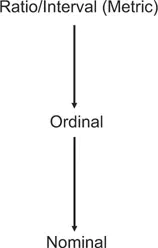
Figure 1.1 shows the three levels of measurement. The metric level is shown on top because it is the most informative. Metric data can always be reduced to ordinal data by using the numerical values to rank the data (e.g., ranking people from the tallest to the shortest based on their heights). Likewise, ordinal data can be reduced to nominal data by performing a median split and classifying cases as above or below the median. Transforming data from a higher level to a lower level is known as data reduction. Data reduction throws away information; for example, knowing that Marie is taller than Jennifer does not tell one how much taller Marie is. Nevertheless, data reduction is sometimes performed if the assumptions of a statistical test designed for metric data are not met. One might then reduce the data to ordinal and perform a statistical test that is designed for ordinal data. One can also reduce ordinal (or metric) data to nominal. One cannot move from a lower level to a higher level in the figure because that requires information that is missing.
Categorical and nonparametric statistics is concerned with statistical methods designed for ordinal- and nominal-level data. However, these methods are often used with metric data when sample sizes are small (and therefore some of the assumptions of t tests, ANOVA, and linear regression are not met) or when the data are skewed or otherwise highly abnormal. In the latter cases, standard methods may not be as statistically powerful as categorical and nonparametric ones. In reading this book, it is very important to remember the definition of statistical power:
Statistical power refers to the ability to reject the null hypothesis and find a “result.” (To be more technically precise, it is the probability that one will reject the null hypothesis when the alternative hypothesis is true.)
Figure 1.1 Three levels of measurement. The figure shows that metric data can be reduced to ordinal data, which can in turn be reduced to nominal data. Metric data are the most informative because they carry information on how different the cases are on a variable in quantitative terms. Nominal data are the least informative because they contain no information regarding order or ranks.
Because conducting a study requires a large amount of work, one usually wants to use the most powerful statistical methods. (Obtaining a p value of .06 or .07 is not sufficient to reject the null hypothesis and therefore can be very disappointing to researchers.) That is why, in planning a study, one wants to use the most valid and statistically powerful methods one can.

Probability

All statistical methods—including categorical/nonparametric ones—require an understanding of probability. In the remainder of this chapter, I review the basic axioms of probability and use them to derive the binomial formula, which is the foundation of many of the tests discussed in this book.
In this section, I use a canonical example of tossing coins up in the air and asking questions about the probability of a certain number of them coming up heads. Note that whether a coin comes up heads or tails is a nominal outcome (it either happens or it doesn’t)—which is why understanding probability is essential to categorical data analysis.

The Meaning of Probabil...

Table of contents

  1. Cover
  2. Title
  3. Copyright
  4. Dedication
  5. BRIEF CONTENTS
  6. CONTENTS
  7. Preface
  8. About the Author
  9. CHAPTER 1 Levels of Measurement, Probability, and the Binomial Formula
  10. CHAPTER 2 Estimation and Hypothesis Testing
  11. CHAPTER 3 Random Variables and Probability Distributions
  12. CHAPTER 4 Contingency Tables: The Chi-Square Test and Associated Effect Sizes
  13. CHAPTER 5 Contingency Tables: Special Situations
  14. CHAPTER 6 Basic Nonparametric Tests for Ordinal Data
  15. CHAPTER 7 Nonparametric Tests for Multiple or Related Samples
  16. CHAPTER 8 Advanced Rank Tests (for Interactions and Robust ANOVA)
  17. CHAPTER 9 Linear Regression and Generalized Linear Models
  18. CHAPTER 10 Binary Logistic Regression
  19. CHAPTER 11 Multinomial Logistic, Ordinal, and Poisson Regression
  20. CHAPTER 12 Log-Linear Analysis
  21. CHAPTER 13 General Estimating Equations
  22. CHAPTER 14 Estimation Procedures
  23. CHAPTER 15 Choosing the Best Statistical Technique
  24. Answers to Odd-Numbered Problems
  25. Index