At her accession in 1558 Elizabeth I inherited a troublesome legacy with a long history of wars against France and Scotland. This international situation was becoming a huge financial burden on the English crown and economy.
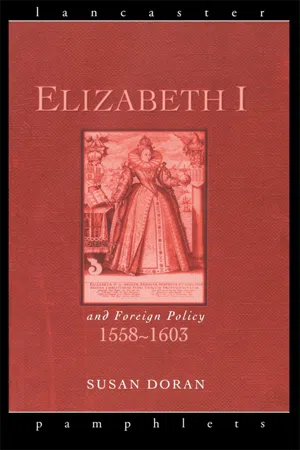
Elizabeth I and Foreign Policy describes and assesses England's foreign policy during the second half of the sixteenth century. It includes coverage of Elizabeth's relations with foreign powers, the effect of Reformation on foreign affairs, Elizabeth's successs as a stateswoman and the war with Spain.
- 96 pages
- English
- ePUB (mobile friendly)
- Available on iOS & Android
eBook - ePub
Elizabeth I and Foreign Policy, 1558-1603
About this book
1
BACKGROUND
English Foreign Policy before 1558
For most of the late medieval and early Tudor period, English foreign policy rested upon twin pillars: hostility towards the kings of France and friendship with the rulers of Burgundy⋆. Conflict with the former arose from competing dynastic⋆ claims to lands and titles in France as well as rivalry over influence in Scotland. Amity with the duke of Burgundy, who ruled the Netherlands, was based on mutual economic interests and a shared hostility towards France.
Anglo-French conflict originated in the Norman period, when the English dukes of Normandy vied for power with their neighbour and overlord, the king of France. It entered a new phase, however, when Edward III laid claim to the French throne in 1337, and at the same time attempted to win back the ancestral lands of Normandy, Anjou, Poitou and Gascony which had been lost during the previous century. Thanks largely to the skill of the English longbowmen, Edward III enjoyed notable victories at Crécy (1346) and Poitiers (1356), and the French king was forced to recognise his title to the duchy of Aquitaine. Henry V, who resumed the war soon after his accession in 1413, won the still more famous battle of Agincourt in 1415, conquered much of Normandy, and was recognised as the heir of the French dauphin. During his son’s reign (Henry VI 1422–61, 1470–1), however, English successes were reversed. Civil strife within England coincided with the political recovery of the French monarch, and undermined the English military effort. Furthermore, the French started to use artillery, which gave them the advantage in battle. As a result, England lost Normandy in 1450 and Gascony in 1453; all that remained of its French empire was the pale of Calais.
Brought up on heroic tales of chivalry, Henry VIII’s dream was to emulate Henry V by winning honour in battle, regaining the lost lands in France and making good his claim to the French crown. But, after some initial successes, Henry found that he lacked the financial resources to keep his army in the field during the early 1520s. The result was that he was unable to benefit from the overwhelming victory of his ally, the Holy Roman Emperor Charles V, against Francis I of France at the battle of Pavia (1525). It was only after his revenues had been boosted by the spoils of ecclesiastical property that Henry could again attempt to win glory and territory in France, but this time he contented himself with the capture of some towns in Picardy near Calais. In 1544 his army captured Boulogne, but two years later he agreed to the Treaty of the Campe which made provision for the French king to purchase the town after eight years. The cost of the war against France and the garrisoning of Boulogne had proved too high to continue indefinitely, and Henry was forced to accept that military adventures on the continent were out of the question for the time being.
During the early years of the next reign, it became even more apparent that war against France, whether on the Continent or in Scotland, was beyond the means of the English king. For this reason, the Edwardian privy council signed a peace-treaty with Henry II of France in 1550, which handed over Boulogne some years early. Similarly, Mary I (1553-58) wanted peace with France, despite her marriage to Charles V’s son, Philip of Spain. Had Henry II not acted in an aggressive way towards England, she might well have avoided being drawn into her husband’s war against the French. As it was, English troops joined with Philip II’s army to win a victory at the battle of St Quentin. Soon afterwards, however, the French invaded the English pale and captured Calais in January 1558; it was the most humiliating defeat for England in the Tudor period (Doran 1999).
In addition to disputes over titles and lands in France, the French and English monarchs competed for influence in Scotland. The problem here was also long standing. Since the reign of Edward I, English kings had claimed lordship over their Scottish counterpart and asserted that he owed them homage. In response to these theoretical claims and to Edward I’s invasions, the Scots turned to France for protection and in 1295 signed an alliance with Philip IV. Thereafter, the alliance (to be known as the ‘Auld Alliance’) was renewed whenever the Scots felt threatened by the English monarch or their king wanted to assert independence of action. During Henry VIII’s reign, the ‘Auld Alliance’ was responsible for the outbreak of a war in 1513 and again in 1542. On the former occasion, James IV of Scotland invaded northern England to assist his ally Louis XII after Henry had set out with his troops to fight against France. James’ defeat and death at the battle of Flodden (1513) temporarily ended the danger from Scotland. In the mid 1530s, however, his son (James V), who had by then reached adulthood, began rebuilding the French connection. Unable to rely on James V’s loyalty, Henry decided to bolt his back door before embarking on his new project of war in France. Thus, in 1542 he ordered his army to attack the Scots, who suffered a major defeat at the battle of Solway Moss. With the death of James three weeks later, Henry saw an opportunity for controlling Scotland by arranging a dynastic marriage between his own son Prince Edward and James’ baby daughter Mary Queen of Scots. Perceiving a threat to their national independence, the Scots resisted. The subsequent ‘Rough Wooing’ of Queen Mary resulted in six years of Anglo-Scottish warfare (1544-50).
On Henry VIII’s death in January 1546, Lord Protector Somerset made the Scottish War the priority of his government’s policy, and an army entered Scotland to crush opposition to the marriage. The aim was to establish a union of the two realms and to extend the Protestant Reformation into Scotland. But, despite an initial victory in pitched battle at Pinkie (1547), the policy was a dismal failure. Somerset’s strategy of establishing garrisons in the Lowlands, which were designed to control the surrounding areas, alienated the Scots, even those who were his political allies, and proved horrendously expensive to maintain. Henry II of France, moreover, could not afford to allow his ally to be swallowed up by his enemy, and consequently sent some 10,000 men to Scotland. Mary was carried off to France, while the French troops joined in the Scottish attacks on the English garrisons. As a result of this intervention, England was forced to evacuate Scotland. By the end of Edward VI’s reign, therefore, the northern kingdom was little more than a French satellite. Its monarch was residing in France and betrothed to the dauphin; and after 1554 its regent was the French-born Mary of Guise, the widow of James V, who ruled with the help of French bureaucrats.
It was chiefly the need for allies against France that caused English monarchs to develop a close relationship with the dukes of Burgundy. In the early fifteenth century (especially the years 1419-35) the dukes acted as active allies against the kings of France, who were their feudal overlord and political rival. At the end of the century, the dukes had become Habsburg princes: first Philip (1482-1506), the son of Emperor Maximilian I, and then Charles (1506-56), who became king of Spain in 1516 and was elected Emperor Charles V in 1519. The Habsburgs were rivals of the French king in other areas of Europe, particularly Italy and Navarre, and were at war against the kings of France at regular intervals from 1512 until 1559. Henry VIII, consequently, had little difficulty in negotiating a Habsburg alliance against Louis XII in 1512 or against Francis I in 1521 and 1543. The Habsburgs, however, were unreliable partners, who frequently failed to give Henry much-needed military backing and signed separate (if temporary) treaties of peace with France whenever it suited them. The ‘ancient amity’ with the Burgundian rulers, therefore, was not without its strains.
A new dimension to Anglo-Habsburg tensions arose, however, when Henry discarded his wife, Catherine of Aragon, the aunt of Charles V, and broke with the papacy. On several occasions in the late 1530s, Charles threatened a crusade against England, leading Henry VIII to consider forming an alliance with the Lutheran princes⋆ of Germany, who had also broken with the pope and established Protestant churches in their own territories. In addition, until her accession as queen, Charles posed as the protector of Catherine’s daughter Mary, who increasingly came under pressure to change her religious allegiance and practices. Although the emperor actually did very little to aid Mary, she looked to him for guidance, and soon after her accession she married his son, Philip, against the wishes of many in her court and council. This Habsburg marriage alliance eventually brought England into war against France (April 1557), a war which became increasingly unpopular after the capture of Calais in January 1558, especially as the economic burdens in England were growing unacceptably heavy.
In the early Tudor period, shared economic interests helped the maintenance of close ties between the rulers of England and Burgundy, and proved instrumental in preventing political difficulties between them from escalating into open warfare. In the fifteenth century, Antwerp in the Netherlands had become the destination for English woollen cloth exports and the centre of financial services used by merchants and monarch alike.
This traffic was immensely profitable both for the Merchant Adventurers⋆ and for English monarchs, who raked in the dues from customs. England’s merchants, moreover, enjoyed substantial commercial privileges in the Netherlands by dint of the commercial treaty known as the Magnus Intercursus (1496). The advantages were not just one-way however; the Netherlands also gained from this commercial relationship. The import of unfinished English cloth stimulated textile manufacturing in the finishing processes and attracted international traders to Antwerp. As a result Antwerp became a boom city, doubling its population in the first half of the sixteenth century (Ramsey 1975). Any disturbance to its trade with England could destabilise its economy and create political difficulties for its ruler.
To sum up, Elizabeth I inherited a strong commercial relationship with the Netherlands, a tradition of friendship with its rulers and a long history of wars against France and Scotland. In recent years, however, this warfare had failed to bring any political advantages to England. The English army had defeated the French and Scots in battle, but the victories had not been followed up by political successes. Henry VIII had won Boulogne, but it had brought him no nearer to the French crown and had proved an expensive outpost which could not be retained. Mary’s troops had helped Philip win a useful victory, but her garrisons in the Calais pale had been unable to ward off a French assault. England had won three pitched battles in Scotland between 1513 and 1547, but its political leaders could not bring an end to the ‘Auld Alliance’ nor secure control over its northern neighbour by force, persuasion or dynastic union. Foreign policy in the first part of the sixteenth century had therefore been for the most part assertive, even aggressive, but generally ineffectual. The wars, furthermore, had proved so difficult to finance that they had drained the crown’s resources and imposed an onerous burden on the economy.
Between 1538 and 1552, the English crown spent about £3.5 million on wars against France and Scotland, a sum raised by loans, the debasement of the currency, and the sale of crown lands. In 1558 Elizabeth inherited a debt of £300,000, which was only paid off in 1578. At Elizabeth’s accession in November 1558, therefore, many members of the political elite were disillusioned by continental warfare and demoralised by the military and political defeats against France and Scotland.
2
NEW PROBLEMS 1558–68
Elizabeth I came to power just when the military, political and religious maps of Europe were beginning to change. During the first half of the century, France and the Habsburg Empire were the two major military powers in Europe, with England a respected second-runner. Thus, Francis I and Henry II of France proved capable of putting large armies into the field to challenge the might of Charles V, while Henry VIII was a much sought-after ally. During the second half of the sixteenth century, however, Spain came to be the pre-eminent power in Europe. In 1567, its army stationed in the Netherlands comprised 10,000 men; soon afterwards it was augmented to 50,000; and at its peak of strength in 1574 the governor-general in the Netherlands formed an army of some 86,000 men. Philip II’s naval force was also impressive: Spanish galleons contributed to the Holy League’s victory over the Turks at Lepanto (1571); and the armadas against England were formidable both in the number and size of their ships. The French monarchs, on the other hand, were militarily and financially weakened by a series of civil wars, which ran from 1563 to 1598. France consequently could provide no effective counterbalance to Spain. Indeed, in the early Elizabethan period, only the Turks provided a military challenge to the Spanish Empire, and distracted Philip II from asserting his power in northern Europe. After 1577, however, the Turks signed a series of truces with Spain, thereby freeing the king to pursue expansionist policies.
As far as England’s military power was concerned, Elizabeth could barely compete with the French kings, never mind Philip II. Since England’s population was significantly lower than that of both France and Spain, fewer men were eligible for conscription. Warfare, moreover, was becoming more expensive and Elizabeth could not afford to put large numbers of troops in the field even for relatively short campaigns; a standing army was simply out of the question. The English army was way behind its European rivals in technology and training. It lacked sufficient artillery to take Leith from the French in 1560, and in 1588 was still making use of the longbow, which was by then an outmoded form of armament on the Continent. Regular training of troops only began in England after 1572, whereas it was usual in mid-century Europe. A new logistical difficulty was introduced with the loss of Calais; without a bridgehead on the Continent, military adventures abroad were impossible unless allies provided an operational base. In these circumstances, Elizabeth had to think very carefully before raising an army to fight in overseas campaigns. The most striking political development in Europe evident at Elizabeth’s accession was the dismantling of Charles V’s vast empire. In 1555 Charles V had been forced to concede a degree of religious toleration to the Lutheran princes⋆ in Germany. Disillusioned and exhausted by his failure to preserve the unity of Christendom, Charles abdicated and divided his inheritance. He handed over Habsburg territories in Italy, the Americas, the Netherlands, Franche-Comté and Spain to his son Philip, and bequeathed his Austrian lands and imperial title to his brother Ferdinand. As a result of this partition, the Netherlands were no longer the geographical centre of Charles V’s monarchia, but instead an offshoot of the Spanish empire. The departure of Philip II in August 1559 from the Netherlands to Spain symbolised its change in status; but it also had practical repercussions that created problems in Anglo–Spanish relations.
Philip never again visited the Netherlands and thus had no opportunity for arranging personal meetings with Elizabeth, which might have been useful for dissolving suspicions and smoothing over difficulties between the two rulers. In the absence of such interviews, both monarchs became entirely dependent on the skill and goodwill of their resident ambassadors for building up trust and resolving disputes between them. Unfortunately their representatives were rarely up to the job. As far as Elizabeth’s resident ambassadors to Spain were concerned, Sir Thomas Chalonner proved a competent diplomat in his embassy of 1561 to 1565, but his successor John Man (1566–68) lacked the necessary tact to carry out his mission successfully and was expelled in the spring of 1568. He had particularly offended Philip by referring to the pope disparagingly and openly praising the Huguenot⋆ rebels. His demands for personal freedom of worship also went down badly at the Spanish court. Since he was never replaced, there was no one to represent Elizabeth’s interests or present the English point of view at Madrid. Nor was Elizabeth well informed about Spanish policy. As for Philip II’s ambassadors to England, only Guzman de Silva (1564–68) proved sympathetic and adept at developing good relations with the queen and her leading ministers. The remainder ended their period of office in disgrace because of their involvement in Catholic intrigues. Perhaps the most disastrous was Guerau de Spes (1568– 72), though Bernardino de Mendoza (1578–84) ran him a close second. These two did considerable damage to Anglo-Spanish relations: they fostered the belief in England that Philip II and his agents were plotting to overthrow Elizabeth, and helped to convince Philip that Elizabeth was at the centre of an international Protestant conspiracy to incite rebellion in the Netherlands and France. De Spes’ incompetence was largely responsible for the rupture in Anglo– Spanish relations in January 1569 (Ramsey 1984).
An even more important change in international politics concerned religion. During the first half of the sixteenth century, international relations were essentially dynastic⋆ in character, notwithstanding Martin Luther’s break with Rome in 1521 which came to divide Lutherans from Catholics. Until 1559 the rivalry between the Habsburgs and the kings of France eclipsed confessional conflicts. Indeed the Habsburg–Valois Wars so dominated international affairs that the Catholic Charles V tried to form an alliance with Henry VIII, after his own break with the papacy, rather than unite with Francis I in a crusade against him. Similarly, despite their own religious orthodoxy, both Francis I and Henry II of France gave aid to the Lutheran princes of Germany against Charles V. At the same time, English rulers felt little solidarity with European Protestants. Henry VIII refused to sign up to the 1530 Augsburg Confession of Faith of the German Lutherans and join the Schmalkadic League of Lutheran towns and princes. Edward VI’s ministers also remained aloof from the League and stayed neutral when the Lutheran princes took up arms against the emperor in 1547 and 1551. All this changed, however, during Elizabeth’s reign. In the 1560s there seemed to be a hardening of the confessional divide in Europe.
After 1555, the confessional conflict between the German Lutheran princes and the emperor subsided. In that year, the peace of Augsburg was signed, which gave the German Lutheran princes the right to follow their own ...
Table of contents
- Cover Page
- Title Page
- Copyright Page
- GLOSSARY
- 1 BACKGROUND
- 2 NEW PROBLEMS 1558–68
- 3 TRADITIONAL DIRECTIONS IN FOREIGN POLICY 1558–68
- 4 CRISIS MANAGEMENT 1568–85
- 5 THE CONTEMPORARY DEBATE OVER POLICY 1558–85
- 6 WAR 1585–1603
- 7 CONCLUSIONS
- SELECT BIBLIOGRAPHY
Trusted by 375,005 students
Access to over 1.5 million titles for a fair monthly price.
Study more efficiently using our study tools.
Frequently asked questions
Yes, you can cancel anytime from the Subscription tab in your account settings on the Perlego website. Your subscription will stay active until the end of your current billing period. Learn how to cancel your subscription
No, books cannot be downloaded as external files, such as PDFs, for use outside of Perlego. However, you can download books within the Perlego app for offline reading on mobile or tablet. Learn how to download books offline
Perlego offers two plans: Essential and Complete
- Essential is ideal for learners and professionals who enjoy exploring a wide range of subjects. Access the Essential Library with 800,000+ trusted titles and best-sellers across business, personal growth, and the humanities. Includes unlimited reading time and Standard Read Aloud voice.
- Complete: Perfect for advanced learners and researchers needing full, unrestricted access. Unlock 1.5M+ books across hundreds of subjects, including academic and specialized titles. The Complete Plan also includes advanced features like Premium Read Aloud and Research Assistant.
We are an online textbook subscription service, where you can get access to an entire online library for less than the price of a single book per month. With over 1.5 million books across 990+ topics, we’ve got you covered! Learn about our mission
Look out for the read-aloud symbol on your next book to see if you can listen to it. The read-aloud tool reads text aloud for you, highlighting the text as it is being read. You can pause it, speed it up and slow it down. Learn more about Read Aloud
Yes! You can use the Perlego app on both iOS and Android devices to read anytime, anywhere — even offline. Perfect for commutes or when you’re on the go.
Please note we cannot support devices running on iOS 13 and Android 7 or earlier. Learn more about using the app
Please note we cannot support devices running on iOS 13 and Android 7 or earlier. Learn more about using the app
Yes, you can access Elizabeth I and Foreign Policy, 1558-1603 by Susan Doran in PDF and/or ePUB format, as well as other popular books in History & British History. We have over 1.5 million books available in our catalogue for you to explore.