The development of communication studies has been a lively process of adoption and integration of theoretical constructs from Pragmatism, Critical Theory and Cultural Studies. Critical Communication Studies describes the intellectual and professional forces that have shaped research interests and formed alliances in the pursuit of particular goals.
Hanno Hardt reflects on the need to come to terms with the role of history in academic work and locates the intellectual history within the context of competing social theories. The book provides a substantive foundation for understanding the field and will be a major text in all courses dealing with communication history and theory.
eBook - ePub
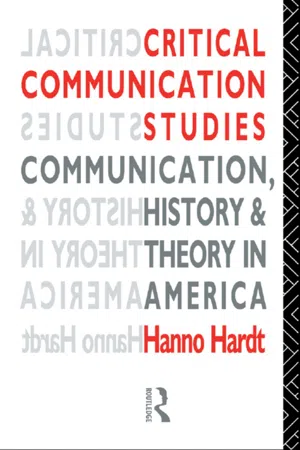
Critical Communication Studies
Essays on Communication, History and Theory in America
- 300 pages
- English
- ePUB (mobile friendly)
- Available on iOS & Android
eBook - ePub
About this book
Information
Chapter 1
On defining the issues
Communication, history and theory
A history of the past is worthless except as a documented way of talking about the future.Kenneth Burke
The literature of communication research in the United States is rich in accumulated insights into the workings of communication and the role and function of the media. It also reflects the dominance of a strong and persistent social science tradition that has survived various theoretical challenges during the last sixty years.
Recently a number of historical accounts have appeared to help document the development of the field and, in some cases, to celebrate the accomplishments of a generation of communication researchers. Such a need to trace the course of communication research throughout its rise to independence and credibility within a behavioral science tradition may be the inevitable sign of age, the expression of a moment of certainty when truths arise from expert self-reflection to produce a retrospective vision of social-scientific discoveries that have helped define the meanings of communication in modern society. This desire for a sense of history caters to the need for recognition, but it also reifies and reproduces the reality of communication research and challenges the imagination.
An interest in historical explanations of the field, however, may also serve to reinforce dominant expressions of theory and reassure research practices at a time of change, when self-doubt, mixed with the challenge of competing theories, threatens the foundations of dominant articulations of communication research and their traditional domain.
In either case, reflections on the contribution of communication research to society, or realizations of intellectual challenges and the prospects that the measured calm of a paradigm dialogue may erupt into a paradigm struggle, constitute attempts to define the status of the field. They are also evidence that communication research benefits from the general search for social and political explanations of society and continues to be part of an interdisciplinary theoretical debate.
The efforts of communication research throughout this century were rarely accompanied by self-reflection or directed by a selfconscious analysis of its own history, except for periodic reviews of the position of the field when the number of research perspectives, making claims on the centrality of communication in their pursuit of knowledge, increased the need for recognizing past accomplishments of the field; or more recently, when direct attacks on the authority of a traditional social science approach and its underlying philosophical premises persisted within the communication research establishment. Thus, a major effort to “rethink communication” from within the field was launched in the 1980s, beginning with a special issue of the Journal of Communication that dealt with the “ferment in the field” (1983), to the recent publication of position statements and research perspectives (Brenda Dervin et al., 1989).
Dervin and her fellow editors noted the pluralistic challenges to traditional notions of the field, acknowledging widespread dissatisfaction with the state of communication inquiry; it is particularly interesting, however, that they wondered about technical-administrative aspects of organizing the field in the face of diverse ideological and intellectual expressions about communication by raising questions about constituting “a scholarly community,” constructing “a coherent educational curriculum,” establishing “disciplinary standards of evaluation,” or developing “a coherent understanding of the knowledge of the field and our own place within it” (1989: II, 27). Their overtly administrative concerns seem to confirm the idea that the problem of theorizing about communication has always coexisted with attempts by academic units or professional organizations to harness theoretical and practical concerns.
Since the editors present their eclectic selections as reflections of communication studies (1989: I, 17), they invite some conclusions about the type and range of conceptions occupying the field. Indeed, the neglect of areas like political economy or feminist studies, in particular the emphasis on “cultural” studies, and the reliance on external expertise for the definition of its status within the social sciences, especially in the case of Rosengren, Giddens and Hall, help solidify an evolving definition of communication and offer, at least implicitly, descriptions of its exact intellectual boundaries.
More importantly, these deliberations reflect the dilemma of a field whose search for a theoretical grounding proceeds without an adequate understanding of its own intellectual history as a significant source of knowledge about its position among and within various disciplines. They had been initiated by a perceived need for critical insights into the relationship between communication studies and social theory and remain part of an ongoing process of legitimizing communication research and its relevance to contemporary analyses of culture. Although Anthony Giddens’s conclusion about the centrality of communication studies “to what social theory is about and to what social science is about” (1989: I, 65) must have been viewed by communication research interests as a welcome reassurance of its status, it contributed little to an understanding of the field.
But it is equally plausible that the invitation to rethink communication reflects the tendencies of organized pressures to exhibit intellectual uniformity rather than to encourage an intellectual enterprise to experience a variety of paradigmatic choices; as Carolyn Marvin has pointed out, one cannot avoid such institutional moves toward “the elimination of intellectual variety, and perhaps vitality,” and she concluded that “orthodoxy is no index of intellectual progress” (1989: II, 188). Therefore, the sense of closure as described by the type of questions concerning the intellectual, administrative and educational unity of the field as a community may be an indication of an anxiety to proceed, perhaps for political reasons, with a search for unifying principles. In any event, this approach is a strong reminder of the scientific desire during much earlier periods in the history of the social sciences to discover laws of human nature and find reassurance in the predictability of social practice. The practicality of such technical uniformity has been reinforced in a quite different fashion by Robert Craig’s return to the original notion of philosophy as the foundation of all sciences. By locating communication as a practical art in a practical context at the center of any movement toward a unifying paradigm (1989: I, 118), he offered a “new” practical discipline of communication that related the contributions of empiricism, Critical Theory and hermeneutics.
Nevertheless, the quest for social knowledge and the prospects of rediscovering the subject have always been stronger than the unifying efforts of an organizational or territorial logic that characterizes the struggle for academic power.
At the same time, there also emerged an appreciation of the need to theorize and the need to tolerate other perspectives; that is to say, to recognize that communication research is aligned with a variety of substantive areas and disciplines from which it gains legitimacy and, ultimately, the strength to prevail politically over others. After all, the current practice of communication research has changed very little, as Craig has pointed out (1989: I, 105), while new ideas employ different strategies to establish their own orthodoxies elsewhere.
Most importantly, throughout this period of rethinking communication, there have been scant references to the pivotal role of history and historical analysis. As a result, interpretations of the course of communication studies have exhausted themselves in definitional issues of disciplinary or intellectual boundaries or questions of periodicity while ignoring conceptual or analytical approaches to the history of communication research within the larger realm of social theory and history.
In general, the result of historical inquiry into the field has been fragmentary, mostly episodical or autobiographical in its accounts of the dominant empirical perspectives of communication research and contributes more to the reinforcement of specific theoretical positions than to answers about communication research in the context of social theories.1
The sporadic appearance of these historical assessments, however, offers answers which may provide the key to understanding what communication research is, the reasons for it, and its claims of being an autonomous science. In fact, it can be argued that communication research, like sociology and history, for instance, studies people and institutions in specific cultural, political and economic environments and under conditions of change; that its reasons for existence are buried in its history within academic disciplines and their relationship to the political and economic demands of society; and that its ambition to be recognized as an autonomous discipline has failed because of the ambiguity of its own claim to theory.
The identity of communication research as an integrated field of inquiry rests on the recognition of socio-historical interests in the study of communication, despite the initial impact of an American social science tradition that underestimated and ignored the significance of its historical dimension, and in light of developing notions of historical sociology or social history that carry the promise of a common terrain of study and common theoretical problems. In this sense, communication research shares the history and the problems of sociology, in particular, including its failure to understand and appreciate the need for historical analysis.
The prevalent nature of American communication research has been empirical, ahistorical and unreflective, recent criticism in journals and professional organizations notwithstanding. Its proximity to Pragmatism has provided a philosophical context for the celebration of instrumental values and the practicality of human action that reflects the utilitarian nature of liberal-pluralism. In this context, communication research has operated with a functional definition of the individual that emerged from the requirements of a technologically driven society in which cultural attitudes, that is, the potential of literary or historical explanations of social existence, gave way to the demands of industrial growth and technological superiority. Under these circumstances, historical analysis turns into a search for evidence that locates communication research in the path of scientific knowledge and on the side of social progress.
This approach to history reflects the success of the social sciences and the performance of communication research, in particular, in helping to produce a social climate that has resulted in a general lack of historical consciousness in society at large. Consequently, the understanding of the relationship between past and future and the need to act upon the present conditions of existence, that is, the dialectic between historical consciousness and ahistorical practice, has been upset. The loss of history was replaced by an obsession with facts and events to maintain a sense of direction, and communication research as an applied social science focused on the contemporariness of social or political problems. But by failing to look inward, communication research also failed to move forward.
The absence of history in communication research reflects a general condition of society. It coincides with the decline of dominant systems, beginning with the demise of grand social theories and concluding with the fall of great political powers. They are being replaced by a series of competing interests representing theoretical or political compromises or variations of dominant systems. Thus, the waning eras of functionalism and Marxism are characterized by the primacy of methodological and epistemological issues, while the death of communism is celebrated by an aging Western capitalism. It has provoked a search for new alliances among old constituencies and for new villains in an illusionary struggle for world domination. These recent developments are reminiscent of Alvin Gouldner’s observations about the demise of transitional systems of power a few years ago when he remarked that
The dying are entitled to a moment of insight and selfrecognition. The old moneyed class in the West may discover that its deepest historical affinity with the political elite in the East is that both were transitional classes. In the East, the Vanguard Party was the communist equivalent of the Protestant Reformation; once having paved the way for the New Class, it (like Protestantism) becomes a hollow ideological shell.(1979:93)
Twenty years later, the world has recognized the transitional nature of social and political theories and their exponents.
More specifically, the regime of Parsonian social theory has lost its exclusive influence on social thought because of its insistence on reducing social life to the idea of functions and equilibria. It operated in an ahistorical context and has been increasingly delegitimized by concrete social and political events in the United States and elsewhere. But most importantly perhaps, in the context of communication, “functionalist theories have lacked adequate accounts of human action,” according to Giddens, who claimed that “human agents appear in Parsons’s scheme … as ‘cultural dopes,’ not as actors who are highly knowledgeable (discursively and tacitly) about the institutions they produce and reproduce in and through their actions” (1981:18).
In contrast, Giddens has proposed a theory of structuration which acknowledges the “duality of structure,” by which he meant that “structured properties of social systems are simultaneously the medium and outcome of social acts” and suggested that “all social action consists of social practices, situated in time-space, and organized in a skilled and knowledgeable fashion by human agents” (1981:19). Implicit in the notion of time-space as a constitutive element of social systems is the idea of history as an integral part of social theory. Efforts to recast functionalism, on the other hand, have not been able to restore the traditional grip of Parsons’s functionalism on the social sciences.
Similarly, contemporary Marxism has embarked on the long march through history, from Marx and Hegel to Critical Theory and French structuralism. Its power has resided in a capacity for selfcriticism and the seemingly endless creative energy of an intellectual commitment to reconstituting Marxism in different historical moments. Although attacked, reduced in its claims, and significantly altered by contemporary theorists, its revolutionizing Utopian spirit has survived in an ambiguous and delimiting way and emerges sporadically in an urgent plea to respond to the real conditions of society. Marxism remains committed to providing intellectual leadership, it is imbedded in practice and encourages innovative and interdisciplinary analysis, particularly when it preserves its political dimension and considers a conception of human practice that realizes the active, practical relations among human actors and between human actors and their material environment.
Consequently, a series of theoretical perspectives, including hermeneutics, phenomenology and structuralism, has begun to replace the great theories, vying for the attention of scholars returning to the safety of old orthodoxies or trying to attract others who had turned completely away from the reconstruction of social theory. The resurgence of Marxism during the last decades, reflecting the extraordinary intellectual diversity of Western Marxism after the Second World War, marks an essential contribution to the encouragement of social theory in general.
Communication research moved from social or cultural concerns to predominantly social-scientific practices, particularly since the nineteenth century, replacing the earlier work of the Chicago School. Lately, however, communication research has been confronted with the emerging centrality of culture and cultural practice in contemporary theoretical discourse, including the requirements of historical understanding. Indeed, the idea of communication constitutes a point of contact between ideologically distinct approaches to the study of society on a terrain whose boundaries for explicating Marxist and non-Marxist theories often remain blurred in the definitions of critical and phenomenological approaches to communication.
By succumbing to a scientific approach the identity of communication research merged into the dominant structure of society, where it was absorbed in the reproduction of power and the maintenance of the economic system, and in the language of domination, and lost its ability to recognize its own history. Yet, recalling history remains a necessary condition for mapping a course of action; it is the key to identity and understanding.
The fate of communication research in the United States may well rest in its ability to recover its sense of history. This means that a discussion of the path of communication research must move beyond its reconstructed biography on to the contemporary terrain of theoretical discourse where the historical perspective dominates social theory and theorizing affects the use of history. The inability to recognize the relationship between history and theory and to consider the historical under the methodological pressures of the prevalent social-scientific mode of inquiry has seriously reduced the role of communication research to catering to the currents of contemporary priorities.
On the other hand, the “discovery” of history, not as a particular discipline but as a method of inquiry by a number of other academic fields of study, including literary studies and feminism, and the recovery of the notion of culture as the appropriate environment for the study of human actors, have already led to a different kind of scholarship that invents, borrows and returns ideas about communication without much respect for the sanctity of a particular field of social research or for the pressures of uniformity and performance within a given paradigm. It amounts to a rediscovery of the centrality of communication as a philosophical/theoretical concept within the context of thinking about the complexity of the social.
Thus, communication research may disappear completely, absorbed by a series of cultural or political and economic interests in the relationship between human subjects and society, whose ideas of Cultural Studies embrace questions of communication and who rely on communication research purely for topical references or methodological expertise. There is also the possibility, however, that the dominant perspective of communication research will adapt to the evolving conditions of multi-disciplinary analyses of the social environment by yielding to alternative definitions or visions of studying society with the result of changing the field forever. In either case, the boundaries of communication research are shifting to accommodate the diverse sites of communication in the study of culture and society.
The terrain of communication research is vast, encompassing the concerns of historians of civilization and theorists of society, who have always been drawn to the idea of language and communication as basic elements in the definition of humanity and in the construction of cultures. The notion of communication involves the use and application of the means of communication, ranging from the utilization of language to the production and reproduction of social realities through media. Raymond Williams once offered an appropriate reminder of the centrality of communication in the study of societies when he suggested that a “definition of language is always, implicitly or explicitly, a definition of human beings in the world” (1977:21). It was also an appeal to consider the cultural dimensions of communication, which stretch beyond traditional boundaries of scholarly disciplines and become a new territory of cultural inquiry. In fact, the identification of communication research with the directions of specific academic disciplines, like sociology or psychology, is a product of a historical process that must be open to interpretation and reevaluation as these disciplinary boundaries are beginning to shift with the recognition of different theoretical and methodological needs.
A historical understanding of communication as human practice and as a means of production is also a prerequisite for an informed critique of the contemporary conditions of society, particularly when it is necessary to transcend the current stage of social and economic practice and to propose concrete steps toward a democratic system of communication.
Indeed, the ultimate goal of historical and theoretical insights into communication and society must be to help formulate a political agenda; these times require a type of communication research that addresses the definite conditions of social existence, including the need for change, and the potential contributions to building a better society. The preparation for alternative ways of looking at communication in society rests on a version of communication research that is able to conceive of differences and that appeals to the imagination which is rooted in historical consciousness. That is to say, the notion of change contains elements of remembrance and desire and an understanding of contemporary conditions that relies on reacting to images of the past and prospects of the future. Heidegger stressed the idea that
history is not synonymous with the past; for the past is precisely what is no longer happening. And much less is history the merely contemporary, which never happens, but merely “passes,” comes and goes by. History as happening is an acting and being acted upon which pass through the present, which are determined from out of the future, and which take over the past. It is precisely the present that vanishes in happening.(1961:36)
Such a view of history places the human subject at the center, identified and bound by the temporal determination of existence; it reflects Dilthey’s influence on Heidegger, but is also reminiscent of Marxist writings that share a commitment to the concrete conditions of social practice. Dilthey talked about the individual as a historical being, for instance, “determined by his place in time and space and his position in the interaction of cultural systems and communities” (1962:79). Its contemporary importance is reflected in the work of Anthony Giddens who has insisted that “social theory must acknowledge, as it has not done previously, time-space intersections as essentially involved in all social existence” (1979:54).
In this context theory reveals itself as being historical; it is a social critique that is historical itself in its articulation of the relation between social practices and histo...
Table of contents
- Cover Page
- Communication and Society
- Title Page
- Copyright Page
- Preface and acknowledgments
- Chapter 1: On defining the issues
- Chapter 2: On discovering communication
- Chapter 3: On ignoring history
- Chapter 4: On introducing ideology
- Chapter 5: On understanding hegemony
- Chapter 6: On locating critical concerns
- Notes and references
Trusted by 375,005 students
Access to over 1.5 million titles for a fair monthly price.
Study more efficiently using our study tools.
Frequently asked questions
Yes, you can cancel anytime from the Subscription tab in your account settings on the Perlego website. Your subscription will stay active until the end of your current billing period. Learn how to cancel your subscription
No, books cannot be downloaded as external files, such as PDFs, for use outside of Perlego. However, you can download books within the Perlego app for offline reading on mobile or tablet. Learn how to download books offline
Perlego offers two plans: Essential and Complete
- Essential is ideal for learners and professionals who enjoy exploring a wide range of subjects. Access the Essential Library with 800,000+ trusted titles and best-sellers across business, personal growth, and the humanities. Includes unlimited reading time and Standard Read Aloud voice.
- Complete: Perfect for advanced learners and researchers needing full, unrestricted access. Unlock 1.5M+ books across hundreds of subjects, including academic and specialized titles. The Complete Plan also includes advanced features like Premium Read Aloud and Research Assistant.
We are an online textbook subscription service, where you can get access to an entire online library for less than the price of a single book per month. With over 1.5 million books across 990+ topics, we’ve got you covered! Learn about our mission
Look out for the read-aloud symbol on your next book to see if you can listen to it. The read-aloud tool reads text aloud for you, highlighting the text as it is being read. You can pause it, speed it up and slow it down. Learn more about Read Aloud
Yes! You can use the Perlego app on both iOS and Android devices to read anytime, anywhere — even offline. Perfect for commutes or when you’re on the go.
Please note we cannot support devices running on iOS 13 and Android 7 or earlier. Learn more about using the app
Please note we cannot support devices running on iOS 13 and Android 7 or earlier. Learn more about using the app
Yes, you can access Critical Communication Studies by Hanno Hardt in PDF and/or ePUB format, as well as other popular books in Social Sciences & Historiography. We have over 1.5 million books available in our catalogue for you to explore.