eBook - ePub
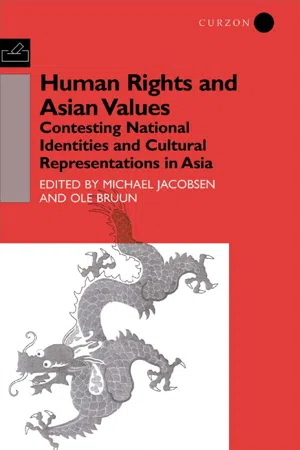
Human Rights and Asian Values
Contesting National Identities and Cultural Representations in Asia
- 330 pages
- English
- ePUB (mobile friendly)
- Available on iOS & Android
eBook - ePub
Human Rights and Asian Values
Contesting National Identities and Cultural Representations in Asia
About this book
The Asian challenge to the universality of human rights has sparked off intense debate. This volume takes a clear stand for universal rights, both theoretically and empirically, by analysing social and political processes in a number of East and Southeast Asian countries. On the national arenas, Asian values are linked to the struggle between authoritarian and democratic forces, which both tend to convey stereotyped images of the 'west', but with reversed meanings.
Information
1
Since There Is No East and There Is No West, How Could Either Be the Best?
Edward Friedman
Between 1964 and 1966, when I was a finishing graduate student living in a dormitory at Taiwan University in the city of Taipei, I learned a lesson about democracy. Chatting in the dorm room one day about nothing in particular with one of my three roommates, the sound of a hand on the outside doorknob reached us. My roommate froze into rigid silence. Realizing I had seen his fright, he was embarrassed. In the pervasive police atmosphere of Taiwan under martial law, people learned not to speak in the presence of third parties. Behaviour premised on internalized fear was a matter of survival.
Democracy does not totally destroy this fear. It persists in some form in all systems of unequal power—including an ordinary work place or classroom where the less powerful can still rationally fear reprisal from the more powerful.
Such fear accompanied me to college. On my first day, at the end of the long series of tables set up for freshman registration, a student sat with a petition and invited me—as all other students—to read the petition and sign it. I made up a lame excuse and stumbled on, scared even to glance at the document. Then, realizing what I had done, I snuck around behind the person with the petition to peek at its actual contents. It was about the fall schedule of the football team. I felt like a fool. I mulled over the sources of the fears that had paralyzed me—McCarthyism, personnel files, the FBI, job hires where employers keep out so-called troublemakers, etc. I was not proud of myself.
Yet it became clear to me in non-democratic Taiwan that democracy greatly reduces internalized fear. Democracy enhances life. It removes a humiliating burden of anxiety and terror. Achieving normality can seem a miracle. There was a world of difference between my embarrassment as a college freshman and my graduate roommate’s terror in Taiwan in 1964.
Yet my college freshman experience exemplifies a point that critics of human rights absolutism have correctly made. The difference between a democracy and a non-democracy need not be a difference between absolute good and absolute evil. In fact, all really existing democracies are replete with flaws and injustice. The attainment of the goals of human rights and the fulfilment of the promise of democracy are far from realized in actually existing democracies. In fact, much of the progress in approaching those goals is only quite recent. The civil rights revolution that ended the system of apartheid terror in the south of the USA is but a second half of the twentieth century development.
The recent nature of democratic progress suggests that there may be far less of a distinction between some Asian countries with flawed electoral systems at the end of the twentieth century and so-called democracies in Europe or North America only a generation or two ago. Indeed, much of the supposedly distinct value structure of so-called Asian development states also looks much like the value structure of European societies only a generation or two ago, a fact which helps explain how the Victorian leader of Singapore, Lee Kuan Yew, could turn into a Confucian. The values actually are similar. It is startling to me that truly intelligent and insightful individuals still give credence to the parochial and politicized proposition that there really are vital Asian values which are different from and superior to Western values, as when the brilliant Frank Ching promotes as Asian values ‘thrift, hard work and respect for one’s parents’,1 as if the Protestant ethic embrace of frugality and diligence and the Hebrew Bible’s Ten Commandments admonition to respect thy father and thy mother could only be penned by Confucius. When East and West are properly compared, much of the supposed cultural distinctiveness of one or the other swiftly disappears.2 Imagining human rights in ways that privilege the so-called West produces misreadings of both the potential of the East and the reality of the West.
DEMOCRACY YES, WEST NO
Few people who embrace the West as the home of democracy and human rights have even an inkling of how recent and politically charged that notion, the ‘West’, is. Before the defeat of Nazism and the integration of a democratized Federal Republic of Germany into an Atlantic Alliance, most Germans rejected the notion that Germany was in the West. They mocked France and Britain as abstract and cold-blooded sites of inhumanity, while Germany was imagined as a warm community of truly humane values. They did not appreciate the blessings of constitutional democracy. In Germany, in the heartland of Europe, the core of the so-called West, liberal democracy actually could long be dismissed as immoral. Oswald Spengler, in his famous 1917 tome, The Decline of the West, expressed this Western anti-democratic perspective. ‘Democracy exists where money equals political power’. In 1990 many German intellectuals still insisted that the East of Germany was a humane anti-capitalism and rejected German re-unification.
Even the United Kingdom is only recently ‘the West’. Anglo-American culture long treated Irish Catholics not as part of the West but as savagery beyond the pale of civilization. Into the twentieth century, Harvard University discriminated against Irish Catholics. The notion of a Western civilization, of all of Europe and North America sharing common values is a recent invention. In fact, for most of their history, citizens of the United States thought of themselves as part of the New World in contrast to the Old World, not partners with Europe in a common Western project. Americans saw themselves as a society of merit while Europe was seen as an alien world of frozen statuses based on blood inheritance. Europeans tended to return the negative favour, marginalizing Americans as a people without culture.
‘The West’, imagined as a sharing of democratic values is a late-twentieth-century product dynamized by Woodrow Wilson’s intervention in the Great War (which Asians mocked as a barbarous European Civil War) to save democracy. But Wilson’s agenda was not welcome by conservative rulers in France and Great Britain. The notion of a democratic West is largely a creation infused by Cold War propaganda, a trope to stigmatize invidiously a ‘totalitarian’ East. Ironically, the secret services in the Soviet Communist bloc tried to turn the notion of the West as a uniquely ‘free world’ to its own anti-democratic purposes, treating democracy as an alien element out to subvert an authentic socialism. As outrage grew at Soviet bloc despotism, people began to long to join the camp of democracies, now imagined as ‘the West’. The myth of a democratic West became popular and is conventionally mistaken for a deep historical truth, something embodying ancient verities and long continuities.
The notion of ‘the West’, however, is so ideologically informed that it blinds people who identify with the category even from understanding themselves. ‘Westerners’ happily embrace the idea that their purportedly unique blessedness is rooted in a culture that values the individual. But no serious history of democracy focused on matters such as expanding aristocratic rights to ennoble ever more groups, or church-state conflicts, or the need to end religious wars with institutionalized toleration of the other community does so by highlighting individual values. Democracy ended intolerance. It pacified the war of group against group. It achieved some religious freedoms so that stigmatized groups became, more or less—often less—equal citizens. It was entire categories of people that were first excluded and then included. People in Europe and North America misconstrue themselves and mislead others in presenting themselves as uniquely individualistic.
Actually, if one focuses on campaigns to protect the environment or ban smoking, one would see how much ‘the West’ actually still puts the collective good first The taxes democratically imposed in ‘the West’ for the common weal can make ‘the East’, in contrast seem selfish and individualistic. After all, Asia has 13 of the 15 most polluted cities in the world. If one compares existing democracies in Asia with those in Europe or North America on the issue of state intervention in the sexual activities of citizens, on matters such as abortion, there is far more interference by the government in the West than in the East. It would be easy to argue that the West, not the East, puts the common good first. Whichever way one’s politics leads one to oppose categories of East and West, the result is almost pure ideology.
While there is no West opposed to an East, there are struggles everywhere for democracy and human rights. Nations which are democratizing are morally better for it. There are other large benefits of democracy besides the reduction of fear of the authorities. These boons include a likelihood of a peaceful transfer of power rather than an endless series of succession crises, any of which could threaten to explode into civil disorder and monstrous blood-letting. A pacified power struggle is a great gain. In addition, the proceduralism of democracy makes it more possible for people to live on stable expectations rather than the threat that all can suddenly disappear because of the whim or fiat of unaccountable political power which can threaten groups whose ultimate purposes of life conflict with the mobilizational underpinnings of the ruling bloc. By labelling a group as bourgeois or backward or counter-revolutionary in Communist China or Cambodia or Korea or Vietnam, they are turned into non-people and victims, as shown by the fate of people of Chinese ancestry in Vietnam or Muslims in Cambodia. Finally, democracies make falliblism less likely. That is, in a non-democracy where criticism and alternative programmes are not part of the daily political routine, ruling groups that err are regularly told only that their errors are actually successes. Consequently, political mistakes are often compounded and intensified. Non-democracies are hence prone to intensifying their mistakes, leading on to horrors such as famines, which democracies far more readily avoid.3 Reducing fear, providing domestic peace and secure expectations and avoiding the horrors of falliblism are among the great benefits of democracy.
THE EAST PROMOTES HUMAN RIGHTS
Democracy, however, is not the good or just society. Utopia is a dream, perhaps a nightmare. Real democracies are replete with problems and evils. Democracy is but a political mechanism for trying to grapple with a nation’s problem. To be sure, democracy is a blessing in helping people avoid palpable horrors. But the political institutions of democracy are in no way a guarantee that problems will, in fact, be solved. Consequently, real democracies can and do institutionalize human rights abuses. Critics of human rights absolutism are correct that much unfairness and inequity can and does persist in democracies. Actually there can easily even be instances for a particular period of time of more basic violations of human rights in a democracy than a non-democracy. There is no necessary linkage between democracy and human rights. No form of polity is absolute insurance against social injustice or economic failure.
This in no way negates the political superiority of democracy. Authoritarianism is certainly not a guarantee against social injustice or economic failure either. Daily, pervasive and persistent traumas of non-democracies, however, do not wound the body politic in democracies. The Chinese writer Ding Ling told me about her internal exile in China’s frigid northeast during the era of the despot Mao Zedong. Sometimes her beloved managed to visit her. They longed to share intimate thoughts. Alone in a room, in bed together, about to whisper so no one could overhear them, the shameful internalized fear of life in Mao’s China still led them to a final act exposing their mutual loss of dignity. They pulled the blanket over their heads before starting to whisper. Her tale reminded me of my rigid, terrified roommate at Taiwan University.
And yet, because democracy is but a means for dealing with political issues, it does not assure a people that a democratic government will even promote their human rights. This is why human rights movements grow inside of democracies. They invariably have lots of work to do protecting stigmatized groups—women, aliens, particular religions or ethnicities, prisoners, poor, etc. The political mechanisms of democracy should not be confused with basic human rights. It should not be forgotten that in the discussions on creating a League of Nations at the Versailles Conference, Japan sought to ban racism and democratic America, Britain and France helped to defeat the anti-racist effort. In addition, at ‘the preparatory conference on the UN charter at Dumbarton Oaks in 1944…the US and Great Britain…opposed… inclusion of provisions for non-discrimination and equal rights in the declaration, [while] the Chinese were positive to such an inclusion’.4
The conventional wisdom that the modern human rights movement begins with the victory of Western democracy over fascism in World War II, leading to the crafting of the 1948 United Nations Universal Declaration on Human Rights is not persuasive. This is not because the Universal Declaration is not a great achievement. It most certainly is a glory worth celebrating. But the Universal Declaration was not the victory of Western democracy. Democracy, in fact, was not yet victorious in Europe in Spain, Portugal or Greece. In addition, Stalin’s side also won over Nazism and expanded Moscow’s tyranny far to the west in Europe into Germany, Czechoslovakia, Hungary, Poland, etc. The conventional ‘Western’ wisdom which is parochially self-congratulatory also ignores persistent struggles for human rights of ‘non-Western’ nations. At the United Nations, at its origin, only 13 of the 51 member nations considered themselves ‘Western’. Only 6 of the 18 on the Human Rights Commission were ‘Western’. The Universal Declaration was more global than ‘Western’.
Actually, human rights was experienced in most nations of the world as part of the struggle for ‘self-determination’. This made sense since rule by alien others who wield absolute and arbitrary power over a people to whom they felt no deep commonality meant that the subordinated people had no guaranteed human rights. Consequently, human rights abuses were ubiquitous. The anti-colonial struggle is understood by its members, most of the human race, as fundamental to the human rights movement. If that interpretation can be absorbed, it then also becomes easier to understand why a right of development can become part of a human rights dialogue. Stronger powers can treat weaker nations most inhumanely. They treat the structures of power they create to privilege themselves as natural givens. Therefore, people who raise issues of debt relief, market access or governing international finance because the lack thereof helps enchain a people within the trammels of stagnant misery where life is savage and short should also, if one is serious in seeking a human life for all in the human species, be taken seriously.5 The a-priori dismissal of so-called group rights by certain ‘Western’ individualists seems culturally parochial and blind to the actual history of rights expansion. Such ‘Western’ parochials do not comprehend how matters such as religious freedom, free association, labour rights and cultural survival are very much group rights. Historically, rights have been denied to groups, to genders, races, religions, etc. The ‘Western’ discourse which makes ‘individualism’ the base of democracy misunderstands the history of political freedom and impedes progress in human rights.
Since human rights are matters for inclusiveness, aiming at all human beings, it seems strange that ‘Westerners’ hear human rights as individual rights. The point is to reach all, not one. Perhaps the peculiar discourse of individualism reflects aspects of European cultural history. It may be that people in ‘the West’ hear rights as individual because ‘soul-speak’ seems presuppositional. That is, in the Greek-Christian cultural world, people learn that they have souls. This morally informed self feels like one’s true essence. That soul is to be morally restrained and ethically informed. That religiously informed notion of the individual is, however, usually misunderstood outside of ‘the West’ where individualism sounds like pure egoism, absolute materialism and hedonistic selfishness, rather than a moral essence.
‘The West’ is not sufficiently aware of its cultural presuppositions to explain itself clearly. The Western discourse on rights often detours serious discussions on human rights. It is full of arrogant and ignorant claims about the individual. Historically, after all, it is groups that have been excluded.
This is in no way to suggest that there is something wrong with the notion of protecting individual human rights. In order to protect all groups, one must protect each member. Even when it is a community that is discriminated against, it is particular people who are jailed, tortured and murdered. Human rights universalism implies guaranteeing the rights of each and all. Nonetheless, in the crucial work of protecting each and every individual, it is important not to be smitten by a metaphysics of individualism that obscures the reality of historical struggles to end the exclusion of and the discrimination against groups and communities.
Rights were for millennia privileges of narrow elite groups, powers of office, status or blood. Only in recent centuries, as narrow privilege was expanded to include more and more groups, did rights come to apply to all humanity. The European tradition, as virtually all others, is historically predominantly exclusionist, authoritarian and hierarchical. But since soul-speak goes back to ancient times, Europeans misleadingly seem to be saying that individual freedom is an ancient heritage. This makes the West seem most peculiar and inimitable. Actually, germs of values which can eventually serve a project of human rights and democracy abound in all cultures and can travel.6 Those who imagine human rights as a product of the Christian West might recall that Christianity was born in Asia.
Of course, in the ‘West’, despite a language of rights and individualism, national pride obscures deep histories of rights denial. Hypocrisy and inhumanity are rife in the real world of politics. The United States Constitution that went into effect in 1789, thus establishing institutions of political democracy, also legalized slavery. Surely no one would dis-agree that there are few things more inhuman than the enslavement of one person by another, a cruel power inequality that allows for the buying and selling of people at a master’s will. Yet in the American south, slave owners in the first half of the nineteenth century insisted that American liberty, the leisure of the free to learn, reason and participate in the politics of the republic, was premised on the existence of slavery. Slave owners defended slavery as morally superior. Slavery was embraced as ethically excellent. Within ‘Western’ culture, even in the age after the Enlightenment, many could still experience slavery as moral.
The effort of some Europeans to persuade other Europeans that slavery was immoral only began to gain momentum at the end of the eighteenth century. In fact, when Haiti’s slaves rebelled in 1791 against France, Britain, although at war with revolutionary France in Europe, dispatched troops to Haiti to help the French maintain slavery, and did so in the na...
Table of contents
- Cover Page
- Title Page
- Copyright Page
- Preface
- Introduction
- 1: Since There Is No East and There Is No West, How Could Either Be the Best?
- 2: Universal Rights and Particular Cultures
- 3: Thick and Thin Accounts of Human Rights: Lessons from the Asian Values Debate
- 4: Once Again, the Asian Values Debate: The Case of the Philippines
- 5: Human Rights and Asian Values in Vietnam
- 6: Particularism, Identities and a Clash of Universalisms: Pancasila, Islam and Human Rights in Indonesia
- 7: Modernization without Westernization? Asian Values and Human Rights Discourse in East and West
- 8: Human Rights in Vietnam: Exploring Tensions and Ambiguities
- 9: Freedom as an Asian Value
- 10: The Chinese Debate on Asian Values and Human Rights: Some Reflections on Relativism, Nationalism and Orientalism
- 11: Universal Human Rights and Chinese Liberalism
- 12: Practice to Theory: States of Emergency and Human Rights Protection in Asia
- 13: Human Rights Education in Asia: The Case of the Philippines and Beyond
- 14: The Rights of Foreign Migrant Workers in Asia: Contrasting Bases for Expanded Protections
- Select Bibliography
Trusted by 375,005 students
Access to over 1.5 million titles for a fair monthly price.
Study more efficiently using our study tools.
Frequently asked questions
Yes, you can cancel anytime from the Subscription tab in your account settings on the Perlego website. Your subscription will stay active until the end of your current billing period. Learn how to cancel your subscription
No, books cannot be downloaded as external files, such as PDFs, for use outside of Perlego. However, you can download books within the Perlego app for offline reading on mobile or tablet. Learn how to download books offline
Perlego offers two plans: Essential and Complete
- Essential is ideal for learners and professionals who enjoy exploring a wide range of subjects. Access the Essential Library with 800,000+ trusted titles and best-sellers across business, personal growth, and the humanities. Includes unlimited reading time and Standard Read Aloud voice.
- Complete: Perfect for advanced learners and researchers needing full, unrestricted access. Unlock 1.5M+ books across hundreds of subjects, including academic and specialized titles. The Complete Plan also includes advanced features like Premium Read Aloud and Research Assistant.
We are an online textbook subscription service, where you can get access to an entire online library for less than the price of a single book per month. With over 1.5 million books across 990+ topics, we’ve got you covered! Learn about our mission
Look out for the read-aloud symbol on your next book to see if you can listen to it. The read-aloud tool reads text aloud for you, highlighting the text as it is being read. You can pause it, speed it up and slow it down. Learn more about Read Aloud
Yes! You can use the Perlego app on both iOS and Android devices to read anytime, anywhere — even offline. Perfect for commutes or when you’re on the go.
Please note we cannot support devices running on iOS 13 and Android 7 or earlier. Learn more about using the app
Please note we cannot support devices running on iOS 13 and Android 7 or earlier. Learn more about using the app
Yes, you can access Human Rights and Asian Values by Ole Bruun,Michael Jacobsen in PDF and/or ePUB format, as well as other popular books in Politics & International Relations & Asian Politics. We have over 1.5 million books available in our catalogue for you to explore.