- 192 pages
- English
- ePUB (mobile friendly)
- Available on iOS & Android
eBook - ePub
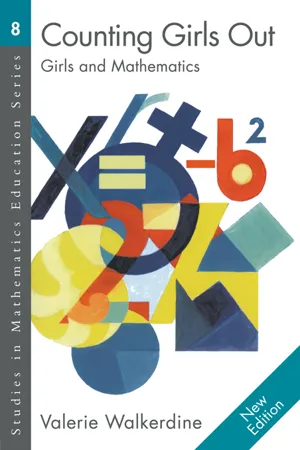
Counting Girls Out
About this book
The question about girls' attainment in mathematics is met with every kind of myth, false 'evidence', and theorizing about the gendered body and the gendered mind. The 'Girls and Mathematics Unit' led by Valerie Walkerdine has, over a period of ten years, carried out a detailed theoretical and empirical investigation in this area. The book tackles issues and prejudice and examines and puts into perspective many claims that have been made about women's minds. It also probes the relationship between evidence and explanation: why are girls still taken to be lacking when they perform well, but boys are credited even when they do not?
Information
1 Subtracting the Feminine
The chief distinction in the intellectual powers of the two sexes is shewn by man’s attaining to a higher eminence, in whatever he takes up, than can woman … if men are capable of a decided pre-eminence over women in many subjects, the average mental power in man must be above that of woman. (Darwin, 1896, p. 564)
Of course it is not a new trick to subtract the feminine, to render it worthless and in so doing to count girls out. Charles Darwin demonstrates for us how easily the slippage is achieved from the idea of men’s superior attainment to their greater mental capacities. But the slippage is most simplistic in understanding women’s and girls’ participation and attainment in Mathematics. The connection made by Darwin — between eminence and mental powers — is commonly asserted when discussing why women are under-represented in higher-level careers requiring Mathematics. From there one progresses easily to the idea that such under-representation is produced by the mass psychopathology of the female mind.
Women, after all, are clearly irrational, illogical and too close to their emotions to be good at Mathematics. Or so the story goes. Endlessly repeated variations on the theme are still being reworked, in one empirical investigation after another. Girls and women are said to be different, lacking, while boys’ and men’s ‘mastery’ of Mathematics, their claim to superior rationality and scientific truth, is unchallenged, as though their ‘attaining higher eminence’ were proof enough. When examining these issues one can fall into the trap of attempting either to prove exactly what girls lack so that it can be put right, or to demonstrate that there is no lack at all. We think that such approaches trap us, and the girls and women we shall meet in these pages, like flies in a web, into playing the game by patriarchal rules. We believe that it is necessary to avoid stepping into this trap and to ask afresh why the questions were posed in this way.
It is facile, however, to assert that these facts and ideas are mere rhetoric and that we can easily uncover ‘what really happens’ or girls’ ‘real’ performance. We will demonstrate that there is no simple ‘real’ on the basis of which interventions can be made. How we carry out the research, what questions we ask, what counts as data, what is judged to be true are all entangled in the pursuit of ‘the truth’, and we get caught up in this too. Our research becomes a process of disentangling, of pulling ourselves free of the web. It is like unpicking knitting, the wool still bearing the imprint of the knots which formed it into a garment. This garment often seemed to fit us well and even to keep us warm on winter nights. Taking it apart can be painful and does not reveal the easy certainty of answers. Of course, one can hide behind complexity, use it as a way of failing to address the possibility of real interventions and struggles. But there have been so many ‘easy’ answers which told us what was wrong with girls and how to put it right. Such answers do more harm than good, because they insist that there is something wrong with girls that has to be corrected.
We want to tell a different story, full of fact and fiction and fantasy. It is a story of women doing research from which we cannot and will not extricate ourselves as the narrative unfolds. The story in this book is also in many ways our own story. That is, the issues we will raise reflect our own histories not only as women but also as women who went on to higher education and academic work in a university. Our careers were channelled through those routes usually open to women; secretarial work and the so-called ‘caring professions’. Although we were all well qualified — in psychology, sociology, and education — none of us had had straightforward academic careers. We all had to struggle for a sense both of the importance of the work we wanted to do and of our own worth. It was often difficult to remember that research such as this, challenging existing assumptions, methods and theories, produced hostility and resentment, which were difficult for us to deal with, especially when combined with power. The Unit was not, however, composed of mathematicians. Some of us had been good at Mathematics at school, while others had not. While some might think that this sort of work should be carried out by mathematicians, it was precisely our different approaches and experiences which allowed us to address these questions in new ways.
Our approach is developed from work done in Britain, and builds upon Post-Structuralism (see Derrida, 1972; Squire, 1989; Parker, 1989; Henriques et al., 1984). This work has been very influential in challenging some of the ideas about mind based on Structuralist universals, which are common in Mathematics education today. It puts into historical perspective the construction of scientific ideas (or truths) about girls and boys, men and women, minds and Mathematics. It allows us to take apart these truths and their forming and informing of practices in which girls and women are taken to be poor at Mathematics. We shall explore existing explanations of girls’ performance and suggest that there is more behind them than meets the eye, then go on to document the theoretical and empirical evidence underlying our account. This will lead us to test scores and classrooms. We shall meet teachers, children and parents in homes, nursery, primary and secondary schools to examine how the relation between theory and practice is actually lived. Our research represents six funded studies, each concentrating on a different age group, between 1978 and 1987.
Our first project was a pilot study, part of a larger piece of work on cognitive development in nursery and infant schools. In this we formulated the basis of our work on power and concluded that girls were not failing in the early years of schooling. On the basis of this work, we obtained another grant to examine the transition of a group of children from the top classes of two junior schools into the first year of a comprehensive. We proposed that if there was no falling-off in performance in junior school, we should examine what happened in secondary school: the period of the reputed falling-off. We backed this up with a further study in the same comprehensive of children in fourth-year Maths and English classes. In both studies we found no falling-off — indeed, in general terms the girls were outperforming the boys. We decided that an entirely different account of the issues was needed.
We then went on to research the early socialization arguments by following a group of girls who had been the object of a previous study at four; we set out to discover what had happened to them at ten. Because we had data on their interaction with their mothers we were able to add an investigation into the transition from home to school and to examine the effects of early socialization on later performance. Since this sample consisted of all white girls stratified by social class, we could examine aspects of class-based division. This work led us to be very critical of socialization accounts, especially those which laid stress on the mother’s role. We argued that mothering was the object of certain scientific truths which constantly naturalized some practices and pathologized others, laying educational success and failure at the door of all mothers. We also carried out a more detailed study of 6-year-olds at home and at 1 infant school, and further confirmed the analysis of the 4- and 10-year-olds. We were then fortunate enough to obtain 2 grants to reassess and reanalyse all the data, from 4 to 15, and to present our analysis in a coherent manner. Here is that accumulated analysis, theoretical and empirical.
While we established that girls were felt to lack something, even when they were successful, it seemed equally and positively that boys were felt to possess the very thing that girls were taken to lack. It would seem easy to prove or disprove this by recourse to empirical evidence. However, we shall argue that things are not so straightforward. Girls are still considered lacking when they perform well and boys are still taken to possess something even when they perform poorly. In other words, we need carefully to examine the relationship between evidence and explanation.
There have been so many accounts of ‘the problem’ and many attempts to intervene with forms of anti-sexist practice. We are critical of many of the taken-for-granted assumptions of such practice — not because we are critical of it in general but because we think that some of it has perpetuated the problem it was intended to cure. Blame has fallen on girls themselves, or on their mothers or female teachers. In addition, approaches on the basis of getting girls to ‘choose’ non-stereotyped subjects also tend at the very least to be confounded when they continue to opt for the more traditionally ‘feminine’ subjects. We shall argue that both the theoretically traditional approaches and the kind of anti-sexist interventions sometimes attempted make things worse. Although our central project was to examine theoretical and empirical evidence relating to Mathematics, we argue that Mathematics becomes a foil or filter for examining more general issues of gender and education.
First we situate our work within the existing empirical approaches, then we start to outline some of the historical and theoretical background. We decided to begin with the youngest children and end with our study of 15-year-olds. However, this method presents problems, since some of the work on older children was undertaken before that on younger children. Our ideas developed as we went along. This means that we shall present work informed by a more complex theoretical analysis before some of that on older children. We hope that readers will understand and bear with us, because when presenting research of this quantity and complexity some organizational method must be found. We decided on this one because it allows examination of the issues as they relate to girls progressing through their school careers. First of all, however, we shall return to the question of truth in order to examine the basis on which the issue of girls and Mathematics has been understood.
2 The Truth about Girls
What Is the Truth?
This may seem a strange way to begin, but we do not think that finding the truth about girls and Mathematics is possible. There are scientific ‘facts’, of course, but we shall demonstrate that these are open to serious question. We should, however, state straight away that we do not want to argue that current work on girls and Mathematics is a false or pseudoscience and that what is needed is a feminist science, which will unproblematically tell the unbiased and undistorted truth. The issues of truth, scientificity and method are more complex, and in the next three chapters we shall outline our approach to these issues.
As we stated in Chapter 1, we saw, throughout our work, the need to rethink the entire debate about girls and Mathematics, based as it is on the assumption of female failure. In this chapter, however, we examine existing approaches, particularly work on statistical significance upon which many of the claims about girls’ failure rest.
When James Callaghan, then prime minister, launched the ‘Great Debate’ in a speech at Ruskin College, Oxford, in 1976, he referred to the needs of industry and to the production of a curriculum that would get ‘talented young people into science and engineering subjects’. As part of this he asked: ‘Why is it that such a high proportion of girls abandon science before leaving school?’
While questions have been raised about women’s minds for many centuries, Callaghan’s question matches the recent interest in, and explanations of, girls’ performance in Mathematics. Let us first examine these, for different concerns at different historical moments have themselves helped to produce different definitions of — and solutions to — the ‘problem’. In other words, no single and unbiased research question will locate the absolute truth about girls and women. Rather, it is important to show how different kinds of question lead to different interventions.
Our starting point is that there is no simple category ‘woman’ which can be revealed by feminist research, but that as feminists we can examine how facts, fictions and fantasies have been constituted and how these have affected the ways in which we have been positioned, understood and led to understand ourselves. Hence, while much feminist counter-research has attempted empirically to disprove the facts about girls’ and women’s performance, we felt that a fundamental problem remained. Accepting the categories and terms within which the issues were framed left feminist work always on the defensive and trapped within empiricism. This chapter should explain some of the details of our method, but first we examine the terms of recent debate.
Although explanations of girls’ performance tend to treat girls as a unitary category and to consider girls versus boys, this deflects from the specificity of the issues and the debate. To understand these we must examine two aspects concerned with the context of education within the developmental framework of the modern state.
Current approaches may be understood in relation to general theories of Mathematics education, especially to the notion of reason and reasoning. The important context is the concern expressed by James Callaghan. While British education since the war had shown considerable concern for inequality, this was always within a meritocratic system aimed at selecting children of aptitude and ability to join the ranks of professionals. In the post-war period the focus was on working-class boys. By the 1970s it was on girls in general, partly due to the impact of the women’s movement. But for our purposes, the important aspect of this debate was the link that was made between wastage, talent and finding talent. The debate was understood and acted upon according to theories and practices within the psychological literature of ability. This literature sought to find high-achieving girls by a set of testing procedures which already designated ability as a product of a certain sort of mental equipment. Debates therefore keyed right into the contested areas of success, failure and mind, especially tenaciously held ideas about differences between male and female minds, brains and modes of thinking.
So the wastage-of-talent argument was couched in terms of the generic category ‘girls’, within which we could not possibly encompass girls in general: a point which is glossed over. The expressed concern was about the numbers of girls and women entering high-level careers requiring Mathematics and science; such careers require at least A levels and usually a university degree. Only 10 per cent of 18-year-olds in this country take A levels, however, and an even smaller proportion go to university. We are talking then about a very specific and extremely small proportion of girls, though you would not think so from the literature. The purpose of this examination is to outline some of the problems in existing approaches and explain how we developed our own approach and methodology.
There are several traditions of work in the field, most of which emanate from the United States and reflect the concerns of American psychology, especially social psychology, in supporting the way nation is ‘produced’; while British work stems from post-war developments in social democracy, with the consequent concerns about ability and aptitude, testing, finding bright pupils.
Let us briefly review the way in which different traditions of work have viewed ‘the problem’. These divide roughly into ‘nature’ and ‘nurture’ arguments. While some researchers claim differences in spatial ability and brain lateralization, others suggest that ‘personality’ factors and socialization experiences are to blame. Most studies work from the premiss that girls are worse at Mathematics and then attempt to explain this by global generalizations about females. But since we have already established that the issues which gave rise to concern in the first place were fairly specific, there seems to be a problem about these assumptions and starting points.
The most hotly disputed approach deals with alleged sex differences in spatial ability, supported either by a genetic or an environmental reading. The genetic lobby would link the work to differences in verbal and non-verbal intelligence and with research on brain lateralization. The environmentalists use ideas of sex-role stereotyping to suggest that girls and boys have different play and developmental experiences. There is scant definition, however, of the precise link between performance on visuo-spatial tests and school Mathematics. It has generally been considered more progressive to locate girls’ supposed ‘lack’ within the environment, although this may be just as oppressive, for it ignores women’s biology altogether. This is not to argue for a return to genetic approaches, but to locate our examination and understanding within a critique of that dichotomy.
The spatial-ability issue has gained widespread acceptance at a common-sense level and has featured widely in anti-sexist interventions in early education. It has often, for example, been suggested that girls do badly because they do not play enough with construction toys. They are then encouraged to play with Lego, but teachers are still dismayed that they tend to construct not vehicles but houses (see Chapter 5).
Environmental approaches, especially in the American literature, concentrate on factors which may produce female drop-out from high-school Mathematics. The literature on fear of success (Leder, 1980) uses classic research to examine higher Mathematics as a ‘masculine’ field of study. ‘Bright’ girls tend to display ‘fear-of-success’ responses in relation to Mathematics in far greater numbers than boys. This led Leder to conclude not only that such girls were less likely to take Mathematics in the first place, but that those who did were more likely than boys to leave the field early. It was, moreover, girls who appeared to be particularly vulnerable to social pressures towards traditional femininity who were least likely to choose Maths.
Maths anxiety became another concern, and women particularly were said to have a phobia about Maths and numbers. Again, the dominant theme was the take-up of higher-grade courses. However, studies of Maths anxiety do not report consistent findings: there are few differences between boys and girls. Nevertheless, a few studies have examined ‘extreme’ anxiety and their results support the hypothesis that more women than men are ‘Math anxious’ (Brush, 1978). Fennema and Sherman (1976) have noted several deficiencies in this approach, suggesting that it does not allow for the face that men may be more socialized into not openly displaying their anxiety. Such anxiety may also arise from being tested and from a lack of confidence in one’s ability to learn the subject. In our view, however, anxiety cannot be separated from complex social processes nor from the involvement in Mathematics of fantasies about masculinity and femininity. Dweck and her associates (Dweck and Repucci, 1973; Diener and Dweck, 1978) have attempted to demonstrate that helplessness in the face of failure is a factor which particularly affects girls and may, therefore, affect their mathematical performance. They argue that there are important differences between children who display either ‘learned helplessness’ or ‘mastery orientation’ when faced with mathematical and other academic tasks.
This construct, ‘learned helplessness’, has been applied in an effort to explain sex differences in Mathematics performance. The evidence suggests that girls may be more prone to a learned-helplessness response, especially in tasks involving Maths. Careful review of this literature suggests that the sex differences are neither as consistent nor as strong as has been postulated (Parsons, 1983). Dweck also suggests, however, that teachers help to create this situation by responding to boys and girls in different ways, seeing girls’ poor performance as due to lack of ability and boys’ to lack of effort. This idea of helplessness implies that so-called female passivity is a learned response.
There is also a literature based on attribution theory (Weiner, 1971), where it is generally argued that boys tend to attribute their success to internal, stable causes (ability) and their failures to external, unstable causes (lack of effort), whereas girls tend to reverse this patte...
Table of contents
- Cover
- Halftitle
- Title
- Copyright
- Contents
- Acknowledgments
- Series Editor’s Preface
- Introduction Changing Views of ‘The Gender Problem’ in Mathematics
- 1 Subtracting the Feminine
- 2 The Truth about Girls
- 3 Science, Reason and the Female Mind
- 4 Mothers and Daughters at Four
- 5 Power and Gender in Nursery School
- 6 Entering Infant School
- 7 10-Year-Olds
- 8 Junior-Secondary Transition
- 9 Entering Secondary School
- 10 The Fourth Year
- 11 Examining Mathematics Texts
- 12 No Charge: Political Arithmetic for Women
- Afterword
- Bibliography
- Index
Trusted by 375,005 students
Access to over 1.5 million titles for a fair monthly price.
Study more efficiently using our study tools.
Frequently asked questions
Yes, you can cancel anytime from the Subscription tab in your account settings on the Perlego website. Your subscription will stay active until the end of your current billing period. Learn how to cancel your subscription
No, books cannot be downloaded as external files, such as PDFs, for use outside of Perlego. However, you can download books within the Perlego app for offline reading on mobile or tablet. Learn how to download books offline
Perlego offers two plans: Essential and Complete
- Essential is ideal for learners and professionals who enjoy exploring a wide range of subjects. Access the Essential Library with 800,000+ trusted titles and best-sellers across business, personal growth, and the humanities. Includes unlimited reading time and Standard Read Aloud voice.
- Complete: Perfect for advanced learners and researchers needing full, unrestricted access. Unlock 1.5M+ books across hundreds of subjects, including academic and specialized titles. The Complete Plan also includes advanced features like Premium Read Aloud and Research Assistant.
We are an online textbook subscription service, where you can get access to an entire online library for less than the price of a single book per month. With over 1.5 million books across 990+ topics, we’ve got you covered! Learn about our mission
Look out for the read-aloud symbol on your next book to see if you can listen to it. The read-aloud tool reads text aloud for you, highlighting the text as it is being read. You can pause it, speed it up and slow it down. Learn more about Read Aloud
Yes! You can use the Perlego app on both iOS and Android devices to read anytime, anywhere — even offline. Perfect for commutes or when you’re on the go.
Please note we cannot support devices running on iOS 13 and Android 7 or earlier. Learn more about using the app
Please note we cannot support devices running on iOS 13 and Android 7 or earlier. Learn more about using the app
Yes, you can access Counting Girls Out by Valerie Walkerdine in PDF and/or ePUB format, as well as other popular books in Education & Education General. We have over 1.5 million books available in our catalogue for you to explore.