- 184 pages
- English
- ePUB (mobile friendly)
- Available on iOS & Android
eBook - ePub
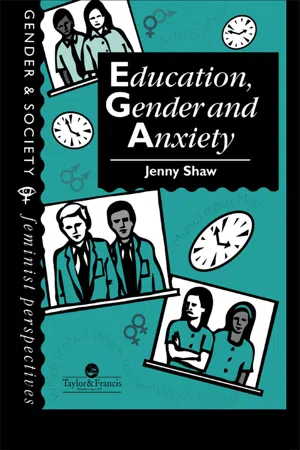
Education, Gender And Anxiety
About this book
This interdisciplinary text explores the scope for applying psychoanalytical ideas to gender inequalities that are inherent in the educational system. Although modern education aims to egalitarian and meritocratic, it is still true that in most cases it does not improve the life chances of girls to the extent that it ought to, or does for boys. Based on literature gathered from North America, Europe and Britain, this text argues for an 'object relations' approach when analysing gender differences in subject choice and polarisation in reading, writing and drawing, and stresses the need to pay close attention to the unconscious processes which school settings mobilise. Analysing the concept of 'in Loco Parentis', it presents parenting as the emotional substructure of education, and suggests challenging areas for future empirical work.
Information
Chapter 1
Introduction: The Unconscious Curriculum
As a broad topic, the issue of gender in education is both more or less publicly accepted and widely assumed to be on the wane; at least insofar as talking about gender has meant talking about the educational fortunes of women and girls. Many take the view that though gender in this sense used to be a ‘problem’, it solved itself once parity in entry and pass rates for GCSE and ‘A’ level were achieved and men and women entered higher education in roughly equal numbers, as they now do. Indeed, the report from the National Commission on Education Learning to Succeed (1993) makes only the briefest mention of gender, and then only in relation to girls and computing. The work begun by feminists and other educationalists in the 1970s to raise consciousness is, in a sense, complete.
The debates about how gender undermines educational opportunities which are theoretically equal, how segmented labour markets influence school practices and outcomes, how teachers discriminate, often inadvertently, and how the all-pervasive discourses of femininity and masculinity shape school experience are more or less over, or at least have come to a halt. It can seem almost old-fashioned to argue that there are still gender issues in education to be taken seriously unless, of course, they are presented as being about boys’ declining performance. Stressing the lead that girls now have in reading, in GCSEs and even in ‘A’ levels, two Sunday Times journalists, writing in 1994, claimed ‘It is the pitiful performance by boys that now requires radical rethinking to equal opportunities. The question is: have girls had it too good for too long while society has complacently accepted that boys will be boys?’ (Hymas and Cohen, 1994).
Catching up in the university entrance stakes is hardly having it ‘too good for too long’, but it would be perverse to ignore or deny that improvements have occurred. Many of the institutional barriers which once prevented girls and women from receiving the same educational opportunities as boys and men have clearly been removed. Blatant discrimination, such as the rules which once prevented women from taking their degrees at Oxford and Cambridge, the infamous marriage bar for women teachers, or a curriculum system that shunted girls into domestic science and boys into metalwork, have gone. Even where no formal barrier existed there had been informal processes which effectively designated some subjects, such as mathematics and the natural sciences, as male domains in which women and girls were not welcome, or much at home. This has changed, though possibly not as much in physics as in chemistry and biology; but it has changed nevertheless. The natural sciences have become more attractive, or less formidable, to girls. But something else, other than the formal and informal arrangements, manages to produce lines of demarcation every bit as effective as the old ones; this demonstrates that the ‘problem’ of gender in education is not solved once women and girls’ access to certain institutions is improved. That something else is, until it is better understood, pretty invisible and mysterious. It is also mobile, flexible or perhaps opportunistic for, like infections, it finds new environmental niches in which to flourish, for example, computer studies or postgraduate education. Gender divisions in education have not gone away; though they have to some extent gone underground, they flourish in the face of considerable effort to suppress them. But as a going, public concern they have changed, to become less a concern with the fate of girls exclusively and more one of genuinely understanding the interplay between how gender is socially constructed and how schooling adds to, or detracts from, this process.
Girls still seem to take to reading more easily than boys and boys, systematically, get more help to overcome their gender-specific disadvantage. Men teachers in the primary sector have a one-in-two chance of being a deputy or a head, whilst in the secondary school sector there have actually been fewer headships for women since schools became predominantly coeducational. The numbers of women students getting first class degrees at Oxbridge has also declined since the all-women colleges admitted men and, as first degrees lose their ‘positional’ advantage, postgraduate qualifications have become more critical, but also more male-dominated. And, perhaps most important of all, the arts/science divide which runs along gender lines seems as robust as ever. Lastly, there are gender differences in the impact that education has on later careers. However egalitarian or meritocratic education aims to be, it does not improve the life chances of girls to anything like the extent that it ought to or does, sometimes, for boys. Hardly any of this happens because of overt discrimination, but it happens.
In broad terms girls may be getting as ‘good’ an education as boys, but this does not secure for them the same lifetime advantages or occupational benefits that it does for men. In a striking study of progress and promotion within the British Civil Service, an organization with a formal commitment to equality of opportunity and meritocracy, Ronald Roberts et al. (1993) showed that men did not need their higher educational qualifications to get on and that women, even when they had them, could not profit from them. Of course, occupational mobility is not the same as education, although it is meant, in some degree, to follow from it. Research such as this, which shows how little difference getting a good education may make to women and their careers, how resistant the ‘glass ceiling’ is to cracking (Gregg and Machin, 1993) and how the percentage of women getting into senior managerial jobs may now be declining, undermines a widely held complacency that assumes improving access to education is an adequate way of achieving social justice and an easy means of reform. It forces anyone concerned about gender, education and its consequences to reconsider their basic assumptions. For what seems almost inescapable is that informal, interpersonal and interactional processes have taken over from formal, gender-based barriers to produce much the same effects. And it is these that need to be at the centre of any new theory of gender and education.
As a result, sociologists of education have shifted their interest away from formal obstacles and towards these informal, interpersonal and interactional processes. It is this movement that has brought them nearer to theories, such as psychoanalysis, which deal with the irrational, with unintended consequences and with unconscious processes. Something similar has gone on in the broader field of sociology. Here, the discipline has finally given up its self-imposed obligation to start all discussions with fairly fixed structures (institutions) and moved, through the debate over functionalism, structuration, system and social integration, towards a greater interest in process. Inevitably sub-fields, like education, echo some of the broader intellectual shifts, but there are specific factors within the field of education. Because the sociology of education has always had a strong practical orientation (it is hard to venture the merest idea without being confronted with the question of what should be done, or what policies should be proposed) the whole domain has not dissolved in a flux of postmodernist uncertainty. The basic questions remain: how do educational systems, generate, reinforce or alter gender divisions and what, if anything, should be done? In attempting to answer these questions it is clear that it is individuals, pupils, teachers, parents and administrators who have to make decisions and choices. As subjects, they may be partially created by the institutions in and through which they live, but they maintain a degree of physical substance or materiality which is independent of those institutions. The crucial feature of schooling is that all those who enter do not come out the same. It is individuals who have to negotiate identities and pathways, but what they have to negotiate are educational institutions.
The broad paradigm breakdown in the sociology of education began when ethnicity and gender dislodged class as the main theme and the effects of this have made the whole field less traditionally sociological. One of the most cited of all books in the sociology of education is Paul Willis’ Learning to Labour (1977), an ethnographic account of twelve young lads in the British midlands who, at the time of the study, could look forward to jobs in the car and other manufacturing industries of the region. Though still at school, their attention and behaviour was largely focused on the class-based culture of the shop floor. And, anticipating their workplace identities, they rejected what the schools had to offer and ridiculed those pupils who took their education seriously. Though they were proud of themselves and their ‘resistance’, which included a macho attitude to women and a lot of bravado, they were nevertheless securing for themselves a lifetime of subordination and, for a regular supply of labour ‘capital’. This, anyway, was the interpretation offered by Willis and was intended to show how sophisticated and devious cultural hegemony could be. Yet today the study is largely remembered as a key, early text in the study of masculinity and macho culture and for illustrating E.P.Thompson’s (1963) definition of class as a relationship and not a thing, ‘something which happens in human relationships’. Gradually, even those still obsessed with the primacy of class turned to seeing it as a matter of process and interpersonal behaviour.
However, the interpersonal/interactional/culture focus has done more than add a nail to the coffin of class as the backbone of the sociology of education: it has demonstrated the need for a theory, or theories, which encompass or articulate individual and institutional processes. Individualism has long been the bottom line of education, indeed it has been blamed for most of the faults of the British system (Hargreaves, 1980), especially for its capacity to occlude a public perception of education as a ‘social good’ needing public investment and collective support. This individualism continues to be evident in, and indeed to justify, many recent reforms such as the Assisted Places scheme, the introduction of grant-maintained schools and the City Technology Colleges programme. So agency, individuals, and how they make choices has to be part of the story, but agency need not only be conscious, although it is usually understood as such: it can be semi conscious or unconscious. And it is this semi-conscious or unconscious agency that gives a new twist to the old idea of the ‘hidden curriculum’ (Jackson, 1968).
Usually understood as all the social messages which are learned in school, but are most definitely not part of the formal curriculum, the term ‘hidden curriculum’ is as ubiquitous as it is imprecise. Nevertheless, it gave a huge boost to the study of gender and education because it legitimized and brought together discussion of subtle, covert and often somewhat intangible processes and gave them a unitary name that was not simple ‘prejudice’. It was not as clear-cut or as institutionalized a concept as the ‘formal curriculum’, with which it was paired, but it marked out a territory in which the study of gender and classroom practice or school organization could be undertaken. Throughout the late 1970s and 1980s it was, in fact, the main intellectual paradigm for the sociology of gender and education.
Marxist ideas of social reproduction had re-energized the sociology of education in the early part of this period, especially through the work of Sam Bowles and Herb Gintis (1976), but had been notably unable to account for gender; though some socialist feminists such as Michele Barrett (1980) claimed that occupational divisions were the basis of gender divisions in education. But, in general, labour market determinism could neither overcome the fact that girls’ academic performance was often as good as, or even better than, that of boys whilst their occupational fortunes were almost always worse, nor the failure to explain exactly how the labour market exerted an influence on educational institutions.
The absence of ‘grand’ or even ‘middle range’ theory, plus the difficulty of getting funding, meant that most of the research in this period was empirical, small-scale, qualitative and observation-based. It produced work sensitive to nuance and to group dynamics which was good at showing how far practice diverged from the rhetoric of equal opportunities. It identified how early a form of gender bullying or sexual harassment started in schools and colleges, and how pervasive it was. And it also demonstrated how texts and teaching materials were unwittingly prescriptive and proscriptive about gender, knowledge and status. All of this huddled under the blanket term ‘hidden curriculum’ which became a shorthand for the informal, the mysterious and the unknown.
All of this was happening in the university seminar. In INSET (in-service training) courses a slightly different tack was taken. Equal access (which focuses on individuals) to all courses, or educational institutions, had been shown to be an insufficient condition for changing gendered outcomes within education and much more concern was gradually given to sexism, to sexual harassment, to discrimination and to ‘inner’ factors such as identity formation. As awareness of racism and sexism grew, the ‘problems’ of gender or ethnicity changed from the task of convincing local authorities, schools or colleges to adopt policies and the practice of equal opportunities towards that of combating racism or sexism directly: that is, of getting children, teachers and parents to be less sexist. Much of this work is sensitive to unconscious determinants (Cohen, 1989). Going along with this change has been a certain pessimism, for whilst educational change is always slower than expected, change that is aimed at attitudes tends to be even slower than that which targets rules and regulations. Moreover, gender divisions have the annoying habit of mutating. Just when it seems that progress is being made, such as making science less ‘masculine’, new fields such as computer studies appear, which are deemed just as socially important, and quickly become predominantly male domains. Thus theories were needed which explained resistance to change as much as the initial emergence of sexual division and this, too, pointed in the direction of psychoanalysis.
However, psychoanalysis is not a panacea. It is not a general theory of gender and education and it does not displace or demolish all other theories. There are many topics about which it is not illuminating, and many of these are educational. But there are some which really can be turned around by the perspective. My grasp of what university seminars are really about and why so many of them are really unpleasant affairs with people leaving feeling anxious, bored, disappointed or, if they were giving a paper, frightened and maybe inadequate, changed fundamentally after reading Roger Holmes’ (1967) description of them as re-enacted versions of the primal horde. Freud had used the myth of the primal horde to explain his account of the birth of society and the human capacity to form and maintain groups. It was a psychological version of the ‘social contract’ theory and in it the collective guilt at real or symbolic patricide played a large part. Shared guilt, as much as mutual fear, tempered the individual aspirations and jealousies and led to the invention of rules, morality and social institutions which could contain and channel potential aggression.
Holmes took the argument out of pre-history and applied it to all ritualized and formal meetings, of which the university seminar was just an example. The chairman, the room plan and the behaviour of participants were analysed in terms of power, predictability and control. The chairman was simultaneously omnipotent and impotent, he was ultra-real and powerful, yet non-existent; he could not talk. He was treated with exaggerated awe and deference. When the audience came in they chose, voluntarily, to sit in particular places, most notably not in the front seats, and when they spoke they did so in a form of coded aggression and sarcasm. At some level, everyone in the seminar wants to dispossess the speaker and is inhibited only by fear of retaliation from the speaker and revenge from other, disappointed, seminar members who entertain similar ambitions. Hence the rituals of speaking to the ‘chair’ are accepted and votes of thanks given to the most boring of speakers. In this account, Holmes used a psychoanalytical vocabulary to describe the behaviour in an educational setting that was, at least for me, very familiar and convincing.
Psychoanalysis is a theory of meaning and of symbols; it is open-ended, not final. It aims to provoke and stimulate, to lead to another train of ideas. A recent justification of it as a way of telling stories praises the ambiguity of psychoanalysis for returning the reader to his or her thoughts.
Psychoanalysis—as a form of conversation—is only worth having if it makes our lives more interesting, or funnier, or sadder, or more tormented—or whatever it is about ourselves that we value and want to promote; and especially if it helps us to find new things about ourselves that we didn’t know we could value. (Phillips, 1993, p. xvii)
This book was originally intended to apply three or so well known psychoanalytical concepts or papers to three or four rather intractable schoolbased problems: just to show that there was another way of approaching gender differences in reading and writing, classroom interaction, sexstereotyped subject choice and the single-sex/coeducation school debate. At first I simply wanted to introduce into an educational context the ideas of social systems as defences against anxiety, of certain aspects of learning as being based on feeding, of the different implications for each sex of separation from their mothers and of school subjects or disciplines as functioning as ‘transitional objects’. I never imagined that this would lead to a general theory of gender and education and, because I had no original data to present, I envisaged a fairly speculative attempt to re-open a discussion that had become rather stuck and predictable. There seemed to be some scope for such an attempt because, for a variety of reasons, the discourses of education and psychoanalysis had been unusually well insulated from each other.
As time passed two processes converged. First, I began to realize that there was a common theme to the set of psychoanalytic papers I wanted to use and that this lay in individual, or institutional, responses to anxiety. The second was that as the changes introduced to the British education system by the 1989 Education Reform Act began to be visible, I saw that it might even be possible to make a prediction. This is still a fairly unusual thing to do in the social sciences, but I was moving towards a view of gender divisions within education as a sort of collective defence mechanism. As a central tenet of psychoanalytic thought is that defence mechanisms are triggered by anxiety, I realized that there was at least a possibility of suggesting that if general levels of anxiety within an education system were raised, as I think they are with all the testing and change that has occurred, then we might expect, or predict, a deepening of gender divisions within them. At the moment this is still speculation. To take it further, more time and detailed empirical research is needed. At this stage all that I can hope to do is spell out why certain gender divisions in education are tied to anxiety.
I hope that it is clear that I am not turning to psychoanalysis because of a diffuse sense that there is a theoretical vacuum at the heart of the gender and education debate and that psychoanalysis could fill it. Whilst I believe that there is mileage to be gained from applying the perspective to the expressions of gender that appear in educational settings, I am not suggesting that psychoanalysis will plug all the gaps in knowledge or solve all the practical problems. I am not a psychoanalyst and my choice of texts and ideas is skimpy to say the least. I use those which have struck me as being applicable to a range of gender ‘problems’ in education that I happen to think are the most serious in their social consequences. Obviously there are other issues, perhaps just as important, which will not be amenable to a psychoanalytic or depth psychology approach in any shape or form. I certainly do not intend to champion a psychoanalytic or depth psychology approach above all others.
At this stage, I am not proposing a comprehensive theory of gender in education, though there is a clear implication that if sexual divisions in education act as a defence against educationally produced anxiety then we can be reasonably sure that, as anxiety increases, so will sexual divisions, in a variety of forms. Certainly, the grounds for thinking this way are strengthened as the levels of public anxiety about education in Great Britain are increased with more formal testing points, the publication of league tables and worry about the future of schools, in or outside of Local Education Authority control. The central argument of this book which, I think, justifies importing psychoanalytical ideas, is that anxiety is central to the functioning of education systems and to the form that gender takes within them. It seems unlikely that formal education could have no effect on the formation of gender identities, but exactly how is still a mystery unless, as I shall try to show, we look at the role of anxiety and responses to it.
I am acutely aware of the tendency for ‘theory’ and...
Table of contents
- Cover Page
- Title Page
- Copyright Page
- Feminist Perspectives on The Past and Present Advisory Editorial Board
- Preface
- Chapter 1: Introduction: The Unconscious Curriculum
- Chapter 2: Education, Sociology and Feminism: Themes and Perspectives and Object Relations
- Chapter 3: Anxiety and Defence Mechanisms: Driving Forces
- Chapter 4: Parenting and Teaching: Being Emotionally ‘In Loco Parentis’
- Chapter 5: The Unconscious Meanings of Reading
- Chapter 6: Curricula and Transitional Objects
- Chapter 7: Polarization, Subjects and Choice: ‘Male Wounds’ and ‘Crossroads’
- Chapter 8: Classroom Interaction, Gender and Basic Assumptions
- Chapter 9: Fears, Fantasies and Division in Single-Sex Schools
- Chapter 10: Conclusion: Gender Divisions in Future
- Bibliography
Trusted by 375,005 students
Access to over 1.5 million titles for a fair monthly price.
Study more efficiently using our study tools.
Frequently asked questions
Yes, you can cancel anytime from the Subscription tab in your account settings on the Perlego website. Your subscription will stay active until the end of your current billing period. Learn how to cancel your subscription
No, books cannot be downloaded as external files, such as PDFs, for use outside of Perlego. However, you can download books within the Perlego app for offline reading on mobile or tablet. Learn how to download books offline
Perlego offers two plans: Essential and Complete
- Essential is ideal for learners and professionals who enjoy exploring a wide range of subjects. Access the Essential Library with 800,000+ trusted titles and best-sellers across business, personal growth, and the humanities. Includes unlimited reading time and Standard Read Aloud voice.
- Complete: Perfect for advanced learners and researchers needing full, unrestricted access. Unlock 1.5M+ books across hundreds of subjects, including academic and specialized titles. The Complete Plan also includes advanced features like Premium Read Aloud and Research Assistant.
We are an online textbook subscription service, where you can get access to an entire online library for less than the price of a single book per month. With over 1.5 million books across 990+ topics, we’ve got you covered! Learn about our mission
Look out for the read-aloud symbol on your next book to see if you can listen to it. The read-aloud tool reads text aloud for you, highlighting the text as it is being read. You can pause it, speed it up and slow it down. Learn more about Read Aloud
Yes! You can use the Perlego app on both iOS and Android devices to read anytime, anywhere — even offline. Perfect for commutes or when you’re on the go.
Please note we cannot support devices running on iOS 13 and Android 7 or earlier. Learn more about using the app
Please note we cannot support devices running on iOS 13 and Android 7 or earlier. Learn more about using the app
Yes, you can access Education, Gender And Anxiety by Jenny Shaw in PDF and/or ePUB format, as well as other popular books in Education & Education General. We have over 1.5 million books available in our catalogue for you to explore.