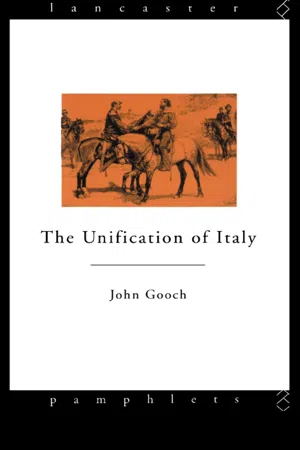
John Gooch's book is a concise introduction to the unification of the Italian states and the legacy of this union. Starting in 1815 at the end of the Napoleonic Wars, the book goes on to explain how, despite the causes of disunity, these Italian states shared racial, linguistic, and cultural factors, which led to their eventual political unity.
- 58 pages
- English
- ePUB (mobile friendly)
- Available on iOS & Android
eBook - ePub
The Unification of Italy
The Unification of Italy
Introduction
In 1815 Italy consisted of eight separate states. Most were under the direct or indirect control of Austria, and those that were not were ruled by conservative, absolutist kings. Forty-five years later Piedmont– Sardinia, by no stretch of the imagination powerful enough at the outset to dominate the peninsula, provided Italy with her first king and stamped unification on the country. To achieve this foreign domination had to be overcome, local absolute rulers had to be unseated, and the different enthusiasms of patriots had to be united in support of a small, conservative state which occupied only the north-eastern corner of the country and whose upper classes habitually spoke French and not Italian. All this had to be accomplished without stirring the Great Powers, accustomed since the fifteenth century to regarding Italy as their playground, into repressive intervention. In the circumstances it is small wonder that after unification had been achieved Gladstone described it as ‘among the greatest marvels of our time’.
The Risorgimento, the movement for the unification of Italy, was seen by contemporaries as a triumph of nationalism - the dominant force of mid-nineteenth-century Europe. To assess how accurate this judgement is, it is necessary to disentangle the many threads which made up Italy’s ‘national revolution’; for the Risorgimento was in essence a process during which many struggles came together to become one. At its heart lay two motive forces. The first was a search for political liberty within Italy. Those who fought for this goal spread along a spectrum extending from the bourgeoisie, who wanted only to reform and limit the powers of absolutist monarchs, to democrats such as Garibaldi who desired mass involvement in politics. The second force was the search for independence. The desire to cast off oppressive foreign rule ultimately united those directly under Austria’s thumb, those whose rulers depended upon Austrian bayonets to sustain them, and those who sought to free themselves from the rule of ‘foreign’ Italian princes.
The parties involved in each of these struggles – and they were of course often related – were by no means in agreement about their objectives. And it was never a foregone conclusion that they would only be resolved by creating a united Italy. The history of the Risorgimento is the story of how and why these many groups at first struggled separately and failed, and then struggled together and succeeded.
Strands of Revolution, 1815–48
During the first stage of the Risorgimento, men of action put their faith in techniques of revolt to topple unpopular monarchs. Their methods – conspiracy and insurrection – failed. Yet this failure contributed to the long-term success of the Risorgimento, for it helped, first, to demonstrate that to spark off a revolt it was not enough merely to recruit a small, dedicated group of fighters and hope that others would follow their example; some commonly accepted ideological basis was needed to unite men. Secondly, and equally as important, the failures of activists and the quiet success of businessmen and writers contributed to a growing consciousness of national identity. Without this there could have been no ‘national’ revolution. As yet, however, ideas and action were the concerns of only a very few.
THE NAPOLEONIC LEGACY
From 1796 until 1815 Italy was under French domination. After 1815 the period of French control provided patriots with an important legacy. Left-wing activists could look back with nostalgia to the republic established at Rome in February 1798, to the two Cisalpine republics of the north created in 1797 and 1800 and to the Parthenopean republic proclaimed at Naples in 1799. Monarchists could point to the kingdom of Italy and the kingdom of Naples established in the later years of French domination. Also the efficiency of French government offered a striking contrast to absolutist rule. However, the most important consequence of French rule was to establish in men’s minds the idea that Italy could become a unitary state.
BUONARROTI AND THE CARBONARI
For more than a decade after the Restoration of the monarchy secret societies plotted against absolutist rulers. In northern Italy the League of Sublime and Perfect Masters, founded in 1818 and led by Filippo Buonarroti, spread conspiracy from its headquarters in Turin. Its immediate goal was independence from Austria, its ultimate aim – revealed only to a few – was a communistic society. In the kingdom of the Two Sicilies its counterpart was the Carbonari (named after the rural charcoal burners), which had existed in Naples since 1807 and whose chief target was the Church.
In the south the Carbonari joined a rising by elements of the Bourbon army on the night of 1/2 July 1820. Ferdinand quickly gave way and granted a version of the radical Spanish constitution of 1812 – which had a single elective chamber – and at once found himself faced with a separatist rising in Sicily. At the congress of Laibach on 26 January 1821 Ferdinand obtained European support, and with Vienna’s assistance he crushed the rebels at the battle of Rieti on 7 March 1821.
In Piedmont, liberal aristocrats and bourgeois democrats plotted to introduce a constitutional régime and unite the province with Lombardy and Venetia in a kingdom of Upper Italy. Revolution broke out on the night of 9/10 March and king Victor Emmanuel I at once abdicated in favour of his brother Charles Felix. Austria, Russia and Prussia would not accept a Piedmontese constitution and Charles Felix flatly refused to have anything to do with it. With Austrian help he easily suppressed the rebels.
The revolutions of 1820–1 had unseated kings in Turin and Naples with apparent ease. However, they had equally easily been crushed by Austrian intervention, underlining the importance of Great Power reaction to events inside Italy. Seeing the fate of these risings people began to link constitutionalism with independence, since it appeared that domestic freedom could prevail only as long as the Austrians did not suppress it. When the July revolution of 1830 brought a constitutional régime to power in France the conspirators hoped she would maintain a policy of international non-intervention and guard them against Austria.
Revolution broke out again in 1831, beginning in Modena and spreading rapidly to Parma, Bologna, the Marches and Umbria. Once again it lacked any widespread roots or any unifying cause. One group wanted to make Francesco IV of Modena – a fierce reactionary – into the head of a liberal national movement. He initially approved this plan but then changed his mind and had the plotters arrested on 3 February 1831, two days before their insurrection was due to begin. In Bologna resentment had been growing at the backwardness and restriction of clerical rule. The interlude between the death of Pope Pius VIII on 30 November 1830 and the election of Gregory XVI on 2 February 1831 allowed the plot to mature, and on 4 February 1831 a rising broke out in Bologna. Francesco IV promptly fled to Vienna for help, and the duchess of Parma took refuge with the Austrian garrison at Piacenza. In Bologna the aristocracy and higher bourgeoisie quickly seized the reins from the conspirators and set about dismantling papal government, issuing a constitution on 4 March 1831. At this point the revolution was undermined from outside. The future Napoleon III was plotting at Rome, and Metternich artfully put before king Louis-Philippe of France the spectre of Bonapartism established in central Italy. France at once recognized that Austrian intervention was a ‘family affair’ – the duke of Modena and the duchess of Parma were both members of the Austrian royal family – and Austrian troops moved in to crush the revolt, which ended on 26 March when the provisional government of Bologna capitulated.
MAZZINI AND YOUNG ITALY
Giuseppe Mazzini (1805–72) was born in Genoa, a hothouse of republicanism and nationalism, and grew up amidst the heated debate which raged there between revolutionaries and conservatives. He had joined a branch of the Carbonari in 1827 but soon became disillusioned by their lack of clear political purpose: ‘My initiator had not uttered a syllable which gave a hint as to federalism or unity, as to republic or monarchy’, he wrote later, ‘just war against the government, no more.’ He soon determined his own objective: to free Italy from Austrian occupation, indirect control by Vienna, princely despotism, aristocratic privilege and clerical authority. Arrested in November 1830, he was briefly imprisoned before being released and exiled the following January. It was whilst in prison that he developed the ideas which led him to found Giovine Italia (Young Italy) in 1832.
Mazzini’s new patriotic revolutionary society was a reaction to the failure of 1820–1 and 1831, from which he concluded that the old revolutionaries had been too cautious and that the Italian nationalist movement had reached a point of maturity which put it ahead of its leadership. It was also a response to the widespread risings across Europe in 1830–2 which led many to feel that revolt was in the air. More specifically, Mazzini was influenced by a book published in 1831 by Buonarroti entitled Reflections on Federal Government Applied to Italy. In it the old revolutionary confessed to having abandoned his belief in a federal republic in favour of a unitary one as this was a better way to avoid social inequality and would be more able to defend itself. Buonarroti still believed, however, that before anything could happen in Italy there must be a democratic revolution in France. Mazzini scorned this ‘wait and see’ attitude, believing that Italy could make its own future.
Young Italy was founded, first, on a firm belief in progress, which had been stifled by the Restoration. Mazzini believed that God had given missions both to peoples and to nations, and the strong feelings of patriotic nationalism which he imparted to Young Italy were founded on his conviction that Italians could make themselves into a nation-state and that Italy had a mission in the free world. The second important characteristic of the movement was its emphasis on a united Italy, in contrast to the localism of other patriotic movements. Thirdly, Mazzini was a republican: only this form of government, he believed, could secure the equality of peoples.
Mazzini aimed to marry thought and action by the twin means of education and popular insurrection. In practical terms he was singularly unsuccessful. A plot hatched in Marseilles in 1833 to invade Savoy was denounced, and another, later in the same year, for a rising of patriots in Naples came to nothing. In February 1834, a small force of Mazzinians crossed the border from Switzerland into Savoy. When the local population failed to show any enthusiasm for the call to arms they at once retreated.
The fiasco of the invasion of Savoy ended the first phase of Mazzini’s activities, and by February 1836 he reported that Young Italy had completely broken up. Mazzini himself fled to London in 1837 and remained there for the next eleven years. In 1839 he announced that he was going to reconstitute Giovine Italia, with the important addition of workers’ groups: ‘In the first period of our existence we worked for the People but not with the People’. However, he remained implacably hostile to socialism, believing that all classes must be united in the struggle for Italy and not divided against one another. And he ignored the agrarian problems which affected so deeply the everyday life of the peasant masses in many parts of Italy.
Mazzini’s example spawned a succession of imitators. Risings in Sicily and the kingdom of Naples in 1837 and perpetual stirrings in the Papal States prompted Nicola Fabrizi to found the Legione italica (Italic Legion) in 1839 and try to link the various groups of plotters. An uprising in Naples planned for 31 July 1843 never took place and the bands which rose briefly and disorganizedly in the Papal States were soon crushed and their ringleaders executed. The Bandiera brothers, members of Giovine Italia who had founded their own secret society, tried to raise an insurrection in Calabria in June 1844. It failed and both brothers were taken and shot. Trouble was endemic throughout much of Italy on the eve of 1848, but it was of a local and narrowly based variety. Men were wooed by Mazzinian ideals; masses remained stubbornly uninterested in them.
ECONOMIC NATIONALISM
In the years before 1848 most of Italy was economically backward. Apart from silk the main products were grain, oil, wine, wool, cotton and flax and these were chiefly produced for local consumption. External markets were hard to enter because of the high tariff walls which most states put up; and a marked tendency to put surplus profits into land, often for social reasons, deprived industry of much needed investment. Lombardy was the exception to this general picture. Here a favourable climate permitted the growth of mulberry trees, and silk became the dominant product. From 1824, as foreign markets expanded, Lombards sold initially to London and then, as first Indian and later Chinese and Japanese silk took over, they moved into French and German markets. Lombard silk producers chafed at the restrictive tariffs imposed on them by Vienna and were bitterly hostile to Austrian attempts to divert their trade from its traditional flow through Genoa and move it instead to Trieste, fearing that they would be stranded on the margin of European development.
If not directly interested in unification, Lombard businessmen became more interested in progress and economic development as they nurtured their export trade. The rules of the market place and developments in science and technology were of considerable importance to them, and newspapers and journals sprang up to give these economic liberals the knowledge they sought. It was in this area that connections could be made between freedom of trade and freedom of the individual. Writing in Florence’s Commercial Journal on 14 July 1847, Camillo Cavour, a future prime minister of Italy, put the point clearly: ‘We are convinced that in working to lower the barriers that divide us, we are working for the intellectual and moral progress of Italy as well as for its material prosperity.’
The tariff barriers put up by a divided Italy were a political obstacle to economic development. Another adverse consequence of political division was a poor communications network. Only Lombardy had a good road and canal network. The railway system was rudimentary; only three short stretches of railway existed in Austrian-controlled territory, together with one in Piedmont and one in Naples. Régimes which were so backward dismayed and annoyed moderate liberals looking to improve their economic position and take advantage of the opportunities which a more modern state system of credit institutions, free trade and good communications could provide.
CULTURAL NATIONALISM
Alongside republican activists there existed by 1848 an influential group of moderates who propagated their ideas through books and journals. Cultural nationalism was first put forward in the review Antologia (Anthology), founded in Florence in 1821 to spread literary ideas to a national audience. The other forerunner of the literary explosion of the 1840s was the journal Universal Annals of Statistics, Public Economy, History, Travel and Commerce, founded in Milan in 1824. The Congress of Italian Scientists, which first met at Pisa in 1839, was another expression of national consciousness as well as a vehicle for disseminating progressive ideas. Although political discussion was formally excluded, the debates on economic and social problems carried unmistakable undertones of reformism.
A spate of published histories made liberals much more aware of their national past. In 1839 Troya produced the first volume of his History of Italy in the Middle Ages. Nine years earlier, count Cesare Balbo had produced a History of Italy under the Barbarians, and he followed this with a Summary of the History of Italy in 1846. The Tuscan journal Italian Historical Archive and the Piedmontese Society for Patriotic History were part of the same phenomenon.
The first of a number of programmes for unification put forward during these years was Vincenzo Gioberti’s Of the Moral and Civil Primacy of the Italians, published in 1843. A liberal catholic who believed that Mazzinian tactics had failed and who preferred to put his trust in princes, Gioberti believed that an Italian risorgimento would be the first step to the world hegemony of a reformed church. He proposed a confederation of states under the pope’s leadership, supported by Piedmont: the union of Italy, he wrote, ‘must commence where faith and force chiefly reside, that is, in the holy city and the warrior province’. Balbo’s Summary of the History of Italy helped give a historical basis to the concept of the pope as the defender of Italian liberty.
An alternative prospectus for unification came when Balbo published Of the Hopes of Italy in 1844. Arguing that the Piedmontese monarchy was destined to lead Italy, he set the struggle firmly in a European frame. For Austria to be ousted from the peninsula would require assistance by the Great Powers. To Balbo, the immediate task was to build up a rational, moderate body of nationalist opinion. The argument for Piedmont as the natural leader of a united Italy was also put forcefully by Massimo d’Azeglio in The Most Recent Events in Romagna (1846) and Proposal for a Programme for Italian National Opinion (1847). D’Azeglio suggested that it was in the princes’ interests to ally with the moderates who were seeking to liberate Italy from reaction: ‘If Italian sovereigns do not want their subjects to become extreme liberals’, he wrote, ‘they must make themselves moderate liberals.’ His programme included popularly elected communal councils, public trial by jury, progressive press laws, a general system of railways and the breaking down of internal commercial barriers.
Why had the revolts failed? Absolutist régimes had proved vulnerable to initial assault but had been able to recover with external assistance. This highlights the importance of the international alignment: until the Concert of Europe failed in 1824–5, Britain was prepared to support intervention by the Great Powers w...
Table of contents
- Cover
- Half Title
- Series Page
- Title Page
- Copyright Page
- Contents
- Foreword
- Time chart
- Map
- Introduction
- Suggested reading
Trusted by 375,005 students
Access to over 1.5 million titles for a fair monthly price.
Study more efficiently using our study tools.
Frequently asked questions
Yes, you can cancel anytime from the Subscription tab in your account settings on the Perlego website. Your subscription will stay active until the end of your current billing period. Learn how to cancel your subscription
No, books cannot be downloaded as external files, such as PDFs, for use outside of Perlego. However, you can download books within the Perlego app for offline reading on mobile or tablet. Learn how to download books offline
Perlego offers two plans: Essential and Complete
- Essential is ideal for learners and professionals who enjoy exploring a wide range of subjects. Access the Essential Library with 800,000+ trusted titles and best-sellers across business, personal growth, and the humanities. Includes unlimited reading time and Standard Read Aloud voice.
- Complete: Perfect for advanced learners and researchers needing full, unrestricted access. Unlock 1.5M+ books across hundreds of subjects, including academic and specialized titles. The Complete Plan also includes advanced features like Premium Read Aloud and Research Assistant.
We are an online textbook subscription service, where you can get access to an entire online library for less than the price of a single book per month. With over 1.5 million books across 990+ topics, we’ve got you covered! Learn about our mission
Look out for the read-aloud symbol on your next book to see if you can listen to it. The read-aloud tool reads text aloud for you, highlighting the text as it is being read. You can pause it, speed it up and slow it down. Learn more about Read Aloud
Yes! You can use the Perlego app on both iOS and Android devices to read anytime, anywhere — even offline. Perfect for commutes or when you’re on the go.
Please note we cannot support devices running on iOS 13 and Android 7 or earlier. Learn more about using the app
Please note we cannot support devices running on iOS 13 and Android 7 or earlier. Learn more about using the app
Yes, you can access The Unification of Italy by John Gooch in PDF and/or ePUB format, as well as other popular books in History & 19th Century History. We have over 1.5 million books available in our catalogue for you to explore.