![]()
1 The Rich Spectrum of
Human Potential
Influences on the development of
human abilities and capacities
Every human being has the potential to manifest the finest mosaic of attributes in a dazzling complexity of difference and diversity. Yet so often, this human mosaic is dull and tarnished — only a hint of the incipient splendour remains. And yet, sometimes, we are inspired by the light radiated from an individual.
(Belle Wallace)
This chapter outlines the key principles which maximise the development of children's learning.We examine the constituents that produce a rich learning environment in which children can develop their vital general learning capacities: intuition, memory, creativity, reasoning or logic, and metacognition which is the super-ordinate learning capacity.
The chapter also discusses the full range of human abilities together with the learning processes and competencies or outcomes which should inform a curriculum that aims to develop thinking and problem-solving.
Appendix 1 on pages 133–50 is arranged in three main parts:
- Appendix 1A provides practical teacher observational checklists outlining:
1A.i general problem-solving abilities
and the core characteristics that are specific to each human ability:
1A.ii core characteristics for Foundation Key Stage 1 (4- to 7-year-olds)
1A.iii core characteristics for Key Stage 2 (7- to 11-yearolds)
- Appendix 1B provides suggestions for practical activities that allow children to display these characteristics.
- Appendix 1C provides checklists for reflection on preferred activities across the full range of human abilities:
Checklist 1 provides a reflective checklist of preferred activities for children at the upper end of Key Stage 2. This supplements the experience of working across the full range of activities suggested in Appendix B.
Checklist 2 provides a reflective checklist of preferred activities for teachers who need to recognise fully the profile of their own abilities so that they have a clearer understanding of their own preferred learning and teaching modes.
Every child is born with huge potential for learning – potential for a wide range of human abilities to develop and manifest through rich human activity. Current neuro-biological research suggests that rich experiential play in the early years of brain development activates and establishes a complex network of connections which children need for later learning in physical, social, emotional and cognitive domains. Parents and teachers play a vital role in this development, interacting, extending experiences, acting as role-models, and providing examples and opportunities for practice.
There is a range of key principles that characterise the optimum development of children's potential. These principles constitute the essential factors that should combine to enrich the interaction between children and their parents, mentors or teachers. The principles are outlined below.
Key principles in maximising the development of children's learning
| 1. Within a rich environment of learning experiences, young learners use vital general learning capacities: intuition, memory, creativity, logical thinking, and metacognition. These capacities dynamically interact in the process of problem-solving. |
| 2. Problem-solving should optimally take place using the full range of human abilities. |
| 3. Through a developing network of learning processes, children need to acquire a range of competencies or outcomes. |
| 4. Children should understand their problem-solving processes and should use these processes across a wide range of problem-solving activities. |
We need now to analyse and break down the principles highlighted above and to look in depth at these interrelated components that bring about children's effective learning.
What constitutes a rich environment of learning experiences?
June Maker and Usanee Anuruthwong (in press) use the metaphor of a tree when discussing children's learning environments. They suggest that the growth of a tree responds to the amount of water available – too much rots the tree, while too little stunts its growth. Nevertheless, many trees adapt to their growth environments. Similarly, an ‘over-rich’ environment can flood a child with too many sensations and too much stimulation, denying the child's own essentially individual personality and her or his need for personal space and adequate rest. Conversely, an ‘impoverished’ environment denies the child rich experiential opportunities and development is stunted. These experiential opportunities are both physical in the sense of the actual surroundings and dynamic in the sense of the quality of human interaction.
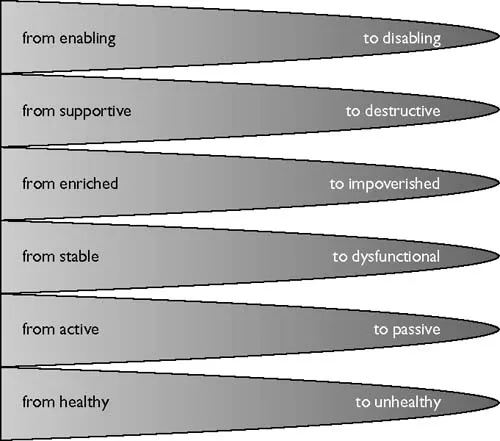
We could think of optimal environmental influence as lying somewhere along the continuum shown in Mindmap 1.
Mindmap 1: The continuum of influential environmental factors
However, many children not only survive but triumph over potentially disabling environments, and usually there is at least one enabling factor – such as the child's own inner resilience, perception and determination, or an adult/mentor who supports and encourages.
- In what ways do the early years and primary classrooms foster an enabling environment for children?
- What can schools do to help parents understand children's need for rich experiences, quality time and interaction?
What do we mean by vital general learning capacities?
Recent theorists argue that ‘intelligence’ is the capacity for problem- solving, both with regard to everyday life problems, and also with regard to so-called ‘academic’ and ‘practical’ problems such as those that occur, for example, at all levels in maths and science or history and literature.
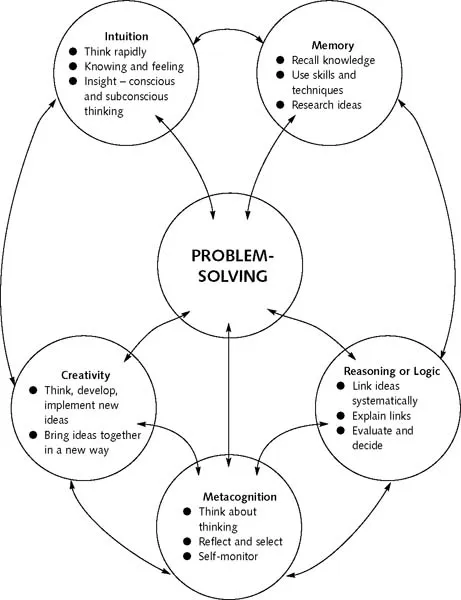
We call into action a number of capacities that are interdependent and interactive during the process of problem-solving. These are illustrated in Mindmap 2.
Mindmap 2: Vital general learning capacities
© June Maker and Belle Wallace (2004) Thinking Skills and Problem-Solving – An Inclusive Approach, David Fulton Publishers.
Intuition
Intuition is the capacity to ‘know something immediately’. The thinking is rapid, it may be logical and creative, and it combines rapid understanding and insight that uses elements of both subconscious and conscious thinking. Children have a great capacity for intuitive understanding – knowing and feeling before they develop language to express that understanding and feeling. We could refer to their intuitive understanding as their ‘first language’ and call the sounds and symbols they learn to express ideas their ‘second language’. Many very able children process knowledge and information so rapidly that they have difficulty explaining the steps of their thinking when they are asked to ‘write down the stages’. While many adults retain and use their capacity for intuitive thinking in diverse scenarios, sadly all too many adults distrust thinking that cannot be broken down into obviously connected logical steps.
Memory
Everyone needs a store of knowledge that is experiential or acquired through finding out about the world. Everyone also needs knowledge that is specific to a particular ability, for example wide language vocabulary, maths sequences, decoding and spelling, music notation and dance movement.
We use both experiential and ability-specific knowledge in the process of problem-solving. The child has tremendous memory capacity for learning new ability-specific knowledge and skills when the learning is embedded in real-life experiential contexts.
Creativity
Creativity is the general capacity to think of, develop, and implement new or appropriate ideas and solutions, or to bring unusual ideas together in a new way. The creative capacity can result in a personally creative idea or product, as happens often with young children, or in an idea or product that is universally ‘new’, as is the case with older, more experienced and mature learners. Creative thinking is an essential element in problem-solving.
Reasoning or Logic
Reasoning or logic is the capacity to link ideas in systematic steps that can be explained or justified. However, there are different modes of logic. For ex...