- 352 pages
- English
- ePUB (mobile friendly)
- Available on iOS & Android
eBook - ePub
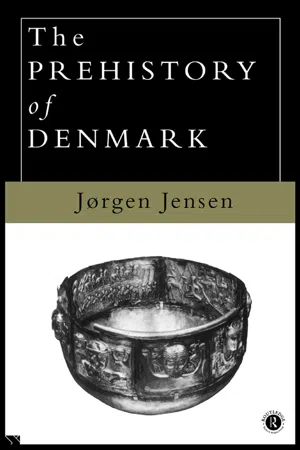
The Prehistory of Denmark
About this book
First Published in 2004. This book is both a survey of Danish prehistory and a detailed presentation of the problems, themes and literature of modern Danish archaeology. It was written to present a general survey of the prehistory of Denmark as it has emerged after the past decade of research. The book is composed of four sections: The hunters and gatherers, the first farmers, towards a new era and the chiefdom of the Iron Age. Each section includes chapters dealing with the environment, demography, subsistence patterns and social patterns. Each section is followed by a survey of the archaeological record for the period and a discussion of the relevant literature. The book concludes with a bibliography of approximately 700 titles covering most of the major Danish archaeological studies since about 1950.
Information
PART I
The hunters and gatherers 11,000–4200 BC
1
A changing environment
After the last Ice Age
During the Pleistocene, northern Europe underwent at least four waves of fierce, cold ice ages. During at least two of the warmer periods which intervened between the ice ages, man appears to have lived in Denmark. The oldest and best documented finds are man-made tools from Vejstrup Forest in Jutland. Through them we can trace the presence of man in Denmark more than 200,000 years back in time.
Unfortunately, our knowledge of the first appearance of man in Scandinavia is so scanty that it would be impossible to attempt to determine his behavioural patterns. Not until after the last Ice Age, the Würm-Weichsel, can we piece together a coherent picture of human evolution in Denmark.
Approximately 13,000 years ago began the climatic change which brought the last Ice Age to a close. During this glacial period, Denmark was completely covered by ice except for the western parts of Jutland. At Hald near Viborg, the edge of the ice made a sharp angle. From here it extended westwards towards Britain. To the south the ice margin extended down through mid-Jutland.
As the ice sheet retreated, vast quantities of meltwater began to flow out to the cold arctic sea, and where the ice had once lain, a barren landscape was now exposed. The most striking feature of the newly revealed land was the pale raw soil. This barren raw soil imparted to the landscape a remarkably light colour due to the fact that the soil contained no humus but much lime. Even where sparse vegetation gradually began to grow, the light colour predominated. Only after an exceedingly slow ‘maturation’ process lasting thousands of years was the light raw soil converted into dark fertile mould. When the ice disappeared, the land was, from a biological point of view, still young.
The first pioneer flora which spread over the barren earth, thus creating an open tundra, consisted in part of mountain avens (Dryas octopetala), which was conspicuous in the landscape with its ivory-white flowers on long stems. Here and there were white carpets of this flower. Dwarf willow (Salix herbacea), arctic willow (Salix polaris), dwarf birch (Betula nana) and sea buckthorn (Hippophaë rhamnoides) flourished, along with the now rare Öland rock rose (Helianthemum oelandicum) which tinted southern slopes yellow during the short arctic summer (Figure 4). All these immigrated pioneers were hardy and cold-tolerating. Many of them could survive under snow most of the year; all of them managed to blossom and produce seeds during the brief cool summer. These pioneer growths were characterized by their love of light and their preference for calcareous soils. During this period, the summer temperature averaged 8°–9°C.
Around 10,500 BC came one of the first brief warm phases which can so deeply disturb the delicately balanced arctic vegetation. The first Late Glacial warm phase is called the Bølling oscillation. During this short period, a park tundra developed in Denmark with light forests of birch in the warm areas. The open tundra still dominated in the cold north-facing or damp areas. The landscape became green in the summer, but the return of the night frost must have brought bright yellows and reds, followed by winter whiteness.
During the Bølling oscillation, the area which is now Denmark was freed of ice; but the mild temperature was only a brief respite. A new cold thrust around 10,000 BC (the Older Dryas) caused a major recession; the light pioneer forest was obliterated and once more the open tundra prevailed.
Then, several centuries later, a new warm phase known as the Allerød period began. Once more a park tundra grew up with birch (Betula pubescens) as the dominant tree. Quaking aspen (Populis tremula) and rowan (Sorbus aucuparia) also appeared together with juniper (Juniperus communis) and bird cherry (Prunus padus). The climate was so mild that presumably pine also grew.
During the Allerød period the south-eastern and north-western parts of the country contrasted sharply with one another. South-east Denmark now had a temperate climate with an average July temperature of 13°–14°C. Then around 9000 BC, a last sudden temperature drop (the Late Dryas) was felt over most of Europe north of the Alps. The climate became subarctic, the summer temperature sank to about 10°C. The inland ice ceased to thaw on the Scandinavian peninsula, and in Denmark trees very nearly stopped growing. The south was a park tundra, whereas in the north-west a wide open tundra dominated. The flora resembled that found today near the northern pine forest limit.
Animals as well as pioneer plants found their way to Denmark toward the close of the Ice Age. The reindeer was the characteristic tundra animal. In pursuit came its worst enemies: the wolverine and the wolf. Bison and wild horses grazed in the Late Glacial terrain, and there were also lemmings and blue hares. Fish of the Late Glacial waters included perch (Perca fluviatilis) and pike (Esox lncius).
During such mild periods as the Bølling and the Allerød, animal life grew increasingly varied. It was, from a modern viewpoint, a strangely mixed fauna. Tundra and steppe animals such as the reindeer, wild horse and bison still flourished in the milder environment. Now, however, the open forest vegetation attracted forest animals to the country. The newcomers included the now-extinct Irish elk (Megaloceros giganteus) and the common elk. The beaver, the brown bear and the lynx also arrived.
The Late Glacial ice sea was inhospitable to both flora and fauna. During cold periods the sea was frozen in the winter and filled with drift ice in the summer. However, whales and seals made their home in this ice sea. There are traces of the Greenland whale (Balaena mysticetus) and the killer whale (Orcinus orca); the ringed seal (Pusa hispida) and the walrus (Odobenus rosmarus) probably also lived in the glacial sea. Fish included the high arctic cod species Gadus saida. In warmer periods there was less drift ice. Along with the temperate mollusc fauna, new larger animals such as the rorqual (Balaen optera physalus) and the blue whale (Sibbadus musculus) also appeared. Arctic birds on the open sea included multitudes of long-tailed ducks (Pagonetta glacialis).
The extent of the land during the Late Glacial period is still not entirely known. At first northern Denmark was still heavily weighed down by the ice sheet masses. Northern Jutland consisted of a series of islands and the ice sea extended further eastwards, along the island of Læsø, roughly down to the present north coast of Zealand. The Baltic surface was still frozen. The land now freed from the weight of the ice gradually rose. But during the warmer periods the sea-level rose even faster then the land due to the influx of meltwater. In the end, it was the rise of the land which most influenced Denmark’s geography. By the end of the Glacial period the land mass seen in Figure 6 had appeared.
This outline of the development of nature from the Late Glacial period and on through the millennia is based upon more than a century of research. Geological, pollen-botanical and zoological investigations have shed light on the migration of plants and animals to the land uncovered by the melting of the ice. Of especial importance is the relative chronology of Danish vegetational history which has been described in botanist Knud Jessen’s division of the pollen diagrams (Figure 5) into nine zones (I–IX). These zones can today be pinpointed chronologically by radiocarbon datings. In the main, the great drama of the development of the environment after the last Ice Age has been revealed. However, it still remains to identify the factors which set this drama into motion: the development of the climate and the soil, and not least of all man’s influence on nature.

Figure 4 An open landscape covered with a hardy and cold-tolerating vegetation was the scene of the appearance of the first hunting groups to arrive in Denmark after the last Ice Age. The general impression may have resembled this landscape from the Tollund bog in central Jutland.
In the Late Glacial landscape just described, the first hunting communities appeared. Man’s role during this period resembles that of the pioneer plants and animals. The lives of the hunting people were totally shaped by their marginal environment. Nor is it surprising that traces of the first reindeer hunters are so scarce. This reflects a tiny population, the size of which was proportional to the resources available. To be sure, the fauna of Denmark has probably never since been so varied as in the sunny Late Glacial period. But these resources were subject to extreme seasonal changes which determined both the size of the population and human behaviour. As will be shown, rising average temperatures in the subsequent period eased conditions for the hunting people and altered their existence.

Figure 5 Pollen chart of the vegetational development in Denmark as described by botanist Knud Jessen in his division of the pollen diagrams into nine zones.
The first continuous forest
Quite suddenly, around 8300 BC, the temperature rose drastically and in a short time the open park tundra was completely transformed. This period is termed the Pre-Boreal. Now a light and open birch forest spread over the terrain. The rapid rise in temperature encouraged the growth of trees such as aspen and birch which here and there had survived the cold period. Pine followed. All these trees were light-demanding pioneers and were the only species which survived long. They had already existed in the warm Allerød period. However, their development was irregular. Shortly after the first steep increase in temperature a brief cold period set in, delaying growth for some centuries. Then once more the temperature rose.
The continuous forest created by the warmer climate totally altered the animal life of the territory. The abundance of big game which had once roamed the open land now disappeared, to be supplanted by more localized species. The hunters’ favourite game, the reindeer, vanished, and the aurochs and elk instead made the forest their home. Gradually red deer also became common in the light pioneer forest. Naturally, the presence of these meat-yielding animals strongly influenced the hunters’ way of life. During the Pre-Boreal, the land mass of Denmark looked completely different from today (Figure 6). It was then the northernmost tip of a large continent extending westward all the way to Britain. The climate was still cool, averaging about 15°C in July.
A new forest scene: the Hazel-Pine forest
After the light, open forest of the Birch-Pine period had endured for more than a thousand years, a new and more radical transformation of Denmark occurred about 7000 BC. As the summer temperature continued to rise trees appeared which later dominated the forest: oak (Quercus), elm (Ulmus), hazel (Corylus), aspen (Populus tremula) and lime (Tilia cordata). Hazel, the first to migrate, now reigned in the forest together with pine. The appearance of hazel marks the beginning of the Boreal period. This tree thrives in the meagre shadow cast by a forest of birch, pine and aspen, where it also receives an ample quantity of sunlight. The underwood must have been rich in nuts, which became a vital supplement to the diet of the forest inhabitants.

Figure 6The relationship between land and sea about 8500 BC. A major part of the Scandinavian peninsula is still covered by the inland ice.
In the Boreal hazel-pine forest, the large meat animals such as the aurochs and the elk still abounded. At the same time the red deer, the roe deer and the wild boar also became common. Compared with the wealth of game in the Late Glacial landscape, the forest of the Hazel-Pine period was nearly barren. In the poverty of its bio-mass, the Boreal forest can be compared to a desert or semi-desert. But from an ecological point of view, nature had evolved into a new stage of greater diversity and stability than before. Seasonal fluctuations in the availability of resources became less drastic. A broader spectrum of choice of existence now opened to the inhabitants of the land. The transformed environment had remoulded the life of the hunter communities. Most probably the population gradually increased due in part to a lesser dependence on seasonal variations in the access to food, the presence of large game animals, and the abundance of edible plant foods such as nuts, roots, bulbs, mushrooms, bark, fruits, plant juices, and many more. Although these plant foods have not yet been studied carefully, it is likely that gathering played an ever-increasing role in the life of human societies. In the following, the term ‘hunters and gatherers’ will refer to the societal form which prevailed from the Pre-Boreal period onward.
During the Boreal, Denmark was still much larger in area than it is today (Figure 7). But in both the Pre-Boreal and Boreal periods, the sea-level rose rapidly. The North Sea flooded over the land bridge between Jutland and Britain. One arm of the sea reached south of Britain, thus creating the Channel. The Baltic was turned into an enormous lake (the Baltic Ice Lake), the outlet of which was a wide river running through what is today the Storebælt. The land mass was at least one-fourth larger than modern Denmark. Today almost all the old coastlines are submerged.
The stable primeval forest
Warmth-loving trees immigrated to Denmark during the Boreal: first came hazel, later elm, ash (Fraxinus) and lime. No stable equilibrium among these trees existed. However, the forest slowly evolved toward the stable primeval forest of the Post-Glacial warm period. By this is meant that the light-demanding pioneer trees of earlier times were gradually supplanted as shade trees gained ground. This process produced the equilibrium characteristic of a mature ecosystem. This period—the Allerød—saw the culmination of climatic development. Presumably the summer temperature was 2°–3°C higher than today.

Figure 7The relationship between land and sea about 7000 BC.
At the commencement of the Hazel-Pine period, hazel competed with the pioneer trees and these were, in the long run, doomed. Increasing warmth encouraged new shade trees to immigrate. Thus the forest moved into the phase of stable development which was to change the existence of its inhabitants so profoundly. By 6000 BC the stable primeval forest seems to have been formed. This stage was achieved at the same time as the climate changed from dry to humid; Denmark acquired an Atlantic oceanic climate. Doubtless the formation of the North Sea played its part in the increased humidity and warmth.
The dense primeval forest covering the land after 6000 BC was especially dominated by the lime, but elm and oak were also highly visible in the forest. The most striking feature of the stable primeval forest was its dense canopy. As undergrowth was relatively sparse, big game was afforded a poor selection of food. Aurochs and elk gradually died out and red deer and roe deer also decreased in number. However, the wild boar, which seeks its food in the moist forest floor, apparently survived undisturbed. In general it seems that the decrease in the bio-mass is sometimes exaggerated. A number of factors indicate that swift and synchronous alternations between dense and sparse vegetation could occur over large areas comprising whole stands of trees. Cyclic regeneration in the forest did not take place in isolation but over large areas covered by a whole stand of trees of the same age which had simultaneously been toppled by a storm. Thus the interior of the forest always included large glades which offered favourable conditions for many of the food plants of the big forest game. On the whole, however, the interior forest shows low productivity and low diversity. It is thus hardly capable of supporting year-round settlements even on a minor scale.
Out by the coasts and around the numerous inland lakes, swampy areas and streams, living conditions were much more favourable. Here the vegetation and fauna were far more richly varied than in the forest (Figure 9). Abundant sunlight provided a basis for fertile plant growth and teeming animal life. In time this situation became even more important for the population of the country.
The far north of the Scandinavian peninsula was still locked by enormous quantities of ice from the Ice Age. To the south, however, the increasing warmth continued to release gr...
Table of contents
- Cover Page
- Title Page
- Copyright Page
- List of Figures
- Preface
- Introduction
- PART I: The hunters and gatherers 11,000–4200 BC
- PART II: The first farmers c. 4200–2800 BC
- PART III: Towards a new era 2800–500 BC
- PART IV: The chiefdoms of the Iron Age 500 BC–800 AD
- Bibliography
Trusted by 375,005 students
Access to over 1.5 million titles for a fair monthly price.
Study more efficiently using our study tools.
Frequently asked questions
Yes, you can cancel anytime from the Subscription tab in your account settings on the Perlego website. Your subscription will stay active until the end of your current billing period. Learn how to cancel your subscription
No, books cannot be downloaded as external files, such as PDFs, for use outside of Perlego. However, you can download books within the Perlego app for offline reading on mobile or tablet. Learn how to download books offline
Perlego offers two plans: Essential and Complete
- Essential is ideal for learners and professionals who enjoy exploring a wide range of subjects. Access the Essential Library with 800,000+ trusted titles and best-sellers across business, personal growth, and the humanities. Includes unlimited reading time and Standard Read Aloud voice.
- Complete: Perfect for advanced learners and researchers needing full, unrestricted access. Unlock 1.5M+ books across hundreds of subjects, including academic and specialized titles. The Complete Plan also includes advanced features like Premium Read Aloud and Research Assistant.
We are an online textbook subscription service, where you can get access to an entire online library for less than the price of a single book per month. With over 1.5 million books across 990+ topics, we’ve got you covered! Learn about our mission
Look out for the read-aloud symbol on your next book to see if you can listen to it. The read-aloud tool reads text aloud for you, highlighting the text as it is being read. You can pause it, speed it up and slow it down. Learn more about Read Aloud
Yes! You can use the Perlego app on both iOS and Android devices to read anytime, anywhere — even offline. Perfect for commutes or when you’re on the go.
Please note we cannot support devices running on iOS 13 and Android 7 or earlier. Learn more about using the app
Please note we cannot support devices running on iOS 13 and Android 7 or earlier. Learn more about using the app
Yes, you can access The Prehistory of Denmark by Jorgen Jensen in PDF and/or ePUB format, as well as other popular books in Social Sciences & European History. We have over 1.5 million books available in our catalogue for you to explore.