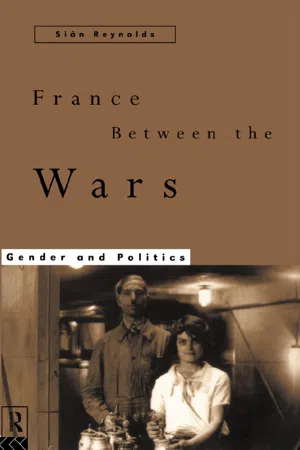
- 296 pages
- English
- ePUB (mobile friendly)
- Available on iOS & Android
eBook - ePub
About this book
Sian Reynolds challenges the prevailing assumption that women had little influence or power in France during the interwar period. She combines extensive empirical research with revealing insights into France's political history and women's history.
1
DEMOGRAPHY AND ITS DISCONTENTS
If France stops producing large families, you can put the grandest clauses in the treaty [of Versailles], confiscate all Germany’s cannon, do anything you please and it will be to no purpose: France will be lost, because there will be no more Frenchmen.
(Georges Clemenceau, 11 October 1919)1
An unpopulated country cannot be a free country. It lies wide open to every invasion, a prey vulnerable to every appetite. We shall therefore pursue a policy of pronatalism which will enable France to remain what she was in the last century.
(Edouard Daladier, 4 June 1939)2
Oh yes, there were many, many abortions (unnamed woman, interviewed about the 1930s).
(Thébaud 1986:299)
In December 1927, two schoolteachers appeared before magistrates in the French town of Saumur. Henriette Alquier and Marie Guillot were accused of offences under the 1920 law forbidding propaganda for birth control. The ‘Alquier affair’ as it became known inspired heated outbursts inside and outside parliament, both for and against the accused.
The 1920 law had been passed by the first post-war National Assembly, in reaction to the loss of life during four years of fighting, when almost 1.5 million French soldiers had died and thousands more had been disabled. Anxiety about the French birth rate, already historically low before the war, inspired a current of opinion generally known as pronatalism, that is support for measures to increase the numbers of births. It had supporters in almost all political parties. The same parliament passed another law in 1923, redirecting abortion cases to magistrates’ courts instead of to juries, with the aim of obtaining more convictions. Both laws redefined and extended penalties for offences associated with abortion or birth control. They have retrospectively become famous, though there was comparatively little public outcry at the time: what press comment there was sympathized with the pronatalist anxiety of the day.3
Henriette Alquier (née Clergue), mother of a small daughter, was twenty-nine, a village schoolteacher from south-west France: she had joined the Groupes Féministes de l’Enseignement Laïque (GFEL), a tiny minority of left-wing feminists within the schoolteachers’ union closest to the Communist party, of which she and her husband were also members. The report she prepared for the 1926 Grenoble conference of the GFEL was on ‘Motherhood as a social function’. Most of it was an outspoken protest at child poverty, as witnessed by primary schoolteachers, and in particular at the high rate of infant mortality in France, estimated at 100,000 a year. She described the partial solutions offered by legislation or private charity over the years—maternity allowances, free milk, crèches—as inadequate, and proposed that motherhood should become a ‘social function’, paid for by the collectivity. It was not this proposal which caused trouble, however, but the closing section, calling for more information about sex and contraception. Putting the accent on class, Alquier claimed that bourgeois legislators, ‘whose own wives can limit the number of their children in the privacy of their boudoir or adulterous love-nest’, had passed strict laws against publicity for birth control, so that ‘working-class women who needed information were deprived of it’. Contraception ‘hurts nobody’, the report continued, ‘it does not damage the physiology of man or woman and it is puerile to claim that destroying a spermatozoon or cell is attacking human life. [One day in the future], it will be possible to teach contraceptive techniques openly’.4
Read out at the conference in Alquier’s absence, the report was published in a special number of the GFEL Bulletin (printed in Saumur). Marie Guillot as editor was responsible for its contents. Not many people would have read it, had it not been referred to in May 1927 in a parliamentary question to the Minister of Education, put by a right-wing député Georges Pernot, an energetic pronatalist, and supporter of the 1920 law.
By 1927, parliament was no longer as preoccupied with the birth rate as it had been in 1920. The 1924 elections had produced a majority further to the left, but the first coalition government, based on the Cartel des gauches and led by the radical Edouard Herriot, fell in 1925. By 1927, the Cartel was in ruins and Herriot was Minister of Education in a government led by Raymond Poincaré, the centreright politician who had stabilized both the plunging franc and public opinion. Holding on to the Education Ministry, and thus to the state school system, was one of the concessions the Radical party had obtained after the Cartel’s collapse. As premier, Herriot had proposed several anticlerical measures, including strictures against religious congregations, which had provoked such sharp reactions that he had backed down. Now Catholic organizations and pronatalists alike called for action to be taken by the Minister of Education against Mme Alquier, a statesalaried ‘corrupter of the young’. Birth control was still a sensitive topic. It would seem no accident that dissidence over this issue should come from state primary schoolteachers, viewed by the church as the foot-soldiers of anticlericalism.
Even a Radical party leader was not disposed to defend in public any kind of ‘neo-Malthusianism’, as the birth control movement was known in France, and Herriot had himself voted for the 1920 law. Pressed to take action against one of the ministry’s employees, he described Alquier’s report as ‘provocative, a slap in the face of authority and inciting to immorality’. He promised that legal steps would be taken and that should the author be acquitted by the courts, he would press for sanctions within the educational system, via the ministry.5
Surprised by this reaction from a man of the anticlerical left, the teachers’ union hastened to Alquier’s defence. Her socialist lawyer argued that his client was being victimized. She had given no details of contraceptive methods (the real target of the law), merely expressing the wish that they could be openly revealed, whereas the authors of several works of fiction had been more explicit. The campaign attracted support not only from the extreme left but from the republican and non-communist Ligue des Droits de l’Homme, as well as from freemasons and trade unionists. After a string of witnesses testifying to the ‘irreproachable’ characters of the two accused, Alquier and Guillot were acquitted by the Saumur magistrates. Alquier returned to her village, where she carried on teaching and for a while became treasurer of the local branch of the Communist party.
Starting with this incident is one way of approaching a subject at once unavoidable and daunting. In inter-war France the apparently private world of family and reproduction stood in the forefront of public debate. By no means neglected, the subject has on the contrary been written about a great deal. The very comprehensiveness with which it has been covered has been an effective way of roping off a demographic history in which women are present, if only in a reproductive role, from a political history peopled exclusively by men. This chapter will draw on what exists already, rather than repeat it. There is no need for another account of France’s demographic history, or of the measures taken by governments in response to that history. Nor will it explore the cultural aspects of the question, illuminatingly discussed by Mary Louise Roberts, who suggests that the preoccupation with the birth rate after the Great War was a sign of the need to ‘purge moral and gender anxieties as well as military and economic ones’ (Roberts 1994:214).
The approach here will take the form of exploring the gender issues at the heart of the population question in a political context, relating them both to the politics of the day and to the way they are treated in historical accounts. What may strike us now is how both contemporaries and historians seem to be preoccupied with a single aspect of population change, namely conception—or contraception. Such selectivity has influenced the way this particular ‘field of gender’ has come to be viewed, a point that will become clearer if we review the existing historical narratives through which ‘the population question’ in France has been approached. Broadly speaking, they fall into two groups: the first having its origins in demography, the second inspired by libertarian or feminist politics. (Right/left distinctions, while not irrelevant, are not always the most useful ones in this context.) These approaches provide a useful, indeed an inevitable starting point, but they have structured the field in a rather limiting way. The second step will therefore be to indicate some of the gaps in the story.
THE DEMOGRAPHIC LAMENT AND ITS CHALLENGERS
Almost all general histories of the inter-war years approach the population question through the optic of ‘the demographic lament’ voiced by the pronatalists. The lament can be simply summarized: the French were/are having too few children and the government ought to do something about it. In this perspective, the interwar years were and still are seen as an age of acute crisis. As the words of Clemenceau and Daladier suggest, the ‘demographic lament’ had already appeared in the nineteenth century in response to the comparative population figures in France and in other European countries.6 The French population had stopped expanding as fast as that of its neighbours well before 1900. In its early days, the lament was inspired by fear of military defeat. The Franco-Prussian War could still be remembered by middle-aged adults in 1914, and the catastrophic losses during the Great War understandably lent the anxiety new strength. France might have emerged on the winning side, but rarely had victory been so dearly bought, and the next generation was gravely depleted. By the later 1930s deaths were exceeding births in France so when, during the Second World War, Marshal Pétain famously blamed a shortage of ‘children, weapons and allies’ for the crushing defeat of the French army in 1940, many will have believed him, although retrospectively military historians have not confirmed his claim.
The scientific version of the demographic lament was produced by the French school of demography (a word coined in France). From the nineteenth century to the present, demographers have argued that energetic government measures to encourage more births were/are desirable. Commitment to this idea is recognized to run high in the institutions of French population studies, in particular the Institut National des Etudes Démographiques (INED).7 Demographers, as the intellectual interpreters of the raw material of statistics, the census returns, have provided most of the data used by historians. If, as in France, a strong focus is placed on the birth rate, that delimits the subject in such a way as to marginalize other topics. The demographic agenda has helped structure general political histories of France, in a way unmatched elsewhere. So while today playing down its military significance, historians and textbook writers still give plenty of space to the birth rate, usually including it as a structural feature. It has become commonplace to suggest that a sagging demographic profile was associated with France’s general stagnation before 1939. The low birth rate, which persisted despite the best efforts of the pronatalists, is seen as an index of immobility, lack of vigour and vision (‘un pays de vieux’), and anxiety about change—by contrast with the post-1945 years, opportunely characterized by a baby-boom and eventually by economic take-off. This powerful and by no means implausible account links population size both explicitly and implicitly with progress and economic development.8
In this perspective, the historian could read the Alquier affair as symptomatic of the climate of opinion. The scandal caused by her report could be explained by demographic anxiety, and the decision to prosecute seen as evidence of the watchfulness of a pronatalist movement confident that its views were shared. Pernot had no doubt been alerted to raise the matter in the Assembly by the energetic Alliance Nationale pour l’Accroissement de la Population Française, the chief pronatalist political movement.9 It could also be read as a sign that no government could afford to ignore pronatalist protests once they had been aroused. After all, elections were due in 1928.
But while staying within a demographical perspective, Henriette Alquier’s summons and acquittal could equally well be inserted into a variation on the story, this time stressing the lack of impact of punitive policies, such as the 1920 law, on the birth rate figures—with the suggestion that her views might secretly have been shared by many French people. If the case was dismissed, the magistrates must have thought the charges excessive. And the pro-Alquier campaign showed that enough people were sufficiently moved by the cause to express their dissent in public. In other words, the affair drew attention to the ineffectiveness of the 1920 law.
Effectiveness became an integral part of the demographic debate. Already, in 1920, the pronatalist député Professor Pinard had remarked more in sorrow than in anger that repressive measures would do nothing to alter the birth rate (Guerrand et al. 1990:70). Another pronatalist described the measures as ‘a sword-thrust in water’. The logic of effectiveness has been a potent shaper of historical narrative. The routine rhetoric describing the inter-war period as a time of high anxiety but low results informs the reader that it was ‘not until such and such a measure was passed that the population question was being seriously tackled’. Prominent in the logic of effectiveness is the economic argument. Both contemporaries and historians have argued that whereas repression only led to people evading the law, financial encouragement to have children might have produced more results. (In the end, the French state tried both.) Alquier herself had called for state subsidies for motherhood, an approach that might be supported from both left and right. Pronatalists of the right favoured family subsidies across the board, making families with children, whatever their circumstances, better off than those without. Those on the left wanted redistribution in favour of working-class or low income families. Historians, by entering into the effectiveness debate and suggesting that (repressive) measures aimed at raising the birth rate were ineffective, while more vigorous economic ones might have succeeded, appear to accept the premises of the demographic lament, while avoiding what is sometimes seen as the reactionary discourse of pronatalism.10
If they wish to avoid the latter it is for two reasons: first because pronatalism has come to be associated with the despised Vichy regime of 1940–4, of which it was an integral policy, and second because of the growth of a more recent libertarian tradition in history, strongly opposed to the demographic lament. By and large, the history of birth control or of ‘Malthusianism’ has been written by those who approve of it. In this school of history, it is the demographers and pronatalists who are described as irresponsible and backward-looking: French demographers ‘have allowed themselves to forget the objectivity required by a scientific work and to succumb to partisan passion’ (Ronsin 1980:227–9). From a libertarian perspective, the inter-war years are viewed, with the Vichy years, as a time of harsh repression. ‘Pro-birth control’ narrators argue that the spread of contraception has been a force for progress, improving the quality of life of both children and parents. They chronicle the efforts of pioneers of family planning and the opposition they encountered from pronatalism—depicted as the enemy, whether inspired by church or state. Singled out for particular condemnation are the 1920 and 1923 measures outlawing contraception and abortion (‘les lois scélérates’). Family allowances, while not openly criticized, are seen as partly vitiated by their incentive force (since they have always rewarded larger families disproportionately). Progress in this context is interpreted as the modern, rational and scientific control of family size: small families would represent a forward-looking rather than a stagnant or backward-looking society. In the progressive agenda, gender is not ignored, but is considered in a campaigning mood rather than analysed, since the ‘pro-Malthusian’ literature largely dates from the atmosphere of sexual liberation after May 1968, in a France where non-therapeutic abortion was only legalized for the first time in 1974, and where contraception had long been subject to legal restrictions. This literature tends to characterize the inter-war period in adversarial terms, so that the famille nombreuse of the pronatalist’s dream is read straightforwardly (perhaps a little simple-mindedly), as a site of women’s suffering and oppression. In this perspective, Alquier is an anti-authoritarian heroine in a sort of golden legend of progressive pioneers.
As one would expect, she also figures fairly prominently in feminist history. In the first wave of women’s history, after 1968, a tale of emancipation was being told, including praise of the unsung heroines of the birth control movement (cf. Bouchardeau 1977). Such narratives take for granted opposition to pronatalism: what interests them is faster or slower progress towards emancipation for women. As historical writings, they reflect the period of their composition, when a generation reacting violently against the ideology of motherhood was campaigning for legal abortion and contraception. The rhetoric takes on a resistance flavour: ‘Unmoved by the family propaganda then at its height, women ran their…private lives according only to their own aspirations’ (Sohn 1992:95). Although the actual reasons for demographic trends may have been ‘complex and not reducible to women’s assumed desire, or lack of it, to have children’ (Roberts 1994:123), Alquier can clearly be viewed as a brave resister to the oppression of women, especially working-class women.11
These examples certainly don’t exhaust the possibilities for tackling the population question, but they indicate some of the main approaches, rooted in demographic history on one hand, and emancipation history on the other. Both logics are perfectly defensible in their own terms, but seem to me unduly limiting.
In the early days of women’s history, great hopes were placed in demography as a counterweight to traditional political history, in which no women figured. But, before long, enthusiasts were disconcerted to find
that [even] a pioneering sector like historical demography, should say so little about women, considering them simply as a variable of reproduction; that it takes an interest only in couples, rather than isolates who were probably in the majority, especially among women; and that when it reconstitutes families, it retains only masculine patronymics, adopting a patrilinear vision of history.
(Perrot 1984:9)
The demographic perspective, highlighting the birth rate, had no sooner reintroduced women to the historical record than it apparently reduced them from whole human beings to temporarily fertile bearers of children. Of no period does this seem to be more true than of the inter-war years.
Perhaps as a result, in general histories of this period, the subject of reproduction is usually treated as a preliminary structural feature, or located within a discussion of the economy, rather than given any political dimension. Demography is one of the few sections of a general historical narrative where sexual difference is always remarked upon, but it is treated as a fixed ‘apolitical’ background to a more chronologically presented, all-male, political history. The ‘repressive’ laws of 1920 and 1923 are regularly cited in demographic contexts, but not in a political account of that legislature, and only rarely do they figure in a political chronology.
This segregation is unfortunate and by no means inevitable, for population policy cannot be separated from politics. As Joan Scott has said of family policies in general,
political decisions were represented as protections of natural social relationships among family members, especially mothers and children, This kind of representation depicted social policy as outside politics—when in fact vast social and political reorganizations were being attempted or implemented.
(Scott 1987:27)
Similarly, Susan Pedersen has pointed out that certain French employer strategies in the 1920s and 1930s ‘have largely escaped the detection and scrutiny of historians because they operated through the legally autonomous, ostensibly benevolent and apolitical family allowance funds’ (Pedersen 1993b:288). Defining what is and what is not political has been one of the major ways of obscuring gender in the past.
That said, the early campaigning history by femi...
Table of contents
- Cover Page
- Title Page
- Copyright Page
- Acknowledgements
- Abbreviations
- Introduction
- 1: Demography and its Discontents
- 2: From Kindergarten to Youth Hostel
- 3: ‘A Slip of a Girl Can Fly it’
- 4: What Did People Do All Day?
- 5: From the Depression to the Strikes
- 6: The Truce Between the Sexes?
- 7: The Permeability of Public Life
- 8: War and Peace
- 9: Rights and the Republic
- Conclusion
- Notes
- Sources and Bibliography
- Chronology
Trusted by 375,005 students
Access to over 1.5 million titles for a fair monthly price.
Study more efficiently using our study tools.
Frequently asked questions
Yes, you can cancel anytime from the Subscription tab in your account settings on the Perlego website. Your subscription will stay active until the end of your current billing period. Learn how to cancel your subscription
No, books cannot be downloaded as external files, such as PDFs, for use outside of Perlego. However, you can download books within the Perlego app for offline reading on mobile or tablet. Learn how to download books offline
Perlego offers two plans: Essential and Complete
- Essential is ideal for learners and professionals who enjoy exploring a wide range of subjects. Access the Essential Library with 800,000+ trusted titles and best-sellers across business, personal growth, and the humanities. Includes unlimited reading time and Standard Read Aloud voice.
- Complete: Perfect for advanced learners and researchers needing full, unrestricted access. Unlock 1.5M+ books across hundreds of subjects, including academic and specialized titles. The Complete Plan also includes advanced features like Premium Read Aloud and Research Assistant.
We are an online textbook subscription service, where you can get access to an entire online library for less than the price of a single book per month. With over 1.5 million books across 990+ topics, we’ve got you covered! Learn about our mission
Look out for the read-aloud symbol on your next book to see if you can listen to it. The read-aloud tool reads text aloud for you, highlighting the text as it is being read. You can pause it, speed it up and slow it down. Learn more about Read Aloud
Yes! You can use the Perlego app on both iOS and Android devices to read anytime, anywhere — even offline. Perfect for commutes or when you’re on the go.
Please note we cannot support devices running on iOS 13 and Android 7 or earlier. Learn more about using the app
Please note we cannot support devices running on iOS 13 and Android 7 or earlier. Learn more about using the app
Yes, you can access France Between the Wars by Sian Reynolds in PDF and/or ePUB format, as well as other popular books in History & French History. We have over 1.5 million books available in our catalogue for you to explore.