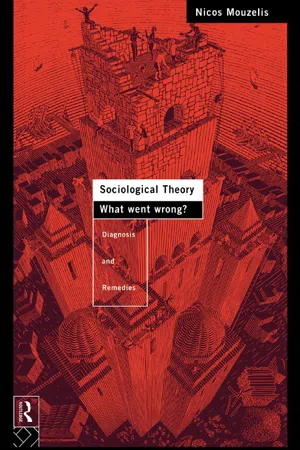
Social theory is open to many passing currents. Claims to originality tend to thrive and past achievements are often ignored. In Sociologiocal Theory: What Went Wrong? Mouzelis claims that "problems" currently being isolated are not really problems, and that "achievements" claimed are little more than pretensions. He argues that we have been premature to dismiss thinkers from the late 1950s and early 1960s and that we can build on their ideas to produce a more effective, more relevant social theory.
Written with precision and with clarity, Sociological Theory: What Went Wrong? is a compelling analysis of the central problems of sociological theory today and of the means to resolve them.
- 236 pages
- English
- ePUB (mobile friendly)
- Available on iOS & Android
eBook - ePub
About this book
Information
Part I
DIAGNOSIS
1
IMPASSES OF MICRO-SOCIOLOGICAL THEORIZING
Overreaction to Parsons
With the middle and late periods of Parsons’ oeuvre marked by an underemphasis of both micro and macro actors, the various interpretative sociologies that mushroomed from the 1960s onwards have almost entirely focused on the former. This disregard of macro actors has had grave consequences for the further development of sociological theory as such.
There are several explanations for this surprising neglect by theorists, whose avowed purpose had been to redress Parsons’ overly systemic analysis and to ‘bring back people’ into sociological studies.
One obvious reason is the excessive fear of reification that haunts hermeneutically-and ethnomethodologically-oriented sociologists. For them, any reference to organizations or larger collectivities as having goals, taking decisions, implementing policies, etc., smacks of anthropomorphism, of endowing collectivities with characteristics proper only to individual human actors. For several reasons this excessive fear of reification (often exacerbated by the crude manner in which macro sociologists, especially Marxists, refer to whole classes as having projects, strategies, etc.) is quite unjustified. The ascription of anthropomorphic, decision-making capacities to formal organizations and other collectivities is mostly no more than a convenient shorthand to avoid long-winded descriptions of complex processes of representation and of group decision-making. In so far as verbal abridgements can readily be translated into detailed action terms, there is no reification. The stenographic assertion that, for instance, the trade union movement has adopted such-and-such a policy entails no reification because one can, when asked, give a blow-by-blow account of the actual interactive, decision-making processes the trade union leaders, cadres, etc. were involved in.1
Another reason that partly explains the reluctance of interpretative sociologists to deal with macro actors is their populistic predilection for‘lay persons’, ‘ordinary members of society’, ‘mundane’ encounters, etc. Partly in overreaction to the explanations by conventional historians of long-term developments as the doings of kings and ‘great men’, micro sociologists have concentrated their energies on micro actors’ contributions to the construction of social reality. As a result they ignore not only collective actors but also what for convenience one may call ‘mega’ actors—i.e. individual actors in control of considerable resources, whose decisions stretch widely in space and time.
In other words, micro sociologists tend to forget that actors, because of their very unequal access to the economic, political and cultural means of production,2 contribute just as unequally to the construction of social reality. Attempting, however, to explain the symbolic construction of social wholes by exclusive reference to ‘lay persons’ or ‘ordinary’ members is like trying to account for the construction of a complex edifice by reference only to bricklayers, completely ignoring the contribution of architects, managers, foremen, accountants, lawyers, etc.3
A third reason for the neglect of macro actors by interpretatively-oriented sociologists is the all-pervasive ‘individual-society’ schema, which one finds in the Durkheim-Parsons tradition. Despite significant alterations by micro sociologists, this schema has survived in its fundamental logic up to the very present. Being highly misleading, it has driven micro-sociological theorizing into a fatal cul-de-sac. Nowadays, of course, given the phenomenological shift from Weber’s focus on the subjective orientations of individual actors to intersubjectivity as the basic unit of analysis, one no longer speaks of the ‘individual’. Moreover, given the micro sociologists’ fear of reification, Society (capital S) is also considered a highly suspect concept. But the macro-society/ micro-individual distinction has survived in various new guises, such as the contrast between institutional or social structures on the one hand and interactions or encounters on the other—the former being always linked with the macro, and the latter with the micro level of analysis.
This association of action with micro makes itself felt particularly strongly in respect of face-to-face interactions which, as a matter of course, are invariably considered as micro phenomena, as the building blocks out of which macro institutional orders are constructed. Whether one looks at the writings of Garfinkel, Cicourel, Goffman, or their numerous disciples, one always comes up against the ubiquitous idea that to study face-to-face interaction is to study micro phenomena, and given this, the problem then becomes one of linking face-to-face encounters on the micro level with social or institutional structures on the macro level.
1
THE DEBATE ON THE NATURE OF GOFFMAN’S ‘INTERACTION ORDER’
I shall try to make the above point more concrete by taking a look at the recent debate on the nature of Goffman’s idea that interaction is an order sui generis, quite distinct from both individual agents and macro social structures.4 The major contributors to the debate take it for granted that the interaction order is micro and quite distinct from macro phenomena. Their only point of serious disagreement is over which aspect of micro-social reality the interaction order refers to. So Ann Rawls tries to establish its specificity by reference to moral ‘ground rules’ emanating from the interaction situation itself, and particularly from the ‘presentational’ needs of the social self.5 Stephen Fuchs rejects this, and attempts a definition of the interaction order based on Luhmann’s distinction between interactional, organizational and societal systems. The interaction system, which emerges ‘as soon as copresent interactants perceive mutual perceptions and select their communications accordingly’,6 is less encompassing than the organizational and societal systems.
What is interesting in the arguments of Rawls and Fuchs is that both conceive of the interaction order as micro, with Rawls focusing on micro rules specifically linked to the logic of encounters, and Fuchs on micro-social systems. Moreover, they both contrast interaction with a macro state of affairs: for her this being ‘social structure’ or ‘institutional order’, for him the more encompassing organizational and societal systems.7
The identification of institutional and social structures with the macro level, and ‘free’ agency of interaction with the micro level, is not limited to micro sociologists. It is equally accepted by those interested, whether positivistically or non-positivistically, in the analysis of macro phenomena. So Peter Blau, in his attempt to differentiate between micro and macro sociology, says that the macro-structural approach is not interested in ‘social interactions between individuals’, and analyses instead ‘the rates of social interaction between social positions’. He argues further that
the macro-sociological focus is appropriate for the study of entire societies or other large-scale collectivities, because it is impossible to trace and dissect the interpersonal relations of many thousands or millions of people, and neither would it be meaningful if all were described.8
But if macro sociology focuses on large collectivities and micro sociology on ‘relations between individuals’, where does an interaction fit inbetween a few individuals (mega actors) who happen to be heads of state and whose decisions may have world-wide repercussions?
To give an obvious example: the face-to-face encounter between Churchill, Roosevelt and Stalin at Yalta in 1945 led to crucial decisions which, among other things, shaped the post-war map of Europe and profoundly affected the lives of millions of people. In what sense could that interaction between these three men be seen as a micro event?
There appears to be no place in the schemes of Rawls, Fuchs, Blau or Goffman for interactions of this kind, i.e. face-to-face encounters whose intended or unintended consequences, to use Giddens’ formulation, stretch very widely in time and/or space. The broad, macro impact of face-to-face interactions may be due to the fact that the interacting individuals occupy a powerful institutionalized social position (as in the example given above); or it may be due to dispositional (e.g. personal charisma) or situational factors (e.g. an assassin who kills a head of state).
The key distinction between the positional, dispositional and interactive-situational dimensions of social games will be developed extensively in Chapter 6; here it is enough to emphasize that, for whatever reason, face-to-face interactions are not always micro phenomena. Often the face-to-face interactions of a few individuals who—for positional, dispositional or situational reasons—have a lot of power, are absolutely crucial for understanding how whole societal orders are constructed, reproduced or transformed. To repeat, it is the micro-interaction/macro-structure distinction that is responsible for this obvious fact not being taken seriously among sociologists.
The misleading distinction between macro-institutional structures and micro interaction disregards not only the fact that face-to-face interactions can be macro, but also that institutional structures can take a ‘micro’ form. Consider, for instance, the banal example of a national business organization which has a number of local branches. One can view the local organization as a social system related to a more encompassing social system at the national level. The local business organization like the national one can be viewed, to use Giddens’ terminology, both in terms of ‘strategic conduct’ and in terms of ‘institutional analysis’ (see Chapter 6, Section 2). That is to say, one can view it as a figuration of interrelated actors (managers, employees, blue-collar workers, etc.) as well as an interrelated ensemble of institutionalized rules/norms. To focus on the latter, and to use Parsonian terminology, the local organization’s social structure can be viewed in terms of four institutional subsystems: adaptation (A), goal achievement (G), integration (I), latency (L). These, as I will explain in Chapter 5, do not refer directly to actors but to institutions—in ourexample, to micro institutions. For instance, the adaptation subsystem (A) refers to all institutionalized norms which deal with the ‘economic’, i.e. the ‘acquisition of resources’ problem of the local firm, such as rules about how to recruit personnel, how to buy raw materials, how to borrow money, etc. Such institutionalized rules can be strictly local (i.e. one might find them only in this local system or only in local social systems); or they may be rules which are more widely used (for instance, basic rules about property, contract, etc.). But in so far as the latter rules are embodied within the social positions of our local social system, and in so far as they contribute together with the ‘local’ rules, to the constitution and reproduction of local micro games, then they can be viewed as the economic micro institutions of the local firm. And as we can talk about the economic institutions of the local firm, we can as well talk about its political institutions (G), legal institutions (I), etc. Despite the fact that Parsons’ AGIL scheme presents serious difficulties (see Chapter 5), I think it is useful in reminding us that one can analyse not only whole societies in terms of institutionalized subwholes, but also less encompassing social systems like a formal organization.9
2
NEGLECT OF SOCIAL HIERARCHIES: BRIDGING THE MICRO-MACRO GAP VIA THE LOGIC OF AGGREGATION OR REPRESENTATION
Another important point to emphasize here is that the identification of interaction with micro, and of institutions with macro, leads to an underemphasis of social hierarchies, of the fact that institutionalized positions/roles and actors are often related not only horizontally but also vertically. For instance, actors, being part of a multiplicity of hierarchically organized wholes (corporations, trade unions, political parties, etc.) deal routinely with other actors both hierarchically subordinate and superordinate. (The same can be said, of course, when the focus is not on actors and interactions but on hierarchically organized positions.)
The acute importance of the above emerges beyond any doubt when one takes into account that, ever since the development of state societies, hierarchies have played the crucial role in ‘caging’ human beings in authoritatively organized social systems10—this caging being dramatically accentuated by the spread of bureaucratic forms of organization in most spheres of modern life. Even if in ‘postmodern’ or post-industrial societies there has been a certain amount of debureaucratization, in the long run bureaucratic structures (though perhaps of a more flexible nature) willremain the major mode by which social members relate to the increasingly centralized economic, political and cultural arenas of nation-states.
In view of the above, one cannot properly consider the passage from the micro to meso11 and macro levels of analysis without seriously taking into consideration how modern societies are hierarchically organized, and particularly how micro actors are hierarchically related (through formal organization or otherwise) to meso and macro actors.
Micro sociology ignores all of this by insisting that actors and face-to-face interactions belong to the micro, and institutional structures to the macro level. This absurd but strongly rooted misconception precludes any study of how micro, meso and macro actors relate to each other within specific hierarchically organized contexts. It is not at all surprising, therefore, that the present debate on the links between micro and macro sociology, as well as the older, related debate on methodological individualism versus holism, has led precisely nowhere. Not only do neither of these debates theorize the concept of social hierarchies, they both leave it out of account altogether as though it did not exist.12 Trying, however, to investigate how micro actors and encounters relate to the constitution, reproduction and transformation of larger collectivities without taking into serious consideration the hierarchical aspects of social wholes, is like trying to swim in a pool that has been drained of water.
In the absence of a concept of macro interaction, and of the notion of hierarchically organized positions linking micro, meso and macro actors, how do micro sociologists relate micro to macro phenomena? The short answer is that they try to do so through the direct or indirect use of a logic of aggregation. Randall Collins’ theory of ‘methodological situationalism’ is a typical recent attempt at bridging the micro-macro gap in this manner.13
For Collins, the micro-macro debate in modern sociology was infused with new vigour by such empirically-oriented branches of micro sociology as ethnomethodology, conversational analysis and cognitive sociology. The earlier philosophical and more abstract debates of macro sociology have had to give way to criticism from a perspective that is both theoretically sophisticated (ethnomethodology, for instance, is based on Husserlian phenomenology) and founded on very detailed empirical research. The purpose of the new approach is not to reject what macro sociology is doing, but on the contrary to improve its exploratory potential by reconstituting it on radically empirical, micro foundations. It is believed that only in this way can we move ‘towards a more successful sociological science’.14
Collins’ own chief goal is to fashion a conceptual apparatus for translating such macro concepts as society, community, class or state intoempirically observable or accessible interactions between real people. For this purpose, and contrary to mainstream methodological individualism, his basic unit of analysis is not the individual actor, but the encounter or micro-interactional situation (hence his label ‘methodological situationalism’). Whether applied to the examination of Churches, schools, factories or social movements, methodological situationalism always sees human beings at the root of such phenomena—human beings interacting with each other in specific situations and investing their encounters with varying degrees of emotional energy and cultural resources.
Although Collins’ methodological situationalism is quite complex, based as...
Table of contents
- COVER PAGE
- TITLE PAGE
- ACKNOWLEDGEMENTS
- INTRODUCTION
- PART I: DIAGNOSIS
- PART II: TENTATIVE REMEDIES
- CONCLUSION
- APPENDIX: HIERARCHICAL ASPECTS OF LIFE TRAJECTORIES
- NOTES
- SELECT BIBLIOGRAPHY
Trusted by 375,005 students
Access to over 1.5 million titles for a fair monthly price.
Study more efficiently using our study tools.
Frequently asked questions
Yes, you can cancel anytime from the Subscription tab in your account settings on the Perlego website. Your subscription will stay active until the end of your current billing period. Learn how to cancel your subscription
No, books cannot be downloaded as external files, such as PDFs, for use outside of Perlego. However, you can download books within the Perlego app for offline reading on mobile or tablet. Learn how to download books offline
Perlego offers two plans: Essential and Complete
- Essential is ideal for learners and professionals who enjoy exploring a wide range of subjects. Access the Essential Library with 800,000+ trusted titles and best-sellers across business, personal growth, and the humanities. Includes unlimited reading time and Standard Read Aloud voice.
- Complete: Perfect for advanced learners and researchers needing full, unrestricted access. Unlock 1.5M+ books across hundreds of subjects, including academic and specialized titles. The Complete Plan also includes advanced features like Premium Read Aloud and Research Assistant.
We are an online textbook subscription service, where you can get access to an entire online library for less than the price of a single book per month. With over 1.5 million books across 990+ topics, we’ve got you covered! Learn about our mission
Look out for the read-aloud symbol on your next book to see if you can listen to it. The read-aloud tool reads text aloud for you, highlighting the text as it is being read. You can pause it, speed it up and slow it down. Learn more about Read Aloud
Yes! You can use the Perlego app on both iOS and Android devices to read anytime, anywhere — even offline. Perfect for commutes or when you’re on the go.
Please note we cannot support devices running on iOS 13 and Android 7 or earlier. Learn more about using the app
Please note we cannot support devices running on iOS 13 and Android 7 or earlier. Learn more about using the app
Yes, you can access Sociological Theory: What went Wrong? by Nicos Mouzelis in PDF and/or ePUB format, as well as other popular books in Social Sciences & Social Theory. We have over 1.5 million books available in our catalogue for you to explore.