- 240 pages
- English
- ePUB (mobile friendly)
- Available on iOS & Android
eBook - ePub
About this book
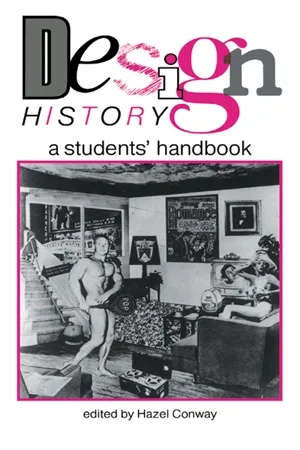
Hazel Conway introduces the student new to the subject to different areas of design history and shows some of the ways in which it can be studied and some of its delights and difficulties. No background knowledge of design history, art or architecture is assumed.
Information
1
Design History Basics
HAZEL CONWAY
There are examples of design and opportunities for studying design history all around us, yet when our surroundings are very familiar, as our houses and streets are, we tend to take them for granted. We cease to see them, or even to think that there is anything much of interest in them. Wherever we are design affects us all, both directly and indirectly, consciously and subconsciously. At home the lighting, carpets, curtains, wallpaper and furniture all contribute to the interior design of a room. Every period has its own ways of arranging furniture, and today is no exception. Not long ago the main focus of a living-room would have been the fireplace, but this is not necessarily so today. Outside, the design of the front gardens, the variety of colours of the front doors, the textures of the bricks, contribute to the environment, as do the shops, the traffic and the open spaces. Of course not all the features that go towards creating our environment were consciously designed, some occurred by accident, or neglect, or by juxtaposition. One of the most obvious examples of design in our society, intended to attract our attention wherever we find ourselves, is that of advertisements. In the street, in the shops, reading the papers or magazines, or watching television, advertisement designers hope to have a direct effect on us, and this we recognize. Their indirect effects are, however, much more subtle and not nearly so easy to recognize, yet our perception of ourselves, our surroundings and our society are affected by them.
At home among familiar furniture you know from experience which chairs are comfortable, but how closely do you ever look at any particular one? If you are asked to describe one chair exactly from memory, could you do so, and where would you begin? When you note – almost without thinking about it because it is so obvious – that the form taken by a dining chair is different from that of an easy chair for relaxing in, you are beginning to identify how form is related to use, and this is one aspect of design analysis. If you visit a museum and see a collection of dining chairs from a period covering a century or more you will again note differences in the forms the chairs take, even though they all have a similar use. If you ask yourselves the reasons for these differences then you will again be involved in design analysis.
All the examples of design that you see around have their histories, but the development of the study of design history is very recent and it is only in the last decade that a range of degree courses has been introduced in which it forms a major element. Those who are involved in the practice of design history, whether they are in museums, in teaching, research or elsewhere, have clear but differing ideas about what it is, but outside this group few people have any real understanding of the subject or how it can be studied. Common misconceptions include the idea that design history is primarily about aesthetics and collecting rare and beautiful objects, or about fashion, or historic periods and the styles of design associated with particular periods. What makes it even more complex is that there are elements of truth in all these views, and these will be explored. Another confusion lies in the interpretation of the word ‘design’. When we talk about the design of a lamp, for example, we may be concerned with the mental processes and the drawings and models that eventually result in that particular lamp; we may be concerned with the production process, the form and material of the lamp and how it is used; we could also be concerned with how the lamp was marketed, advertised, packaged and sold. Design history can be concerned with any or all of these aspects.
Another area of confusion concerns the scope of design history as a subject and its relationship to other histories. It was largely as a result of these and other confusions that the idea for this book came about.
Although many historical examples are included in this introduction to design history, it is not intended to be a concise history of the subject. The aim is to show how to study the subject by looking at a number of different areas, and illustrating a variety of approaches by means of case studies. The approaches and skills needed to study advertising design, say, differ from those needed to study shoe or aircraft design, and in practice design historians tend to specialize, as do designers. It is for this reason that this book divides design history into a number of areas which reflect those specializations. Dress and textiles, ceramics, furniture, interior design, industrial design, graphics, and environmental design are the titles of the chapters and in general the designers working in these areas have their particular professional institutions and publications. The exception to this is environmental design. Environmental design can include architecture, town planning, landscape design and civil engineering and each of these areas has their own professional institutions and publications.
Although this division of design history into various areas reflects the professional structure of practising designers, it is in many ways arbitrary for there are many links between the areas both in terms of theory and practice. The practical link between furniture and interior design is an obvious example, and the presence of graphic design in the environment, whether in the form of advertising, or street or shop signs, is another.
Stylistic Influences such as that of Neo-Classicism (q.v.) affected architecture as well as dress design, ceramics, silver, furniture and interiors. In addition important theories affected a broad spectrum of design, as well as architecture. For example de Stijl (q.v.) philosophy, which developed in Holland from 1917 on, embraced painting, architecture, furniture and interior design, town planning/environmental design and graphics. The work of many designers ranges across a spectrum of design: William Kent’s (q.v.) work included architecture, landscape, furniture and interior design while William Morris (q.v.) worked in textiles, stained glass and book design, and his theories embraced the whole basis of society. The various chapter headings of this book should not therefore be taken to imply rigid boundaries, for these do not exist. This means that readers with a particular interest in, say, industrial design or furniture should not restrict themselves to reading only those chapters for there may well be useful material elsewhere.
The reasons for studying design history are similar in many ways to those for any historical study. They relate to our need to understand the present, and are based on the belief that such an understanding is impossible without a knowledge of the past. Studies of the past enable us to understand where we have come from, and something of the complex choices and decisions that have led to where we are today. Without that perspective our understanding is limited. We become prisoners of the present, unable to forsee alternatives, or recognize our own possibilities of choice. When, for example, newspapers talk of ‘Victorian values’, they imply an era when thrift, self-reliance, and hard work were the norm. That view of the Victorian period conveniently ignores the appalling living conditions, high mortality rate, and excessive hours of work, often in dangerous conditions, in order to make a particular point about society today, in comparison with that of a hundred years or so ago. Newspapers are not in the business of historical accuracy, they are in the business of selling papers and ideas, but unless we as readers have some historical understanding, we are likely to accept uncritically the viewpoint being projected. An understanding of history is part of the process of exercising control over our own lives, whether as individuals, groups or societies. The objects that are the main focus of studies in design history, the forms that they take and the ways in which they were produced and used, are the material result of complex changes and choices. Studies of how our material culture evolved, its meaning and influence, can give us a larger perspective of our past. The core of the discipline of design history concerns the search to understand particular designs in the context of the period in which they were produced, and the enjoyment of the subject lies in the intellectual and emotional stimulus that this provides. There are however many factors which can inhibit that understanding.
Subjective and Objective Responses
Design history, like any other history, is not solely concerned with the accumulation of facts. It is concerned with understanding and finding explanations of the past by evaluating, selecting and ordering data, as E. H. Carr discusses so clearly in What is History? (1961). Everyone has his or her own preferences and prejudices, and our own likes and dislikes can come between us and our historical studies. We all know from personal experience that we like some designs for particular reasons, and not others. This is a subjective reaction that everyone experiences, but you must be careful not to draw historical conclusions from your own likes and dislikes, or to argue that because you do not like a design it is therefore not important historically. Although the qualitative analysis of design and your imaginative response to it may be one of the reasons encouraging you to study the subject in the first place, there is a great difference between such design appreciation and the study of design history. In talking about your reactions to familiar and to unfamiliar surroundings I implied that looking carefully is one important aspect of an interest in design and in design history. Designing if it is to move beyond theory into practice means putting ideas into form. These may be two-dimensional or three-dimensional, and they could be drawings or sketches or they could result in a finished object such as a chair. Form is thus a very important part of design and hence of design history. However opinions concerning the beauty of particular forms have varied widely in the past and although some of the major philosophers have tried to evolve satisfactory criteria in order to identify clearly what is beautiful and what is not, opinions on it remain subjective.

Figure 1.1 Cast-iron seat, Richmond Park, c. 1870
You can look at the design of this cast iron garden seat (Fig. 1.1) with its highly ornamental foliage design in terms of the material it is made of and the processes of production, but if you look at the ornamentation, how are you to talk about it in a way that has any historical validity? Attitudes towards such design have altered and continue to do so, and a subjective analysis in terms of today’s criteria, that is, whether you like it or not, would tell you more about today’s criteria than it would about this particular design. To attempt to understand this seat design and why those particular forms were used you would need to know what the Victorians at that time thought of ornament, and what they meant by the ‘correct use of ornament’. You would also need to understand the criteria affecting design and read the works of those who were influential in defining those criteria, like John Ruskin, A. W. N. Pugin, Henry Cole and William Morris (qq.v.). Design history implies trying to understand an object in the context of the period in which it was produced. Criticism of good and bad design in any period cannot be approached from the basis of your own individual likes and dislikes, but must come from an understanding of the theories and philosophies prevailing at the time. It is in this area that many of the older books on the subject can prove confusing, for they take the standpoint of, say, the Modern Movement (q.v.) of the 1920s and 1930s, and evaluate everything from that basis, with obvious distortions arising. This is one of the reasons why the following chapters try to provide guidance on the books available.
The Problem of Survival
Most of us have vivid memories of our home, which go back to early childhood, but how much remains of that furniture or furnishings some ten, twenty or more years later? Wear and tear, changing family requirements, moving house and successive schemes of decoration will all have left their mark and much will have changed or disappeared. It might be possible to build up a partial picture of the past from photographs, or bills, from shops that supplied furniture, or from firms that undertook to redecorate, or from diaries or letters. For most of us such documentary evidence would have been destroyed long since and it would be a very rare family that had a written record or a photographic survey made of all the rooms in their home. Herein lie many of the historian’s problems. You may be thrilled to discover the grandfather clock which had been handed down through several generations of the family, but is it more significant historically than the everyday articles that each generation takes for granted, uses, and then throws away? A variety of objects survive from the past and you need to be cautious in your interpretation of them. You need to ask why some have survived and others have not. You need to consider strength and durability as well as real and assumed values, and sentimental attachment, when attempting to assess the historical value of such evidence.
If we look at any period of history our picture of it derives from many sources, the literature, paintings, buildings and artefacts that have survived and that have been collected. For many people it is the museum’s picture of the past that is one of the most readily accessible sources, and until very recently the main emphasis of many museum collections was on the rare and exotic, and objects which were commonplace did not appear. This was partly a question of what had survived from the past, for the things that were in everyday use got worn out, broken and were thrown away, while the precious and expensive were looked after carefully and survived. Many museums were set up in the nineteenth century and were based on the collections of private individuals with their emphasis on curiosities from strange lands, and precious items. There was no incentive to collect the commonplace. Recently an enormous interest has developed in the commonplace, and the balance is being redressed, but if you are studying the artefacts of today or yesterday you need to be very aware of the type of image you are likely to receive unless you are very careful. Two books on this topic that I have found both stimulating and provocative are Donald Horne, The Great Museum (1984), and Patrick Wright, On Living in an Old Country, The National Past in Contemporary Britain (1985). Both books explore, in their very different ways, the question of images of the past, the variety of distortions that can arise, and the reasons for them.
The Heroic Approach
Exhibitions, books, magazine articles and some museum collections tend to emphasize the heroic approach to design history. That is to say they concentrate on the rare and expensive and the major works of major designers in any period: Adam, Wedgwood, Aalto, Dior (qq.v.). The work of these people was very important and I am certainly not trying to deny this. Part of the historian’s task is that of evaluating and determining what is significant and what is not, and this in turn relates to what is history and the approaches that can be taken. In general historical studies we no longer concentrate solely on kings and queens and battles and conquests. Similarly in design history it is important to recognize that there is more to it than the study of key figures and key objects. The design of goods that most people live with is important. Indeed it was the feeling that design was part of everyday life and used, that it was an activity with a social and material context, rather than something isolated, to be put in a museum, that attracted many of us to its study in the first place.
Today opinions on the beauty and on the financial value of particular objects are inextricably linked. Newspapers report extraordinary sums reached in auctions for the work of a particular designer; the emphasis of collectors and of museums on the rare or the expensive object, and lavishly illustrated books, encourage the belief that it is only such items that are of importance or of any interest and that the main criterion for such importance and interest is the market value. This attitude in turn tends to encourage us to devalue our own surroundings, for logic indicates that they cannot be important if they are not worth much. Yet the surroundings of each individual are very important and design history recognizes this in focusing studies on those surroundings as well as on the rare, the valuable and the beautiful.
Often it is very difficult to find out about the ‘anonymous’ design in any period. For recent periods of the last sixty or so years, the techniques of oral history, recording the memories of those who were there and experienced working in a particular factory, or using a particular design, have made a significant contribution to areas that were previously ‘hidden from history’. Obviously there are limitations to how far back in time you can reach by this method and there are real challenges in disentangling what is ‘remembered’ and what actually took place. Examples of the application of oral history techniques are given in the chapters on ceramics, furniture and environmental design. Feminist history has also made a significant contribution to rescuing women designers previously ‘hidden from history’. In the chapter on furniture the author indicates how feminist history has influenced the study of furniture, and this approach is applicable to other areas of design history.
Sources
In the study of design history you will be involved in a process of finding out, questioning and interpretation. In order to gain a full picture of the topic that you are studying you may be involved with a wide range of source material ranging from the object itself, or drawings, to books and documents such as letters, bills or diaries. This material is divided into two main areas: primary sources and secondary sources. In general primary sources are sources contemporary with the period that is being studied, while secondary sources are interpretations of a period by later historians and writers. The deciding factor is the context in which the material is being studied and there are no rigid boundaries between the two. This book, for example, would, according to the above definition, qualify as a secondary source, but if the topic of research was concerned with the way design history is perceived, or the way it is taught today, then this book could qualify in that context as a primary source. The initial way in which to familiarize yourself with a subject is by means of secondary sources.
SECONDARY SOURCES
These can include general histories, articles in magazines and journals, monographs and picture books. In any study using secondary sources you need to be aware of the stance taken by the authors towards their material, for authors as much as anyone else respond to and reflect the criteria and prejudices of the time they are living in, and this in turn affects their interpretation of the material they are writing about. The author’s viewpoint is thus important in itself for it is another factor which can help you to build up your understanding of a period, particularly if a book was written at a time when a great argument was raging about a particular topic. What you need to be careful of is how you weigh and evaluate secondary sources. It is useful to start by asking who wrote a particular text, and when it was first published. The date of publication can provide an indication of the author’s viewpoint, and the context in which the study was undertaken. You should also look at the primary evidence that the book is based on. Here the bibliography and footnotes will give some indication, but if these are absent, or few in number, then you will have to rely on a critical examination of the text and its conclusions. When you have read a number of secondary sourc...
Table of contents
- Cover
- Halftitle
- Title
- Copyright
- Contents
- List of Plates
- Acknowledgements
- List of Contributors
- Introduction
- 1 Design History Basics
- 2 The Study of Dress and Textiles
- 3 Ceramic History
- 4 Furniture History
- 5 Interior Design
- 6 Industrial Design
- 7 Graphic Design
- 8 Environmental Design
- Further Reading
- Useful Names and Addresses
- Glossary
- Index
Trusted by 375,005 students
Access to over 1.5 million titles for a fair monthly price.
Study more efficiently using our study tools.
Frequently asked questions
Yes, you can cancel anytime from the Subscription tab in your account settings on the Perlego website. Your subscription will stay active until the end of your current billing period. Learn how to cancel your subscription
No, books cannot be downloaded as external files, such as PDFs, for use outside of Perlego. However, you can download books within the Perlego app for offline reading on mobile or tablet. Learn how to download books offline
Perlego offers two plans: Essential and Complete
- Essential is ideal for learners and professionals who enjoy exploring a wide range of subjects. Access the Essential Library with 800,000+ trusted titles and best-sellers across business, personal growth, and the humanities. Includes unlimited reading time and Standard Read Aloud voice.
- Complete: Perfect for advanced learners and researchers needing full, unrestricted access. Unlock 1.5M+ books across hundreds of subjects, including academic and specialized titles. The Complete Plan also includes advanced features like Premium Read Aloud and Research Assistant.
We are an online textbook subscription service, where you can get access to an entire online library for less than the price of a single book per month. With over 1.5 million books across 990+ topics, we’ve got you covered! Learn about our mission
Look out for the read-aloud symbol on your next book to see if you can listen to it. The read-aloud tool reads text aloud for you, highlighting the text as it is being read. You can pause it, speed it up and slow it down. Learn more about Read Aloud
Yes! You can use the Perlego app on both iOS and Android devices to read anytime, anywhere — even offline. Perfect for commutes or when you’re on the go.
Please note we cannot support devices running on iOS 13 and Android 7 or earlier. Learn more about using the app
Please note we cannot support devices running on iOS 13 and Android 7 or earlier. Learn more about using the app
Yes, you can access Design History by Hazel Conway in PDF and/or ePUB format, as well as other popular books in Design & Fashion Design. We have over 1.5 million books available in our catalogue for you to explore.