- 208 pages
- English
- ePUB (mobile friendly)
- Available on iOS & Android
eBook - ePub
About this book
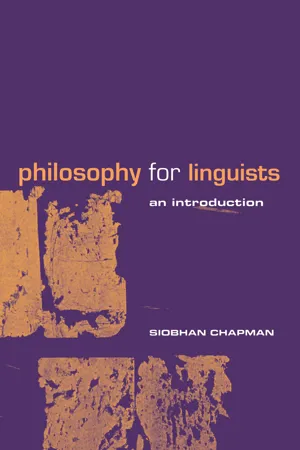
Philosophy for Linguists provides students with a clear, concise introduction to the main topics in the philosophy of language. Focusing on what students of linguistics need to know and how philosophy relates to modern linguistics, the book is structured around key branches of the field: semantics, pragmatics, and language acquisition. Assuming no prior knowledge of philosophy, Siobhan Chapman traces the history and development of ideas in the philosophy of language and outlines the contributions of specific philosophers. The book is highly accessible and student-oriented and includes: a general introduction and introductions to each chapter numerous examples and quotations comprehensive suggestions for further reading an extensive glossary of linguistic terms.
Information
1 Words and things
Introduction
Much of what goes on in linguistics can be described under the general heading of ‘analysis’. Linguistic analysis involves, for instance, identifying and describing the structures and sounds of a language, and attempting to explain the relationships between them. But that isn’t the whole story. Linguistics is a discipline which concerns itself with the study of language in all its aspects and, as linguists, we need to consider how the individual elements of a language relate not just to each other, but to the world outside. We need to study not only the relationships within a linguistic system, but also those between this system and the things it describes. After all, it is only through such relationships that language functions as it does in communication. To study only the internal structures and relationships of a language might tell us a lot about its complexities and regularities, but it would somehow ‘miss the point’; we would be no nearer to being able to explain how language actually ‘works’ than we were when we started.
Part of the task of explaining how language works is to account for the obvious difference between examples such as 1) and 2); in general, 1) is accepted to be ‘true’, while 2) is labelled ‘false’.
1) A kangaroo is an animal.
2) Zebras have wings.
Another part of the task is to describe how speakers use language for particular purposes: how 3) might count sometimes as a question and sometimes as a request, and how 4), although labelled ‘false’, might sometimes be used to communicate something which is true.
3) Can you reach the top shelf.
4) My flatmate is a machine.
These are issues which we will address in Chapters 3 and 4, but first we need to establish how the component parts of these sentences contribute to our interpretations. Our examples are made up of individual words such as kangaroo, zebras and flatmate. Before we can discuss what sentences ‘mean’, and what speakers might ‘mean’ by what they say, we need to establish what we are talking about when we discuss the meanings of these words.
There might not seem to be much of a problem here. ‘Surely’, a cynical non-linguist might say, ‘if you want to know what kangaroo means you only have to look it up in a dictionary—the whole point of dictionaries is to give the meanings of words’. If we do as the cynic suggests and reach for our dictionary, we will read that a kangaroo is ‘a large Australian herbivorous marsupial’. But this hasn’t got us any further forward. We haven’t got outside the linguistic system at all; we have simply complicated things by introducing other words such as marsupial. What we have obtained from the dictionary is not in fact the meaning of the word, but a definition of one word by means of a series of other words.
Our cynical friend is not going to give up that easily. He takes us on a trip to a zoo and positions us in front of a certain enclosure. ‘There’, he says, pointing at a particular animal, ‘That is a kangaroo. That’s what the word means’. Again we have to explain patiently that it’s not quite as simple as that. It might seem reasonable (although it’s far from uncontroversial, as we will see) that the brownish creature over there, or the group of such creatures, is the meaning of the word kangaroo in 1) above. But our friend might find it harder to point at the meaning of, say, bird. He would need to decide on one particular creature to point at, making a choice between, say, the penguins, the ostriches and the parrots. Drawing a picture of a bird-like figure would hardly help; our friend would need to make a series of decisions about what counted as an essential feature of ‘bird-hood’. Whatever his final drawing looked like it would be bound to bear little resemblance to some of the creatures in the zoo labelled ‘bird’; if his drawing bore a reasonable resemblance to a canary it could hardly pass for a sketch of a flamingo. Finally, no matter how carefully he searches the zoo, our friend won’t be able to point at anything and say ‘There, that’s what unicorn means’. But that is hardly grounds for saying that the word unicorn is meaningless; it’s a perfectly acceptable word of the English language. At this point our friend is forced to admit that there is more to linguistics than he thought.
The problems which we have just been considering have been discussed in philosophy for well over two thousand years. Many of the philosophers who have contributed to the discussion have done so because they were interested in its implications for their study of knowledge, or of logic, or of the nature of reality. Their contributions have therefore had varying degrees of relevance to linguists and, as we will see, some have been taken on as basic premises of linguistics, while others have been more or less abandoned. Nevertheless, it’s worthwhile for linguists to study a discussion which has concerned itself with so many of the questions raised by the relationship between words and things.
One of the earliest points of discussion, and one which has remained central, is the question of whether words can in fact be said to refer directly to things at all. This may at first appear an odd, even an unnecessary question to ask, but we saw earlier that it was one which caused problems for our cynical friend, especially when he tried to relate the word bird directly to an object. He knew very well what it meant for something to be called a bird, and could identify any number of individual birds; he could also talk about birds when there were none actually present. But there was no one specimen which met the definition completely. One way of answering the question might be to say that it’s not objects themselves to which words refer, but our idea of objects; the word bird refers to an idea, or mental image, of what a bird is like. This answer has been suggested by those philosophers who subscribe to an ideational account of meaning. According to such accounts, we use words to refer to our internal impressions, which are derived from our experiences of the world. One of the biggest problems facing ideational accounts of meaning, however, is related to the problem our friend encountered when he tried to draw an explanatory picture of a bird. It’s the problem posed by ‘general ideas’; an idea of ‘bird’ would have to be general enough to be compatible with any individual example of a bird, but would therefore run into danger of being too general to count as a coherent meaning.
An alternative approach to meaning, one which avoids the problem of general ideas, is known as the direct reference account. This is more or less the account adopted by our friend when he tried pointing at animals to explain meaning. The meaning of a word such as bird is simply the set of individual objects to which it applies. The meaning of an individual name such as Charles Darwin, or description such as the head keeper, is simply the particular individual referred to. This is to describe meaning in terms of denotation. A word or phrase denotes a certain object or objects in the world. However, in many cases direct reference on its own is not enough to explain meaning. Remember the problem our friend had explaining why unicorn is a legitimate word in English. If meaning were simply reference then unicorn should be a nonsense word, because there is nothing which it denotes. But we could taunt our friend with 5) and not be accused of talking nonsense.
5) Search as hard as you like, you won’t find any unicorns.
And furthermore, we can assure him of the truth of 6) without having any idea what the denotation of the biggest animal in the zoo is. To find out what this phrase refers to would require a lot of hard and potentially dangerous work with a tape measure, but we can use the phrase, and use it perfectly coherently, without knowing, or caring, what animal actually fits the description.
6) That gate has to be wide enough for the biggest animal in the zoo to get through.
Examples such as these are generally explained by saying that words don’t just have denotations, they also have connotations. The word connotation is used informally to describe properties which are implied or suggested; you might, for instance, be advised to avoid using a word because it has ‘bad connotations’. In linguistics and philosophy the word has a much more specific meaning. It is used to describe the particular properties which make a word or phrase applicable. The phrase the head keeper will denote one particular individual at any one time, and its denotation will vary from time to time depending on retirements, promotions and so on. But it connotes a property, the property of being head keeper, and the property itself remains constant. A similar distinction is made between the extension and intension of an expression. The extension of a singular term such as the head keeper is, again, just the person who happens to hold that post at any one time, while the extension of a general term such as elephant is the set of all individual elephants. The intension of a word or phrase, like the connotation, can be seen as a property, or set of properties, which remain constant. These properties describe the relevant individual or individuals, and can therefore be seen as a set of criteria for determining the extension at any given time.
We are now in a position to explain examples 5) and 6). The term unicorn doesn’t denote anything; it has no extension. But 5) is nevertheless a meaningful sentence because unicorn has a connotation, or intension; we know what type of (non-existent) animal we are talking about, just as we know that no such animal exists. Similarly, the biggest animal in the zoo connotes a particular property, and we can discuss the animal which has that property without knowing what specific animal it is, without knowing the denotation of the phrase. In both these cases, then, it is intension rather than extension which is central to explaining the ‘meaning’ contributed to sentences by individual words and phrases. There are, of course, situations in which the opposite is true: in which extension is central. Imagine the question in 7) appearing in a history exam.
7) Q Who was the Monarch of England in 1600?
Ai Elizabeth I.
Aii The person with supreme power over the laws and government of the kingdom.
The first answer would get you full marks. It gives the extension of the term the Monarch of England in 1600, by indicating the actual individual it refers to. The second answer, however, would probably be considered to be facetious, or else to have seriously missed the point of the question. It gives the intension of the term by describing the properties which determine its application. Both answers might be argued to give ‘the meaning’ of the Monarch of England in 1600, but it is quite clear that the ‘right’ answer to the question is the extensional, rather than the intensional, meaning.
There is a particular type of sentence which highlights the distinction between intension and extension, and which would be problematic for an account of meaning which didn’t distinguish between the two. Consider the following scenario. A stockbroker, let’s call him Clarence, frequents his local Conservative club most Friday evenings, and knows several of the other members, at least to nod to. One in particular, whom he knows only as Archibald, he occasionally has a chat with while they wait at the bar, and Clarence is inclined on the whole to think that Archibald is a good sort. Now it so happens that Clarence falls on hard times. Due to an unprecedented slump in the stock market his regular income all but dries up, and before he knows it, he is overdrawn at the bank. Much to his chagrin he receives a particularly stern letter from his bank manager, whom he doesn’t know, but whose signature he makes out to be ‘A. Braeburn-Twinsett’. He concludes that Braeburn-Twinsett must be a very rude and unsympathetic fellow. However, on the occasions when he visits the Conservative club, now rather less frequently, he still occasionally chats to Archibald, and still gets on well with him. Now it just so happens that ‘A.Braeburn-Twinsett’ is Archibald, who has never told Clarence what his surname is, or what he does for a living. In this context, we would be justified in saying that 8) is an accurate statement of Clarence’s views, but we would have to admit that 9) is most definitely not true.
8) Clarence believes that Archibald is a jolly nice chap.
9) Clarence believes that Braeburn-Twinsett is a jolly nice chap.
The problem is that the names Archibald and Braeburn-Twinsett denote the same individual, so if 8) is true it seems logical that 9) must be true as well, or else Clarence must hold two opposing views about the same person. The solution, of course, is that although the two names have the same extension, they don’t have the same intension. As far as Clarence is concerned, Archibald is ‘the chap in the Conservative club’ and Braeburn- Twinsett is ‘my bank manager’. It is the intension of the names which is relevant to the ‘meaning’ of 8) and 9).1 These examples couldn’t be explained if meaning consisted simply of the object denoted, as our cynical friend originally suggested when he tried to explain meaning by pointing to animals in the zoo. As we shall see, examples such as these have been described as involving ‘intensional contexts’, precisely because they present situations in which the intension of an expression, rather than its extension, are relevant to questions of meaning and related decisions about truth and falsity. Examples 8) and 9) are also known as referentially opaque contexts, or simply opaque contexts. To be opaque is the opposite of being transparent; in these contexts you can’t ‘see through’ to the reference of the relevant names.
Before we look at some of the ways in which philosophers have approached such questions, we need to consider one other function which words sometimes serve. Again, it’s easiest to do this by considering a pair of examples.
10) Writers are often troubled people.
11) Writers rhymes with lighters.
Example 10) is not a problem for the account of meaning we have outlined so far. The word writers is here being used to refer to a group of people who are the extension of the term, and of whom it is said that they are often troubled. But the same cannot be said about 11). Here writers can’t be referring to a group of people at all; it makes no sense to say that people ‘rhyme’ with anything. It is only words which can be said to rhyme, and so 11) can only be understood as a statement about the word writers itself. It’s the word itself, rather than its extension, which is being referred to. As further evidence of this, note that 11) only makes sense with the singular verb, rhymes. The sentence would make no sense if we changed it to rhyme to agree with the plural noun writers, as in ‘Writers rhyme with lighters’.
The distinction between examples such as 10) and 11) is generally referred to as the difference between the use of a word and its mention. Example 10) includes a use of the word writers; it refers to its usual extension. In 11), however, the word is mentioned without being used; it refers only to the word itself. Note that the word lighters is also mentioned here rather than used; 11) is concerned with the word lighters, not with its extension. This distinction is conventionally signalled by putti...
Table of contents
- Cover
- Halftitle
- Title
- Copyright
- Contents
- Acknowledgements
- Introduction
- 1 Words and things
- 2 Propositions and logic
- 3 Truth and reality
- 4 Speakers and hearers
- 5 Language and mind
- Glossary
- Notes
- References
- Index
Trusted by 375,005 students
Access to over 1.5 million titles for a fair monthly price.
Study more efficiently using our study tools.
Frequently asked questions
Yes, you can cancel anytime from the Subscription tab in your account settings on the Perlego website. Your subscription will stay active until the end of your current billing period. Learn how to cancel your subscription
No, books cannot be downloaded as external files, such as PDFs, for use outside of Perlego. However, you can download books within the Perlego app for offline reading on mobile or tablet. Learn how to download books offline
Perlego offers two plans: Essential and Complete
- Essential is ideal for learners and professionals who enjoy exploring a wide range of subjects. Access the Essential Library with 800,000+ trusted titles and best-sellers across business, personal growth, and the humanities. Includes unlimited reading time and Standard Read Aloud voice.
- Complete: Perfect for advanced learners and researchers needing full, unrestricted access. Unlock 1.5M+ books across hundreds of subjects, including academic and specialized titles. The Complete Plan also includes advanced features like Premium Read Aloud and Research Assistant.
We are an online textbook subscription service, where you can get access to an entire online library for less than the price of a single book per month. With over 1.5 million books across 990+ topics, we’ve got you covered! Learn about our mission
Look out for the read-aloud symbol on your next book to see if you can listen to it. The read-aloud tool reads text aloud for you, highlighting the text as it is being read. You can pause it, speed it up and slow it down. Learn more about Read Aloud
Yes! You can use the Perlego app on both iOS and Android devices to read anytime, anywhere — even offline. Perfect for commutes or when you’re on the go.
Please note we cannot support devices running on iOS 13 and Android 7 or earlier. Learn more about using the app
Please note we cannot support devices running on iOS 13 and Android 7 or earlier. Learn more about using the app
Yes, you can access Philosophy for Linguists by Siobhan Chapman in PDF and/or ePUB format, as well as other popular books in Languages & Linguistics & Linguistics. We have over 1.5 million books available in our catalogue for you to explore.