- 144 pages
- English
- ePUB (mobile friendly)
- Available on iOS & Android
eBook - ePub
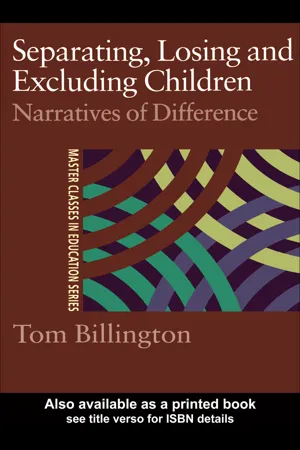
About this book
There has been an outpouring of children from schools over the last few years. The reasons for their exclusion from schools include: learning difficulties, behavioural problems or physical disability. Other reasons that are not dependent on a 'deficit' model of the children relate to Conservative-led initiatives involving school league tables, greater accountability, inspections, etc. Whatever the reasons, the new government are committed to reducing the number of children who are forced out of mainstream schooling.
The author addresses the key issues and relates them to the main theory/literature in the area. He 'unpicks' the major theories and applies them to possible ways of working with children in the classroom. Four case studies are used in order to make these proposed ways of working more accessible. As with other books in the series, exercises, readings and questions are set throughout.
Information
1 Working with Difference
The difference between the most dissimilar characters, between a philosopher and a common street porter, for example, seems to arise not so much from nature as from habit, custom and education…. The difference of talents comes to be taken notice of, and widens by degrees, till at last the vanity of the philosopher is willing to acknowledge scarce any resemblance.
(Smith [1776], 1970, p. 120)
Unacceptable Differences
This is a book about differences. In particular, it is about the differences that are looked for in children, the consequent separations, losses and exclusions which they experience and the activities which characterize our professional practices with them.
That all children are different is unsurprising and that we should be interested in these differences, too, seems unremarkable. That we should be interested in certain differences rather than others seems more worthy of attention and analysis. That we should then develop whole industries, technologies and practices in order to measure and manage some specific differences, however, does indeed seem remarkable. For on what basis are certain differences selected for scrutiny? Indeed, whether we celebrate, tolerate or remediate differences are issues which present themselves as a stream of dilemmas throughout our working lives with children.
What are the effects upon the children, therefore, of the professional activities which we select? Indeed, how are we to work with those children, the very nature of whose disease, disability or difficulty we might in itself choose to eliminate, when at some level they may well have an understanding of the consequences which are associated with their difference—the Separating, Losing and Excluding which are the subject of this book. Perhaps professional energies might be channelled rather towards practices which seek to minimize some of the more punitive effects of social exclusion.
Public expectations of professionals working with children, however, whether teachers, social workers, psychologists or health practitioners, seem ever to be on the increase. Governments, local authorities and parents are demanding more and more—more work, more skills, more change. Whilst we will be unable to meet all these demands it is clear that professional survival may well depend on our capacities to adapt in a world which, increasingly, expects that its workers react promptly at the behest of fast-fluctuating economic conditions. This book seeks to provide theoretical and practical resources which can support our efforts to make sense of such changing circumstances and support also our endeavours to develop ethical professional practices in respect of the children to whom we devote our working lives.
Origins of a Book
This is a book born out of my work as a psychologist employed by a Local Education Authority (LEA). It is born, therefore, out of my work with other professionals and children whom I meet on a daily basis, all of us seeming to do the best we can, but often colliding (although sometimes embracing) at moments of frustration or distress. Many professionals throughout the various supporting agencies—schools, LEAs, Social Service Departments and Health Authorities—are employed in order primarily to work with children whose differences are considered so significant that they warrant our special attention; for us, then, there can be little energy expended on celebrating our successes. For example, to access my time, other professionals such as teachers have to convince either myself or the LEA of the gravity of a particular situation, or else the severity of a child’s difficulties and in order to do this I can be subjected to a litany of problems and stories of failure.
Too often, I thus enter situations which seem irretrievable and I can then experience a further deep sense of unease, which is not only related to the misfortunes suffered by those involved, adults and children, but related also to the ineffectiveness of many of the responses I am permitted to make. Invariably, the other professionals with whom I am involved are kind enough to welcome me into the situation and rarely have I known any direct hostility. The meagre resources at my disposal, however, certainly in terms of available time, place restrictions upon the nature of my involvement and restrict the effectiveness of any resistance to the anticipated social exclusion. Too often, therefore, I enter into a situation when an exclusion of some form (and for whatever reason) can appear to provide the only viable alternative (although sometimes things will have deteriorated to such an extent that any kind of change would provide welcome respite).
For we live in a culture in which children are removed from one school and placed elsewhere just because their differences are deemed unacceptable, although usually there will be a paucity of evidence to suggest that this will result in any kind of success. In this book I consider that such solutions are devised often in accordance with the needs of government rather than necessarily with what a child might choose for themselves, and thus constitute punitive acts of authority in which children’s differences are identified prior to the imposition upon them of a social exclusion. I suggest that the effects of such separations may be detrimental and long-lasting, even on those occasions when the child may initially appear as beneficiary.
It is not just children who are affected by such processes, however, for I believe that all who work with children in blaming cultures—social arenas in which children are made to suffer the consequences of their difference—will suffer the effects of involvement. The pathologizing culture in which we live, one in which individuals are made to pay for their own unacceptable difference, affects us all; for a culture in which children are pathologized is a culture which has at its disposal the capacity to pathologize the adults too, parents, teachers or psychologists, for example.
I suggest, too, that the culture in which we live and work is a culture in which the authentic nature of our experience is challenged constantly and the physical demands placed upon us for more and more (whether change, work or skills) can make it virtually impossible for us to retain ownership of our experiences in our daily work, whether commonplace or epic for example, and can thus exhaust our capacities for authenticity. I hope, therefore, that this book can support fellow professionals by its searching for adult qualities and also by its insistence that children too, whatever the nature of their difficulties or disabilities, may also know moments of profound experience and authenticity. As such, I hope that my efforts to find ways of telling stories about children in this book might not only encourage a determination to preserve our own sense of the profound but also help to encourage that sense in all the children with whom we work. For it is the assaults upon the knowledge and ownership of our own experience in our professional lives and places of work which this book endeavours to resist. I suggest that we can most effectively support ourselves in our work by resisting the culture of blame which pathologizes children’s unacceptable differences and which can otherwise lead to lifetimes of separation and fragmentation.
Ability and Pathology
On occasions, it may appear to the reader that the text of the book moves away from the sites of practice and towards mere theory or even philosophy. At such times I would plead for patience, however, because always the aim will be to link such passages back to practical situations. It is a tenet within the book, however, that theory is practice (see Burman et al., 1996) and that by practising theory we can change our professional practices.
One such theory which underpins many of our current practices with children concerns the concept of ability and a book about children’s differences is drawn inexorably to discourses, not just of ability but by definition, also of dis-ability. Indeed, I suggest that children’s abilities and, in particular, their intelligences and potentials to learn provide sites for many of the theories and practices which are used often to justify their ultimate removal and exclusion from various arenas of social activity. I suggest here, however, that many of the models of ability, intelligence and learning are themselves limited and that more dynamic representations are necessary in order that we might access the ways in which learning can occur.
Now I do not deny that differences exist between children; nor do I claim that differences do not occur in their talents and intelligences; on the contrary; but perhaps the prevailing culture in which reductionist models of abilities and differences are allocated encourages models more suited to physical or medicalized problems—‘The practice of diagnosis is not appropriate to human difficulties’ (Parker et al., 1995, p. 62).
Neither education nor psychology, of course, are responsible solely for any of the injustices which might be represented in this book, for governmental processes are many and complex. However, in part, I write here because of five young people whom I have known—Gary, Mary, James, Peter and John—and because of the ways in which their very being seems to be restricted by the kinds of stories which professionals write about them. I will endeavour not to restrict representations of their humanity to arid narratives of ‘difficulties’ but place them alongside richer, more vivid descriptions of intelligence from which they would often tend to be excluded. Indeed, it is a premise of the book that there are forms of expression which are more able to conceive of, and which can re-present the range and intensity of human experience. One aim, therefore, is to resist the injustice of being perceived essentially, and in a way which assumes authority over all other characteristics and intelligences, as a pathology or ‘handicap’ (see Sinason, 1992).
Structure
The book, therefore, seeks to encourage certain ways of thinking about, speaking about and writing about children who are perceived as different. I hope that, eventually, the book might contribute to the emergence of new professional practices by resisting the culture of individualized blame (whether directed towards children or child professionals) and by resisting too the ghettoization in which many children and adults too can currently become detached from some of the big ideas and possibilities of life.
Following this opening, Chapters 2 and 3 are linked around the issues of power which are raised throughout the book. Initial consideration is given to some of the processes which, I suggest, permeate many professional practices which are directed towards children, for example:
• the ways in which various individuals and ‘populations’ can be identified, separated and excluded from areas of social life;
• the ways in which various individuals or ‘populations’ can either be seen, written about or else pathologized;
• the ways in which individuals, including professionals, can act to resist within some of these processes.
It is argued that power relations are reproduced within everyday acts and interactions, no matter how inconsequential they may seem, and that they can be reproduced also, not only within the more clearly recognizable professional processes and practices (for example, such as those performed by teachers, psychologists and social workers) but also in all of the social relations which are generated by forms of institution and government.
Chapter 2 begins to address these issues through a narrative style which attempts to communicate something of the messiness of everyday social situations rather than claiming an absolute veracity of events. The ensuing dilemmas which occur in the relations are introduced in a case study which has been taken from my work as a psychologist practising within the education system. The chosen case study is of Gary, a 15-year-old boy for whom the Local Education Authority sought ‘psychological advice’ from me as part of a ‘Formal Assessment of Special Educational Needs’ under the 1993 Education Act. The stories are reconstructed from recollections, reflections and also ‘field notes’ (Walkerdine, 1990) made at the time.
In contrast with the style of narrative adopted in Chapter 2 and its individualized stories of experiences, Chapter 3 focuses on the nature of power relations and the activities of government. In so doing, I look to place some of the professionalized activities on a larger, historicized canvas upon which those activities are connected to the institutional demands of government. Just as Chapter 2 situates the processes of exclusion in the stories of individual people and events, Chapter 3 locates its own narratives of exclusion within the changing histories of particular forms of governmental activity, for example, ‘how psychology [and education] functions within current institutionalized structures of inequality’ (Burman, 1994, p. 1).
Many of the key theoretical issues which present themselves during Chapters 2 and 3 are only introduced prior to further consideration later in the book. The essential frameworks which inform the questions of subjectivity, power and narrative are provided by recourse to historical and also discourse analytic texts, in particular, Foucault (1967, 1977), Rose (1989), Parker (1992), Burman (1994), Billington (1995).
In Chapters 4 and 5, the claims to truth made through language, narrative and representation are examined and the contributions to the processes of separating and excluding which are made in professional accounts of child psychopathology are considered. The reader is introduced to representations of ‘Mary’ and ‘James’ and the ways in which certain words and linguistic practices contribute to particular outcomes for them. Questions raised through recourse to history and language are organized within a broadly discourse analytic approach. These chapters, however, rely on modes of analysis and also ideas about speaking and writing which are derived from seemingly diverse sources including Genette, Lacan, Berger, Bion, Newman and Holzman.
In Chapters 6 and 7 the book attempts once more to juxtapose particular practices and also the sites in which children can be located within a broader, world history, doing so by referring again to my own professional work and experience. The process of ‘reading’ political economy is begun and Adam Smith, Karl Marx and Eric Hobsbawm are often invoked as political and historical commentators in their respective centuries. The works of Lev Vygotsky and Robert Hinshelwood then support important links between social, political and psychological arenas in the late twentieth century and, once again, particular modes of analysis are suggested (for example, ‘alienation’, ‘object-relations’).
Chapter 8 provides the reader with some short experimental representations of individual children prior to employing psychoanalytic readings, which are adopted here for the possibilities which they can offer, not only for relocating individuals within their social conditions but also for resisting the processes of simplistic, individualized pathologization. Specific ideas and practices here are derived from, principally, the works of Bion and Hinshelwood but also the writing of Donna Williams (who has a diagnosis of autism) and are again applied to case studies taken from my professional practices as a psychologist working within the English education system—Mary and James once more, but also Peter.
The book concludes by considering some of the outcomes of the various cases in the book and also by suggesting bases upon which resistances can continue to be developed and which can challenge the prevailing culture in which the separating and excluding of children occur through the pathologizing discourses of stigmatized differences.
Endpiece
The theoretical models throughout the book demand that the reader does not view accounts of indiviual actions as factual but rather as representations as they are a means only of bringing critical illumination to the social processes in which all our professional practices are embedded. Indeed, it is important to note here that, as practitioner, I now operate within the context of a successful LEA which has many good teachers and schools together with well-respected officers and support services.
For it is the industrialized processes of accounting for difference which can too often lie unobserved in our activities with children and, in particular the ways in which such differences can be infected by the practices of pathologization in order to serve economic and political exclusions. It is the intention, therefore, to provide the reader with a range of theoretical tools which can be utilized to analyze these processes of social exclusion in action. Utilization of these resources (primarily history, language, discourse analysis and psychoanalysis) may lead, hopefully, to the emergence of activities better able to resist the punitive and discriminatory consequences of those practices which can be found in education and psychology as well as in other arenas of government, both for the children and for the professionals themselves.
I suggest that the nature of much of our current thinking about children’s own thinking and intelligences will one day be considered primitive and I am sceptical, therefore...
Table of contents
- Cover
- Halftitle
- Title
- Copyright
- Contents
- Series Editors’ Preface
- Acknowledgements
- 1. Working with Difference
- 2. Gary—A Formal Assessment
- 3. Pathologizing Children: Power and Regulation
- 4. Speaking of Mary
- 5. Authority and the Written Word
- 6. Memory, History and the Division Of Labour
- 7. Alienation or Pathology?
- 8. Tales from the Autistic Spectrum
- 9. Conclusion: Discourse on Science
- Notes
- References
- Index
Trusted by 375,005 students
Access to over 1.5 million titles for a fair monthly price.
Study more efficiently using our study tools.
Frequently asked questions
Yes, you can cancel anytime from the Subscription tab in your account settings on the Perlego website. Your subscription will stay active until the end of your current billing period. Learn how to cancel your subscription
No, books cannot be downloaded as external files, such as PDFs, for use outside of Perlego. However, you can download books within the Perlego app for offline reading on mobile or tablet. Learn how to download books offline
Perlego offers two plans: Essential and Complete
- Essential is ideal for learners and professionals who enjoy exploring a wide range of subjects. Access the Essential Library with 800,000+ trusted titles and best-sellers across business, personal growth, and the humanities. Includes unlimited reading time and Standard Read Aloud voice.
- Complete: Perfect for advanced learners and researchers needing full, unrestricted access. Unlock 1.5M+ books across hundreds of subjects, including academic and specialized titles. The Complete Plan also includes advanced features like Premium Read Aloud and Research Assistant.
We are an online textbook subscription service, where you can get access to an entire online library for less than the price of a single book per month. With over 1.5 million books across 990+ topics, we’ve got you covered! Learn about our mission
Look out for the read-aloud symbol on your next book to see if you can listen to it. The read-aloud tool reads text aloud for you, highlighting the text as it is being read. You can pause it, speed it up and slow it down. Learn more about Read Aloud
Yes! You can use the Perlego app on both iOS and Android devices to read anytime, anywhere — even offline. Perfect for commutes or when you’re on the go.
Please note we cannot support devices running on iOS 13 and Android 7 or earlier. Learn more about using the app
Please note we cannot support devices running on iOS 13 and Android 7 or earlier. Learn more about using the app
Yes, you can access Separating, Losing and Excluding Children by Tom Billington in PDF and/or ePUB format, as well as other popular books in Education & Education General. We have over 1.5 million books available in our catalogue for you to explore.