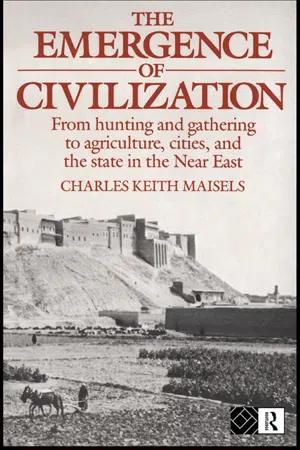
The Emergence of Civilisation is a major contribution to our understanding of the development of urban culture and social stratification in the Near Eastern region. Charles Maisels argues that our present assumptions about state formation, based on nineteenth century speculations, are wrong. His investigation illuminates the changes in scale, complexity and hierarchy which accompany the development of civilisation. The book draws conclusions about the dynamics of social change and the processes of social evolution in general, applying those concepts to the rise of Greece and Rome, and to the collapse of the classical Mediterranean world.
eBook - ePub
The Emergence of Civilization
From Hunting and Gathering to Agriculture, Cities, and the State of the Near East
- 416 pages
- English
- ePUB (mobile friendly)
- Available on iOS & Android
eBook - ePub
The Emergence of Civilization
From Hunting and Gathering to Agriculture, Cities, and the State of the Near East
Chapter one
Introduction
1
The disciplines of archaeology and anthropology
Archaeology and geology are twin sisters of the nineteenth-century enlightenment. It was geology that turned antiquarianism into archaeology. As early as 1836, the antiquarian and customs official Jacques Boucher de Perthes (1788–1868), argued that man had been contemporary with presently extinct animals, and in 1847 he published the first volume of his signally titled Antiquités celtiques et antédiluviennes (Daniel 1964:44). Although evidence for the antiquity of Man (long before the Biblical Flood and his supposed creation around 4,000 BC) was accumulating from several locations, Boucher’s view did not become the accepted one until endorsed in 1859 by the geologists Evans and Prestwich, who visited his quarry sites at Abbeville in that year (Daniel 1964:45).
However, scholarly antiquarianism, which can be considered protoarchaeology, was pioneered in Denmark and Sweden during the seventeenth and eighteenth centuries, thanks to continuous state support. Thus, since Thomsen’s (1836) guidebook to the Danish National Museum, clearly setting out the ‘Three Age System’ (Stone, Bronze, Iron), systemic classification for the conceptualization of prehistoric societies (and thus encouraging their recovery through excavation), has been by means of this ‘Ages System’, based upon the materials employed for weapons and tools. Consequently we now think in terms of Old and New Stone Ages (i.e. Palaeolithic and Neolithic, a distinction introduced by Lubbock), then those of Copper (Chalcolithic), Bronze, and Iron.1 Coupled with William ‘strata’ Smith’s ‘principle of superposition’, stating that objects found lower in the (undisturbed) earth are older, the nascent discipline of archaeology had found its organizing principles; that is, both its field of study and its means of analysis. As Lubbock proclaimed on the first page of his best-selling Prehistoric Times (1865): ‘Archaeology forms the link between geology and history.’
With the expansion of archaeology and anthropology both geographically and in depth throughout this century, processes formerly aggregated can now be distinguished thanks to the much finer resolution thus made possible, a process greatly assisted by a range of scientific techniques, foremost among which is radio-carbon (C14) dating for absolute chronologies (when calibrated). It is no longer possible, for instance, to see the Neolithic as a ‘revolution’ or ‘explosion’, the immediate consequence of a ‘breakthrough’ such as the ‘invention’ of pottery or the sickle.
In 1936 Vere Gordon Childe published Man Makes Himself, which Daniel, introducing the fourth edition (1965:x), called ‘an epoch-making synthesis of prehistory’. There Childe modified the Three Age System of Neolithic, Bronze, and Iron Ages that he had previously employed, by introducing his own concept of ‘Two Revolutions’, the Neolithic and the Urban (McNairn 1980:91–9). For Childe, the term Neolithic represented the advent of pottery, textiles, woodworking, and village life on the basis of regular food production by agriculture and pastoralism, in contrast to (wild) food procurement (Childe (1936) 1965:88). He saw the Urban Revolution not simply as a further growth and nucleation of population, but as a wholly new form of civic existence (‘civilization’) based upon intensified agriculture, plus further development of crafts stimulated by an emergent stratification into rulers and ruled. With its monumental buildings, didactic art, organized religion, trade, writing, and the appearance of natural science, Childe identified the Urban Revolution with the advent of the state:
The neolithic revolution was the climax of a long process. It has to be presented as a single event because archaeology can only recognize the result; the several steps leading up thereto are beyond the range of direct observation. A second revolution transformed some tiny villages of self-sufficing farmers into populous cities, nourished by secondary industries and foreign trade, and regularly organised as States.
(Childe 1965:105)
Childe’s synthesis (continued in What Happened in History, 1942, and Social Evolution, 1951), effected a conceptual revolution in archaeology, for ‘he supplemented an exclusively chronological by a cultural approach’ (Clark 1976: 5). The holistic approach which Childe promoted was given further impetus through the work of Grahame Clark. Clark (1952) stressed the ‘economic approach’ to prehistory, employed to understand the whole mode of life of the people being investigated, ranging from their articulation with the environment to their cosmological reflections upon it.
Shortly after, in concluding a review of technique in archaeology, Wheeler identified the ‘problem of numbers’ as the ‘one problem more than [any] other which demands investigation during the next thirty years’ (Wheeler 1956:245). This demographic emphasis, he maintained, was required to illuminate the whole ‘social unit’ as a dynamic system. Indeed, in that same year (1956) were published a number of ethnologies incorporating numerical data bearing upon demographic issues in contemporary societies (Smith, R.T.; Mitchell, J.C.; Tait, D.). Further harbingers of changing concerns and outlooks had been Taylor’s (1948) critique of his colleagues in the United States, A Study of Archaeology, and the synthesis by Willey and Phillips in 1958, entitled Method and Theory in American Archaeology. This was the work that contained the famous aphorism: ‘archaeology is anthropology or it is nothing’ (op. cit.:2).
Concerns with economy, environment, and demography were thus very much in the air when, late in the 1960s, the New Archaeology was articulated by Lewis Binford in the United States and by David Clarke in the UK. It was indeed in the very same year, 1968, that Clarke’s programmatic Analytical Archaeology appeared, while Lewis and Sally Binford edited and contributed to a collection well entitled New Perspectives in Archaeology. This latter was perhaps decisive in launching what has come to be called ‘processual archaeology’, or, with the emphasis on the aforementioned aphorism, palaeoanthropology. It also gave rise to a heightened and explicit interest in ethnoarchaeology, an approach that seeks to get beyond the use of ethnology and ethnography merely as external sources of analogy for an archaeology going about its traditional business. Instead ethnoarchaeology’s function is to integrate social and cultural anthropology as an organic part of the practice of archaeology. This by having ethnography inform the premisses employed in the reconstruction of dead societies through excavation.
Inform does not, of course, mean exhaust. There is a great deal in the approach and practice of palaeoanthropology which social and cultural anthropology cannot possibly provide. None the less, what can be done should be done, and hence ‘the subdiscipline (of ethnoarchaeology) is defined broadly as encompassing all theoretical and methodological aspects of comparing ethnographic and archaeological data, including the use of ethnographic analogy and archaeological ethnography’ (Stiles 1977:87).
Analogy is the use of aspects of the known to construct a model for the unknown. The pitfall is obviously the substitution of a construct for what is yet to be discovered. Archaeological ethnography is ethnology undertaken amongst living (or at least recent) societies in order to illuminate aspects of social behaviour either ignored or inadequately treated in conventional ethnology, such as material culture often is. Archaeological ethnography is also known as ‘living archaeology’; but Gould (cited Stiles 1977:88), rightly in my view, states that ‘Ethnoarchaeology…refers to a much broader general framework for comparing ethnographic and archaeological patterning.’
Included in ethnoarchaeology is historical ethnology, the attempt to reconstruct ethnology from written sources, here of course Mesopotamian. This, however, is not an analogical procedure, and is more powerful than any such. The next most powerful research tool is analogy derived from archaeological ethnography conducted, as near as can be made out, amongst the ‘living descendants’ of the society being archaeologically recovered. Examples are Hopi Indian ethnology for palaeoindian research, or rural and upland ethnology in Iraq for ancient Mesopotamian societies, of which much more below. This is also called the ‘direct historic’ or ‘continuous’ approach, in contrast to ‘external’ analogues from other areas, which is termed the ‘general comparative’ or ‘discontinuous’ approach. This is by far the weakest procedure, and is best regarded as only suggestive or heuristic.
Explication of those interrelationships is perhaps best done through what can be called the ‘Hawkes Ladder’, which illustrates levels in social reconstruction and the complementary roles of archaeology and anthropology in producing it. In discussing W.W.Taylor’s A Study of Archaeology, already mentioned as criticizing his colleagues’ practice of archaeology as ‘mere chronology’, Christopher Hawkes outlined a ‘fourfold answer…to take you from comparison and analysis of observed phenomena to the human activity that produced them’ (1954:161).
In this logical procedure there are four degrees of difficulty, the lowest of which, marked 1 on Figure 1.1 is to know what the artefacts recovered in excavation are and how they were made. Artefacts here means everything wrought by human hands, thus including the likes of ditches, building plans, pits, and so forth, in addition to the more usual sense of pots, tools, and general mobiliary. From animal bones and grains recovered, tools, weapons, and facilities, perhaps as explicit as the finding of sickles in association with storage bins and bread-wheat grains or pollen, or shell-middens and fish weirs, it is quite easy and relatively safe to infer the sorts of subsistence activities underpinning a particular society. This is level 2 in the diagram. What however is neither easy nor safe is to make ready inferences about the sorts of social structure obtaining. Certain things are positively excluded, such as huntergatherers grouping themselves into cities while remaining huntergatherers, but a great deal else is indeed possible by way of variation. Hawkes (op. cit.: 162) gives the example of the uncovering of architectural features whose function ought to be obvious, but is it? If in the excavation of a settlement one hut turns out to be larger than the rest, does one infer: a chief’s hut (hence ranking), or a ‘men’s house’ (hence either no ranking on Melanesian analogues, or stratification on that of historical southern Iraqi experience), or is it a temple?
All this difficulty as to social structure in level 3. But assume from the discovery of altars, niches, and statuary in this larger building that we have decided that it is a temple. What can we know of the religious beliefs held? And beyond this, of that people’s cosmology, which is a compound of the religious and the empirical? If the excavated material from Mesopotamia, which is comparatively very rich, was all we had, it would have been impossible even to give the sketchy picture of Mesopotamian cosmology provided in this work. For a fairly sure knowledge of level 4 we need either written texts or ethnology in a continuous tradition; otherwise our inferences are either too general (‘hunter-gatherers pray for good hunting, farmers for good crops’) or just guesswork, more or less interesting. Archaeology is well able, despite manifold practical difficulties, to uncover the material record (level 1) and to make fairly secure inferences about subsistence activities on that basis (level 2). As we have seen, however, the problems arise in getting beyond this stage, for archaeologists are rightly not content to leave it there (cf. Renfrew 1984:3–19). The problem in getting to the next level (3) and beyond is both evidential and logical.

Figure 1.1 The Hawkes Ladder
This is where anthropology comes in,2 supplying concepts, models, and different data. Archaeological anthropology can sometimes do this in the most direct fashion, in which case data relevant to all four levels can be provided (though this will never be even in quality or quantity). Failing this, not so much ethnology (what the anthropologist sees and is told through participant observation), but the issues raised at the theoretical level (ethnography) can be of assistance to archaeology at its own analytical/theoretical level, that of palaeoanthropology. Palaeoanthropology is in its turn able to provide anthropology with the added dimensions of time-depth and a processual perspective3 which it currently all too often lacks. Conversely, it is not a matter of whether to use ethnology and ethnography in reconstructing the prehistoric past, for our views of other places and different times are already imbued with notions thus derived, as Orme (1981:2) has indicated; but rather what ethnological materials and which ethnographic concepts should be applied to archaeological interpretation while not substituting for it: ‘Archaeological interpretation has depended on ethnography from its infancy in the sixteenth century, through the great growth spurt of the nineteenth century to the present day.’ For crucially, ‘the idea of a past [qualitatively] different from the present, a keystone of archaeology, was established through the use of ethnography’ (Orme 1981:7).
2
Social evolution and anthropology4
The ‘way was opened’ from modern (field) anthropology to participation in the New (processual, social) Archaeology by the ‘Man the Hunter’ Symposium held at the University of Chicago in April 1966, and published under that title in 1968, edited by Richard Lee and Irven De Vore. It was a timely impulse because, during most of this century, anthropology ‘social’ and ‘cultural’ has tended to eschew developmental classification, such as the evolutionism of its pioneers like Tylor and Frazer. Indeed in the United States cultural anthropology became positively anti-evolutionary after Boas (White 1960:v; Sahlins and Service 1960: 1), while in Britain the topic was just generally ignored. Even in France ‘anti-evolutionist feeling has been intense for most of this century …and to a large extent remains so’ (Testart 1988:1).
Those were the conditions under which Murdock (1949:187) could write in his broad synthesis entitled Social Structure, which employed a selection of data from the Yale Cross-Cultural Survey (begun 1937), that he had ‘weighed a number of such [evolutionary] suggestions against the data from his [sic] sample societies, but he has found none which accords with the ethnographic facts’. He complains that Lesser and White in various articles5 were outrageous enough to suggest that ‘hunting and gathering are earlier than herding and agriculture, that a stone age has everywhere preceded the use of metals, and that community organisation antedates the development of any kind of complex political state. It is alleged’, Murdock further complains, ‘that comparable evolutionary sequences can also be established in the field of social organisation’ (ibid.). This indeed has been an indispensable and even commonplace grid since formulated sociologically by John Millar of Glasgow in 1771 (Evans-Pritchard 1981:34; Finley 1983b:10), for it makes the most sense of the widest range of data—prehistoric, historic, and ethnographic—though perhaps less obviously in synchronic than in diachronic perspective.
Yet in rigorous statistical tests employing just such ethnological data, Raoul Naroll (1956:687–715), Freeman and Winch (1957:461–6), Gouldner and Peterson (1962:1–94), and M.J.Harner (1970:67–86), the last-mentioned employing the total universe of the 1,170 societies with codified data in Murdock’s own Ethnographic Atlas, convincingly demonstrated that there was indeed such a fundamental set of evolutionary relationships.
Carneiro (1967:234–43), employing 205 organizational traits in a total of 100 societies, showed the relationship between population size and the complexity of social organization to be logarithmic, the number of organizational traits being proportional to the root (or power) of the population size.
A decade earlier Freeman and Winch (1957:464) employing scalogram analysis and Murdock’s selection procedures on 48 societies from the Cross-Cultural Survey and the Human Relations Area Files, ‘clearly demonstrate[d] a scale among six of the eight tested items: punishment, government, education, religion, economy and written language vary [ing] together to form a unidimensional array’.
Previous objections to evolutionism, most a consequence of the a-prioristic schematism of earlier workers that had tended to produce at best a conjectural, and at worst a counter-factual history (Lowie 1946), are thus removed.
The solution has been found to reside in replacing unilineal with multilineal sequences (as best described by Carneiro 1973:100), thus disposing of the presupposition that differing societies represent set stages along a single path. Further, cross-cultural uniformities can be sought, and underlying causation made clear, by measuring the actual type and degree of social complexity obtained along political and economic axes (degree of hierarchy and number of distinct occupations),6 and by differentiating the social order (system of organizations) from the social structure (network of roles), as discussed in Chapter 8. Thus I employ the term ‘succession’ to look at a long series of transformations in societies, without prejudging their individual processes, whether their paths are parallel, or how much they may have in common at any particular stage.
In short an acceptable evolutionism (and some such is indispensable), is descriptive rather than prescriptive. By comparison it situates advancing complexity where that is empirically manifest, so that ‘...
Table of contents
- Cover Page
- Title Page
- Copyright Page
- List of figures
- List of maps
- List of tables
- Glossary of some physical terms
- Acknowledgements
- Preliminary
- Chapter one: Introduction
- Chapter two: The premisses of social succession
- Chapter three: The ecology of the Zagrosian Arc
- Chapter four: The origin and growth of villages
- Chapter five: The heartland of cities
- Chapter six: The institutions of urbanism
- Chapter seven: Theories of the state
- Chapter eight: From status to state
- Chapter nine: Modelling societies: modes of production
- Chapter ten: Ideology and political economy of the Mesopotamian state
- Chapter eleven: Summary and overview
- Appendix A: The pantheon of the Sumerian city-state
- Appendix B: Inanna and Dumuzi of the dates
- Appendix C: The spread of farming from the Near East
- Appendix D: Support of and from the early temple
- Appendix E: The interactive evolution of alphabetic script
- Appendix F: The Ages System
- Notes
- Bibliography
Trusted by 375,005 students
Access to over 1.5 million titles for a fair monthly price.
Study more efficiently using our study tools.
Frequently asked questions
Yes, you can cancel anytime from the Subscription tab in your account settings on the Perlego website. Your subscription will stay active until the end of your current billing period. Learn how to cancel your subscription
No, books cannot be downloaded as external files, such as PDFs, for use outside of Perlego. However, you can download books within the Perlego app for offline reading on mobile or tablet. Learn how to download books offline
We are an online textbook subscription service, where you can get access to an entire online library for less than the price of a single book per month. With over 1.5 million books across 990+ topics, we’ve got you covered! Learn about our mission
Look out for the read-aloud symbol on your next book to see if you can listen to it. The read-aloud tool reads text aloud for you, highlighting the text as it is being read. You can pause it, speed it up and slow it down. Learn more about Read Aloud
Yes! You can use the Perlego app on both iOS and Android devices to read anytime, anywhere — even offline. Perfect for commutes or when you’re on the go.
Please note we cannot support devices running on iOS 13 and Android 7 or earlier. Learn more about using the app
Please note we cannot support devices running on iOS 13 and Android 7 or earlier. Learn more about using the app
Yes, you can access The Emergence of Civilization by Charles Keith Maisels in PDF and/or ePUB format, as well as other popular books in History & Middle Eastern History. We have over 1.5 million books available in our catalogue for you to explore.