eBook - ePub
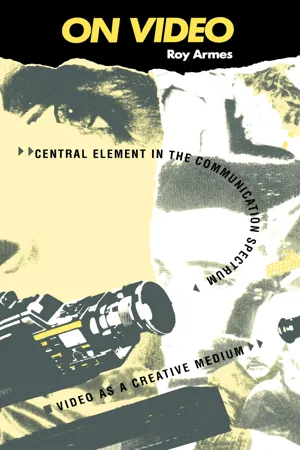
On Video
About this book
Though video systems are now growing ever more accessible, and practical video work is undertaken at every level of education, this is the first book-length historical and theoretical study of the medium. On Video explores video on two levels: first, it examines the relationship between technology and society; and second, it probes the connection between production methods and the communication of meaning.
Information
PART ONE VIDEO IN ITS HISTORICAL CONTEXT
For twenty-five centuries, Western knowledge has tried to look upon the world. It has failed to understand that the world is not for the beholding. It is for hearing. It is not legible, but audible.
(Jacques Attali 1985: 3)
The first need in attempting to reach an understanding of video is to define its proper historical context, and this means discarding the customary picture that emerges from the standard histories of cinema. In such histories, the origins of film are seen to lie solely in photography, and the primacy of the image is unchallenged, with sound merely entering at a single historical moment (the end of the 1920s) to supplement the visuals. Television – defined perhaps as ‘the electronic image’ – is fitted into this pattern in ways that ignore its radically new blend of sound and image, while video appears as no more than a kind of appendix or footnote – usually in the concluding paragraphs dealing with ‘the future of the media’.
In fact video is the key final link in a complex chain of developments in both image and sound reproduction. It is true that still photography has a special place in the history of the communication media as the first system of recording to be perfected. But from the 1840s onwards there was a parallel development in the reproduction and transmission of sound – first the electric telegraph, then the telephone, and finally, at the end of the century, wireless transmission. Though arguably irrelevant to the initial invention of cinema in the 1890s, this strand of development is clearly a crucial part of video's ancestry. When we consider developments from the latter part of the nineteenth century onwards, we find that sound reproduction, far from being a ‘poor relation’, is more properly seen as the dominant partner. Sound reproduction has consistently preceded image reproduction and sound media have constantly shaped the subsequently developed visual media.
In the 1890s Edison invented a peepshow, the kinetoscope, and not projected motion pictures, because his thinking was influenced by the commercial success then being enjoyed by his ‘talking machine’, the phonograph, as an amusement-hall coin-in-the-slot entertainment. If the cinematograph was invented by a photographer, Louis Lumière, it was the American and European pioneers of the phonograph, Thomas Edison and Charles Pathé, who industrialized it and gave it its commercial pattern. In any case, to see early cinema as a ‘silent’ medium and hence simply as the heir to still photography is a misconception. Music was always a vital accompaniment, even at Lumière's first showings of the cinematograph in the 1890s. Sound systems were sought from the earliest days and what so-called silent cinema lacked was not sound, but merely synchronized speech.
Viewed from an economic standpoint, the introduction of synchronous sound to the cinema in the 1920s was not the result of a collaboration between industrial equals, but a virtual colonization of the motion-picture business by huge electrical companies grown rich on the profits from the telephone and from radio. The Radio Corporation of America (RCA) was in fact the first of the transnational multimedia corporations which have subsequently come to dominate totally the sound and image industries. It was the structures and institutions developed by sound radio in the 1920s which determined those later adopted by television. Moreover, after the Second World War, the development of magnetic sound tape, which barely merits a mention in most film histories, revolutionized film editing, as well as transforming the record industry and creating a context for video.
The one recent technical advance in which a sound-and-image system preceded a purely sound one was, significantly, a commercial failure. The laser video disc introduced by Philips and Sony in 1975 was not a success, perhaps because there was no pre-existing experience on the part of consumers of buying pre-packaged material, such as films, for domestic viewing. The system had therefore to be relaunched a few years later, using only part of its potential, as a sound-only system, the compact disc. This found a ready market, despite the high cost of the CDs, because there was a public which regularly bought pre-recorded music and was used to paying large sums for advances in recording technology (from 78s to LPs to stereo, etc.). With the video cassette recorder having established itself since around 1979, first as a system of personal off-air recording and then for replay of hired or purchased material, there might be a possibility of reintroducing the laser video disc. Indeed at the moment of writing Philips and Sony are preparing the launch of a revamped version of LaserVision: the 12 cm diameter compact disc video (CDV) which contains 5 minutes of analog video with digital sound and 20 minutes of digital sound without video images. But video tape seems capable of keeping pace with any improvements in television technical specifications (for example, 1,000-line high-definition pictures and stereo sound), so the potential advantage of a ‘hi-fi’ system seems precluded. Furthermore, the reason why the laser disc is so attractive to the record industry – it is a replay-only system which precludes piracy – is precisely the feature which will make it least attractive to purchasers.
When we consider video it is not enough to show how it reproduces the image-sound systems developed by film and television. We also have to recall that it adopts a recording process analogous to that of magnetic sound tape, whose spread of application and production potential it exactly echoes. The full possibilities of the new medium of video can therefore only be properly understood if we reject the limitations of the customary film-television-video line of approach and see video within an overall history of sound and image reproduction which stresses the interconnections between the various systems.
1 | EARLY SOUND AND IMAGE REPRODUCTIONTo an ever greater degree the work of art reproduced becomes the work of art designed for reproducibility. From a photographic negative, for example, one can make any number of prints; to ask for the ‘authentic’ print makes no sense. But the instant the criterion of authenticity ceases to be applicable to artistic production, the total function of art is reversed. Instead of being based on ritual, it begins to be based on another practice – politics. (Walter Benjamin 1973: 226) |
There are three clearly distinguishable, if overlapping, stages in the history of sound and image reproduction: the cluster of media developed in the latter part of the nineteenth century, the electronic revolution that began with the creation of radio broadcasting in the 1920s and continued with the development of television, and the new phase inaugurated after the Second World War by the introduction of Electro magnetic recording. The present chapter deals with the tremendous burst of creative and commercial energy in the latter part of the nineteenth century, when three new media emerged – the still photograph, the gramophone record, and the film – and key initial work was undertaken on wireless and tape recording. Although the means of recording are totally different from those of video, the modes of industrial organization and forms of social application of these media had an enormous impact on subsequent developments, and to understand video we need to consider the context which they so largely shaped.
As we approach this history, there are a number of general factors which need to be borne in mind. We sometimes talk of technologies creating new societies – as in the title of Robert Sklar's social history of the US cinema, Movie-Made America (1975), or in such a phrase as ‘the TV generation’ – but in fact the relationship is quite the reverse. As Raymond Williams has demonstrated, it was wider social developments – the accumulation of capital and transformation of industrial production throughout the century – which led directly to the emergence at the end of the nineteenth century of the technologies underlying the new communication media (Williams 1974: 9–31).
This was a period of huge social transformation, with the rise to fuller power of the bourgeoisie creating new markets for goods and utilities to be produced by what was still a largely unregulated ‘freeenterprise’ industrial system. Overlapping with this was the emergence of the working class with increasing political strength (thanks to the extension of democracy), greater education and more leisure and purchasing power – a force to be feared, controlled, and exploited commercially. The late nineteenth century was also the height of European imperialism, culminating in the invasion of Egypt and the carving up of Africa in the 1880s. It was only at the very end of the century that the United States emerged as an overseas imperialist power, intervening to annex Hawaii and divert the liberation struggles in Cuba and the Philippines in 1896. This was an era of expansion in all forms of communication, with the spread of the railways prompting the growth of the telegraph, first ancestor of the electronic broadcast media of the twentieth century. At the same time growing literacy fostered the creation of the first news agencies and the emergence of the first popular press in Europe with the Parisian Petit Journal and the London Daily Mail.
The connection between technological development and social need is by no means as simple as might be thought (Winston 1986: 15–34). The history of communications technology shows that very frequently devices are invented as answers to short-term problems which fade into insignificance compared to the actual long-term applications which have been totally unforeseen. The classic example here is the cinema, which was invented in a form allowing one-minute glimpses of everyday life in movement – waves breaking on the beach or a train entering a railway station. Yet the superior marketing possibilities (and hence profitability) of narrative films designed for a lower-middle- and working-class audience soon became apparent. As a result, within twenty years the word ‘film’ had taken on a totally new meaning, as epic stories capable of sustaining a three-hour narrative (like D. W. Griffith's pioneering The Birth of a Nation (1915)) enthralled audiences world-wide and made a fortune for producers, distributors, and exhibitors alike.
Similarly, the process of invention is by no means simple and clear-cut. There is no unambiguous pattern of ‘firsts’ as individual great minds come up with instantly practical solutions to known but baffling problems. Often only part of the problem is solved initially. Daguerre, for example, offered a form of photography which allowed a sharp visual image but did not permit this image itself to be replicated (every daguerreotype was a unique object). Invention in the sound and visual media is more often a case of numerous theorists and practical men fumbling simultaneously in the dark, with fame and fortune going not necessarily to the most talented, but rather to those with access to capital, to workshop and laboratory resources, and to the high technical skills of dedicated craftsmen (this is true of Daguerre, Edison, Eastman, and Lumière).
Inventions have almost as often been independently duplicated as they have been knowingly duped or stolen. A striking example here is nitrocellulose film, which George Eastman developed and manufactured in 1889, but which had been quite independently patented two years earlier by the Reverend Hannibal Goodwin, the latter's heirs eventually being awarded $5 million in compensation after a very lengthy lawsuit (Jenkins 1975: 125–7, 332–4). On occasion, a development is made by means of equipment which everyone knows is transitional, but which has the virtue of being simple and reliable, and hence to some extent reassuring to those who entrust their fortunes to it. An example here is synchronized sound film which was introduced in 1926, via a Warner Bros subsidiary Vitaphone, through a system of sound-on-disc, although a superior, electronic, and less cumbersome sound-on-film system had already been brought to an advanced state of development by the Western Electric company (Ogle 1977: 201). Equally, some seemingly key advances are ignored for years. Halftone printing – the first method of reproducing photographs directly on the printed page without the intervention of an engraver – was used sporadically from around 1880 onwards. Yet the quality of the reproduction was initially coarse and uneven, and, given the graphic efficiency and economic competitiveness of the engraving and woodcut processes, there was no commercial incentive to improve the halftone process and to apply it widely until highspeed printing presses were developed at the turn of the century (Goldsmith 1979: 110– 11). It will be clear from these preliminary remarks that nineteenth-century developments in communication technology were complex. Before, however, we turn to consider them in detail, there is a significant stage of prehistory which deserves at least brief attention.
Prehistory
Support for claims about the visual bias of our western culture – in which ‘seeing is believing’ and an eye-witness is to be believed while hearsay evidence is inadmissable – comes from the fact that the first western efforts were directed at the reproduction of the visible. These efforts, occurring some 400 years before the invention of photography, belong to the remote prehistory of the media, but they have a lasting interest. Significantly, progress on two related developments – the reproduction of reality and the mass production of images – was begun at almost precisely the same time in the early fifteenth century. As Rudolf Arnheim notes, it was the woodcut, the earliest preserved example of which is a Madonna with the Four Virgin Saints dating from 1418, which ‘established for the European mind the almost completely new principle of mechanical reproduction’ (Arnheim 1974: 284–5).
This advance was to be immediately reinforced by the invention of printing from moveable type before the middle of the century. There are Chinese precedents for the woodcut and for printing with moveable type, just as it is to the Chinese that we owe the invention of paper. But the second key fifteenth-century development – the codification of the rules for duplicating reality systematically – is an exclusively European phenomenon. The principle of the camera obscura – that light entering a minute hole in the wall of a darkened room throws onto the opposite wall an inverted image of a sunlit scene outside – had been known since antiquity. But it was only in 1435 (just seventeen years after the first known woodcut) that the optical laws governing this phenomenon were used as the basis for establishing the rules of central perspective by Leon Battista Alberti in his book On Painting. From this point onwards, western culture had a wholly distinctive and seemingly objective way of reproducing natural forms.
The European system of central perspective as codified by Alberti is interesting in many ways. Firstly, it is felt by those who use it to be an extremely realistic method of rendering optical space. Secondly, as Rudolf Arnheim observes, it is at the same time ‘so violent and intricate a deformation of the normal shape of things that it came about only as the final result of prolonged exploration and in response to very particular cultural needs’ (Arnheim 1974: 283). Whereas other systems of visual organization have been discovered independently in a number of different cultures, there is no parallel anywhere else for the European system. Thirdly, it provoked the use, as aids for draftsmen, of such devices as the camera obscura (the practical application of which to drawing was first described by Giovanni Battista della Porta in 1553). In this way it began the continuing interrelationship between western art and western technology. Fourthly, the portable camera obscura devices designed specifically for draughtsmen came to be equipped with lenses selected precisely because they produced an image conforming to central perspective rules (Scharf 1974: 19–26). In this way a self-proving system was set up (the rules were ‘proved’ by the lenses which were designed to produce just what the rules predicted), so that the ‘truth’ of perspective could become part of the west's unquestionable common-sense knowledge.
Photographic, film, and video cameras are merely devices for recording, by photochemical or electronic means, this long-established, predetermined way of seeing. Yet since central perspective is a system of organizing space in terms of a single static eye, it opens up a gap between what we actually see and what the camera shows us, which continues to haunt the debates about the realism of photographic, filmic, and video images. For Arnheim, the discovery of central perspective was ‘a dangerous development in Western thought’, since it marked ‘a scientifically oriented preference for mechanical reproduction and geometrical constructs in place of creative imagery’ (Arnheim 1974: 284). From the standpoint of the present study, however, it opens up the fascinating area where art and technology, reproduction and representation coexist.
The timing of the two developments is also very significant. If we look at the wider context of society and culture in the early part of the fifteenth century, we find a major reshaping of western consciousness. This was the age of the Copernican revolution in science and of such technological advances as the discovery of gunpowder, the invention of canons and portable firearms, and the redesigning of sailing ships (Cipolla 1970). In this context the principles of the organization of central perspective (as a way of measuring, reproducing, and hence controlling the physical world) and the mechanical reproduction of woodcuts and books (allowing a new flow of images and ideas) contributed to the progress which, at the end of the century, was to lead to the onset of European world dominance.
When we take up the story of sound and image reproduction again with the invention of photography in 1839, it is precisely to the handful of dominant European nations, Britain, France, and Germany – now joined by an emergent United States of America – that we have to turn. These were the most advanced industrial countries of the nineteenth century, and it was in their factories and laboratories that the key nineteenth-century advances were realized. In their turn, the huge communication industries based on the successive discoveries of the reproduction and transmission of sounds and images have contributed to the reshaping of western consciousness.
Photochemical and mechanical recording
The nineteenth-century media of sound and image reproduction involved two separate but related requirements. The first was the duplication of some aspect of reality – the visual appearance of a landscape or the sound of a human voice, for instance. The newly acquired sound or image would need to be ‘fixed’ in some way and the choice of the carrier base on which it was recorded was of great importance. Some amplification of the aural or visual ‘imprint’ also had to be devised if the reproduction was to be made fully accessible to an audience. The second major requirement for the full commercialization of such duplications of reality was that they themselves should be able to be mass produced and marketed. The conventional still photograph, the feature film, and the gramophone record – which have their roots in nineteenth-century technology – fulfilled all these requirements and hence have been able to play such an important part in our lives.
The importance of the carrier base cannot be over-emphasized, as the analogy with the book shows. Writing in the form of engraved stones or impressed clay tablets had existed for thousands of years before the invention of the book, which emerged only when writing was applied to a pliant, light-weight, and easily portable substance. The early history of the book is the history of successive carrier bases – papyrus, parchment, paper – which both preserved words and allowed them to be distributed widely. The successive stages of the handwritten book also relate directly to the type of support: the papyrus roll (or volumen) succeeded by the parchment book (or codex). Paper is a prerequisite for the next stage, the printed book, which adds mass production to the book's earlier functions of preservation and distribution (Escarpit 1966: 19–20). In a similar way, celluloid is a prerequisite for popular photography and the cinema, supplanting glass plates for photography and paper rolls for projected images (Wollen 1982: 170). In this connection the enormous importance of sound and video tape to the preceding media of radio and television broadcasting can be clearly seen: they too allow sounds and images to be preserved, mass produced, and distributed in new ways.
In the initial form in which the new media of sound and image reproduction eme...
Table of contents
- Front Cover
- Half Title
- Title Page
- Copyright
- Dedication
- CONTENTS
- General editor’s preface
- Introduction The need for a new perspective
- PART ONE VIDEO IN ITS HISTORICAL CONTEXT
- PART TWO VIDEO IN ITS SOCIAL CONTEXT
- PART THREE VIDEO AS VIDEO
- Bibliography
- Index
Trusted by 375,005 students
Access to over 1.5 million titles for a fair monthly price.
Study more efficiently using our study tools.
Frequently asked questions
Yes, you can cancel anytime from the Subscription tab in your account settings on the Perlego website. Your subscription will stay active until the end of your current billing period. Learn how to cancel your subscription
No, books cannot be downloaded as external files, such as PDFs, for use outside of Perlego. However, you can download books within the Perlego app for offline reading on mobile or tablet. Learn how to download books offline
Perlego offers two plans: Essential and Complete
- Essential is ideal for learners and professionals who enjoy exploring a wide range of subjects. Access the Essential Library with 800,000+ trusted titles and best-sellers across business, personal growth, and the humanities. Includes unlimited reading time and Standard Read Aloud voice.
- Complete: Perfect for advanced learners and researchers needing full, unrestricted access. Unlock 1.5M+ books across hundreds of subjects, including academic and specialized titles. The Complete Plan also includes advanced features like Premium Read Aloud and Research Assistant.
We are an online textbook subscription service, where you can get access to an entire online library for less than the price of a single book per month. With over 1.5 million books across 990+ topics, we’ve got you covered! Learn about our mission
Look out for the read-aloud symbol on your next book to see if you can listen to it. The read-aloud tool reads text aloud for you, highlighting the text as it is being read. You can pause it, speed it up and slow it down. Learn more about Read Aloud
Yes! You can use the Perlego app on both iOS and Android devices to read anytime, anywhere — even offline. Perfect for commutes or when you’re on the go.
Please note we cannot support devices running on iOS 13 and Android 7 or earlier. Learn more about using the app
Please note we cannot support devices running on iOS 13 and Android 7 or earlier. Learn more about using the app
Yes, you can access On Video by Roy Armes in PDF and/or ePUB format, as well as other popular books in Social Sciences & Television History & Criticism. We have over 1.5 million books available in our catalogue for you to explore.