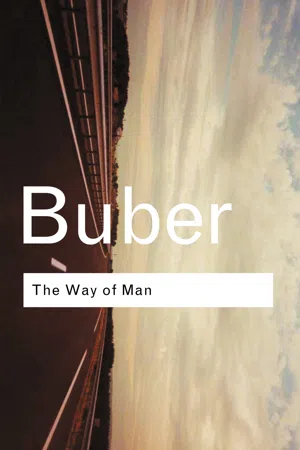
Martin Buber was one of the most significant religious thinkers of the twentieth century. In this short and remarkable book he presents the essential teachings of Hasidism, the mystical Jewish movement which swept through Eastern Europe in the eighteenth and nineteenth centuries. Told through stories of imagination and spirit, together with Buber's own unique insights, The Way of Man offers us a way of understanding ourselves and our place in a spiritual world. 'There is something', he suggests, 'that can only be found in one place. It is a great treasure, which may be called the fulfilment of existence. The place where this treasure can be found is the place on which one stands.' Challenging us to recognize our own potential and to reach our true goal, The Way of Man is a life-enhancing book.
- 48 pages
- English
- ePUB (mobile friendly)
- Available on iOS & Android
eBook - ePub
About this book
Information
1
HEART-SEARCHING
Rabbi Shneur Zalman, The Rav1 of Northern White Russia (died 1813), was put in jail in Petersburg, because the mitnagdim2 had denounced his principles and his way of living to the government. He was awaiting trial when the chief of the gendarmes entered his cell. The majestic and quiet face of the rav, who was so deep in meditation that he did not at first notice his visitor, suggested to the chief, a thoughtful person, what manner of man he had before him. He began to converse with his prisoner and brought up a number of questions which had occurred to him in reading the Scriptures. Finally he asked: ‘How are we to understand that God, the all-knowing, said to Adam: “Where art thou?”’
‘Do you believe,’ answered the rav, ‘that the Scriptures are eternal and that every era, every generation and every man is included in them?’
1 Rabbi.
2 i.e., adversaries (of Hasidism).
‘I believe this,’ said the other.
‘Well then,’ said the zaddik,3 ‘in every era, God calls to every man: “Where are you in your world? So many years and days of those allotted to you have passed, and how far have you gotten in your world?” God says something like this: “You have lived forty-six years. How far along are you?”’
When the chief of the gendarmes heard his age mentioned, he pulled himself together, laid his hand on the rav’s shoulder, and cried: ‘Bravo!’ But his heart trembled.
What happens in this tale?
At first sight, it reminds us of certain Talmudic stories in which a Roman or some other heathen questions a Jewish sage about a biblical passage with a view to exposing an alleged contradiction in Jewish religious doctrine, and receives a reply which either explains that there is no such contradiction or refutes the questioner’s arguments in some other way; sometimes, a personal admonition is added to the actual reply. But we soon perceive an important difference between those Talmudic stories and this hasidic one, though at first the difference appears greater than it actually is. It consists in the fact that in the hasidic story the reply is given on a different plane from that on which the question is asked.
The chief wants to expose an alleged contradiction in Jewish doctrine. The Jews profess to believe in God as the all-knowing, but the Bible makes him ask questions as they are asked by someone who wants to learn something he does not know. God seeks Adam, who has hidden himself. He calls into the garden, asking where he is; it would thus seem that he does not know it, that it is possible to hide from him, and consequently, that he is not all-knowing. Now, instead of explaining the passage and solving the seeming contradiction, the rabbi takes the text merely as a starting-point from where he proceeds to reproach the chief with his past life, his lack of seriousness, his thoughtlessness and irresponsibility. An impersonal question which, however seriously it may be meant in the present instance, is in fact no genuine question but merely a form of controversy, calls forth a personal reply, or rather, a personal admonition in lieu of a reply. It thus seems as if nothing had remained of those Talmudic answers but the admonition which sometimes accompanied them.
3 i.e., proved true; so the leaders of the Hasidic communities are called.
But let us examine the story more closely. The chief inquires about a passage from the biblical story of Adam’s sin. The rabbi’s answer means, in effect: ‘You yourself are Adam, you are the man whom God asks: “Where art thou?”’ It would thus seem that the answer gives no explanation of the passage as such. In fact, however, it illuminates both the situation of the biblical Adam and that of every man in every time and in every place. For as soon as the chief hears and understands that the biblical question is addressed to him, he is bound to realize what it means when God asks: ‘Where art thou?’, whether the question be addressed to Adam or to some other man. In so asking, God does not expect to learn something he does not know; what he wants is to produce an effect in man which can only be produced by just such a question, provided that it reaches man’s heart—that man allows it to reach his heart.
Adam hides himself to avoid rendering accounts, to escape responsibility for his way of living. Every man hides for this purpose, for every man is Adam and finds himself in Adam’s situation. To escape responsibility for his life, he turns existence into a system of hideouts. And in thus hiding again and again ‘from the face of God’, he enmeshes himself more and more deeply in perversity. A new situation thus arises, which becomes more and more questionable with every day, with every new hideout. This situation can be precisely defined as follows: Man cannot escape the eye of God, but in trying to hide from him, he is hiding from himself. True, in him too there is something that seeks him, but he makes it harder and harder for that ‘something’ to find him. This question is designed to awaken man and destroy his system of hideouts; it is to show man to what pass he has come and to awake in him the great will to get out of it.
Everything now depends on whether man faces the question. Of course, every man’s heart, like that of the chief in the story, will tremble when he hears it. But his system of hideouts will help him to overcome this emotion. For the Voice does no...
Table of contents
- Cover
- Half Title
- Title Page
- Copyright Page
- Preface
- Table of Contents
- Introduction
- Original Half Title
- 1 Heart-Searching
- 2 The Particular Way
- 3 Resolution
- 4 Beginning with Oneself
- 5 Not to be Preoccupied with Oneself
- 6 Here Where One Stands
Trusted by 375,005 students
Access to over 1.5 million titles for a fair monthly price.
Study more efficiently using our study tools.
Frequently asked questions
Yes, you can cancel anytime from the Subscription tab in your account settings on the Perlego website. Your subscription will stay active until the end of your current billing period. Learn how to cancel your subscription
No, books cannot be downloaded as external files, such as PDFs, for use outside of Perlego. However, you can download books within the Perlego app for offline reading on mobile or tablet. Learn how to download books offline
Perlego offers two plans: Essential and Complete
- Essential is ideal for learners and professionals who enjoy exploring a wide range of subjects. Access the Essential Library with 800,000+ trusted titles and best-sellers across business, personal growth, and the humanities. Includes unlimited reading time and Standard Read Aloud voice.
- Complete: Perfect for advanced learners and researchers needing full, unrestricted access. Unlock 1.5M+ books across hundreds of subjects, including academic and specialized titles. The Complete Plan also includes advanced features like Premium Read Aloud and Research Assistant.
We are an online textbook subscription service, where you can get access to an entire online library for less than the price of a single book per month. With over 1.5 million books across 990+ topics, we’ve got you covered! Learn about our mission
Look out for the read-aloud symbol on your next book to see if you can listen to it. The read-aloud tool reads text aloud for you, highlighting the text as it is being read. You can pause it, speed it up and slow it down. Learn more about Read Aloud
Yes! You can use the Perlego app on both iOS and Android devices to read anytime, anywhere — even offline. Perfect for commutes or when you’re on the go.
Please note we cannot support devices running on iOS 13 and Android 7 or earlier. Learn more about using the app
Please note we cannot support devices running on iOS 13 and Android 7 or earlier. Learn more about using the app
Yes, you can access The Way of Man by Martin Buber in PDF and/or ePUB format, as well as other popular books in Theology & Religion & Jewish Theology. We have over 1.5 million books available in our catalogue for you to explore.