eBook - ePub
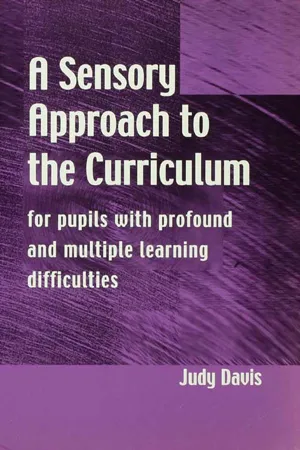
A Sensory Approach to the Curriculum
For Pupils with Profound and Multiple Learning Difficulties
- 128 pages
- English
- ePUB (mobile friendly)
- Available on iOS & Android
eBook - ePub
A Sensory Approach to the Curriculum
For Pupils with Profound and Multiple Learning Difficulties
About this book
Written by a teacher with many years of experience with pupils with PMLD, this book offers a well-tried approach to delivering the curriculum, with particular emphasis on the core subjects. It aims to complement and supplement existing material and provides a useful resource for busy teachers.
Information
PART 1
CHAPTER 1
Why a sensory approach?
In the chaotic world of puzzlement and powerlessness created by profound and multiple learning disability and sensory impairment, we as trusted individuals can help the learner to make sense of his or her world, pointing out significance, mediating sensations, understanding expressions, protecting from overload and enabling achievement.
(Brown et al. 1998 p. 35)
This quote must summarise the difficulties faced by children with profound and multiple learning difficulties and the aims of those who work or live with them and whose concern is to enable them to have the very highest quality of life possible. Six major types of sensory input to the brain must be considered when planning a sensory approach to teaching: visual; auditory; kinaesthetic (the body-image component); tactile; olfactory and gustatory. Involving all the senses in the learning process may be the only way these children will be able to make sense of the world, and the aim of this book is to explore the possibilities of presenting the curriculum in such a way to pupils with complex needs.
Over the years, Piaget's theory of child development has had a powerful influence on thinking. Barber (1994) identifies the two main premises of his theory with particular implications for the cognitive development of pupils with PMLD. The first is that development is the result of complex interactions between the child and his or her environment and the second is that the general sequence of development is both universal and invariant. This does not mean that there will necessarily be a straight progression from one stage to the next for pupils with complex needs, but knowledge of normal development is essential if we are to understand their learning needs and help them to move on.
As soon as they are born, children with any sensory impairment are at a disadvantage. Piaget (1952) explores the pattern of normal development in the sensori-motor stages of babies from birth to two years of age. He describes the first stage as the ‘primary circular motion’ when an infant's movements are involuntary and do not seem to have any link with outside events. Examples of such actions are hand watching and random kicking or hitting strung rattles. He observes that things change at around three months, when babies seem to notice that their actions can effect their environment and they become more deliberate, for example mobiles make interesting noises and shapes when hit or kicked. At this stage of ‘secondary circular reactions’ infants start to show an understanding and an anticipation of the results of their movements and this awareness of cause and effect is considered to be the foundation on which all subsequent learning develops. This assumes, however, that babies are receiving feedback from their actions in the form of interesting sights, sounds or feels and that they are able to organise their bodies sufficiently well to repeat the action. For children with sensory impairment and additional physical disability this will not be possible.
Of equal significance is the probable loss of social interactions experienced by babies with PMLD from the earliest stage. Where there is multisensory impairment they will be unable to pick up on facial expressions, gestures or tone of voice and their own expressions may be equally difficult to interpret. Parents may become discouraged and without the reward of meaningful feedback in the form of a smile, noises or body movement they may interact less and less with their babies and make their own interpretation of their needs. Infants will retreat into their own world and become powerless and vulnerable. In order to compensate for this sense of isolation and confusion they may indulge in self-stimulating and stereotyped behaviour such as head banging, rocking, eye poking or aggression. If such behaviour becomes obsessive, children will become even less responsive to their environment or people in it and increasingly reluctant to use the senses they do have to explore and widen their experiences.
Young babies would normally receive sensory input from their surroundings and also from within their own body system. Brown et al. (1998) describe the first as external sensory input received from a distance, such as light reflected from an object, providing information relating to shape, size, colour etc. The second is described as internal sensory input received from within the body system from the senses of touch, taste and smell, providing information about the body's position in space. They say that when distance senses are impaired, the immediate environment increases in significance. Once again the child may retreat into himself and indulge in stereotypic behaviour in order to escape from a world that seems to be chaotic, unreliable and a possible threat, or alternatively may over-react to stimuli and become highly distractable. It may seem desirable to bombard a passive child with sensory experiences but Brown et al. argue that this could result in increased confusion. They suggest that a lively classroom may not be the optimal learning environment for someone with impairment of the distance senses and that there will need to be careful organisation in the way activities are presented. The important task of the staff will be to structure the physical and social environment in such a way as to promote an understanding of the world which is safe, consistent, interactive, fun and responsive to the learner.
Aitken and Buultjens (1992 p. 1) quote evidence of visual impairment in 50 per cent of children with cerebral palsy, as there is a close association between the development of the eye and the brain. They say that, unfortunately, these visual disorders often go unrecognised as widely available tests of visual functioning usually expect a certain level of cognitive ability, understanding or use of language. They have produced a manual with pages that can be freely photocopied to test what learners actually do see, how they use the vision and other senses they have, and ideas for developing a curriculum for each of the senses and at a level appropriate for the child. All the tests can be carried out without the help of experts but they would necessarily be time consuming and an extra pair of hands would be needed in the classroom. For anyone who is serious about helping children with multiple disabilities to make the most of the abilities they do possess, such testing would build up a very good picture of the ‘whole’ child and establish a baseline from which to build an individual learning programme, although it is strongly advised that a speech and language therapist is consulted throughout the planning process. Other assessment schedules for non-verbal children are listed below under Suggested further reading.
Ouvry (1991) identifies the foundation skills for learning as ‘the ability to focus; sustain attention; filter out competing stimuli and interact purposefully with both people and objects’. These will be skills that most of our pupils will be working on throughout their lives, but this does not necessitate a boring repetition of experiences or childish activities. Although the emphasis is on a sensory approach to the curriculum for pupils with PMLD, this approach to learning is important for everyone, and it would be encouraging to think that practice in special schools could influence teaching methods in mainstream classrooms. Most of us respond to environments that are planned to sooth the senses, as was observed by watching people of all ages sitting or lying in ‘Rest’, the relaxation area of the Dome in Greenwich, London. To quote Madina (1999 p. 41) in the Millennium Experience:
Entering through a hidden, sound absorbing approach, we step inside to experience deep calm. Rest creates a sense of peace by appealing to our senses. In this zone with no edges, no beginning and no end, beautiful layers of light and colour slowly wash against the sky. Gently evolving music loops through cadences at changing pitches and speeds.
For more proof of the need of all human beings to experience the world through their senses, observe adults in any big department store. From the moment of entering they may experience warm air, soothing music, soft pile carpet under their feet and distinctive smells. Colours are compared, materials are felt and cosmetics smelt — shopping over the Internet can never be a substitute for such a total sensory experience, for as John Keats said in a letter to Fanny Brawne (8 July 1819), ‘Nothing ever becomes real til it is experienced’. Longhorn (1996/7) identifies at least 26 senses which we use all our lives and says that encouraging children to use their senses will permeate every aspect of their learning and stay with them for ever. If we are aiming to educate children for life, this must surely be one of the best reasons for advocating a sensory approach to learning for everyone regardless of physical or mental ability.
Suggested further reading
Glenn, S. M. (1988) ‘Activities to encourage children's development in the early years’, in Smith, B. (ed.) Interactive Approaches to the Education of Children with Severe Learning Difficulties. Birmingham: Westhill College.
Longhorn, F. (1993) — see Bibliography.
Ouvry, C. (1987) Educating children with profound handicaps. Worcs: BIMH Publications.
Ouvry, C. and Saunders, S. (1996) — see Bibliography.
Literature and educational videos may be obtained from The Royal National Institute for the Blind, 224 Great Portland Street, London WIW 5AA. Tel: 020 7388 1266.
For assessment scales based on Piaget's theory of child development, see:
Hogg, J. and Sebba, J. (1986) Profound Retardation and Multiple Impairment, vols. 1 and 2. London: Croom Helm.
Hogg, J. and Raines, N. (eds) (1987) Assessment in Mental Handicap. London: Croom Helm.
For assessment schedules see the suggested further reading for Chapter 10.
CHAPTER 2
Developing a sensory approach to the curriculum
In my view, just talking about children knowing, understanding and doing leaves out the major curriculum goal, which is to help children learn what they need to learn, to know what they need to know, and to be able to do certainly what they need to be able to do.(Katz 2000)
What is a sensory curriculum?
It is important to put in context the development of the curriculum documents in Part 2 of this book because important principles have been established during the process. The starting point was the invitation to work with a special school for pupils with physical disabilities and a range of learning difficulties in the development of a ‘sensory curriculum’. In order to establish exactly what was needed we looked at three different attitudes to the position of a sensory curriculum within a school and the ways in which teachers use it as identified by Ouvry and Saunders (1996, pp. 206–7):
It is important to put in context the development of the curriculum documents in Part 2 of this book because important principles have been established during the process. The starting point was the invitation to work with a special school for pupils with physical disabilities and a range of learning difficulties in the development of a ‘sensory curriculum’. In order to establish exactly what was needed we looked at three different attitudes to the position of a sensory curriculum within a school and the ways in which teachers use it as identified by Ouvry and Saunders (1996, pp. 206–7):
- It can be used to stimulate the senses with activities based on stages of sensory development and the acquisition of basic skills identified as priorities in the pupil's Individual Education Programmes (IEPs).
- It can be incorporated into activities which have their own structure and meaning such as drama, music and massage.
- It can be used as an access route to subject-based activities.
The first position suggests a separate sensory curriculum and, while there is a place for providing structured activities for helping pupils to acquire the basic skills as identified by Ouvry (1991) and noted in the previous chapter, it was agreed that the ultimate aim ...
Table of contents
- Cover
- Full Title
- Copyright
- Contents
- Acknowledgements
- Introduction
- Part 1
- Part 2
- Resources
- Glossary of terms
- Bibliography
- Index
Trusted by 375,005 students
Access to over 1.5 million titles for a fair monthly price.
Study more efficiently using our study tools.
Frequently asked questions
Yes, you can cancel anytime from the Subscription tab in your account settings on the Perlego website. Your subscription will stay active until the end of your current billing period. Learn how to cancel your subscription
No, books cannot be downloaded as external files, such as PDFs, for use outside of Perlego. However, you can download books within the Perlego app for offline reading on mobile or tablet. Learn how to download books offline
Perlego offers two plans: Essential and Complete
- Essential is ideal for learners and professionals who enjoy exploring a wide range of subjects. Access the Essential Library with 800,000+ trusted titles and best-sellers across business, personal growth, and the humanities. Includes unlimited reading time and Standard Read Aloud voice.
- Complete: Perfect for advanced learners and researchers needing full, unrestricted access. Unlock 1.5M+ books across hundreds of subjects, including academic and specialized titles. The Complete Plan also includes advanced features like Premium Read Aloud and Research Assistant.
We are an online textbook subscription service, where you can get access to an entire online library for less than the price of a single book per month. With over 1.5 million books across 990+ topics, we’ve got you covered! Learn about our mission
Look out for the read-aloud symbol on your next book to see if you can listen to it. The read-aloud tool reads text aloud for you, highlighting the text as it is being read. You can pause it, speed it up and slow it down. Learn more about Read Aloud
Yes! You can use the Perlego app on both iOS and Android devices to read anytime, anywhere — even offline. Perfect for commutes or when you’re on the go.
Please note we cannot support devices running on iOS 13 and Android 7 or earlier. Learn more about using the app
Please note we cannot support devices running on iOS 13 and Android 7 or earlier. Learn more about using the app
Yes, you can access A Sensory Approach to the Curriculum by Judy Davis in PDF and/or ePUB format, as well as other popular books in Pedagogía & Educación general. We have over 1.5 million books available in our catalogue for you to explore.