- 240 pages
- English
- ePUB (mobile friendly)
- Available on iOS & Android
eBook - ePub
About this book
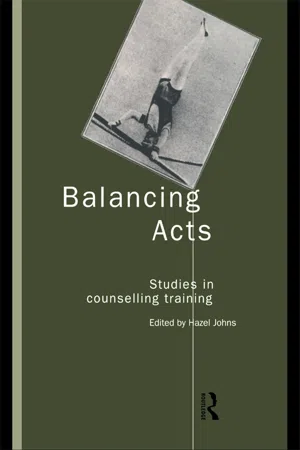
This book examines the philosophy and constructs of counselling training and the means by which students and trainers manage the complex demands placed upon them during the training process. The three main sections of the book explore key aspects of * being trainers : the pressures and stresses involved, issues of gender and power; the complexities of co-training * elements of training : academic and voluntary settings; negotiated and reflective learning; assessment; issues arising from the functions of groups * experiences of being trainees : first hand accounts from practitioners of the challenges they faced in their training. The counsellors, trainers and supervisors who share their research and experience as reflective practitioners provide a clear analysis of the balancing act involved in any adult learning.
Information
Chapter I
On the tightrope
Hazel Johns
Introduction
This book represents some of the work of a Counselling Education and Training Unit, based in a well-established Department for Continuing Education, in the University of Bristol. The contributors (already experienced counsellors) have all been mature students or tutors, or both, on the Master’s degree course in Counselling Supervision and Training, the only one of its kind in Britain. All the chapters have evolved from the counselling trainers’ experience, research and reflection on their practice.
Those three introductory sentences could stand as a metaphor for counselling training. They reflect a number of complex inter-relationships, potential conflicts, competing demands and possible – or impossible – paradoxes. Similarly, the writing of this book has spanned a time filled with exhilarating beginnings and sad endings, both personal and organisational. The department in which our Counselling Unit exists is to close within the year; my mother has died, as have the mothers of three of my close tutoring colleagues; and numerous individual students on many of our courses have faced the costs of unemployment, relationship breakup or losses of various kinds. Yet, we have begun new courses, engaged with fresh student groups, struggled to capture and express creatively old and new ideas. There have been many innovations in trainees’ work settings; at least three students and two tutors have also produced babies, while others have made life-enhancing decisions and risked change of all kinds. In the face of such emotionally intense, personal and professional challenges, it is difficult to sustain energy, commitment, personal integrity, ethical soundness and appropriate focus – yet that is what counselling trainers and trainees have to do.
Counselling training is a complex process. Participants have to tussle with ideas, philosophy and constructs. There is a demand for constant effort to hone perceptions, extend practical skills and give and receive feedback. Most critically, at its heart is the management of personal change, transitions and growth of all kinds. Students and tutors puzzle over conundrums of theory and practice; few concepts are absolute and paradoxes confront at every turn; gains and losses abound. This is true of any kind of adult education with mature students. It is intensified in counselling training by the subject matter and necessary emphasis on the person and personal awareness of both tutors and trainees. A vivid picture comes to my mind of the brave – or foolhardy – man on a tightrope precariously inching his way across Niagara Falls: a balancing act in the extreme and one with which I – and other trainers of my acquaintance – often feel great affinity. At the same time, much of the activity on training courses is mundane. Tasks have to be completed; administration and ‘housekeeping’ attended to; and the minutiae of social interaction flows through and round the group. Trainers and trainees have to develop the ability of a ‘Janus’ figure: the capacity to face in (at least) two directions at once and respond appropriately.
This chapter will outline some of the key balancing acts which both frame and are at the heart of our work. The subsequent chapters explore some of the challenging aspects and complex issues of counselling training which have engaged, fascinated or puzzled the contributors. The writers have their own fascination with the adrenalin and vertigo induced by tightrope walking over dangerous and uncertain depths or over the mudflats of daily demands.
Chinese boxes
In addition to the immediate tasks of counselling training – the intentional preparation of appropriate individuals to become competent, aware and ethically sound counsellors – any trainer or training unit must also manage the ‘Russian doll’ or ‘Chinese box’ effect. Each individual trainee and trainer exists within the specific course, within learning and teaching methodologies, within the training context, within the funding system, within the developments of the wider counselling world, within the political and social culture of the time, and within transpersonal belief systems. All of these elements may demand at particular moments accurate perceptions allied to swift intellectual and emotional footwork, combined with a wide range of skills. Such competencies are necessary in order to make rapid and sensitive responses, based on clear understanding of often-competing concepts or demands, both mundane and highly complex.
The training issues, paradoxes and experiences described in this book exist in two main contexts. One reflects the setting of many counselling courses in the academic world: a Counselling Education and Training Unit, within a Department for Continuing Education, in a large, traditional, civic university, at a time of funding changes and harsh prioritising of resources. The second aspect involves the evolution of a particular course culture (the M.Sc. in Counselling Supervision and Training), in a counselling training setting with specific values and priorities. This operates in the wider world of counselling developments, in a rapidly changing period of professionalisation, during considerable social and political change at the end of the millennium. There are many balancing acts necessary both within and between those inter-connected facets.
Counseling training in universities
Counselling training takes place, of course, in many contexts and much of what follows has parallels elsewhere: conflicts of interest and tensions can and do occur in any setting. There are, though, some particular issues pertaining to the academic world.
Counselling courses have existed in universities in Britain since the early 1960s. The first courses were based on American models, taught, in general, by psychologists and aimed to train counsellors for educational settings. Since then, courses have proliferated, counselling has evolved into a discipline in its own right and methods of counselling training have become more sophisticated and specialist. There has been increasing debate among counselling educators about the ‘fit’ of values, techniques and resources, so that Berry and Woolfe (1997) can legitimately question whether ‘counselling ... and the activity of teaching and learning in universities can ever be congruent with one another’. Many universities are developing innovative, creative curriculum design, teaching methods and assessment. Traditionally, however, universities value intellect, external knowledge, cognitive assessment, objectivity in research and analysis; counsellors place a higher value on feelings, knowledge from within, synthesis, interpersonal skills and self-awareness. In reality – and in an ideal world – students and teachers of any discipline should need and respect both modalities. Counsellors certainly need effective heads and hearts, while scientists, artists and social scientists are more ethically and humanly effective when they ally sensitivity to cognition. Such values and skills should not be seen as in opposition to each other or in a hierarchy of status, but should complement and inform each other. Where counselling courses exist in a conventional academic context, however, tensions, competition and mutual antipathy seem to be all-too-familiar companions. A further disparity might lie in the way in which the organisation’s purpose is defined. Traditional universities may see their main aim as ‘teaching difficult subjects to the ablest young people’ (I quote a vice-chancellor!); counselling training offers a variant of vocational education to mature students, mostly on a part-time basis, linked intimately with practical experience.
Since 1986, when the embryonic Counselling Education and Training Unit at Bristol University began, our own experience has reflected many of these tensions and strains. Being in a university has been both an advantage and a struggle, as we have gradually developed a programme containing a progression of courses at all levels. The courses range from introductory to Masters’: they include short courses for the general public, Open Studies courses carrying credits, a Certificate in Counselling Skills, three postgraduate Diplomas in Counselling, and the M.Sc. in Counselling Supervision and Training. We also offer consultancy and continuing professional development courses in counselling and supervision for experienced practitioners. The Unit has had first one, then two full-time academic staff, who engage and supervise a very large number of part-time tutors. A continuing education department, with its roots in part-time adult education, might seem an appropriate home for counselling training, yet many of our ways of working, especially in the early days, triggered critical reactions in our academic colleagues. Some found surprising the active nature of our teaching and learning methodologies; our staff-intensive teaching and tutoring ratios; and our need for extra small group rooms as well as flexible, large teaching spaces. Others, at times, seemed to regard as unreasonable or inappropriate our insistence on practical skills and personal development (less susceptible to formal, quantifiable assessment methods), as well as on academic theory. Our emphasis on mutually respectful, student-centred, adult-to-adult negotiated working relationships appeared to be something of a puzzle to some staff, since it potentially challenged our own role (and theirs) as experts. It was wounding to hear of negative comments from a few colleagues undermining or undervaluing our work, based not on knowledge but on prejudice, usually expressed indirectly, and often assuming on our part a lack of rigour and intellectual substance.
In reality, funding alterations and political ideologies were forcing all members of the department to face rapid change. Many of the new demands seemed to be an attack on the academic staff’s established values and practices, leading to a general feeling of threat and vulnerability. Counselling was a ‘new’ area of study, representing the new wave of self- financing courses. Some colleagues welcomed our fresh approach and enjoyed exchanging ideas, while some of the negative responses were a reflection of people’s anxieties or stemmed from their ignorance of the counselling field, rather than from specific hostility. Counselling staff reactions to the negativity ranged from hurt and anger to righteous paranoia, from irritation at colleagues’ hypocrisy (since they were often only too willing to use our counselling skills in their own interests!) to indifference and reciprocal antagonism. It was difficult, at times, to resist a bunker mentality; certainly, in the early years, it felt like a struggle for survival, both emotionally and in practical resource terms. It certainly involved a constant balancing of effort: optimising energy for course development, tutor and student support and high-quality learning, while building relationships in the department and the university, devising strategies to change attitudes and ensuring high standards of student performance. Students had to demonstrate appropriate academic and practical competence and adequate personal development. As tutors, we had to be seen to be intellectually able, rigorous in assessment and efficient in managing the demands of the academic system. It was difficult, at times, not to become overly defensive or unhelpfully attacking; even harder not to encourage hostile negativity in both students and tutors to the institution on which we were dependent for resources – limited and hard-won though those were. At the same time, counselling staff were somehow expected to be good at relationships, skilled in negotiation and (almost) saintly in tolerance, whatever the provocation. This was, as counselling has been described, ‘no easy task’ – and we often failed miserably on all counts.
Over time, creative tensions, as well as frustrations, were released by the necessary striving to articulate in debate our teaching and learning philosophies, the comparison of values, the dilemmas and collisions over priorities. Counselling courses in universities can and do stimulate academic work of high intellectual quality, in addition to producing professionally and ethically competent practitioners, who have well-developed self-awareness. The trick is to manage it all without huge personal cost on the part of the trainers and students, without distorting, denying or abusing key counselling precepts and without colluding with students in ‘splitting’ about the organisation. The gains of working in an academic setting can be substantial: access to adequate libraries, cutting-edge research, expectations of intellectual rigour and an established system of academic boards, quality assurance and course development procedures. Counsellors do need theories to inform and challenge their practice; as long as personal and skills development receive equal attention, the university can be a fruitful setting for stimulating high-quality counselling training. The contributions in this book, mostly evolved from personal research at Master’s level, are testament to this potential.
The counselling unit has felt, at times, a lonely, if immensely productive, place; now, after twelve years much has changed in colleagues’ attitudes towards and respect for our programme. As university attitudes to teaching, learning and students’ needs begin to adapt, it feels as if we are pushing at an open door; indeed, there is much more acceptance that we have led the way in terms of course design, learning and assessment methodologies, and student support. By modelling ways of working, by being proudly ‘different’ and by engaging in dialogue, we have stimulated considerable developments in departmental practices and provision. We have also learned from some colleagues’ expertise in related or even quite different academic fields. Some ‘balancing acts’ are worth the effort – indeed, as we are preparing this book, we are living with the irony that the Counselling Education and Training Unit is to survive while the Department for Continuing Education is to be closed. There is, though, no satisfaction in that, but rather a deep sadness in the loss of a valuable resource (albeit with both strengths and limitations) for thirsty adults seeking opportunities to learn.
Counselling training and the counselling world
Just as we have striven to integrate and satisfy the academic demands of the university setting, so we have attempted to sustain a respectful relationship with the emerging professional world of counselling. Over the last thirty or so years, counselling in Britain has developed rapidly (Bond and Shea 1997). The British Association for Counselling (BAC) has also grown from a delicate fledgling to a powerful late-adolescent bird – whether watchful, wise owl or hunting hawk is currently under debate. Much work has been undertaken by the members and officers of BAC in developing codes of ethics and practice and schemes to accredit both courses and individual practitioners (counsellors, supervisors and trainers). To demonstrate our support for and valuing of these efforts, all our students are encouraged to become members of BAC; all students are introduced to the relevant codes, and courses work within them. Our generic postgraduate Diploma in Counselling was one of the first university-based diplomas to apply successfully for BAC course recognition; and the university and the department are organisational members. In developing a progression of courses at all levels, we have also worked at differentiating training for counselling and counsellors from that for counselling skills, while affirming both volunteer and paid activity in the many settings where students operate.
This effort to be full and co-operative members of the counselling world has not been without its tensions. At times, practitioners in other contexts communicate a sense of suspicion about the credentials of university-based training, as if the necessary emphasis in our setting on academic standards might somehow preclude adequate attention to skills, professional practice or personal development. Similarly, there is pressure from BAC to have at least two trainers co-leading any substantial course, for discrete and consistent course membership, and for some course elements, such as personal growth, to be non-assessed. To meet these expectations, trainers in university settings have to fight constant battles about staff–student ratios and against modularisation and formal, traditional assessments. Some counselling trainers in universities have felt strongly that such demands are unreasonable or even irrelevant. They have even formed their own organisation to discuss training issues, a development seen by some as unhelpfully divisive. Yet, at a time of rapid development, BAC still has no trainers’ group or division and the need has been strong for support and peer discussion. At Bristol, we have tried to stay in tune with BAC and accepted the need to challenge university assumptions where they clash with counselling values and concepts. Willing partnership does not, though, always mean complete agreement or a peaceful mind!
There have been many benefits from our decision to place the Counselling Education and Training Unit within rather than outside the concerns of the wider counselling world, yet issues of acceptance and respect for difference create at times a potential element of conflict. Although these are in theory conventionally sacred concepts at the heart of counselling, the struggle to define and protect the emerging profession has led to some ambivalence around ‘must’ and ‘should’ in evaluating training. Both BAC and the United Kingdom Council for Psychotherapy (UKCP) stress, for example, that all validated training courses must have a consistent core theoretical model, adherence to boundaries as essential, confidentiality as pre-eminent and so on (Feltham 1996). The British Psychological Society (BPS) has similar demands in its guidelines for course development. Such mandatory demands might be sometimes inappropriate, irrelevant or simply a matter of opinion. The core values of the Counselling Education and Training Unit are person-centred; these values and attitudes pervade the integrative theoretical model that underpins our courses, influence the teaching and learning methods that we espouse and affect the way we behave as tutors. Representatives of the wider counselling field (for example, in the BAC course accreditation process) have at times disputed some of the specific outcomes of those approaches, even though the particular training practices are fully congruent with our beliefs and within our competencies. Instances of such tension include the appropriateness of course tutors facilitating personal development groups in diploma courses or students engaging in contractual counselling (to extend their experience) with members of other courses. Some of those who disapprove of these practices tend to present their arguments as having absolute validity; in reality, the differences of view stem from differing theoretical perspectives with contrasting understandings of ways of working with issues of power, authority and assessment. To debate such differences in a climate where all views have equal status and where power is shared can be stimulating; to feel that, at worst, a rearguard fight is necessary with a dismissive, autocratic potential enemy is frustrating and was...
Table of contents
- Cover Page
- Title Page
- Copyright Page
- Contributors
- Introduction
- Chapter I On the tightrope
- Part I Being a counselling trainer
- Part II Aspects of counselling training
- Part III Counselling trainees Holding the balancing-pole?
Trusted by 375,005 students
Access to over 1.5 million titles for a fair monthly price.
Study more efficiently using our study tools.
Frequently asked questions
Yes, you can cancel anytime from the Subscription tab in your account settings on the Perlego website. Your subscription will stay active until the end of your current billing period. Learn how to cancel your subscription
No, books cannot be downloaded as external files, such as PDFs, for use outside of Perlego. However, you can download books within the Perlego app for offline reading on mobile or tablet. Learn how to download books offline
Perlego offers two plans: Essential and Complete
- Essential is ideal for learners and professionals who enjoy exploring a wide range of subjects. Access the Essential Library with 800,000+ trusted titles and best-sellers across business, personal growth, and the humanities. Includes unlimited reading time and Standard Read Aloud voice.
- Complete: Perfect for advanced learners and researchers needing full, unrestricted access. Unlock 1.5M+ books across hundreds of subjects, including academic and specialized titles. The Complete Plan also includes advanced features like Premium Read Aloud and Research Assistant.
We are an online textbook subscription service, where you can get access to an entire online library for less than the price of a single book per month. With over 1.5 million books across 990+ topics, we’ve got you covered! Learn about our mission
Look out for the read-aloud symbol on your next book to see if you can listen to it. The read-aloud tool reads text aloud for you, highlighting the text as it is being read. You can pause it, speed it up and slow it down. Learn more about Read Aloud
Yes! You can use the Perlego app on both iOS and Android devices to read anytime, anywhere — even offline. Perfect for commutes or when you’re on the go.
Please note we cannot support devices running on iOS 13 and Android 7 or earlier. Learn more about using the app
Please note we cannot support devices running on iOS 13 and Android 7 or earlier. Learn more about using the app
Yes, you can access Balancing Acts by Hazel Johns in PDF and/or ePUB format, as well as other popular books in Psychology & Education in Psychology. We have over 1.5 million books available in our catalogue for you to explore.