eBook - ePub
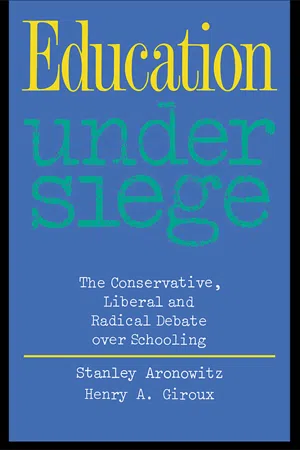
Education Under Siege
The Conservative, Liberal and Radical Debate over Schooling
- 256 pages
- English
- ePUB (mobile friendly)
- Available on iOS & Android
eBook - ePub
Education Under Siege
The Conservative, Liberal and Radical Debate over Schooling
About this book
Public spending on education is under attack. In this challenging book Aronowitz and Giroux examine the thinking behind that attack, in the USA and in other industrialized countries.
Information
FIVE
Reproduction and Resistance in Radical Theories of Schooling
IN THE LAST decade, Karl Marx’s concept of reproduction has been one of the major organizing ideas informing socialist theories of schooling. Marx states that “every social process of production is, at the same time, a process of reproduction…. Capitalist production, therefore…produces not only commodities, not only surplus-value, but it also produces and reproduces the capitalist relation, on the one side the capitalist, on the other the wage-labourer.”1 Radical educators have given this concept a central place in developing a critique of liberal views of schooling. Moreover, they have used it as the theoretical foundation for developing a critical science of education.2 Thus far, the task has been only partially successful.
Contrary to the claims of liberal theorists and historians that public education offers possibilities for individual development, social mobility, and political and economic power to the disadvantaged and dispossessed, radical educators have argued that the main functions of schools are the reproduction of the dominant ideology, its forms of knowledge, and the distribution of skills needed to reproduce the social division of labor. In the radical perspective, schools as institutions could only be understood through an analysis of their relationship to the state and the economy. In this view, the deep structure or underlying significance of schooling could only be revealed through analyzing how schools functioned as agencies of social and cultural reproduction—that is, how they legitimated capitalist rationality and sustained dominant social practices.
Instead of blaming students for educational failure, radical educators blamed the dominant society. Instead of abstracting schools from the dynamics of inequality and class-race-gender modes of discrimination, schools were considered central agencies in the politics and processes of domination. In contrast to the liberal view of education as the great equalizer, radical educators saw the objectives of schooling quite differently. As Paul Willis states, “Education was not about equality, but inequality…. Education’s main purpose of the social integration of a class society could be achieved only by preparing most kids for an unequal future, and by insuring their personal underdevelopment. Far from productive roles in the economy simply waiting to be ‘fairly’ filled by the products of education, the ‘Reproduction’ perspective reversed this to suggest that capitalist production and its roles required certain educational outcomes.”3
In our view, radical educators presented a serious challenge to the discourse and logic of liberal views of schooling. But they did more than that. They also tried to fashion a new discourse and set of understandings around the reproduction thesis. Schools were stripped of their political innocence and connected to the social and cultural matrix of capitalist rationality. In effect, schools were portrayed as reproductive in three senses. First, schools provided different classes and social groups with the knowledge and skills they needed to occupy their respective places in a labor force stratified by class, race, and gender. Second, schools were seen as reproductive in the cultural sense, functioning in part to distribute and legitimate forms of knowledge, values, language, and modes of style that constitute the dominant culture and its interests. Third, schools were viewed as part of a state apparatus that produced and legitimated the economic and ideological imperatives that underlie the state’s political power.
Radical reproduction theorists have used these forms of reproduction to fashion a number of specific concerns that have shaped the nature of their educational research and inquiry. These concerns have focused on analyses of the relationships between schooling and the workplace,4 class-specific educational experiences and the job opportunities that emerge for different social groups,5 the culture of the school and the class-defined cultures of the students who attend them,6 and the relationship among the economic, ideological, and repressive functions of the state and how they affect school policies and practices.7
Reproduction theory and its various explanations of the role and function of education have been invaluable in contributing to a broader understanding of the political nature of schooling and its relation to the dominant society. But it must be stressed that the theory has not achieved its promise to provide a comprehensive critical science of schooling. Reproduction theorists have overemphasized the idea of domination in their analysis and have failed to provide any major insights into how teachers, students, and other human agents come together within specific historical and social contexts in order to both make and reproduce the conditions of their existence. More specifically, reproduction accounts of schooling have continually patterned themselves after structural-functionalist versions of Marxism which stress that history is made “behind the backs” of the members of society. The idea that people do make history, including its constraints, has been neglected. Indeed, human subjects generally “disappear” amidst a theory that leaves no room for moments of self-creation, mediation, and resistance. These accounts often leave us with a view of schooling and domination that appears to have been pressed out of an Orwellian fantasy; schools are often viewed as factories or prisons, teachers and students alike act merely as pawns and role bearers constrained by the logic and social practices of the capitalist system.
By downplaying the importance of human agency and the notion of resistance, reproduction theories offer little hope for challenging and changing the repressive features of schooling. By ignoring the contradictions and struggles that exist in schools, these theories not only dissolve human agency, they unknowingly provide a rationale for not examining teachers and students in concrete school settings. Thus, they miss the opportunity to determine whether there is a substantial difference between the existence of various structural and ideological modes of domination and their actual unfolding and effects.
Recent research on schooling in the United States, Europe, and Australia has both challenged and attempted to move beyond reproduction theories. This research emphasizes the importance of human agency and experience as the theoretical cornerstones for analyzing the complex relationship between schools and the dominant society. Organized around what we loosely label as resistance theory, these analyses give central importance to the notions of conflict, struggle, and resistance.8
Combining ethnographic studies with more recent European cultural studies, resistance theorists have attempted to demonstrate that the mechanisms of social and cultural reproduction are never complete and always meet with partially realized elements of opposition.9 In effect, resistance theorists have developed a theoretical framework and method of inquiry that restores the critical notion of agency. They point not only to the role that students play in challenging the most oppressive aspects of schools but also to the ways in which students actively participate through oppositional behavior in a logic that very often consigns them to a position of class subordination and political defeat.
One of the most important assumptions of resistance theory is that working-class students are not merely the by-product of capital, compliantly submitting to the dictates of authoritarian teachers and schools that prepare them for a life of deadening labor. Rather, as we pointed out in previous chapters, schools represent contested terrains marked not only by structural and ideological contradictions but also by collectively informed student resistance. In other words, schools are social sites characterized by overt and hidden curricula, tracking, dominant and subordinant cultures, and competing class ideologies. Of course, conflict and resistance take place within asymmetrical relations of power which always favor the dominant classes, but the essential point is that there are complex and creative fields of resistance through which class-, race- and gender-mediated practices often refuse, reject, and dismiss the central messages of the schools.
In resistance accounts, schools are relatively autonomous institutions that not only provide spaces for oppositional behavior and teaching but also represent a source of contradictions that sometimes make them dysfunctional to the material and ideological interests of the dominant society. Schools are not solely determined by the logic of the workplace or the dominant society; they are not merely economic institutions but are also political, cultural, and ideological sites that exist somewhat independently of the capitalist market economy. Of course, schools operate within limits set by society, but they function in part to influence and shape those limits, whether they be economic, ideological, or political. Moreover, instead of being homogeneous institutions operating under the direct control of business groups, schools are characterized by diverse forms of school knowledge, ideologies, organizational styles, and classroom social relations. Thus, schools often exist in a contradictory relation to the dominant society, alternately supporting and challenging its basic assumptions. For instance, schools sometimes support a notion of liberal education that is in sharp contradiction to the dominant society’s demand for forms of education that are specialized, instrumental, and geared to the logic of the marketplace. In addition, schools still strongly define their role via their function as agencies for social mobility even though they currently turn out graduates at a faster pace than the economy’s capacity to employ them.
Whereas reproduction theorists focus almost exclusively on power and how the dominant culture ensures the consent and defeat of subordinate classes and groups, theories of resistance restore a degree of agency and innovation to the cultures of these groups. Culture, in this case, is constituted as much by the group itself as by the dominant society. Subordinate cultures, whether working class or otherwise, partake of moments of self-production as well as reproduction; they are contradictory in nature and bear the marks of both resistance and reproduction. Such cultures are forged within constraints shaped by capital and its institutions, such as schools, but the conditions within which such constraints function vary from school to school and from neighborhood to neighborhood. Moreover, there are never any guarantees that capitalist values and ideologies will automatically succeed, regardless of how strongly they set the agenda. Put another way, “In the final analysis, human praxis is not determined by its preconditions; only the boundaries of possibility are given in advance.”10In this rather brief and abstract discussion, we have juxtaposed two models of educational analysis to suggest that theories of resistance represent a significant advance over the important but limited theoretical gains of reproduction models of schooling. But it is important to emphasize that, in spite of more complex modes of analysis, resistance theories are also marred by a number of theoretical flaws. In part, these flaws stem from a failure to recognize the degree to which resistance theories themselves are indebted to some of the more damaging features of reproduction theory. At the same time, however, resistance theories have too readily ignored the most valuable insights of reproduction theory and, in doing so, have failed to examine and appropriate those aspects of the reproduction model that are essential to developing a critical science of education. Furthermore, despite their concrete differences, resistance and reproduction approaches to education share the failure of recycling and reproducing the dualism between agency and structure, a failure that has plagued educational theory and practice for decades, while simultaneously representing its greatest challenge. Consequently, neither position provides the foundation for a theory of education that links structures and institutions to human agency and action in a dialectical manner.
The basis for overcoming this separation of human agency from structural determinants lies in the development of a theory of resistance that both questions its own assumptions and critically appropriates those aspects of schooling that are accurately presented and analyzed in the reproduction model. In other words, the task facing resistance theorists is twofold: first, they must structure their own assumptions to develop a more dialectical model of schooling and society; and secondly, they must reconstruct the major theories of reproduction in order to abstract from them their most radical and emancipatory insights.
The remainder of this chapter will first discuss three important theories that constitute various dimensions of the reproduction model of schooling: the economic-reproductive model, the cultural-reproductive model, and the hegemonic-state reproductive model. Since reproduction theorists have been the object of considerable criticism elsewhere, we shall focus primarily on the strengths of each of these models, and shall only summarize some of the general criticisms. Second, we shall look at what we generously call neo-Marxist theories of resistance that have recently emerged in the literature on education and schooling, examining their theoretical strengths and weaknesses, while at the same time analyzing how they are either positively or negatively informed by theories of reproduction. Finally, we shall attempt to develop a new theory of resistance and shall briefly analyze its implications for a critical science of schooling.
SCHOOLING AND THEORIES OF REPRODUCTION
ECONOMIC-REPRODUCTIVE MODEL
Within the last fifteen years, the political-economy model of reproduction has exercised the strongest influence on radical theories of schooling. Developed primarily around the work of Samuel Bowles and Herbert Gintis, it has had a major influence on theories about the hidden curriculum,11 educational policy studies,12 and a wide range of ethnographic research.13 At the core of the political-economy approach are two fundamentally important questions. The most important of these focuses on the relationship between schooling and society and asks, “How does the educational system function within society? The second question points to a related but more concrete concern regarding the issue of how subjectivities actually get constituted in schools, asking, How do schools fundamentally influence the ideologies, personalities, and needs of students? While theorists who work within this model give different answers, they generally agree on the relationship between power and domination, on the one hand, and the relationship between schooling and the economy on the other.
Power in these accounts is defined and examined primarily in terms of its function to mediate and legitimate the relations of dominance and subordinance in the economic sphere. In this perspective, power becomes the property of dominant groups and operates to reproduce class, gender, and racial inequalities that function in the interests of the accumulation and expansion of capital. This becomes clear in the way economic-reproductive theorists analyze the relations between the economy and schooling.
Central to this position is the notion that schools can only be understood by analyzing the structural effects of the workplace on them. In Bowles and Gintis’s work this notion becomes clear through their reliance on what they call the correspondence theory.14 Broadly spea...
Table of contents
- COVER PAGE
- TITLE PAGE
- COPYRIGHT PAGE
- PREFACE
- ACKNOWLEDGMENTS
- ONE: RETHINKING THE NATURE OF EDUCATIONAL REFORM
- TWO: TEACHING AND THE ROLE OF THE TRANSFORMATIVE INTELLECTUAL
- THREE: MASS CULTURE AND CRITICAL PEDAGOGY
- FOUR: THE LITERACY CRISIS: A CRITIQUE AND ALTERNATIVE
- FIVE: REPRODUCTION AND RESISTANCE IN RADICAL THEORIES OF SCHOOLING
- SIX: RADICAL PEDAGOGY AND THE LEGACY OF MARXIST DISCOURSE
- SEVEN: CURRICULUM THEORY AND THE LANGUAGE OF POSSIBILITY
- EIGHT: NEO-CONSERVATIVE IDEOLOGY AND THE CRISIS IN HIGHER EDUCATION
- NINE: IS COMPUTER TECHNOLOGY THE ANSWER?THE CRISIS IN THE CLASSROOM AND EDUCATIONAL REFORM
- TEN: EDUCATION AND THE CRISIS IN PUBLIC PHILOSOPHY
- ELEVEN: SCHOOLING AND THE FUTURE: REVITALIZING PUBLIC EDUCATION
- SELECTED BIBLIOGRAPHY
Trusted by 375,005 students
Access to over 1.5 million titles for a fair monthly price.
Study more efficiently using our study tools.
Frequently asked questions
Yes, you can cancel anytime from the Subscription tab in your account settings on the Perlego website. Your subscription will stay active until the end of your current billing period. Learn how to cancel your subscription
No, books cannot be downloaded as external files, such as PDFs, for use outside of Perlego. However, you can download books within the Perlego app for offline reading on mobile or tablet. Learn how to download books offline
Perlego offers two plans: Essential and Complete
- Essential is ideal for learners and professionals who enjoy exploring a wide range of subjects. Access the Essential Library with 800,000+ trusted titles and best-sellers across business, personal growth, and the humanities. Includes unlimited reading time and Standard Read Aloud voice.
- Complete: Perfect for advanced learners and researchers needing full, unrestricted access. Unlock 1.5M+ books across hundreds of subjects, including academic and specialized titles. The Complete Plan also includes advanced features like Premium Read Aloud and Research Assistant.
We are an online textbook subscription service, where you can get access to an entire online library for less than the price of a single book per month. With over 1.5 million books across 990+ topics, we’ve got you covered! Learn about our mission
Look out for the read-aloud symbol on your next book to see if you can listen to it. The read-aloud tool reads text aloud for you, highlighting the text as it is being read. You can pause it, speed it up and slow it down. Learn more about Read Aloud
Yes! You can use the Perlego app on both iOS and Android devices to read anytime, anywhere — even offline. Perfect for commutes or when you’re on the go.
Please note we cannot support devices running on iOS 13 and Android 7 or earlier. Learn more about using the app
Please note we cannot support devices running on iOS 13 and Android 7 or earlier. Learn more about using the app
Yes, you can access Education Under Siege by Stanley Aronowitz,Henry A. Giroux in PDF and/or ePUB format, as well as other popular books in Éducation & Éducation générale. We have over 1.5 million books available in our catalogue for you to explore.