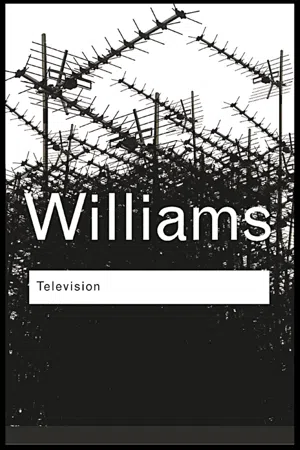
Television: Technology and Cultural Form was first published in 1974, long before the dawn of multi-channel TV, or the reality and celebrity shows that now pack the schedules. Yet Williams' analysis of television's history, its institutions, programmes and practices, and its future prospects, remains remarkably prescient.
Williams stresses the importance of technology in shaping the cultural form of television, while always resisting the determinism of McLuhan's dictum that 'the medium is the message'. If the medium really is the message, Williams asks, what is left for us to do or say? Williams argues that, on the contrary, we as viewers have the power to disturb, disrupt and to distract the otherwise cold logic of history and technology - not just because television is part of the fabric of our daily lives, but because new technologies continue to offer opportunities, momentarily outside the sway of transnational corporations or the grasp of media moguls, for new forms of self and political expression.
- 192 pages
- English
- ePUB (mobile friendly)
- Available on iOS & Android
eBook - ePub
About this book
Information
1
THE TECHNOLOGY AND THE SOCIETY
It is often said that television has altered our world. In the same way, people often speak of a new world, a new society, a new phase of history, being created – ‘brought about’ – by this or that new technology: the steam engine, the automobile, the atomic bomb. Most of us know what is generally implied when such things are said. But this may be the central difficulty: that we have got so used to statements of this general kind, in our most ordinary discussions, that we can fail to realise their specific meanings.
For behind all such statements lie some of the most difficult and most unresolved historical and philosophical questions. Yet the questions are not posed by the statements; indeed they are ordinarily masked by them. Thus we often discuss, with animation, this or that ‘effect’ of television, or the kinds of social behaviour, the cultural and psychological conditions, which television has ‘led to’, without feeling ourselves obliged to ask whether it is reasonable to describe any technology as a cause, or, if we think of it as a cause, as what kind of cause, and in what relations with other kinds of causes. The most precise and discriminating local study of ‘effects’ can remain superficial if we have not looked into the notions of cause and effect, as between a technology and a society, a technology and a culture, a technology and a psychology, which underlie our questions and may often determine our answers.
It can of course be said that these fundamental questions are very much too difficult; and that they are indeed difficult is very soon obvious to anyone who tries to follow them through. We could spend our lives trying to answer them, whereas here and now, in a society in which television is important, there is immediate and practical work to be done: surveys to be made, research undertaken; surveys and research, moreover, which we know how to do. It is an appealing position, and it has the advantage, in our kind of society, that it is understood as practical, so that it can then be supported and funded. By contrast, other kinds of question seem merely theoretical and abstract.
Yet all questions about cause and effect, as between a technology and a society, are intensely practical. Until we have begun to answer them, we really do not know, in any particular case, whether, for example, we are talking about a technology or about the uses of a technology; about necessary institutions or particular and changeable institutions; about a content or about a form. And this is not only a matter of intellectual uncertainty; it is a matter of social practice. If the technology is a cause, we can at best modify or seek to control its effects. Or if the technology, as used, is an effect, to what other kinds of cause, and other kinds of action, should we refer and relate our experience of its uses? These are not abstract questions. They form an increasingly important part of our social and cultural arguments, and they are being decided all the time in real practice, by real and effective decisions.
It is with these problems in mind that I want to try to analyse television as a particular cultural technology, and to look at its development, its institutions, its forms and its effects, in this critical dimension. In the present chapter, I shall begin the analysis under three headings: (a) versions of cause and effect in technology and society; (b) the social history of television as a technology; (c) the social history of the uses of television technology.
A. VERSIONS OF CAUSE AND EFFECT IN TECHNOLOGY AND SOCIETY
We can begin by looking again at the general statement that television has altered our world. It is worth setting down some of the different things this kind of statement has been taken to mean. For example:
- Television was invented as a result of scientific and technical research. Its power as a medium of news and entertainment was then so great that it altered all preceding media of news and entertainment.
- Television was invented as a result of scientific and technical research. Its power as a medium of social communication was then so great that it altered many of our institutions and forms of social relationships.
- Television was invented as a result of scientific and technical research. Its inherent properties as an electronic medium altered our basic perceptions of reality, and thence our relations with each other and with the world.
- Television was invented as a result of scientific and technical research. As a powerful medium of communication and entertainment it took its place with other factors – such as greatly increased physical mobility, itself the result of other newly invented technologies – in altering the scale and form of our societies.
- Television was invented as a result of scientific and technical research, and developed as a medium of entertainment and news. It then had unforeseen consequences, not only on other entertainment and news media, which it reduced in viability and importance, but on some of the central processes of family, cultural and social life.
- Television, discovered as a possibility by scientific and technical research, was selected for investment and development to meet the needs of a new kind of society, especially in the provision of centralised entertainment and in the centralised formation of opinions and styles of behaviour.
- Television, discovered as a possibility by scientific and technical research, was selected for investment and promotion as a new and profitable phase of a domestic consumer economy; it is then one of the characteristic ‘machines for the home’.
- Television became available as a result of scientific and technical research, and in its character and uses exploited and emphasised elements of a passivity, a cultural and psychological inadequacy, which had always been latent in people, but which television now organised and came to represent.
- Television became available as a result of scientific and technical research, and in its character and uses both served and exploited the needs of a new kind of large-scale and complex but atomised society.
These are only some of the possible glosses on the ordinary bald statement that television has altered our world. Many people hold mixed versions of what are really alternative opinions, and in some cases there is some inevitable overlapping. But we can distinguish between two broad classes of opinion.
In the first – (i) to (v) – the technology is in effect accidental. Beyond the strictly internal development of the technology there is no reason why any particular invention should have come about. Similarly it then has consequences which are also in the true sense accidental, since they follow directly from the technology itself. If television had not been invented, this argument would run, certain definite social and cultural events would not have occurred.
In the second – (vi) to (ix) – television is again, in effect, a technological accident, but its significance lies in its uses, which are held to be symptomatic of some order of society or some qualities of human nature which are otherwise determined. If television had not been invented, this argument runs, we would still be manipulated or mindlessly entertained, but in some other way and perhaps less powerfully.
For all the variations of local interpretation and emphasis, these two classes of opinion underlie the overwhelming majority of both professional and amateur views of the effects of television. What they have in common is the fundamental form of the statement: ‘television has altered our world’.
It is then necessary to make a further theoretical distinction. The first class of opinion, described above, is that usually known, at least to its opponents, as technological determinism. It is an immensely powerful and now largely orthodox view of the nature of social change. New technologies are discovered, by an essentially internal process of research and development, which then sets the conditions for social change and progress. Progress, in particular, is the history of these inventions, which ‘created the modern world’. The effects of the technologies, whether direct or indirect, foreseen or unforeseen, are as it were the rest of history. The steam engine, the automobile, television, the atomic bomb, have made modern man and the modern condition.
The second class of opinion appears less determinist. Television, like any other technology, becomes available as an element or a medium in a process of change that is in any case occurring or about to occur. By contrast with pure technological determinism, this view emphasises other causal factors in social change. It then considers particular technologies, or a complex of technologies, as symptoms of change of some other kind. Any particular technology is then as it were a by-product of a social process that is otherwise determined. It only acquires effective status when it is used for purposes which are already contained in this known social process.
The debate between these two general positions occupies the greater part of our thinking about technology and society. It is a real debate, and each side makes important points. But it is in the end sterile, because each position, though in different ways, has abstracted technology from society. In technological determinism, research and development have been assumed as self-generating. The new technologies are invented as it were in an independent sphere, and then create new societies or new human conditions. The view of symptomatic technology, similarly, assumes that research and development are self-generating, but in a more marginal way. What is discovered in the margin is then taken up and used.
Each view can then be seen to depend on the isolation of technology. It is either a self-acting force which creates new ways of life, or it is a self-acting force which provides materials for new ways of life. These positions are so deeply established, in modern social thought, that it is very difficult to think beyond them. Most histories of technology, like most histories of scientific discovery, are written from their assumptions. An appeal to ‘the facts’, against this or that interpretation, is made very difficult simply because the histories are usually written, consciously or unconsciously, to illustrate the assumptions. This is either explicit, with the consequential interpretation attached, or more often implicit, in that the history of technology or of scientific development is offered as a history on its own. This can be seen as a device of specialisation or of emphasis, but it then necessarily implies merely internal intentions and criteria.
To change these emphases would require prolonged and cooperative intellectual effort. But in the particular case of television it may be possible to outline a different kind of interpretation, which would allow us to see not only its history but also its uses in a more radical way. Such an interpretation would differ from technological determinism in that it would restore intention to the process of research and development. The technology would be seen, that is to say, as being looked for and developed with certain purposes and practices already in mind. At the same time the interpretation would differ from symptomatic technology in that these purposes and practices would be seen as direct: as known social needs, purposes and practices to which the technology is not marginal but central.
B. THE SOCIAL HISTORY OF TELEVISION AS A TECHNOLOGY
The invention of television was no single event or series of events. It depended on a complex of inventions and developments in electricity, telegraphy, photography and motion pictures, and radio. It can be said to have separated out as a specific technological objective in the period 1875–1890, and then, after a lag, to have developed as a specific technological enterprise from 1920 through to the first public television systems of the 1930s. Yet in each of these stages it depended for parts of its realisation on inventions made with other ends primarily in view.
Until the early nineteenth century, investigations of electricity, which had long been known as a phenomenon, were primarily philosophical: investigations of a puzzling natural effect. The technology associated with these investigations was mainly directed towards isolation and concentration of the effect, for its clearer study. Towards the end of the eighteenth century there began to be applications, characteristically in relation to other known natural effects (lightning conductors). But there is then a key transitional period in a cluster of inventions between 1800 and 1831, ranging from Volta’s battery to Faraday’s demonstration of electro-magnetic induction, leading quickly to the production of generators. This can be properly traced as a scientific history, but it is significant that the key period of advance coincides with an important stage of the development of industrial production. The advantages of electric power were closely related to new industrial needs: for mobility and transfer in the location of power sources, and for flexible and rapid controllable conversion. The steam engine had been well suited to textiles, and its industries had been based on local siting. A more extensive development, both physically and in the complexity of multiple-part processes, such as engineering, could be attempted with other power sources but could only be fully realised with electricity. There was a very complex interaction between new needs and new inventions, at the level of primary production, of new applied industries (plating) and of new social needs which were themselves related to industrial development (city and house lighting). From 1830 to large-scale generation in the 1880s there was this continuing complex of need and invention and application.
In telegraphy the development was simpler. The transmission of messages by beacons and similar primary devices had been long established. In the development of navigation and naval warfare the flag system had been standardised in the course of the sixteenth and seventeenth centuries. During the Napoleonic wars there was a marked development of land telegraphy, by semaphore stations, and some of this survived into peace time. Electrical telegraphy had been suggested as a technical system as early as 1753, and was actually demonstrated in several places in the early nineteenth century. An English inventor in 1816 was told that the Admiralty was not interested. It is interesting that it was the development of the railways, themselves a response to the development of an industrial system and the related growth of cities, which clarified the need for improved telegraphy. A complex of technical possibilities was brought to a working system from 1837 onwards. The development of international trade and transport brought rapid extensions of the system, including the transatlantic cable in the 1850s and the 1860s. A general system of electric telegraphy had been established by the 1870s, and in the same decade the telephone system began to be developed, in this case as a new and intended invention.
In photography, the idea of light-writing had been suggested by (among others) Wedgwood and Davy in 1802, and the camera obscura had already been developed. It was not the projection but the fixing of images which at first awaited technical solution, and from 1816 (Niepce) and through to 1839 (Daguerre) this was worked on, together with the improvement of camera devices. Professional and then amateur photography spread rapidly, and reproduction and then transmission, in the developing newspaper press, were achieved. By the 1880s the idea of a ‘photographed reality’ – still more for record than for observation – was familiar.
The idea of moving pictures had been similarly developing. The magic lantern (slide projection) had been known from the seventeenth century, and had acquired simple motion (one slide over another) by 1736. From at latest 1826 there was a development of mechanical motion-picture devices, such as the wheel of life, and these came to be linked with the magic lantern. The effect of persistence in human vision – that is to say, our capacity to hold the ‘memory’ of an image through an interval to the next image, thus allowing the possibility of a sequence built from rapidly succeeding units – had been known since classical times. Series of cameras photographing stages of a sequence were followed (Marey, 1882) by multiple-shot cameras. Friese-Greene and Edison worked on techniques of filming and projection, and celluloid was substituted for paper reels. By the 1890s the first public motion-picture shows were being given in France, America and England.
Television, as an idea, was involved with many of these developments. It is difficult to separate it, in its earliest stages, from photo-telegraphy. Bain proposed a device for transmitting pictures by electric wires in 1842; Blakewell in 1847 showed the copying telegraph; Caselli in 1862 transmitted pictures by wire over a considerable distance. In 1873, while working at a terminal of the Atlantic telegraph cable, May observed the lightsensitive properties of selenium (which had been isolated by Berzelius in 1817 and was in use for resistors). In a host of ways, following an already defined need, the means of transmitting still pictures and moving pictures were actively sought and to a considerable extent discovered. The list is long even when selective: Carey’s electric eye in 1875; Nipkow’s scanning system in 1884; Elster and Geitel’s photoelectric cells in 1890; Braun’s cathode-ray tube in 1897; Rosing’s cathode-ray receiver in 1907; Campbell Swinton’s electronic camera proposal in 1911. Through this whole period two facts are evident: that a system of television was foreseen, and its means were being actively sought; but also that, by comparison with electrical generation and electrical telegraphy and telephony, there was very little social investment to bring the scattered work together. It is true that there were technical blocks before 1914 – the thermionic valve and the multi-stage amplifier can be seen to have been needed and were not yet invented. But the critical difference between the various spheres of applied technology can be stated in terms of a social dimension: the new systems of production and of business or transport communication were already organised, at an economic level; the new systems of social communication were not. Thus when motion pictures were developed, their application was characteristically in the margin of established social forms – the sideshows – until their success was capitalised in a version of an established form, the motionpicture theatre.
The development of radio, in its significant scientific and technical stages between 1885 and 1911, was at first conceived, within already effective social systems, as an advanced form of telegraphy. Its application as a significantly new social form belongs to the immediate post-war period, in a changed social situation. It is significant that the hiatus in technical television development then also ended. In 1923 Zworykin introduced the electronic television camera tube. Through the early 1920s Baird and Jenkins, separately and competitively, were working on systems using mechanical scanning. From 1925 the rate of progress was qualitatively changed, through important technical advances but also with the example of sound broadcasting systems as a model. The Bell System in 1927 demonstrated wire transmission through a radio link, and the pre-history of the form can be seen to be ending. There was great rivalry between systems – especially those of mechanical and electronic scanning – and there is still great controversy about contributions and priorities. But this is characteristic of the phase in which the development of a technology moves into the stage of a new social form.
What is interesting throughout is that in a number of complex and related fields, these systems of mobility and transfer in production and communication, whether in mechanical and electric transport, or in telegraphy, photography, motion pictures, radio and television, were at once incentives and responses within a phase of general social transformation. Though some of the crucial scientific and technical discoveries were made by isolated and unsupported individuals, there was a crucial community of selected emphasis and intention, in a society characterised at its most general levels by a mobility and extension of the scale of organisations: forms of growth which brought with them immediate and longer-term problems of operative communication. In many different countries, and in apparently unconnected ways, such needs were at once isolated and technically defined. It is especially a characteristic of the communications systems that all were foreseen – not in utopian but in technical ways – before the crucial components of the developed systems had been discovered and refined. In no way is this a history of communications systems creating a new society or new social conditions. The decisive and earlier transformation of industrial production, and its new social forms, which had grown out of a long history of capital accumulation and working technical improvements, created new needs but also new possibilities, and the communications systems, down to television, were their intrinsic outcome.
C. THE SOCIAL HISTORY OF THE USES OF TELEVISION TECHNOLOGY
It is never quite true to say that in modern societies, when a social need has been demonstrated, its appropriate technology will be found. This is partly because some real needs, in any particular period, are beyond the scope of existing or foreseeable scientific and technical knowledge. It is even more because the key question, about technological response to a need, is less a question about the need itself than about its place in an existing social formation. A need which corresponds with the priorities of the real decision-making groups will, obviously, more quickly attract the investment of resources and the official permission, approval or encouragement on which a working technology, as distinct from available technical devices, depends. We can see this clearly in the major developments of industrial production and, significantly, in military technology. The social history of communications technology is interestingly different from both of these, and it is important to try to discover what are the real factors of this variation.
The problem must be seen at several different levels. In the very broadest perspective, there is an operative relationship between a new kind of expanded, mobile and complex society and the development of a modern communications technology. At one level this relationship can be...
Table of contents
- COVER PAGE
- TITLE PAGE
- COPYRIGHT PAGE
- PREFACE TO THE ROUTLEDGE CLASSICS EDITION
- FOREWORD
- FOREWORD TO THE SECOND EDITION
- 1: THE TECHNOLOGY AND THE SOCIETY
- 2: INSTITUTIONS OF THE TECHNOLOGY
- 3: THE FORMS OF TELEVISION
- 4: PROGRAMMING: DISTRIBUTION AND FLOW
- 5: EFFECTS OF THE TECHNOLOGY AND ITS USES
- 6: ALTERNATIVE TECHNOLOGY, ALTERNATIVE USES?
- NOTES
- SELECTED BIBLIOGRAPHY
Trusted by 375,005 students
Access to over 1.5 million titles for a fair monthly price.
Study more efficiently using our study tools.
Frequently asked questions
Yes, you can cancel anytime from the Subscription tab in your account settings on the Perlego website. Your subscription will stay active until the end of your current billing period. Learn how to cancel your subscription
No, books cannot be downloaded as external files, such as PDFs, for use outside of Perlego. However, you can download books within the Perlego app for offline reading on mobile or tablet. Learn how to download books offline
Perlego offers two plans: Essential and Complete
- Essential is ideal for learners and professionals who enjoy exploring a wide range of subjects. Access the Essential Library with 800,000+ trusted titles and best-sellers across business, personal growth, and the humanities. Includes unlimited reading time and Standard Read Aloud voice.
- Complete: Perfect for advanced learners and researchers needing full, unrestricted access. Unlock 1.5M+ books across hundreds of subjects, including academic and specialized titles. The Complete Plan also includes advanced features like Premium Read Aloud and Research Assistant.
We are an online textbook subscription service, where you can get access to an entire online library for less than the price of a single book per month. With over 1.5 million books across 990+ topics, we’ve got you covered! Learn about our mission
Look out for the read-aloud symbol on your next book to see if you can listen to it. The read-aloud tool reads text aloud for you, highlighting the text as it is being read. You can pause it, speed it up and slow it down. Learn more about Read Aloud
Yes! You can use the Perlego app on both iOS and Android devices to read anytime, anywhere — even offline. Perfect for commutes or when you’re on the go.
Please note we cannot support devices running on iOS 13 and Android 7 or earlier. Learn more about using the app
Please note we cannot support devices running on iOS 13 and Android 7 or earlier. Learn more about using the app
Yes, you can access Television by Raymond Williams in PDF and/or ePUB format, as well as other popular books in Media & Performing Arts & Television History & Criticism. We have over 1.5 million books available in our catalogue for you to explore.