- 204 pages
- English
- ePUB (mobile friendly)
- Available on iOS & Android
eBook - ePub
Coordinating Art Across the Primary School
About this book
Specifically designed for busy teachers who have responsibility for co-ordinating a subject area within their primary school. Each volume in the series conforms to a concise style, while providing a wealth of tips, case studies and photocopiable material that teachers can use immediately.; There are special volumes dedicated to dealing with OFSTED, creating whole school policy and the demands of co-ordinating several subjects within a small school.; The entire set of 16 volumes is available.
Information
Part one The role of the art coordinator
| Chapter 1 |
| The role of the art coordinator |
| Chapter 2 |
| Establishing yourself in the role of art coordinator |
| Chapter 3 |
| Working with the wider community |
Chapter 1 The role of the art coordinator
There are many diverse routes to becoming the art coordinator — it could be that you didn't step back quickly enough when the head was asking for volunteers or it may be that you are a well-qualified and enthusiastic soul who applied for the job and passed the searching interview. There is the bi-polar continuum of suitability for the post and you will know your own position and valence upon it! Wherever you are there will probably be a lot to do. The National Curriculum in Art (hereafter NC Art) is a document which is brimming with good practice and high expectations. While this was what was needed it can highlight a mismatch between the coordinator's vision and that of colleagues who are coping with other equally demanding non-core foundation subjects as well.
Let's consider the inspection findings relating to the coordination of art in primary schools. The following are the key issues for schools taken from the OFSTED inspections report 1995,
Key issues for primary schools
- To meet the full National Curriculum requirements schools need to provide a broad and balanced art curriculum that includes two and three-dimensional work and addresses the two attainment targets, and to provide sufficient resources for this to be achieved.
- Good teaching in art is best supported by sound planning which provides for the progressive acquisition and reinforcement of skills. Teachers need to have a clear idea of what constitutes good standards in art, and to have high expectations of their pupils; these should be communicated by direct instruction, through discussion and through the display of art in schools. This will support improved preparation for art activities by individual teachers.
- Much can be achieved where an art coordinator has sufficient subject expertise. Schools should ensure that the coordinator has appropriate training and opportunities to influence the development of the subject throughout the school.
Unsurprisingly then, OFSTED highlight the need for careful planning that includes an orchestrated approach to assessment and recording and the coordinator's subject knowledge. You will find reference to these issues throughout this book with specific, detailed consideration given as follows:
- subject knowledge — Part 2
- planning — Part 3
- assessment — Part 4
As coordinator you will be wise to set up a framework for both the regular review of art education in your school and a framework for any changes necessary. These needn't be mutually exclusive. Such a framework for review would include the following elements:
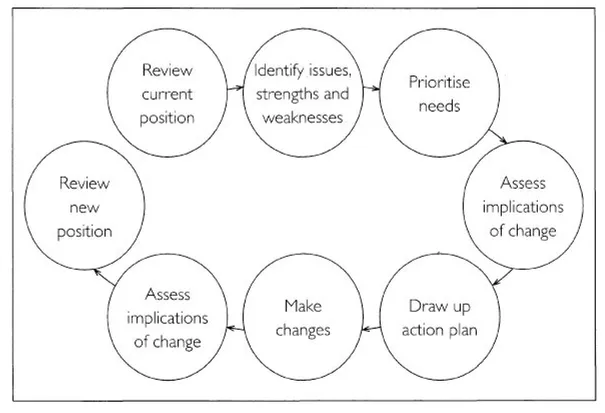
The process above is most effectively achieved when it is an experience shared with colleagues. That said, you need to have done your homework before consulting with colleagues — it's one thing to work with colleagues, it's another to get them to do it for you (or to you, if you've gone in unprepared!). Never go in to a discussion about reviewing art education in your school without having your own perceptions ready for scrutiny. Have your own approach clear in your own mind before you throw the agenda open to others. Harrison (1998) provides a useful framework for working with colleagues.
Review your current position
One of the first tasks you will face as the appointed art coordinator is the formulation of evidence of where your school is currently at in its development of art education. There are a variety of ways in which you could proceed and it is probably the eclectic approach that will work best. Pathways to clarifying the current status include:
How to review the current provision:
- read the school policy on art if it exists;
- read the schemes of work for art;
- examine the schools long- and medium-term plans for art;
- look at existing collections of children's work, e.g. samples kept for Ofsted inspections;
- look at current record keeping;
- investigate the system for resourcing the art curriculum;
- consider Inset provision for art over the previous five years;
- discover the particular facilities offered by your school for art education.
The above can form a checklist for you in the early days and will help to prioritise the demands upon your time. If the policy is well written and the schemes of work reflect those stated intentions then you may well turn your attention to planning, assessment, recording and resourcing. So having looked at the above list of evidence you can now evaluate each of the following major issues using the pragmatic headings of status and response.
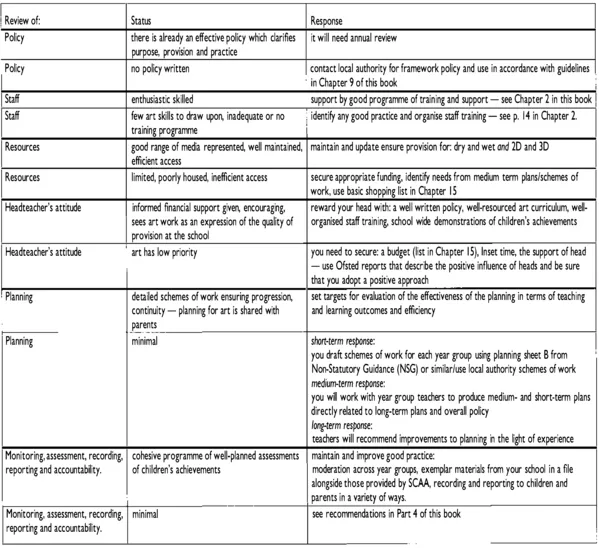
You can add your own key issues, e.g. quality of teaching is a critical issue and one where you will need to develop the trust of the staff before you can evaluate it. Another issue might be accommodation, perhaps you can see ways of rationalising space, store rooms and maybe even classrooms. All the above could equally be presented individually on a continuum of extremes from left to right and you could set targets and monitor development (see action plan that follows). You may find that you are in the fortunate position of maintaining, monitoring and improving existing good provision gradually. Equally you may find that you need to be the instigator of a range of rapid changes. A clear vision of these targets presented with straightforward documentation will help you in your initial discussions with your head regarding the schedule you propose.
The above should help you to arrive at an action plan. Such a plan should identify short-, medium- and long-term targets.
Prioritise needs
Having considered the current provision and identified key issues and responses you will need to prioritise. This will be influenced by the timescale available to you. For example, if your appointment follows a recent OFSTED inspection the chances are that priorities are already identified and that you can reasonably count on having four years to put your vision into effect. In such a scenario it follows that you will have:
- the opportunity to plan for a programme of INSET /training;
- time to consult with staff;
- you will be able to consider the whole school long-term plans and related schemes of work;
- carry out an analysis of existing resources;
- develop a policy;
- arrive at a coherent plan for assessment and monitoring;
- establish yourself in the role of art coordinator;
- and gain the trust and respect of your colleagues.
Alternatively, you may be appointed art coordinator with a short time scale for the above and judicious prioritisation of needs will be necessary. Your commitment to developing all aspects of policy will inevitably be compromised by the urgent need for action. Your priorities will need to be:
- write a policy — use local authority framework;
- write schemes of work — use planning sheet B in NSG for medium-term plans and Chapter 9;
- write a statement of intent regarding monitoring, assessment, recording, reporting and accountability — use Part 4 for good practice on this and your local authority guidelines;
- record your proposals for INSET/training;
- write a statement on resources with costing and an overall budget — use Chapter 15 for this.
Assess implications of change
Before forging ahead with the writing of your action plan you will need to reflect on the possible implications of the changes that you have in mind at both profess ional and interpersonal levels. You will need to consider:
- teaching style favoured by your staff — is there a proper policy or simply an accepted common approach to teaching strategy in your school? (e.g. interactive whole class, group work or individual) How would your vision fit with this and how could you enable staff to accommodate the changes that your vision might involve? For example, can you organise for other staff to observe you? INSET time used for visits to well-chosen schools?
- existing practice in planning — is your vision of planning contrary to this? For example, your school may operate a top down model wherein the coordinator structures the framework for planning for progression and continuity and the year group teachers subsequently work with the coordinator to develop schemes of work. Alternatively, your school may operate a bottom up approach wherein, for example, the coordinator would first work with colleagues to establish their desires regarding what to teach in each year group and then the coordinator builds these pieces of planning into a cohesive plan for teaching and learning ensuring continuity and progression;
- existing demands on colleagues and children for monitoring, assessment, recording, reporting and accountability (MARRA) — how do your proposals fit with these? Typically, most schools will commit a far greater amount of time and effort to addressing MARRA for English and mathematics, but understandably less for the remaining subjects;
- resources — will your approach to the ordering, storage, distribution and maintenance of resources be different from previous practice? If you predict that there may be some initial resistance to your new style, then you may need to temper the process of change with, for example, self deprecating humour (before and after photographs of your own stock room or classroom sink area) or sheer hard graft (you organise the lifting and shifting of the heavy/awkward paper supplies). The point is made elsewhere in this chapter that colleagues are usually prepared to forgive a lot in the face of sheer enthusiasm and energy;
- interpersonal awareness — will there be any implications for the responsibilities of other colleagues resulting from the process of change you propose? You will need to ameliorate some of the potential interpersonal difficulties by appraising colleagues with related interests of the changes, rather than treading on toes. Be aware of where your responsibilities and resources impinge on someone else's. It can make the difference between developing shared understandings and profitable working approaches on the one hand and negative tensions, duplication of work and an undermining of purposeful endeavour on the other. For example, have you appraised the Key Stage 2 coordinator of your proposal to purchase sketch books as the money for this may come out of their budget? Is there a planning or assessment coordinator for the school — appraise them of specific implications of change. You may be about to introduce a lot of 'wet and messy' art activities where previously there has been an overemphasis on dry observational drawing — this will probably have some implications for the caretaker and will the school provide art overalls or will parents need to provide an art shirt for each child?
- the tone you adopt will have a significant effect on the way in which your message of change is received. Will you be serious and enthusiastic about the job or pompous and officious? Are you able to identify tensions and discuss difficulties or will you only listen to positive comments from supportive colleagues? When things go awry will you adopt a pragmatic approach to sort out the crisis and learn lessons subsequently, rather than to overtly apportion blame? To be an effective coordinator you will need to accommodate the shortcomings of some colleagues and the potential of others. Accepting and understanding the way people are is an important first step to being able to get the most out of them.
Draw up an action plan
You will need to draw up an action plan whatever the particulars of your context. You have already reviewed current position, identified issues, prioritised needs and assessed the implications of change. You need to present your action plan in a clear user-friendly format and the following is an example that may help structure your proposals.
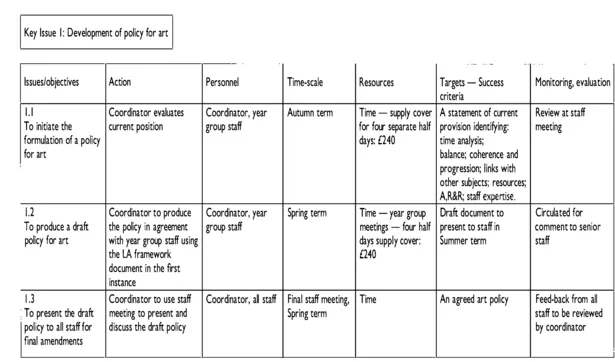
Repeat for each key issue.
Your action plan will need a supporting statement to give a rationale for the action that you are proposing but keep it brief and use simple, direct language to maximise impact and acceptance.
Chapter 2 Establishing yourself in the role of art coordinator
Coordinators can sometimes be so aware of not wanting to appear threatening or officious to colleagues that they actually hold themselves back from being business-like and professional. In terms of your initial approaches to the job you will need to remind yourself that long-standing colleagues will forgive your attentions as the assumption of responsibility for art (they will be pr...
Table of contents
- Cover
- Half Title
- Title
- Copyright
- Contents
- List of figures
- Acknowledgments
- Series editor's preface
- Part one The role of the art coordinator
- Part two What art coodinators need to know
- Part three Whole school policies and schemes of work
- Part four Monitoring for quality
- Part five Resources
- References
- Index
Trusted by 375,005 students
Access to over 1.5 million titles for a fair monthly price.
Study more efficiently using our study tools.
Frequently asked questions
Yes, you can cancel anytime from the Subscription tab in your account settings on the Perlego website. Your subscription will stay active until the end of your current billing period. Learn how to cancel your subscription
No, books cannot be downloaded as external files, such as PDFs, for use outside of Perlego. However, you can download books within the Perlego app for offline reading on mobile or tablet. Learn how to download books offline
Perlego offers two plans: Essential and Complete
- Essential is ideal for learners and professionals who enjoy exploring a wide range of subjects. Access the Essential Library with 800,000+ trusted titles and best-sellers across business, personal growth, and the humanities. Includes unlimited reading time and Standard Read Aloud voice.
- Complete: Perfect for advanced learners and researchers needing full, unrestricted access. Unlock 1.5M+ books across hundreds of subjects, including academic and specialized titles. The Complete Plan also includes advanced features like Premium Read Aloud and Research Assistant.
We are an online textbook subscription service, where you can get access to an entire online library for less than the price of a single book per month. With over 1.5 million books across 990+ topics, we’ve got you covered! Learn about our mission
Look out for the read-aloud symbol on your next book to see if you can listen to it. The read-aloud tool reads text aloud for you, highlighting the text as it is being read. You can pause it, speed it up and slow it down. Learn more about Read Aloud
Yes! You can use the Perlego app on both iOS and Android devices to read anytime, anywhere — even offline. Perfect for commutes or when you’re on the go.
Please note we cannot support devices running on iOS 13 and Android 7 or earlier. Learn more about using the app
Please note we cannot support devices running on iOS 13 and Android 7 or earlier. Learn more about using the app
Yes, you can access Coordinating Art Across the Primary School by Robert Clement,Judith Piotrowski,Ivy Roberts in PDF and/or ePUB format, as well as other popular books in Education & Education General. We have over 1.5 million books available in our catalogue for you to explore.