eBook - ePub
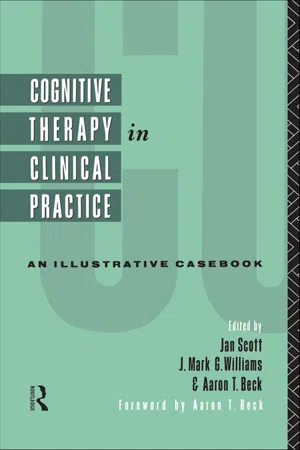
Cognitive Therapy in Clinical Practice
An Illustrative Casebook
- 272 pages
- English
- ePUB (mobile friendly)
- Available on iOS & Android
eBook - ePub
Cognitive Therapy in Clinical Practice
An Illustrative Casebook
About this book
This volume contains examples of how cognitive therapists working in varied settings with groups of adult clients have applied the cognitive model in their domain. Cognitive therapy has much broader application than the traditional area of depression; contributors illustrate the way they work by using extended case material, readers will hear the voices of the clients and empathise with both client and therapist as they seek to build a collaborative relationship. Areas discussed range from drug abuse and eating disorders to obsessive behaviour. Any therapist, however experienced, will learn from `listening in' on the cases presented and students will find it essential reading.
Information
Chapter one
Severely depressed in-patients
Ivy M.Blackburn
Introduction
Cognitive therapy (CT) of depression (Beck et al. 1979) was described as a method of treatment for out-patients with mild to moderate depressions. All published controlled studies of efficacy have so far included only out-patients, usually satisfying research diagnostic critieria for major or definite depression (Spitzer et al. 1978; Feighner et al. 1972), unipolar subtype. Seven studies have compared CT with antidepressant medication, each alone or in combination (Rush et al. 1977; Beck et al. 1979; Blackburn et al. 1981; Rush and Watkins 1981; Murphy et al. 1984; Teasdale et al. 1984; Beck et al. 1985). The results of these treatment trials have all confirmed the efficacy of CT in the treatment of depression, CT being found equivalent or superior to antidepressant medication. Other studies have compared CT with behaviour therapy in the treatment of depressed self-referred students and media-recruited depressed individuals. These studies (Shaw 1977; Taylor and Marshall 1977; Zeiss et al. 1979; Wilson et al. 1983) have found CT superior or equivalent to behaviour therapy and superior to waiting-list controls. Various other studies (e.g. McLean and Hakstian 1979; Shipley and Fazio 1973) have used behaviour therapy with a strong cognitive component in depressed out-patients or depressed students, and found cognitive behaviour therapy to be an effective treatment, superior to psychodynamic or supportive psychotherapy.
Thus, the efficacy of CT, as described by Beck et al. (1979), or of other types of short-term therapies which are primarily cognitive in orientation, has been relatively well established in the treatment of depressed out-patients. Questions which are often posed are: ‘How effective is the same treatment method in the more severely depressed in-patients?’ and ‘Can cognitive therapy be applied to in-patients?’ There are, unfortunately, no published studies to date which could begin to answer these questions, but they are undoubtedly important practical questions. In this chapter, I will discuss some of the problems involved in the treatment of severely depressed in-patients and describe a case study as illustration.
Cognitive therapy with in-patients
Why do cognitive therapy with in-patients?
Since the majority of depressed patients in Britain are treated primarily by their general practitioners and, secondly, as outpatients in psychiatric clinics (Goldberg and Huxley 1980), depressed patients who become in-patients have specific characteristics which distinguish them from the majority of depressed patients. In general, depressed patients who become in-patients in the National Health Service may have one or several of the following characteristics: psychotic features, that is delusions and hallucinations; high suicidal risk and/or suicidal behaviour; severe impairment with gross retardation or agitation, anorexia, and sleep disturbance; the need for electroconvulsive therapy (ECT) because of past history of response to ECT or because of current severity of illness; failure to respond to out-patient treatment and long duration of index episode of illness.
Severely depressed in-patients are almost invariably treated by physical methods of treatment, medication, and/or ECT, with little or no psychotherapeutic input. There are, however, several arguments for the usefulness of a psychotherapeutic approach such as CT in these patients because of, rather than in spite of, the chronic and severe illness characteristics described above.
- Depressed in-patients may often exhibit hopelessness regarding their prospect for improvement. They are likely to have been depressed for a long time and to have already been treated with two or three different antidepressant drugs. They may have, naturally, become sceptical about outcome of further treatment. CT offers an alternative approach which has face validity and may revive some hope in treatment in general. CT techniques can also be used to increase compliance with drug regimens when a combined treatment is being considered.
- The long months of illness or the recurrent nature of the illness, in addition to fostering hopelessness, also creates a sense of lack of control which is increased by the medicalisation of the illness. The patient may often voice the implicit message given by the physician: ‘Something is wrong with my biochemistry—there is nothing I can do about it.’ By its methodology which stresses coping techniques and empirical verification, CT increases a sense of control which is in itself beneficial. A problem may arise about the apparent double or inconsistent message which is being given to the patient when he is receiving both CT and pharmacotherapy. This will be considered later in this chapter.
- Many behavioural problems accompany severe depressive illness,either as primary symptoms of depression or secondary to the chronic nature of the illness. These are inactivity, apathy, increased dependence, lack of self-assertion and indecision. Such problems can be dealt with effectively through cognitive and behavioural methods of treatment.
- The alternative of introducing depressed in-patients to CT after the treatment of their acute episode with physical methods of treatment may decrease the credibility of the therapy as a method of treatment for depression. The patient, who is already nearly recovered, is likely to be less involved in the treatment and less motivated to comply with the tasks which are an integral part of the therapy.
- The promising results on the effectiveness of CT in the prevention of relapse (Simons et al. 1986; Blackburn, et al. 1987) may indicate that CT, at least as an adjunct to pharmacotherapy, is essential for depressed in-patients who have a history of frequent relapses. CT, in these cases, is often best considered as an additional treatment, in combination with medication, but, in my experience, it can also be effective on its own.
Specific problems relating to cognitive therapy with in-patients
Besides the general difficulties encountered in doing CT with severely depressed patients, the ward setting itself imposes constraints and conditions which are not operative in the case of out-patients. First of all, the environment is very restricted in terms of whom the patient interacts with, in terms of potential activities which are available, and in terms of expectations from staff and relatives and of the demands which are consequently put upon the individual. Second, hospital units and wards, in particular in a teaching hospital, are staffed by multidisciplinary teams within which widely different orientations are often represented. Unless good liaison is established, the patient may become totally disoriented. For example, the patient may be expected to attend psychodynamically oriented group therapy in the morning, have 1 hour of CT in the afternoon, talk to ward nurses who may take an excessively supportive role, be interviewed by medical students for teaching purposes, and take medication before going to bed if a combined treatment is being administered. The therapist in charge of the cognitive treatment must, therefore, be in constant liaison with the rest of the staff to inform them about the current stage of therapy and the problems which are being discussed and to get feedback in turn about ward behaviour or other problems. For example, the therapist should attend daily ward staff meetings to discuss the events of the previous day, set common goals, ensure a consistency of approach, and set a certain degree of demarcation for the role of different staff members who are involved with the patient. Third, a necessary deviation from standard out-patient practice is the setting of more frequent appointments. In my experience, daily sessions are indicated at the beginning of the therapy, even if they are short (half-hour) sessions. This is particularly important if the patient is receiving only CT, as otherwise that person might feel that not enough care or attention is being given relative to patients who receive regular medication.
Finally, although the explanation which is given to an in-patient regarding CT does not differ from that given to an outpatient, this requires particular care in the case of patients who may have been treated with only antidepressant medication for a long time before coining into hospital or who may, indeed, be continuing on a different or higher dose of medication while in hospital. Different rationales are called for if a switch from drugs to CT is being offered, or if both treatments in combination are proposed. In the former case, the risks are that patients feel desperate and see CT as the end of the road—’If this fails nothing else will work’; or they may feel angry and think that their time has been wasted so far, that they ‘should have been given cognitive therapy before’. A helpful introduction to CT in such a case, after an initial interview for suitability (see later), may be: ‘Mrs Smith, now that you are here in hospital, we can perhaps think of an alternative treatment approach. You have been taking these tablets for a little while now and, though they have helped a bit, there is still some way to go. We could try one of several other types of medication. However, it may be useful to take a rest from pills at this point and try a different treatment which does not involve taking medication. The treatment I have in mind is cognitive therapy. It involves talking about problems and learning some new skills to cope with them. If this treatment does not suit you after we’ve tried it for a little while, we will think of alternatives. Does that sound OK with you?’ The therapist would then continue in the manner recommended by Beck et al. (1979:72-4) to explain CT and socialise the patient to CT.
When a combined treatment is being envisaged, the introduction may be: ‘Mrs Smith, now that you are here in hospital, we can see whether discussing your problems on a regular basis and learning ways to deal with them, as well as continuing to take the tablets, may help you better. There are many reasons why people become depressed and often we are not sure what these are for each individual. Sometimes, medication alone can help, but sometimes we find that combining medication with a therapy that helps people to work on their problems can be more helpful. Both treatments are equally important and work together. Let me tell you about cognitive therapy....’ And again the usual explanation and socialisation would then ensue. The following case study will try and elucidate these points further, as well as describe the course of therapy.
Case example (Anne)
Short case history and presentation
Anne was a 58-year-old single woman who was admitted to hospital after a referral by her general practitioner. Her presenting complaint was ‘people talking about my secret affair with a gentleman’; ‘people following me’; ‘CID people watching me’; ‘disappointed in and suspicious of everybody’. She had felt depressed and suspicious for a year, having been passed over at work for promotion to a higher rank among the office secretaries. She was having difficulties learning new computing skills and felt that the other typists thought her ‘lazy’ and ignored or shouted at her. Her suspicions had worsened over the last two or three weeks. She thought that people at work were people in disguise in order to watch her and that one of the nurses on the ward was a policewoman. She also complained of a flat mood, being unable to feel and to cry. She looked depressed and agitated.
On mental state examination, she reported sleep disturbance with early, middle, and late insomnia, low mood, guilt, inability to concentrate, loss of interest, somatic and psychic anxiety, loss of appetite, loss of weight, loss of energy and fatigability (score of 27 on the seventeen-item Hamilton Rating Scale for Depression, HRSD, Hamilton 1960). When the research diagnostic criteria (RDC, Spitzer et al. 1978) were checked after a diagnostic interview on the P...
Table of contents
- Cover Page
- Title Page
- Copyright Page
- Contributors
- Foreword
- Chapter one Severely depressed in-patients
- Chapter two Panic disorder and agoraphobia
- Chapter three Obsessions and compulsions
- Chapter four Hypochondriasis
- Chapter five Cancer patients
- Chapter six Eating disorders
- Chapter seven Drug abusers
- Chapter eight Offenders
- Chapter nine Suicidal patients
- Chapter ten The wider application of cognitive therapy: the end of the beginning
Trusted by 375,005 students
Access to over 1.5 million titles for a fair monthly price.
Study more efficiently using our study tools.
Frequently asked questions
Yes, you can cancel anytime from the Subscription tab in your account settings on the Perlego website. Your subscription will stay active until the end of your current billing period. Learn how to cancel your subscription
No, books cannot be downloaded as external files, such as PDFs, for use outside of Perlego. However, you can download books within the Perlego app for offline reading on mobile or tablet. Learn how to download books offline
Perlego offers two plans: Essential and Complete
- Essential is ideal for learners and professionals who enjoy exploring a wide range of subjects. Access the Essential Library with 800,000+ trusted titles and best-sellers across business, personal growth, and the humanities. Includes unlimited reading time and Standard Read Aloud voice.
- Complete: Perfect for advanced learners and researchers needing full, unrestricted access. Unlock 1.5M+ books across hundreds of subjects, including academic and specialized titles. The Complete Plan also includes advanced features like Premium Read Aloud and Research Assistant.
We are an online textbook subscription service, where you can get access to an entire online library for less than the price of a single book per month. With over 1.5 million books across 990+ topics, we’ve got you covered! Learn about our mission
Look out for the read-aloud symbol on your next book to see if you can listen to it. The read-aloud tool reads text aloud for you, highlighting the text as it is being read. You can pause it, speed it up and slow it down. Learn more about Read Aloud
Yes! You can use the Perlego app on both iOS and Android devices to read anytime, anywhere — even offline. Perfect for commutes or when you’re on the go.
Please note we cannot support devices running on iOS 13 and Android 7 or earlier. Learn more about using the app
Please note we cannot support devices running on iOS 13 and Android 7 or earlier. Learn more about using the app
Yes, you can access Cognitive Therapy in Clinical Practice by Jan Scott, J. Mark G. Williams, Aaron T. Beck, Jan Scott,J. Mark G. Williams,Aaron T. Beck in PDF and/or ePUB format, as well as other popular books in Psychology & Clinical Psychology. We have over 1.5 million books available in our catalogue for you to explore.