- 88 pages
- English
- ePUB (mobile friendly)
- Available on iOS & Android
eBook - ePub
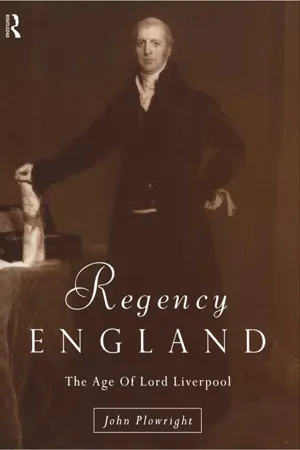
About this book
The early nineteenth century was marked by public disorder, governmental repression and correction. It was a period of revolution, reaction and reform.
This pamphlet focuses on three key issues:
* the factors which combined to produce the turmoil and uprisings of 1812-21 and the severity with which they were put down
* the validity of the distinction between 'repressive' and 'liberal' phases of the administration
* the ability of Lord Liverpool as Prime Minister.
1
Introduction
Introduction
Amongst their more public vices, politicians are notorious body-snatchers. That is to say, they are apt to appropriate the memory of some great statesman of the past in an attempt to legitimise some contemporary policy or at least enhance their own image by association. Notorious examples of this practice include Disraeli’s assumption of the mantle of Palmerston, Lord Randolph Churchill’s abduction of the memory of Disraeli, and Margaret Thatcher’s attempt to conflate her image with that of Winston Churchill.
On the face of it, Lord Liverpool would appear to be a strong contender for such treatment. After all few, if any, Prime Ministers have such a good claim to have been distinguished leaders of their country in both war and peacetime. Aberdeen, Asquith and Chamberlain, for example, appeared, at least in the judgment of their contemporaries, to have failed the test of war, whilst Lloyd George’s and Churchill’s finest hours as premiers were clearly confined to their wartime tenures of No. 10.
Moreover, Liverpool’s record of fifteen consecutive years of service in the highest office of state has not been surpassed since it was set in 1827 (although Margaret Thatcher came close between 1979 and 1990).
How, then, is one to account for the paradox between Liverpool’s political longevity on the one hand, and his relatively poor press amongst historians and lowly place amongst party-political hagiographers on the other?
In part, the answer lies in the fact that Liverpool’s political career was passed in its entirety, unlike that of, say, Peel, in the unreformed parliament whose assumptions, mechanics and imperatives are even more difficult to comprehend than the political world of the post–1832 period. In part, also, it lies in Liverpool’s rather self-effacing character, which whilst admirable in many respects certainly lacked the panache of a Palmerston or Disraeli or even the glamour mustered by a Rosebery or an Eden. He also lacked what Denis Healey called a ‘hinterland’. That is to say, with the exception of an appreciation of literature and the fine arts, he had few interests outside the world of politics.
Thus, if one were simultaneously to give hostages to fortune and indulge in a little historical body-snatching of one’s own, perhaps the closest figure to that of Liverpool as Prime Minister is not Margaret Thatcher but Clement Attlee, who managed to combine solid legislative achievement with a rather deceptive two-dimensional political personality.
This work will endeavour to justify a sympathetic reassessment of Liverpool’s record as party leader and as Prime Minister. In so doing it is hoped that light will be shed on three key questions regarding the period of Liverpool’s premiership.
First, what factors combined to produce public disorder between 1812 and 1821? Second, how severe was governmental suppression of that disorder? Third, is it valid to distinguish between ‘repressive’ and ‘liberal’ phases of the administration, with the personnel changes centring upon 1822 marking the point of alleged transformation?
There will not be an extended discussion of the nature of party politics in this period or of the early career of Robert Peel or of the period between Liverpool’s stroke and the 1832 Reform Act as these matters are dealt with in the relevant sections of three other volumes in the Lancaster Pamphlets series, namely, Political Parties in Britain 1783–1867, Sir Robert Peel: Statesmanship, Power and Party, and The Great Reform Act of 1832, all by Eric J. Evans.
Nor will there be an extended discussion of British foreign policy in this period, except in so far as it is relevant to the questions posed above, as this aspect of Liverpool’s administration merits separate treatment.
2
Lord Liverpool, his administration and the problems of Regency England
Lord Liverpool, his administration and the problems of Regency England
Spencer Perceval’s chief claim to fame is that he is the only British Prime Minister to have been assassinated.
Although the long-standing war with France and serious disturbances within the country might have been a pretext for political assassination, it appears that Perceval’s assassin, John Bellingham, was a mentally unbalanced lone gunman, seeking revenge for imprisonment for debt in Russia, rather than part of a conspiracy. Nevertheless, stepping into Perceval’s shoes in 1812, given the aforementioned difficulties, was an awesome prospect.
Even though Lord Liverpool was only the Prince Regent’s sixth choice as Prime Minister, he was eminently qualified to discharge the difficult task of succeeding Perceval. His father, Charles Jenkinson (1727–1808), had based his career and the family fortune upon a lifetime’s devoted service to George III, and had been rewarded with the title of first Baron Hawkesbury in 1786 and first Earl of Liverpool in 1796. After Charterhouse and Christ Church, Oxford, his eldest son, Robert, had first entered Parliament in 1790 (at the age of twenty). His early entry into Parliament enabled him to serve a long political apprenticeship. After acting as Pitt’s Commissioner at the Board of Control (1793), where he developed his knowledge of commercial affairs, and as Master of the Mint (1796), where he had (in thecustomary manner) augmented his own fortune, he had held the three great secretaryships, having been Foreign Secretary from 1801 to 1803, Home Secretary from 1804 to 1809 (with a brief break in 1806–07) and Secretary for War and Colonies from 1809 to 1812. The last office was arguably of more consequence than the previous two at that stage of the war with France. From 1793 he had never been out of office and from 1801 never out of the cabinet, apart from the short Whig administration of 1806–07.
As Gash has said, ‘Few prime ministers have made such a measured ascent to supreme office or been prepared for it by such comprehensive experience’. It is true that James Callaghan held the three great modern offices of Home Secretary, Foreign Secretary and Chancellor of the Exchequer before becoming Prime Minister in 1976, but his ascent to supreme office was not as measured as Liverpool’s and he held the premiership for a much shorter period.
In addition to his ministerial appointments, Liverpool had been the Tory Leader in the House of Lords since 1803, where he greatly strengthened the government’s debating team against Lord Grenville. Even if few would choose to follow Wellington in placing him on a par with Pitt in this regard, Liverpool was widely acknowledged as a parliamentary speaker of some distinction; one who eschewed orotund rhetoric in favour of closely-reasoned argument. In 1819 his often critical nephew, James Archibald Stuart Wortley (later Baron Wharncliffe), declared his uncle to be perhaps ‘the best speaker in either House of Parliament’.
Moreover, Pitt himself had remarked in 1805 that ‘with his information … and the habits of reflection which he has acquired, he [Liverpool] is by no means a contemptible adviser’, although he also said that he was not a man ‘to whose decision singly I would commit a great question of policy’. Canning, an altogether more partial witness, had told Pitt that Liverpool possessed ‘useful powers of mind, great industry and much information’ and later described him to Wellesley as ‘an able and honourable man’. In short, Liverpool was regarded as possessing generally sound judgment and a safe pair of hands.
Liverpool was also regarded as a man of high morality in his private and public life. This was an asset which improved with age, as the evangelical revival resulted in rising expectations ofexacting moral standards. However, in two respects his scruples had political drawbacks. First, he was so consistently conciliatory and concerned not to cause unnecessary offence to colleagues that anxiety sometimes produced an irritability and depression which threatened to affect his health (although this did not become a serious problem until 1824 when he had to smooth over the differences in cabinet between Canning and his colleagues).
Second, he was too scrupulous to hold out a possibility of patronage which he knew he might not be able to honour. This was a serious disability given that there was insufficient patronage to ensure a reliable government majority in the Commons. Moreover, Liverpool’s integrity meant that he was willing to risk making enemies in the highest ranks of society on questions of patronage, as in 1823, when he refused the King’s request to make his physician and private secretary, Knighton, a privy councillor, or in 1826, when he refused Wellesley’s and Wellington’s claims that their younger brother, Gerald, should receive preferment in the Church.
However, in one important respect Liverpool’s scrupulous approach did pay dividends. By virtue of the fact that he weighed each question on its merits, he was a High or ‘Protestant’ Tory in his opposition to Catholic emancipation but was a liberal Tory in his commitment to Free Trade. He was thus ideally placed, by virtue of this intermediate position, to appeal to, and mediate between, the two wings of the Tory party if ever they came into conflict.
Liverpool naturally attempted to balance the two wings of his party in composing his ministry and in his ‘inner cabinet’ (which consisted of Liverpool, Wellington, Bathurst and Canning after the reconstruction of 1821–3). However, in 1812 Liverpool was unable to secure Canning’s services because, although Canning professed himself to be ‘sincerely desirous of coming into the Regent’s service’ and to consider ‘a reunion with Liverpool in office as an object … most desirable, publickly and privately’, he would not take the Foreign Office or the War or Home Departments if his archrival Castlereagh retained the Leadership of the Commons.
The rivalry between the two men went back at least as far as the time when they were cabinet colleagues in the Duke of Portland’s ministry of 1807–09. Canning, as Foreign Secretary,had campaigned for Castlereagh’s removal from the War Office from March 1809 and had succeeded in this aim in September, following a disastrous military expedition to Walcheren. When Castlereagh resigned the two men fought a duel in which Canning was slightly wounded in his thigh and his pride, whilst Castlereagh lost a coat button after an exchange of two shots apiece. However, in 1812 Castlereagh had already agreed to relinquish the Foreign Office – but not the Leadership of the Commons – to make way for Canning, and thus Liverpool reluctantly felt obliged to refuse Canning’s demand.
Thus Castlereagh continued under Liverpool as Foreign Secretary and Leader of the House of Commons and Canning did not enter the administration until 1816, when he temporarily contented himself with the Board of Control, which had become vacant following the death of the Earl of Buckinghamshire.
Shelley famously referred to Liverpool’s administration as comprising ‘Rulers who neither see, nor feel, nor know’, and Disraeli claimed that its members ‘knew as little of the real state of their own country as savages of an approaching eclipse’. This harsh judgment has been echoed by several historians. R.J. White, for example, writes that ‘By their social intercourse, their classical studies, their mingling in the affairs of county society, and their travels, they could be said to have an extensive knowledge of three things above all else’, namely, ancient Rome, modern (non-industrial) England south of the Trent, and those foreign parts which customarily featured on the itinerary of the Grand Tour. Bentley goes even further in suggesting an ignorance of contemporary society when he writes that for most ‘the home counties, the southeast and the west country filled their horizons … at a moment when the axis of working-class unrest and political radicalism had swung sharply north and west towards centres like Manchester and Glasgow’. Cookson, however, rightly points out that the members of Liverpool’s cabinet ‘were really less the representatives of the landed aristocracy than professional politicians’, like Liverpool’s own father, in so far as only one of them, the Earl of Westmorland (the Lord Privy Seal), possessed ‘impeccable aristocratic credentials’, which came with a long-established title. As the Whig Sir James Graham put it in 1826, it was ‘an administration more connected with the annuities than with land, possessed of few acres’.
Castlereagh’s roots lay in the substantial Irish gentry. He was the second, but eldest surviving, son of Robert Stewart, who had been ennobled as the first Marquis of Londonderry. Viscount Sidmouth, the Home Secretary, and Vansittart, who belonged to the Sidmouth connection and was Chancellor of the Ex-chequer, had emerged from the lesser English gentry; Sidmouth, for example, was the son of Dr Anthony Addington, a physician who owned a small estate in Oxfordshire. The Earl of Harrowby, the Lord President of the Council, and Robinson, the Vice-President and then President of the Board of Trade, owed their positions to grandfathers who had prospered in the law and the diplomatic service respectively. Liverpool himself, like Castlereagh and Sidmouth, came from the squirearchy rather than the nobility, for his father had emerged from an Oxfordshire estate bought by the sea-captain and merchant Anthony Jenkinson. It is, however, the career of John Scott, first Earl of Eldon and the Lord Chancellor, which best illustrates the extent to which the world of Regency politics was not monopolised by those of ancient lineage. He was the third son of William Scott, a prosperous coal factor and business man of Newcastle upon Tyne, who had entered the Commons via grammar school, Oxford, marriage to the heiress of a wealthy banker and a distinguished career in the law.
Thus in White’s opinion (and offsetting his previously quoted words), ‘superimposed upon their landed origins, they possessed the wider outlook and interests of professional politicians’, having come to ministerial office, with very few exceptions, ‘by the long and arduous road of public service, not by the mere possession of titles and estates’.
Liverpool was certainly not ignorant of the impact of the industrial revolution. In 1824 he recommended Lord Stanhope to visit Britain’s new manufacturing towns, praising the steam engine as ‘the greatest and most useful invention of modern Times’. He also urged the King to sanction a £500 treasury grant in order to erect a statue of James Watt.
There was, however, one constraint upon Liverpool’s government which has been pointed out by Bentley and which was of greater significance than their social origins or regional knowledge, namely, their age. ‘Most ministers had been born in the early years of the reign of George III’; Sidmouth and Eldon – aged fifty-five and sixty-one respectively in 1812 – had beenborn even earlier. In so far as these men lacked insight into the problems of the age, this was because they were children of the eighteenth century attempting to cope with the problems of the nineteenth.
Liverpool took control of a Britain beset by problems of a daunting number and magnitude, which conspired to produce considerable social unrest.
The move towards a more capitalist system of farming was socially destabilising to the extent that it facilitated both rural depopulation and massive population growth, up from 10.5 million in 1801 (the year of the first census) to 12 million in 1811 and 14.1 million in 1821. This in turn meant that much of the population was very y...
Table of contents
- Cover
- Half title
- Title
- Copyright
- Contents
- Foreword
- Acknowledgements
- Chronology
- 1. Introduction
- 2. Lord Liverpool, His Administration and the Problems of Regency England
- 3. Disorder and Reaction, 1811–17
- 4. Disorder and Reaction, 1818–21
- 5. The Government’s Record on Reform
- 6. Liverpool’s Record as Premier
- 7. Conclusion: The Legacy of Liverpool’s Premiership
- Select Bibliography
Trusted by 375,005 students
Access to over 1.5 million titles for a fair monthly price.
Study more efficiently using our study tools.
Frequently asked questions
Yes, you can cancel anytime from the Subscription tab in your account settings on the Perlego website. Your subscription will stay active until the end of your current billing period. Learn how to cancel your subscription
No, books cannot be downloaded as external files, such as PDFs, for use outside of Perlego. However, you can download books within the Perlego app for offline reading on mobile or tablet. Learn how to download books offline
Perlego offers two plans: Essential and Complete
- Essential is ideal for learners and professionals who enjoy exploring a wide range of subjects. Access the Essential Library with 800,000+ trusted titles and best-sellers across business, personal growth, and the humanities. Includes unlimited reading time and Standard Read Aloud voice.
- Complete: Perfect for advanced learners and researchers needing full, unrestricted access. Unlock 1.5M+ books across hundreds of subjects, including academic and specialized titles. The Complete Plan also includes advanced features like Premium Read Aloud and Research Assistant.
We are an online textbook subscription service, where you can get access to an entire online library for less than the price of a single book per month. With over 1.5 million books across 990+ topics, we’ve got you covered! Learn about our mission
Look out for the read-aloud symbol on your next book to see if you can listen to it. The read-aloud tool reads text aloud for you, highlighting the text as it is being read. You can pause it, speed it up and slow it down. Learn more about Read Aloud
Yes! You can use the Perlego app on both iOS and Android devices to read anytime, anywhere — even offline. Perfect for commutes or when you’re on the go.
Please note we cannot support devices running on iOS 13 and Android 7 or earlier. Learn more about using the app
Please note we cannot support devices running on iOS 13 and Android 7 or earlier. Learn more about using the app
Yes, you can access Regency England by John Plowright in PDF and/or ePUB format, as well as other popular books in History & Early Modern History. We have over 1.5 million books available in our catalogue for you to explore.