eBook - ePub
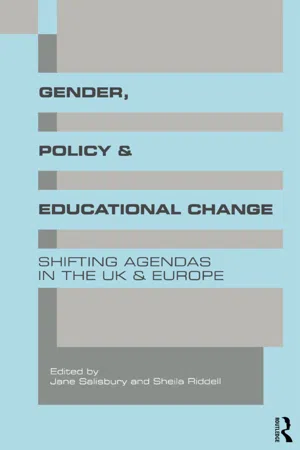
Gender, Policy and Educational Change
Shifting Agendas in the UK and Europe
- 344 pages
- English
- ePUB (mobile friendly)
- Available on iOS & Android
eBook - ePub
Gender, Policy and Educational Change
Shifting Agendas in the UK and Europe
About this book
Gender equality has been a major educational theme for the past two decades and has become interwoven with other policy themes, including those of marketisation and managerialism. Contributors to this strong collection are key researchers in their fields and seek to address the following questions:
* What patterns are discernible in the educational attainment of girls and boys over the past two decades?
* To what extent are changes attributable to gender equality policies?
* What form have gender equality policies taken in different parts of the UK?
* What has been the impact of European equality policies?
* How have gender equality policies been experienced by particular groups including pupils from ethnic minority and working-class backgrounds?
This book aims to take an overall look at how significant have been the changes in experiences, aspirations and culture of girls and boys and male and female teachers. It explores how attempts to improve equal opportunities in education have fared and examines the tensions and contradications in recent policies.
Information
Part 1
Gender and educational reforms
The UK and European context
1 Gender equality and schooling, education policy-making and feminist research in England and Wales in the 1990s
Miriam David, Gaby Weiner and Madeleine Arnot
Introduction
In this chapter we address a number of issues relating to gender and education policy-making: more specifically, the period of UK educational reform at the end of the 1980s and early 1990s, its impact on gender equality and policy-making and feminist quandaries concerning researching gender.
Our discussion draws on a year-long, research project funded by the Equal Opportunities Commission for England and Wales (EOC) which explored educational reform and gender equality in schooling over a ten-year period from 1984–94. We locate this research project in the wider context of education policymaking and commissioned and funded research in Britain today and the range of feminist research perspectives available to us. We argue that policy-oriented research is too limited to identify the reasons for cultural shifts in gender equality, although we reflect on what these reasons might be. First, however, we consider the context of specific policy change and its relationship to gender.
Gender and policy-making
Equality has been a target of British government policy-making at various stages in the twentieth century, though rarely as a high priority. From the 1944 Education Act onwards, ‘equality of opportunity’ was included in the rhetoric of schooling, whether in the 1940s focused on education appropriate to perceived levels of intelligence, or in the 1960s concerned with eradicating social class differences, or on increased gender and racial equality from the 1970s onwards. Indeed, the 1960s and 1970s were most influenced by concerns about equality of opportunity, both in the political arena and in education.
Before 1979, policies under both Labour and Conservative governments were oriented towards the twin goals of greater equality and increased economic growth—with the former seen as contributing to the latter. The main legislation associated with equal opportunities at this time were the Equal Pay Act (1970, coming into force in 1975), the Sex Discrimination Act (1975) which specifically included education, and with respect to ‘race’ issues, the Race Relations Act (1976). This set of legislation led to a range of policy strategies instituted by individual teachers, schools and local authorities, many of whom were anxious to see enacted the spirit as well as the letter of the legislation.
However, by 1979, partly as a consequence of Prime Minister James Callaghan’s speech at Ruskin in 1976 which signalled the end of the post-war boom period and an increasing concern for value-for-money in education, a debate began to develop about the extent to policies aimed at increased equality might be at odds with those aimed at economic growth and individual accountability (David 1980).
At the same time, a number of consistent research findings began to emerge, pointing to inadequacies in schooling for girls. In terms of the formal curriculum, syllabuses and content were found to exclude the experiences of girls and women (whether white or black). At secondary level, where choice was available, girls tended to opt for humanities, languages and social science, and boys for Science, Mathematics and technological subjects (Pratt et al. 1984). Also, students tended to be directed into traditionally male and female subjects and careers, and in the main, girls’ careers were believed to be less important than boys’ (Arnot and Weiner 1987).
In terms of performance, girls were generally found to be achieving well at primary level although they tended to slip back at secondary level, particularly in Mathematics and Science (Kelly 1985; Burton 1986). Boys’ poor performance in English and Languages in primary and secondary school was seen to be offset by their increasingly better performance in examinations as they reached schoolleaving age (Spender 1980). In general, young men were seen to have an advantage in the labour market because many young women had low occupational aspirations, tending to opt for low status and low paid ‘feminine’ jobs to bridge the gap between leaving school and marriage.
The hidden or unwritten curriculum of schooling was also found to exert pressure on students (and staff) to conform in sex-specific ways; for example, there were different rules on uniform and discipline for girls and boys, and sexual harassment and verbal abuse were found to be common features of school life (Lees 1987).
As a consequence, by the early 1980s, some teachers and advisory staff (and the HMI, see Orr 1984) began to develop a range of strategies in order to counter these inequalities. These included: persuading secondary students to opt for non-traditional subjects such as physics for girls and modern languages for boys; encouraging wider career aspiration through non-discriminatory careers’ advice; revising reading schemes and school texts to be less sexist and more inclusive; ‘desexing’ registers and ‘unisexing’ school uniform; appointing female senior staff as positive role models for female pupils; establishing equal opportunities working parties, policy statements and posts of responsibility, and so on (Weiner and Arnot 1987).
The main concerns at this time were: at primary (or elementary) levels, helping girls to become more assertive and removing sexist practices from the formal and hidden curriculum; and at secondary schools, raising the profile of young women in the labour market, persuading girls into Science and Mathematics (there was little focus on boys at this time), and the perceived decline of girls’ performance and self-confidence during adolescence (Whyte 1983; Millman 1987; Chisholm and Holland 1986; Whyld 1983).
Towards the mid-1980s, however, the scenario began to change as municipal socialism in the form of a number of labour-controlled Local Education Authorities (LEAs) adopted increased support for equality initiatives as part of their challenge to New Right policies. More sharply focused, or perhaps, ‘simplistic’ (Gillborn 1995:75) policies were produced which first sought to identity and then to combine different facets of gender policy-making. Connections were made, for example, between gender, race, class and ethnicity as different feminisms began to make an impact on education (Minhas 1986).
Equality began to be viewed as a political football or signifier of the fight between the political Left and Right: in which the principal losers were the metropolitan left-leaning LEAs, whose powers were sharply curtailed by the 1988 Education Reform Act and subsequent legislation (David 1993). At the same time, feminist and equality activists more generally were confronted by what seemed to be a fragmentation of political effort with the emergence of identity politics around different forms of feminist, masculine, black and minority ethnic voices (Weiner 1994). Simultaneously, concepts of equality of opportunity and justice (recast as ‘entitlement’) continued to be promoted within New Right discourses, but in individualistic and weak forms: for instance, the rough justice of the market and the aspirations of the individual were superimposed over post-war welfarism and equality initiatives targeted at identified social groups and communities.
The period from the mid-1970s until the mid-1980s, thus, might be viewed as one where equality issues had a voluntary dimension, of interest mainly to committed politicians, teachers and local authorities. Gender policy development, hence, might originate from local political allegiance, individual teachers or head teachers, an ‘awareness raising’ incident or involvement in one of several funded curriculum development projects (Whyte et al. 1984; Millman and Weiner 1985). Initiatives were often short-term, small-scale, temporary and local, and the national picture was difficult to ascertain. Also, there was little opportunity to evaluate the long-term effects of any policies and practices, though short-term evaluations suggested that the perceptions of some teachers (and pupils) were changing (Whyte et al. 1984; ILEA 1986a, b).
By the late 1980s, as the Conservative government increased emphasis on achievement and standards, interest in gender shifted from policy and practice towards patterns of difference in examinations, and between girls and boys of different social groups (Gipps and Murphy 1994). This coincided with the beginning of the educational reforms when analysis focused on the significance and likely effects of the Education Reform Act and of the National Curriculum (see for example, Arnot 1989; Burton and Weiner 1990; Miles and Middleton 1990; Shah 1990; David 1993).
The set of reforms introduced in the UK between 1988 and 1994 were sweeping and extensive, aimed at destabilising and breaking up the post-war professional culture of schooling which was perceived by some in the New Right as mediocre, collectivist and self-serving. Briefly, the key curriculum reforms affecting curriculum shifts outlined in this chapter are:
- The Technical, Educational and Vocational Initiative (TVEI) in 1983 which was initially a pilot experiment in fourteen LEAs aimed at stimulating curriculum development in technical and vocational subjects for the 14 to 18 age range in schools and colleges, later extended in a diluted form across all LEAs.
- Changes in examinations for 16 year olds at the end of secondary school, particularly the introduction of GCSE (1985 for implementation in 1988), which combined GCE O level examinations with the more recently introduced CSE. These changes provided new criteria for examination and assessment and increased use of coursework.
- Creation in 1986 of a new set of vocational qualifications namely, National Vocational Qualifications (NVQs) and General National Vocational Qualifications (GNVQs).
- The Education Reform Act in 1988 and particularly:
— implementation of the National Curriculum (Core subjects: English, Mathematics and Science, and Welsh in Welsh-medium schools; Foundation subjects: Art, History, Geography, Modern Foreign Language, Technology, Physical Education and Religious Studies.
— introduction of new forms of assessment for the National Curriculum i.e. Standardised Assessment Targets (SATs). - Education Acts of 1992 and 1993, and particularly:
— abolition of HMI and the creation of the Office for Standards in Education (OFSTED) as a relatively autonomous body;
— introduction of a new system of regular, statutory inspections for schools, conducted by members of OFSTED;
— increased emphasis on the role of parents;
— the introduction of statutory requirement for performance tables of school examinations, particularly at the end of compulsory schooling (16+) and for A levels. - Dearing Report (1994) which led to a more streamlined National Curriculum with the introduction of curriculum choice at KS3 (at 13+).
The EOC study: educational reforms and gender equality in schools
We responded to an invitation to tender for a research project from the Equal Opportunities Commission late in 1993. The main task of the proposed research was to collect and collate evidence and information on educational reforms, gender patterns in examinations and assessment, and equal opportunities in schools in England and Wales. Significantly, the EOC’s research division had not collected such information since the mid-1980s. We identified three different methods of data collection for mapping policy and educational changes over a ten-year period, from 1984 to 1994:
- analysis of examination performance data of school leavers especially at 16+ (GCSEs), 18+ (GCE A levels) and 16–18 (vocational qualifications);
- surveys of the perspectives of all LEAs and a sample of primary and secondary state-maintained schools;
- case studies of a small number of LEAs and schools.
Our proposal was based upon our prior knowledge, as feminists, of education although we each brought differing but complementary areas of expertise to the research—involving theoretical, policy, professional and practitioner perspectives. This led us to choose, within the constraints of the terms of reference, a set of questions and a methodology which would produce both a statistical picture and illustrative qualitative examples. However, because of the nature of project funding, we found ourselves unable to adopt an explicitly feminist methodology but, rather, were able to utilise our prior experience of the issues to suffuse the research questions—and to do feminist research covertly. In other words, we were not able to address directly what might be called ‘women’s oppression’ in education or to develop an approach from ‘the standpoint of women’ but rather to look at the relations between the sexes in education (Acker 1994). Moreover, we were required to map trends in gender equality and schooling over a ten-year period, and the contexts in which they occurred rather than to provide wider explanations for the patterns that we might uncover. This mapping exercise was required by the funder, since the EOC needed a basis for recommending new policies, rather than developing a more detailed theoretical explanation. Thus, emphasis was on strategic rather than pure research, and the research was also constrained by limitations of time, money and scope, imposed by the funder.
Evaluating and reflecting on the research
Implementation was also problematic because we had underestimated the extent of the changes in political and policy context. These affected how we could go about mapping change in a national context, given that Wales was experiencing changes that were different from those in England. Scotland had its own separately published study (Turner et al. 1995) and a separate publication was also produced on Wales (Salisbury 1996). Thus gathering data on examination performance and selecting LEAs and schools for the surveys and case studies proved more complicated than anticipated. Additionally, we needed to translate questionnaires to Welsh LEAs and schools into Welsh. Also due to the complex definitions of different databases, data sets available to us often included some students from Scotland and Northern Ireland.
Furthermore, changes in the definitions of characteristics of schools, part of the changing policy context which promoted marketisation and ‘choice’, rendered the sampling frame of schools problematic. Changes in status were particularly notable in the case of newly opted-out schools which had been awarded grant maintained (GMS) status. At the time of research, no comprehensive national database existed for all types of school from which we could draw our sample. For this reason and because of insufficient funding for a more wide-ranging survey, we were compelled to exclude from the study all private/independent schools (not directly funded by government), special schools, and sixth form colleges for 16 to 18 year olds. On reflection, the removal of special schools from the study was unfortunate since investigation of the gender patterns and cultures of such schools would have done much to illuminate the overall analysis. In addition, government strategies to fracture previous LEA-school relations affected access to LEAs and schools, and to their perceptions of the nature of changed performance indicators for schools. Nevertheless, such problems were a salutary reminder of the characteristics of the public policy shifts over time, and strongly informed our policy analysis.
The research approach adopted would have been different had the project had a different sponsor (the Economic and Social Research Council (ESRC) rather than the EOC). On the other hand, as an official government organisation, the EOC gave the research the legitimacy to study these issues and aided access to a range of organisations, schools, LEAs, examination boards, etc. Similarly, it afforded us the opportunity, at a critical juncture, to do important and funded research on a topic of interest to us, at a crucial time in the changing context of gender relations. Nevertheless, th...
Table of contents
- Cover Page
- Title Page
- Copyright Page
- Figures
- Tables
- Contributors
- Acknowledgements
- Abbreviations
- Introduction
- Part 1 Gender and educational reforms
- Part 2 Structures and processes in schools and classrooms
- Part 3 Delegation and the new managerialism
- Part 4 Groups at the margins
- Conclusion
Trusted by 375,005 students
Access to over 1.5 million titles for a fair monthly price.
Study more efficiently using our study tools.
Frequently asked questions
Yes, you can cancel anytime from the Subscription tab in your account settings on the Perlego website. Your subscription will stay active until the end of your current billing period. Learn how to cancel your subscription
No, books cannot be downloaded as external files, such as PDFs, for use outside of Perlego. However, you can download books within the Perlego app for offline reading on mobile or tablet. Learn how to download books offline
Perlego offers two plans: Essential and Complete
- Essential is ideal for learners and professionals who enjoy exploring a wide range of subjects. Access the Essential Library with 800,000+ trusted titles and best-sellers across business, personal growth, and the humanities. Includes unlimited reading time and Standard Read Aloud voice.
- Complete: Perfect for advanced learners and researchers needing full, unrestricted access. Unlock 1.5M+ books across hundreds of subjects, including academic and specialized titles. The Complete Plan also includes advanced features like Premium Read Aloud and Research Assistant.
We are an online textbook subscription service, where you can get access to an entire online library for less than the price of a single book per month. With over 1.5 million books across 990+ topics, we’ve got you covered! Learn about our mission
Look out for the read-aloud symbol on your next book to see if you can listen to it. The read-aloud tool reads text aloud for you, highlighting the text as it is being read. You can pause it, speed it up and slow it down. Learn more about Read Aloud
Yes! You can use the Perlego app on both iOS and Android devices to read anytime, anywhere — even offline. Perfect for commutes or when you’re on the go.
Please note we cannot support devices running on iOS 13 and Android 7 or earlier. Learn more about using the app
Please note we cannot support devices running on iOS 13 and Android 7 or earlier. Learn more about using the app
Yes, you can access Gender, Policy and Educational Change by Sheila Riddell,Jane Salisbury in PDF and/or ePUB format, as well as other popular books in Education & Education General. We have over 1.5 million books available in our catalogue for you to explore.