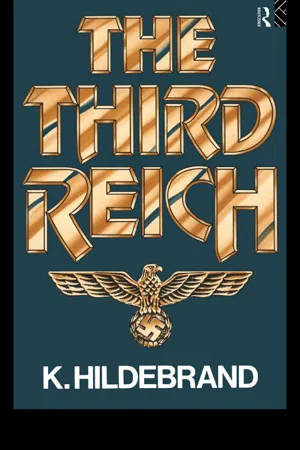
Professor Hildebrand gives a masterly and succinct account of Nazi Germany between 1933 and 1945 and then analyses the major problems of interpretation and the extent to which common ground has been achieved by scholars in the field.
This title available in eBook format. Click here for more information.
Visit our eBookstore at: www.ebookstore.tandf.co.uk.
- 200 pages
- English
- ePUB (mobile friendly)
- Available on iOS & Android
eBook - ePub
The Third Reich
About this book
PART ONE
Historical Survey
(A)
SEIZURE OF POWER AND GLEICHSCHALTUNG, 1933–5
1
The Creation of Totalitarian Dictatorship
When Hitler was appointed Chancellor on 30 January 1933 by President von Hindenburg, he became head of a coalition government of ‘national concentration’, in which conservatives seemed clearly to predominate. Apart from Hitler there were at the outset only two Nazis in the Cabinet. Wilhelm Frick became Minister of the Interior; Hermann Göring was at first Minister without Portfolio and on 28 April became Minister of Aviation. Göring also took over the Prussian Ministry of the Interior on an acting basis, and on 10 April became Prime Minister of Prussia, the largest state in the Reich. Nazi membership of the Cabinet was increased by one when Joseph Goebbels, on 13 March, became head of the newly created Ministry of Popular Enlightenment and Propaganda, but to the outward eye this scarcely affected the balance of power. For, in addition to what appeared to be the strong men of the government—Hugenberg, Minister for the Economy and Agriculture, and von Papen, ViceChancellor and Reich Commissar for Prussia—the government contained four more members of Papen’s ‘Cabinet of barons’: von Neurath, the Foreign Minister, Count Schwerin von Krosigk, Minister of Finance, Gürtner, Minister of Justice, and Freiherr von Eltz-Rübenach, Minister of Posts and Communications. Together with von Blomberg, the Army Minister, and Seldte, the Stahlhelm leader who became Minister for Labour, these members of the ‘old guard’ were expected to keep the Nazis under control and ensure conservative policies. Papen’s idea of taming Hitler seemed to have succeeded. ‘We have roped him in’ (wir haben ihn uns engagiert). In these terms von Papen dismissed conservative misgivings on the subject of Hitler and Nazism, and his self-confident assessment was accepted by most observers at home and abroad. ‘In two months we’ll have pushed Hitler into a corner, and he can squeal to his heart’s content.’
Despite Papen’s self-congratulation the Nazi leader, on the very day of the take-over and immediately before the new government was sworn in by Hindenburg, had won a decisive victory over his conservative ministers and especially Hugenberg, the leader of the German National People’s Party (DNVP). Hitler thus showed from the outset that he was by no means a puppet of powerful army and landowning circles, the bureaucracy and big business. Contrary to an agreement reached between the Nazis and the Nationalists during the negotiations which led to the coalition, after the new government was formed Hitler demanded the right to dissolve the Reichstag elected in the previous November and to hold fresh elections. These, as Hugenberg rightly feared, were unlikely to improve the position of the DNVP; in any case Hugenberg was opposed on principle to further elections and wished to see an extension of presidential power. Since the last election the Nazis and the Nationalists together controlled over 42 per cent of Reichstag votes, while the Centre (Catholic) Party held out hope that they would tolerate the new government if not actively support it. There was thus no compelling reason for new elections, but Hitler demanded them in the hope of using government power to gain a clear majority. He finally gained his point with Hugenberg, as otherwise the coalition seemed in danger, and the aged von Hindenburg, who stood ready to effect the ceremonial transfer of power, could not, it was felt, be kept waiting any longer.
The Reichstag was dissolved on 1 February 1933, two days after Hitler’s appointment as Chancellor. During the election campaign which lasted till the country went to the polls on 5 March, Nazi terrorist tactics, endorsed by the power of the state, were openly exercised against all political opponents, especially communists and social democrats. There now set in a progressive seizure of absolute power, in which it was often difficult to distinguish terroristic from legal measures. A decisive factor was that, in accordance with the modern recipe for a totalitarian coup d’état, the Nazis controlled the Ministry of the Interior, and hence the police power, in the Reich as a whole and also in Prussia. Göring, as head of the Prussian police apparatus, even created an auxiliary police force numbering 50,000, of whom 40,000 belonged to the SA or the SS. In this way police powers were conferred on strong-arm Nazi gangs. Then, in a notorious order of 17 February 1933, Göring instructed the Prussian police to ‘make free (fleissig) use of firearms’ (Hofer and Michaelis, 1965).
From the beginning of February onwards the new rulers used emergency decrees based on Article 48 of the Weimar constitution to restrict the activity of other parties, to limit press freedom and to ensure the docility of the civil service by means of purges. The process of reducing the bureaucracy to subservience was accomplished by party interference and by prudent self-adaptation on the part of civil servants. The law of 7 April 1933 ‘for the restoration of the professional civil service’ gave the party and state full powers over officials who were in any way objectionable: it provided for the more or less arbitrary dismissal of any whose professional competence was in doubt, who were of ‘non-Aryan’ descent, or whose record suggested that they might not be prepared to act ‘single-mindedly and at all times’ in the interests of the national state.
However, it was after the Reichstag fire of 27 February 1933 that Hitler took his most decisive step towards practically unlimited power. The disputed question of who caused the fire (cf. Part Two, Section 4, p. 137 below, and works in the bibliography by W. Hofer and others, 1972 and 1976. H. Mommsen, 1972a, and Tobias, 1964) is not of prime importance in this connection: the main point is the use made of it by the Nazis to seize and consolidate their power. On the day after the fire, which profoundly shocked the general public, von Hindenburg on the advice of the Cabinet issued a ‘decree for the protection of the people and state’ which in effect abolished the basic political rights conferred by the Weimar constitution, although this remained theoretically in force throughout the twelve years of Nazi rule. The decree created a permanent state of emergency and thus gave a cloak of legality to the persecution and terrorisation of the regime’s political opponents.
The last ‘semi-free’ election in Germany took place in this climate of legalised insecurity and open terrorism, exercised in the first instance primarily against the Communist Party (KPD). The two parties of the left, the communists and the social democrats (SPD), were already prevented from taking part on a regular footing. Yet even in these elections, which were illegal by the standards of European parliamentary democracy, the Nazis gained only 43.9 per cent of votes. Thus the party was never returned to power by a majority of the German people. As for the plebiscites held during the Third Reich, which regularly acclaimed the Führer with over 90 per cent of ‘Yeses’, these took place under the political and psychological conditions of a well-advanced or firmly established totalitarian dictatorship, in which such percentages are all in the day’s work.
The coalition of the Nazis and nationalists obtained 51.9 per cent of votes in the election of 5 March 1933, and in accordance with the constitution it could thus have governed with the approval of the Reichstag. However, on 21 March Hindenburg issued a decree supplementing that of 28 February and entitled ‘law for the repelling of treacherous attacks against the government of national recovery’; and on 23 March Hitler proposed an ‘Enabling Law’ designed to terminate once and for all the effective authority of parliament and the constitutional organs of control. The new measure, which required a two-thirds majority of the Reichstag, was to confer on the government for four years the right to enact laws without requiring the consent of the Reichstag or the Reichsrat (Senate). The parties ranging from the Nationalists to the Catholic Centre and the other bourgeois groups were thus confronted with the decision whether to abdicate their own powers. With much hesitation they finally acquiesced in what they regarded as inevitable, believing that their only hope of influencing the government and avoiding worse evils lay in a policy of consent and cooperation, not of resistance. They hoped by their conduct to keep the government within the bounds of legality and thus influence the application of the Enabling Law; by adapting themselves they expected to save their own party apparatus and avoid personal damage to their leaders, officials and members. These hopes sprang from ways of thinking based on the concept of the Rechtsstaat (rule of law), which in principle had not been violated even by the authoritarian Cabinets of Brüning, von Papen and von Schleicher, but which was sharply at variance with the practice of the Nazi dictatorship. The non-Nazi parties lacked the experience to realise that with a totalitarian regime there could be no question of helping to frame events, but only of resistance or subjection. Only the SPD under its chairman Otto Wels courageously voted against the Enabling Law, which was finally passed by the requisite two-thirds majority.
The social democrats’ ‘No’ was seen by conservatives and the bourgeoisie as confirmation that under Nazi leadership they themselves were on the right side of the front uniting all non-Marxist forces. The adversary was clearly on the political left; and on 21 March, two days before the vote on the Enabling Law, this seemed to be confirmed by a major demonstration of unity between Hitler’s new Germany and time-honoured Prussian traditions. At a solemn ceremony in the Garrison Church at Potsdam, Chancellor Adolf Hitler paid homage to the aged President, Field Marshal von Hindenburg, who was revered as a symbolic figure by the majority of Germans. The reconciliation of old Prussia with the new movement seemed complete; conservative and bourgeois Germany identified with the Chancellor’s party, not suspecting that the scene had been planned and stage-managed by Goebbels as a ‘sentimental comedy’ with the object of emphasising Hitler’s seriousness and lulling the apprehensions of his right-wing associates.
Hitler had long ceased to be what the conservative ‘gentlemen riders’ had intended, namely, a faithful steed that would carry them swiftly to their objective. By now the position was reversed, though the fact was not yet obvious in the ‘dual state’ (Fraenkel, 1941) that was coming into being. For the majority of citizens life continued in a normal fashion, often with less disturbance than in the stormy last days of the Republic. The price paid for peace and quiet was unduly high, however, since it meant law giving place to terror in the political sphere. The Nazis began to honeycomb society with party associations and institutions: at the outset these competed with existing bodies, but by degrees they got the upper hand and either absorbed or displaced them. Such bodies as the SA and SS, the Hitler Youth and women’s organisation, the Nazi associations of students, teachers and professors, doctors, civil servants, technicians, and so on, all served the purpose of totalitarian organisation and party control of the German people. All this regimentation gave an impression of order which had long been lacking. The nation marched steadily and in unison towards dictatorship; the new system did away with the inconveniences and incalculability of parliamentary procedure, and for this reason alone many Germans found in it something familiar and not unwelcome.
In the same way the boycott of Jews on 1 April 1933, directed inter alia against Jewish shops, appealed to feelings of antipathy that had long existed in Germany as elsewhere in Europe and which might be classed as ‘normal anti-Semitism’; it was not hard to fan such feelings into something stronger. In the last years of the Weimar Republic Nazi propaganda had been fairly restrained in its anti Semitism and had preferred to stress the battle against communism as more likely to win conservative votes; but now the anti-Semitic component of Hitler’s philosophy and of the Nazi state came to the fore. The ‘scapegoat’ aspect of racial agitation was calculated to have a rallying effect on the SA, whose restless and discontented members were seeking to discover their proper role in Hitler’s state, and in addition it reflected the essence of Nazi thinking and the Führer’s radical objectives. The regime began to introduce ‘eugenic’ measures immediately after the seizure of power, and the ‘Nuremberg Laws’ of 15 September 1935, together with the Law on German Citizenship and Law for the Protection of German Blood and German Honour, degraded the Jewish population to the rank of second-class citizens and subjected them to discrimination and deprivation of rights. In these ways Hitler’s racial policy became manifest at a fairly early stage. This policy, with the demand for the destruction of ‘useless lives’ and for the breeding of a biologically superior race, defined the historic task and ideological purpose, in short the motive force of Nazism in its negative aspect. The anti-Jewish measures aroused some uneasiness, but anti-Semitism also commanded a degree of popular upport.
Political emigration from Germany began at this time, as did the witch-hunt against disaffected intellectuals, writers and academics: this reached a first peak in the public ‘burning of un-German literature’ organised by Goebbels and carried out by Nazi student leaders in the Berlin Opernplatz on 10 May 1933. This too was accepted by the general public, and the loss it represented to the nation’s intellectual life was hardly appreciated at the time. Cultural life was largely steered into Nazi channels by the Reich Chamber of Culture, set up by Goebbels for the purpose on 22 September 1933.
Alarm at the new rulers’ increasingly evident claim to a monopoly position was felt in conservative circles when the Gleichschaltung (‘co-ordination’) of the German component states (Länder) was carried out shortly after the take-over, between 31 March and 7 April 1933. The Nazis played on anti-particularist feelings and represented their action as a step towards unifying the Reich. No notice was taken of the fact that the independence of the Länder was destroyed in favour of a brand of particularism run mad, namely, the duality of state and party in Germany as a whole. This was a distinguishing feature of Hitler’s dictatorship, as was ‘what appears a curious lack of structure in the Nazi system of command’ (Hofer and Michaelis, 1965). The confusion of functions among a multitude of mutually hostile authorities made it necessary and possible for the Führer to take decisions in every case of dispute, and can be regarded as a foundation of his power. The Länder, and not least Prime Minister Held of Bavaria, offered resistance to the law of 31 March 1933 ‘for the coordination of the Länder with the Reich’; but in the last resort this resistance was in vain, because their police powers had been invaded by the Nazis during the election campaign and they had thus already lost much of their independence. Gleichschaltung was soon to be extended to the local level in the Municipal Ordinance of 30 January 1935. For the present it took the form of appointing Reich Governors for each Land under the law of 7 April 1933. This was followed on 30 January 1934 by the Law for the Reorganisation of the Reich, and on 14 February 1934 by the abolition of the Reichsrat.
While the Gleichschaltung of the Länder may have had a sobering effect on many of Hitler’s conservative allies, the traditional ruling class and the bourgeoisie applauded the measures of 2 May against trade unions, which marked a further decisive step towards totalitarian dictatorship. The Nazi Party evidently feared the power of the unions, which they had not been able to overcome in the works council elections held in March 1933. Accordingly they avoided open confrontation with the ADGB (the German TUC) and organised labour, and resorted to a double strategy alternating friendly gestures with persecution and violence. May Day was proclaimed a holiday in honour of national labour, with huge mass demonstrations organised in co-operation with the unions. Like the non-Nazi parties, the ADGB under its chairman Leipart, notwithstanding encroachments by the SA against his members, chose to conform in order to survive and above all to save the organisational structure of the unions. Accordingly the executive of the free unions declared that it would keep entirely out of politics and confine itself to the social sphere, ‘whatever the nature of the state regime’. Its leaders hoped that in return for this the Nazis would permit the existence of a unified trade union system. On 1 May this expectation seemed justified, but it proved to be an illusion on the following day, when, in accordance with a prearranged plan, union premises were occupied by force and leading officials were arrested. The unions were then incorporated, not into the appropriate party organisation—the Betriebszellenorganisation— which already existed, but into the German Labour Front (DAF), founded on 10 May and headed by Robert Ley, chief of staff of the political organisation of the Nazi Party. After its reorganisation in November 1933 the DAF became in practice, though not in law, a compulsory association of employers, clerical and manual workers, in short ‘all persons involved in working life irrespective of their economic and social status’ (proclamation of 27 November 1933). With the destruction of the unions, the power of employers and employees to negotiate salary and wage rates also came to an end. This function henceforth belonged to a new institution, the Public Trustees of Labour (Treuhänder der Arbeit), set up under a law of 19 May 1933.
This development is clear evidence of the fact that, although the Third Reich was friendly to employers, it is not to be regarded simply or mainly as an instrument of counterrevolution. In the first place, it is impossible to overlook certain features of Nazi policy tending towards social equality and the elimination of class differences: these gave the regime a political complexion of its own, indicating that it was not primarily pro-employer or anti-worker. Secondly, from 1933 onwards the state and party began to display their power on the shop-floor vis-à-vis employers as well as workers. For, despite the regime’s bias towards employers in wage disputes, it could not be overlooked that the boss’s traditional position of ‘master in his own house’ was in some ways more restricted by the party’s new measures than it had been by the unions in Republican days. These measures included the appointment of ‘labour trustees’, protection against dismissal, paid holidays and the obligation to provide increased welfare benefits. In addition the leisure organisation Kraft durch Freude (KdF: Strength through Joy), setup under the DAF on 27 November 1933, brought innovations particularly in respect of holidays and the use of leisure-time by the masses, including the system of saving to buy a ‘people’s car’ (Volkswageni). These measures were felt to be progressive and were calculated to excite popular gratitude. They also had to some extent an egalitarian effect, being designed to eliminate class differences in the ‘national community’ (Volksgemeinschaft) of the Third Reich; a similar purpose was served by the State Labour Service introduced on 26 June 1935, which was compulsory for all young people. Such measures went beyond politics in the direction of economic and social reform, the modernising effect of which was not fully visible until later, but which meanwhile helped the regime to dominate all sections of the population and to further its aims in regard to war, expansion and racial policy.
At the same time it could not be overlooked that employers were considerably favoured by Hitler’s economic policy, which was largely the work of Hjalmar Schacht, president of the Reichsbank from 17 March 1933, and from 30 July 1934 also Reich Economic Minister and Minister for the Prussian Economy. Wages, for instance, were frozen at the level which prevailed during the worldwide slump of 1932. This was not much altered in the second half of the decade, when skilled workers became scarce and a ‘grey market’ came into existence, with employers evading the ban on wage increases so as to attract and keep employees by means of covert rewards and indirect grants.
After the Nazi take-over the German economic situation on the whole improved, and unemployment fell. As the world economy gradually recovered, the new regime vigorously pursued work-providing schemes that had been begun under previous governments. The policy of creating employment was accompanied by a call to combat the ‘folly of rationalisation’ and to dispense with ‘mechanical aids’. Laws of 1 June and 21 September 1933 for the reduction of unemployment, loans to young couples, a ‘repair and maintenance programme’ with tax advantages for private and commercial building, and the building of the first Reich autobahn under a law of 27 June 1933—all these paved the way for the reduction of u...
Table of contents
- Cover Page
- Title Page
- Copyright Page
- Preface
- List of Abbreviations
- Part One: Historical Survey
- Part Two: Basic Problems and Trends of Research
- Chronology
- List of Principal Works Cited
Trusted by 375,005 students
Access to over 1.5 million titles for a fair monthly price.
Study more efficiently using our study tools.
Frequently asked questions
Yes, you can cancel anytime from the Subscription tab in your account settings on the Perlego website. Your subscription will stay active until the end of your current billing period. Learn how to cancel your subscription
No, books cannot be downloaded as external files, such as PDFs, for use outside of Perlego. However, you can download books within the Perlego app for offline reading on mobile or tablet. Learn how to download books offline
Perlego offers two plans: Essential and Complete
- Essential is ideal for learners and professionals who enjoy exploring a wide range of subjects. Access the Essential Library with 800,000+ trusted titles and best-sellers across business, personal growth, and the humanities. Includes unlimited reading time and Standard Read Aloud voice.
- Complete: Perfect for advanced learners and researchers needing full, unrestricted access. Unlock 1.5M+ books across hundreds of subjects, including academic and specialized titles. The Complete Plan also includes advanced features like Premium Read Aloud and Research Assistant.
We are an online textbook subscription service, where you can get access to an entire online library for less than the price of a single book per month. With over 1.5 million books across 990+ topics, we’ve got you covered! Learn about our mission
Look out for the read-aloud symbol on your next book to see if you can listen to it. The read-aloud tool reads text aloud for you, highlighting the text as it is being read. You can pause it, speed it up and slow it down. Learn more about Read Aloud
Yes! You can use the Perlego app on both iOS and Android devices to read anytime, anywhere — even offline. Perfect for commutes or when you’re on the go.
Please note we cannot support devices running on iOS 13 and Android 7 or earlier. Learn more about using the app
Please note we cannot support devices running on iOS 13 and Android 7 or earlier. Learn more about using the app
Yes, you can access The Third Reich by Klaus Hildebrand in PDF and/or ePUB format, as well as other popular books in History & 20th Century History. We have over 1.5 million books available in our catalogue for you to explore.