A genetic basis for homosexuality has been all but proved, yet Darwinism, the most widely accepted evolutionary theory, emphasises successful reproduction. How do we explain a lifetime preference for non-reproductive sex?
Whilst social constructionism offers explanations in terms of social learning and cultural preferences, the body of evidence for a genetic predisposition to homosexuality grows. Social learning argues that homosexual sex is merely misdirected and therefore futile, but far from dying out it continues through the ages and is found in different cultures.
What if there was an evolutionary advantage to homosexuality? Straight Science? Homosexuality, Evolution and Adaptation dares to ask such questions.
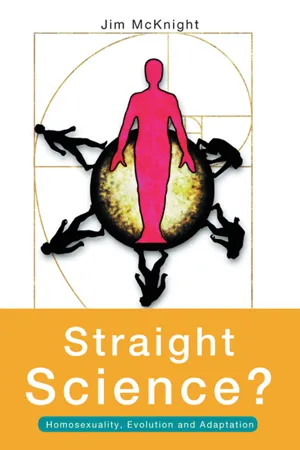
- 232 pages
- English
- ePUB (mobile friendly)
- Available on iOS & Android
eBook - ePub
Straight Science? Homosexuality, Evolution and Adaptation
About this book
Information
Chapter 1
Is male homosexuality adaptive?
The law of evolution has a severe and oppressive countenance and those of limited or fearful mind dread it; but its principles are just, and those who study them become enlightened. Through its reason men are raised above themselves and can approach the sublime.
(Khalil Gibran, The Prophet)
Male homosexuality is a major puzzle for evolutionary theory, for if evolution has a purpose it is reproductive fitness, the passing of our genes to our children. This is our ultimate, if unconscious, reason for existence, as pawns in the grand evolutionary game. Sex that is not reproductive seems to make little sense within an evolutionary framework. Reproductive fitness is a simple and elegant theory. Successful species breed robustly. Natural selection weeds out the less fit and the species prospers. Within a species, if individuals who carry genes for a characteristic breed less, they gradually diminish their genetic representation and their special contribution is lost. Following this argument, over successive generations gay men, who presumably produce less offspring than straight men, should gradually be flushed from the gene pool. Unfortunately for such an elegant theory, this is not the case. Homosexuals were with us through antiquity and, if recent history is any guide, are a robust minority within society. So why hasn’t male homosexuality died out as a less reproductive strain of humanity?
In the literature there are any number of responses to this question and most start by immediately rejecting evolutionary answers. Critics argue that homosexuality is not an innate but rather an acquired behaviour and that Darwinistic interpretations are spurious or ultimately misguided (Halperin, 1990). Other critics will allow the possibility of an innate disposition but argue that homosexuality is so culturally determined that any biological purpose is lost in the sheer variability of a socially constructed behaviour (Thorp, 1992). For these critics, what may have been true of our remote tribal ancestors has been overtaken by modern social realities. What was once homosexuality is not homosexuality now. Even those who allow that homosexuality is a problem for evolutionary theory, and who also assume that a gene for homosexuality exists, argue there is no compelling isomorphism between one’s genes and one’s behaviour. Perhaps these critics are right. Perhaps we choose to be homosexual and learn the right moves during adolescence. Perhaps homosexuality is developmental, a matter of too little testosterone at a critical period of prenatal growth. Perhaps it is just a part of our sexual repertoire and we are all at least a little gay. Clearly there are many ways of characterising homosexuality and the physical act is possibly the least important of these. But to the extent that one’s orientation drives one’s sexual desires the sex act does have profound consequences, so deciding between such alternatives is difficult but important.
Human sexual expression has a complex aetiology. Unfortunately, when our primate ancestors acquired self-consciousness as a survival strategy they also confused the issue by gaining an enhanced repertoire of sexual expressions. Beating the undergrowth for all the myriad ways we humans desire each other is a thankless task and enculturation and our own private experiences loom large in the pattern of our desires if not our orientation. We are also hampered by not having analogous models of homosexuality in our near relatives the great apes, whereby we might explore our own behaviour. To the extent that modern primates other than man are homosexual, such behaviour seems to serve ends only remotely connected with human homosexuality. So with a rising self-consciousness that took us far from our co-evolutionists came a capacity to tinker with the blind forces of evolution. The reasons for human sexual behaviour are now so diverse that it is not easy to tease out the relative contributions that various causative factors might play in one’s sexuality.
While the social constructivist position is still the dominant view within sex research, in the last few years rapid advances in the biosciences have been providing solid evidence for a genetic basis for sexual orientation. Moreover, these advances have shaken complacent notions of homosexuality as a preference and strengthened arguments that it has a genetic substrate. If homosexuality has a genetic basis then we must see it as part of evolution rather than a simple phenotypic variation along the way. A biological basis that has genetic rather than environmental origins requires answers in evolutionary rather than social terms, and returns us to our starting question. For this reason the first task of those committed to a biosocial view of human behaviour is to establish a clear biological/genetic basis for the behaviour. This is the task of Chapter 2.
How then may we explain homosexuality? There are several biological accounts of homosexuality and its origins but unfortunately all have lumps. By way of introducing this fascinating puzzle we will briefly explore the nature of male homosexuality and the problems it poses.
HOMOSEXUALITY, FUTILE SEX?
Many would see homosexuals as poor, benighted individuals who are picking inappropriate sexual targets. A homosexual’s apparent sexual confusion is God-given; an accident; or hormonal; a matter of poor parenting; or simply lack of real sexual outlets—it may even be genetic. Whatever it is, it does not produce children and so is simply futile sex. This view, which equates homosexuality with a sex act, is so simplistic it is nonsensical. Homosexuality is much more than just sex. However, the view’s simplicity has a certain appeal to those who would like to see evolution in equally simple terms: evolution equals children; homosexuality does not equal children; therefore homosexuality is futile sex.
The rub of this argument is that even if we acknowledge a biological component to homosexuality we do not have to acknowledge its usefulness. It may be maladaptive. If for argument’s sake we grant a genetic predisposition to homosexuality then we face several related questions: what is the purpose of a gay gene; how strong is its penetrance; is it adaptive; and most importantly —does it contribute to the reproductive success of the homosexual? We address the majority of these issues in later chapters but the issue of adaptive significance raises immediate problems for a biosocial theorist. To argue that a genetic predisposition exists is not to argue that it is adaptive. Genetic mutation throws up a multitude of deleterious changes for each successful adaptation and it has long been a view in biology that homosexuality is a sexual inversion, or merely a byproduct of evolution, even if genetic in origin. The futile sex view, then, sees homosexuality as misdirected sex. It acknowledges homosexuals are as sexually motivated as heterosexuals but simply choose inappropriate sexual targets. This comfortable assumption, while the dominant view this century, has several problems.
Perhaps the most immediate is that futile or misdirected sex theories of homosexuality say little about the reasons for such misdirection. Too many accounts simply stop with an assertion of futility.
A second problem with the futile sex theory is its constant use to reinforce morality and views of normality. Symons (1979) ruefully observed that with the death of organised religion the basis of morality died too and that Darwinism as its successor has always had to fight off attempts to make it the new morality (see, for examples, Midgley, 1985, 1994; Ruse, 1986). There is much truth in his statement. It is convenient to see heterosexuality as good sex and homosexuality as bad sex but at an evolutionary level such labels mean little. Behavioural geneticists and other interested parties are more concerned with questions of function than normality. ‘Normality’ means nothing in a process that has neither a blueprint nor an end. While this is a trivial difficulty in evolutionary theorising it is of immense importance to the social sciences. Much of the hostility to biological explanations of homosexuality seems a reaction to its moral neutrality, if not indifference to value judgements about sexual behaviour. Clearly, there is much confusion in the literature here. One may say that a behaviour does not lead to an efficient outcome while remaining silent on its worth.
At this point social science and biology sharply diverge. Biologists as scientists qua scientists are interested in the Pandora issue—what’s inside the box? For the biologist science must be neutral even if its usages are questionable. That its usages are often questionable in practice is an entirely separate issue from knowing the facts, and facts must be pursued if for no other reason than intellectual curiosity—an old-fashioned view but one still dominant in the biological sciences. Social science with its less robust grasp of ultimate truth and a more immediate understanding of its own methodological limitations is warier of scientific theorising. Neither the process of knowledge generation nor its usage or dissemination is seen as a morally neutral process. Social science practitioners are suspicious of scientific enquiry and more likely to equate truth, however conceived, with questions of usage. The what and why questions become awfully confused while biology pursues the much clearer how issue. Much of my dissatisfaction with the homosexuality debate flows from this disjunction. Biosocial psychology straddles both the biological and social sciences and wishes to combine the rigour of biological proof with the freedom of social theorising. Much of the opposition to explanations of homosexuality is unhelpful. Surely it is more useful to question assumptions about the futility of homosexuality than to protest against such theorising because it leads to discrimination against homosexuals or even reinforces the prejudices of the enquirers. We will return to these issues in Chapter 5.
Morality notwithstanding, there still remains the assertion that it is futile sex that does not produce children. Yet it is unlikely that homosexuality is just a misdirection of heterosexual impulse. Granted that recorded history is only a moment in evolutionary time and that homosexuality is not part of our fossil record, if a characteristic as seemingly pointless as nonreproductive sex survives for as long as homosexuality has, then it has some significant evolutionary function. If not it would have declined, to become a trivial part of the gene pool. If the incidence of such behaviour is as marked and regular as homosexuality, then it is unlikely that it is a random or spontaneous event. Sheer numbers numbers of homosexuals, cross-cultural similarities, its early onset and its historicity, all argue that homosexuality is significant. Given increasing evidence, we may argue then that homosexuality is either a byproduct of some other adaptive process, or adaptive in its own right. Considering what this adaptive process might be is the major task of this book.
ORIENTATION OR PREFERENCE?
A more fundamental criticism of the futile sex view is the emerging consensus within sex research that we have considerable plasticity in our sexual orientation. Evidence from several studies we review suggests that rather than a bipolar homosexuality-heterosexuality we are all distributed on a continuum of several sexual orientations. In 1948 Kinsey wrote:
Males do not represent two discrete populations, heterosexual and homosexual. The world is not divided into sheep and goats. Not all things are black nor all things white. It is a fundamental of taxonomy that nature rarely deals with discrete categories. Only the human mind invents categories and tries to force facts into separated pigeon-holes. The living world is a continuum in each and every one of its aspects. The sooner we learn this concerning human sexual behavior the sooner we shall reach a sound understanding of the realities of sex.
(Kinsey et al., 1948:639)
This perspective is not new and predates Kinsey. What is new is a growing recognition that our behaviour may be both categorical and continuous. It may well be that there are several discrete homosexualities and that they are all separately distributed on a Kinsey continuum from heterosexuality to homosexuality. There is also growing evidence that some of this variability may be inherited rather than simply a matter of learning or preference. While there are several types of homosexuality (we identify five) we will not consider them all here, rather concentrating on those for which an evolutionary logic is evident. We will return to this at the conclusion of Chapter 2.
Further, there is much confusion in the literature between sexual orientation and sexual preference. How we choose to express ourselves sexually may be quite different from the way nature has made us. A sorry history of gay men passing as straight men is indicative that one’s preference or even how one wishes to be is often not how one is. From a biological perspective a genetic predisposition to homosexuality would be just that, a precursor, or orientation, and no more. Sexual preference on the other hand may well be learned or a matter of personal choice and may even go against one’s nature. While a predisposition does not determine one’s sexual preference it does affect it and when aggregated across a culture will show its influence. Yet for any number of reasons an individual may choose a sexual expression that is at odds with their heredity. In cultures where homosexuality is frowned upon, a homosexual may choose heterosexuality. Such plasticity is not strong evidence for either nature or nurture accounts of homosexuality, merely indicative of human behavioural flexibility. Unfortunately, one’s culture and life experiences are obvious and immediate shapers of sexual expression and it is often easier to give proximate reasons for one’s sexuality than to look for more fundamental reasons. It is part of our purpose here to redress this tendency.
The important point here is that this confusion is more than theoretical. It serves ideological ends. To show that one chooses one’s sexual expression is not necessarily a sufficient explanation of one’s sexuality. A substantial agenda has emerged that equates preference and orientation. This is often deliberate and only points to the shallowness of much theorising about homosexuality. The literature is full of accounts of men who have reluctantly abandoned fulfilling lives as fathers and husbands to acknowledge a driven need to express an orientation which is often confusing and sometimes repugnant to them (Ross, 1983; Malcolm, 1997). More importantly, the variability of sexual behaviour has always been seen as intuitive evidence for a constructivist view of sexuality but it may be argued that it reflects evolution just as well. If we have an innate predisposition to adopt a greater range of sexual expressions then it is relatively easy to argue several ways in which this flexibility is adaptive. Evidence for this view is only indicative at this stage and those in support of a biosocial perspective would not wish to argue nature provides more than a predisposition towards one’s final preference. If it is the case that behavioural plasticity is both innate and adaptive, homosexuality can hardly be considered futile sex. We will return to this question in Chapter 3 but for our present purposes let us not confuse preference with orientation.
HOW MANY GAY MEN AND JUST WHAT IS HOMOSEXUALITY ANYWAY?
Part of the difficulty of accurately assessing homosexuality’s aetiology is we still have little real idea of the extent of homosexuality in our communities. This is partly due to the stigmatisation which keeps a substantial proportion of gay men in the closet but more fundamentally a confusion about the nature and classification of the homosexual experience.
Just what is male homosexuality? As we have already seen homosexuality may be either a preference, or an orientation. It may be enacted or latent, a fantasy, a feeling, or a set of behaviours, or all of these. Would you classify a man of 55 happily married with grandchildren a homosexual if he reported no homosexual contacts but has had a lifelong erotic attraction to men? Kinsey reported that approximately 13 percent of males ‘react erotically to other males without having overt homosexual contacts after the onset of adolescence’ (Kinsey et al., 1948). Is a man who is happily married with children, yet cruises bars and beats for casual homosexual sex homosexual? Weinberg et al. (1994b) found that bisexual men typically experience an erotic attraction to the opposite sex two years before their first attraction to a male. However, they typically experience homosexual contacts a year before engaging in heterosexual sex and on the average first label themselves bisexual at age 27 (and it is worth noting that 25 percent of Weinberg’s sample were still confused about their sexual identity!). Johnson et al. (1994) found in their cohort of 2,051 British men aged 35–44 that while 5.9 percent reported experiencing a homosexual attraction, 8.4 percent had had some homosexual contact, although less than 1 percent had had homosexual sex in the last five years. Johnson’s study as with the others shows that the greatest proportion of homosexual contact occurs in adolescence and then declines as the sample ages. Are adolescents engaging in homosexual sex homosexual or just displaying developmental immaturity?
These and other illustrative examples drawn from the major surveys of sexual behaviour demonstrate the difficulties of defining homosexuality based on feelings, behaviour, or indeed fantasy life. This is further compounded by attempting extensional definitions based on typologies. Just how many gay men are there? How would you begin counting them? If we cannot decide just what is a gay male then we are unlikely to generate a typology with sufficiently discrete categories into which a diverse behaviour may be fitted. This difficulty becomes acute when you consider the sheer variability of any one person’s behaviour—after all variety is the spice of life.
WHAT DO WE KNOW AND WHAT DO WE WANT TO KNOW ABOUT HOMOSEXUALITY?
The way ahead, and this is the only real possibility short of a DNA test for gayness, is to recognise that within the confusion there are similarities of experience and action that might act as medians. There are categories of homosexual behaviour that might be stratified by age, sex, developmental history, fantasies, and sexual behaviour. One of the least helpful approaches is to blur the boundaries of these medians. To do so is to render discussion between viewpoints meaningless. While remaining silent for a moment on its aetiology, much can be said in a short paragraph about homosexuality when adopting this approach: irrespective of type, homosexuality is four times more common in men than women; each seems to be distributed on a continuum from lifelong exclusive homosexuality towards heterosexuality; it is a relatively rare orientation with approximately 1–3 percent of men identifying as exclusively homosexual and having abstained from heterosexual sex over the last five years. Although the rate of homosexual behaviour is highly variable across cultures, 30–40 percent of men have had some homosexual experience; for the vast majority this ends at adulthood. For those whose homosexual experience continues past adolescence, as many men are bisexual as are exclusively homosexual, although the primary orientation of most of these men is heterosexual. While homosexuals and heterosexuals vary markedly in attitudes and behaviour, on the whole they are more characteristically male than female, that is, gayness is a male behaviour.
This brief and no doubt controversial overview will be discussed in glorious detail in this book. But even such a brief account raises many questions and the following list is designed to convince you that it is a topic worthy of exploration. What do we want to know about homosexuality? Perhaps the most important question is, is there a homosexuality or are there different homosexualities? Is homosexuality a preference or an orientation? If just one of these homosexualities has a biological basis what purposes does it serve? Is it adaptive or a byproduct of evolution? If we can find a genetic basis for homosexuality how did it arise and for what purposes? Even more importantly, what maintains this behaviour in the gene pool? Are all men potentially homosexual? Is homosexuality a discrete orientation or is it part of all our natures? Are there mechanisms which might ...
Table of contents
- Cover
- Straight science?
- Title
- Copyright
- Contents
- List of figures and tables
- Preface
- 1. Is male homosexuality adaptive?
- 2. A biology of homosexuality
- 3. Homosexuality as physical evolution
- 4. Homosexuality as social evolution
- 5. The seven deadly sins of sociobiology
- Glossary
- Bibliography
- Author index
- Subject index
Trusted by 375,005 students
Access to over 1.5 million titles for a fair monthly price.
Study more efficiently using our study tools.
Frequently asked questions
Yes, you can cancel anytime from the Subscription tab in your account settings on the Perlego website. Your subscription will stay active until the end of your current billing period. Learn how to cancel your subscription
No, books cannot be downloaded as external files, such as PDFs, for use outside of Perlego. However, you can download books within the Perlego app for offline reading on mobile or tablet. Learn how to download books offline
Perlego offers two plans: Essential and Complete
- Essential is ideal for learners and professionals who enjoy exploring a wide range of subjects. Access the Essential Library with 800,000+ trusted titles and best-sellers across business, personal growth, and the humanities. Includes unlimited reading time and Standard Read Aloud voice.
- Complete: Perfect for advanced learners and researchers needing full, unrestricted access. Unlock 1.5M+ books across hundreds of subjects, including academic and specialized titles. The Complete Plan also includes advanced features like Premium Read Aloud and Research Assistant.
We are an online textbook subscription service, where you can get access to an entire online library for less than the price of a single book per month. With over 1.5 million books across 990+ topics, we’ve got you covered! Learn about our mission
Look out for the read-aloud symbol on your next book to see if you can listen to it. The read-aloud tool reads text aloud for you, highlighting the text as it is being read. You can pause it, speed it up and slow it down. Learn more about Read Aloud
Yes! You can use the Perlego app on both iOS and Android devices to read anytime, anywhere — even offline. Perfect for commutes or when you’re on the go.
Please note we cannot support devices running on iOS 13 and Android 7 or earlier. Learn more about using the app
Please note we cannot support devices running on iOS 13 and Android 7 or earlier. Learn more about using the app
Yes, you can access Straight Science? Homosexuality, Evolution and Adaptation by Jim McKnight in PDF and/or ePUB format, as well as other popular books in Psychology & History & Theory in Psychology. We have over 1.5 million books available in our catalogue for you to explore.