- 392 pages
- English
- ePUB (mobile friendly)
- Available on iOS & Android
eBook - ePub
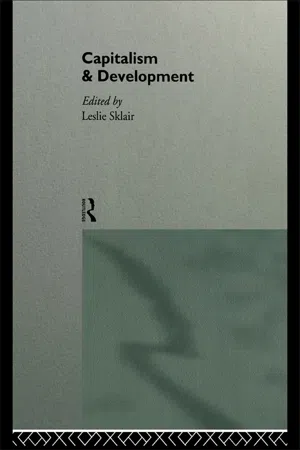
Capitalism and Development
About this book
This collection draws together a distinguished group of authors to explore how capitalism contributes to the development and underdevelopment of the Third World. It provides a superb overview of key concepts such as "capitalism", "development","modernization" and "dependency".
Part I
HISTORIES AND THEORIES OF CAPITALIST DEVELOPMENT
1
DEVELOPMENT
Lodestar or illusion?
Immanuel Wallerstein
There is perhaps no social objective that can find as nearly unanimous acceptance today as that of economic development. I doubt that there has been a single government anywhere in the last 30 years that has not asserted it was pursuing this objective, at least for its own country. Everywhere in the world today, what divides left and right, however defined, is not whether or not to develop, but which policies are presumed to offer most hope that this objective will be achieved. We are told that socialism is the road to development We are told that laissez-faire is the road to development We are told that a break with tradition is the road to development. We are told that a revitalized tradition is the road to development We are told that industrialization is the road to development. We are told that increased agricultural productivity is the road to development We are told that delinking is the road to development We are told that an increased opening to the world market (export-oriented growth) is the road to development. Above all, we are told that development is possible, if only we do the right thing.
But what is this right thing? There is of course no shortage of people who will respond to this query, and respond vigorously, even passionately. If there are protracted revolutionary movements in the world, the underlying drive is to end an oppressive situation. But the other drive that sustains the revolutionaries is the expectation that their victory at the state level will open the door at last to the real development of their country.
At the same time, there has been considerable disillusionment of late with the fruits of past development policies. In China, they talk about the ways in which the Cultural Revolution is said to have blocked for a decade, and so set back, development. In the Soviet Union, they talked about the ways in which bureaucratic rigidities and political errors have changed the economy, and they called for a perestroika. In Africa, they debate what explains the serious worsening of their economic situation since independence and following a ‘decade’, in fact several decades, of efforts to develop. In the United States and Western Europe, they talk about how too large or too inappropriate government involvement in the economic process has hampered initiative and therefore has created a less desirable economic situation than these countries presumably enjoyed previously, or would presumably otherwise enjoy. In all of this grumbling, virtually no one in China or the former Soviet Union or Africa or the United States or Western Europe has challenged either the desirability or the viability of development as an objective. The critics or reformers or whatever they call themselves have merely argued that new and different policies must be adopted to replace those which they assert have failed.
We think of economic development as a post-1945 concept. And it is certainly true that most of our current language, as used by politicians and intellectuals, is a product of the geopolitics of the post-1945 era in the world-system. And it is certainly also true that since 1945 the concept as doctrine has been applied more widely and with greater social legitimation than ever before. But of course the basic idea has much older roots. It seems in fact that its history is concurrent with the history of the capitalist world economy itself. Full-fledged intellectual debates about how countries might be developed were occurring at least as early as the seventeenth century. What else, after all, was at issue in the proposed policies we group together today under the heading of mercantilism?
I should like therefore to review what we know of the history of this capitalist world-economy in order to address five questions:
- Development is the development of what?
- Who or what has in fact developed?
- What is the demand behind the demand for development?
- How can such development occur?
- What are the political implications of the answers to the first four questions?
Then, and only then, will I come to the question in my title: is development a lodestar or an illusion?
Development is a word that has two different connotations. One is the reference to the processes of a biological organism. From little acorns do giant oaks grow. All organic phenomena have lives or natural histories. Somehow they begin; then they grow or develop; eventually they die. But, since they also reproduce, the death of a single organism is never the death of the species.
The presumed socioeconomic analogy is clear. Nations or states or societies somehow (and somewhere) begin; then they grow or develop. The rest of the analogy, however, is rarely pursued. There are few discussions of the likelihood that these entities will eventually die, or that the species will survive via a process of reproduction. We might wonder why the analogy is not pursued to its fullest, and why all our attention is concentrated on whatare taken to be the normalities or abnormalities of the middle segment of the sequence, the presumed growth process.
One reason may be that development has a second connotation, more arithmetic than biological. Development often means simply ‘more’. In this case, we are making an analogy not to an organic cycle but to a linear, or at least monotonic, projection. And of course linear projections go to infinity. Now, infinity is fair away. But it is there, and it is always possible to imagine more of something. This is clearly very encouraging as a social possibility. Whatever we now have some of, we might have more of tomorrow.
Of course, infinity is also quite terrifying. Infinity is in a very real sense a void. Endlessness is not everyone'S cup of tea. There is an entire literature of clinical psychology about the ways in which human beings need to bound their universes, to create an environment of manageable scale, one which therefore offers a reasonable possibility that it is somewhat controllable. Durkheim'S discussion of anomie is another version of the same argument Here, however, we come immediately upon a social relativity. In a set of groups which are located on a scale in terms of quantity of possessions, and which are all seeking more, those groups at the top end of the scale have only the void before them, whereas groups who are at the bottom are bounded by groups above them. So while some may face the uncharted prospects of seeming endlessness, others are clearly facing primarily the more manageable project of ‘catching up’ those who already have more.
There is a further element in the picture, as we all know. There are good times and there are bad times, periods of boom and periods of bust or at least of stagnation. The social interpretation of good and bad times tends to be quite straightforwardly relational. Good times are those moments in which we think we have more than previously. Bad times are those in which we think or fear we have less. If then we distinguish between groups at the high end of the scale of possessions and those at the low end, economic expansion and contraction present different pictures. Those at the high end to be sure have the comfort of being at the high end. They may however in times of expansion fear the void and in times of contraction fear that they will no longer be at the high end. Those at the low end start from the base knowledge of their relatively low level of material reward. Expansion then may open up the optimistic hope of immediate absolute improvement and relative middle-term catching up. Contraction offers on the other hand the gloom of decline from an already low level.
It seems to me therefore not hard to understand why people feel so passionately about development and oscillate so rapidly among alternative schemata for realizing development. Development as the achievement of ‘more’ is the Promethean myth. It is the realization of all our libidinal desires. It is pleasure and power combined, or rather fused. The desire lies within all of us. What the capitalist world-economy as an historical system has done is to make these desires for the first time socially legitimate.‘Accumulate, accumulate!’ is the leitmotiv of capitalism. And in fact, the scientific-technological output of this capitalist system has created some widely visible spectacles of significant accumulation, and an impressive consumption level for about 10 to 20 per cent of the world'S population. In short, the realization of the dream of endless accumulation has come to be not merely legitimate but to seem in some sense plausible.
At the same time, as living beings, we are all too conscious of the problem of death, and suffering. We are all aware that if some consume much, most do not We are all equally aware that consumption is a present-oriented activity, and that in the future we shall not be there to consume. Those who consume well tend to draw the organismic implication that not only they as individuals but the groups of which they are a part will one day ‘decline’. In short, they are faced with ‘civilization and its discontents’.
However, although the controversies concerning development have deep resonances in the collective social psychologies (or mentalities) bred by historical capitalism, the basic issue is not psychological but social. The fact is that historical capitalism has been up to now a system of very differential rewards, in both class and geographic terms. As an empirical fact, this seems to me uncontestable, whether or not we think it theoretically inevitable or historically enduring.
Yet it is also the case that if we look at the various geographical-juridical zones that are today sovereign or potentially sovereign states, some are uncontestably better off than they were at previous moments in the history of the capitalist world-economy, whether the comparison is made between a given state today and that same state (more or less) 50 or 100 or 300 years ago, or the comparison is made between a given state'S ordinal ranking in GNP per capita and the ordinal interstate rank level of the same state 50 or 100 or 300 years ago. This is usually what we mean when we say that a given state, say the United States or Sweden, has ‘developed’. It is ‘better off’ materially and (many would argue) politically (expansion of civil rights etc.).
Who then has really developed in this sense? At one level the answer is easy. What we mean by the locutions, ‘developed’ and ‘underdeveloped’ countries, as they have come to be used in the last 30 years, is precisely the list of those who have ‘developed’ (or not) in either or both senses I spelled out above over the past 50 to 300 years. Generally speaking, we think of the countries of Western Europe plus Japan as the members of that list of ‘developed’ countries. We think of the so-called Third World as constituting the list of underdeveloped countries. The former socialist countries of Eastern Europe present the most controversial category in terms of either comparison: where they are today in relation to where they were; and where they stand in an ordinal ranking today compared to formerly. Analysts do not agree on what the basic economic measurementsshow and/or on whether these measurements are valid indicators for the socialist countries. What then do we know of the pattern of ‘national development’ within the framework of the capitalist world-economy prior to 1945? I believe there are a number of things we can say today with some clarity.
One, a capitalist world-economy began to form centred on the European continent in the sixteenth century. From the beginning, this involved the establishment of integrated production processes we may call commodity chains. These commodity chains almost all tended to traverse the existing political boundaries. The total surplus extracted in these commodity chains was at no point in time distributed evenly in terms of the geographical location of the creation of the surplus, but was always concentrated to a disproportionate degree in some zones rather than in others. We mean by ‘peripheries’ those zones that lost out in the distribution of surplus to ‘core’ zones. Whereas, at the beginning of the historical process, there seemed little difference in the economic wealth of the different geographical areas, a mere one century'S flow of surplus was enough to create a visible distinction between core and periphery in terms of three criteria: the accumulation of capital; the social organization of local production processes; the political organization of the state structures in creation.
Thus, by 1600 we could already say three things about the emergent peripheral zones (such as East Central Europe and Hispanic America) compared with the emergent core zones in Northwest Europe. The per capita consumption was lower. The local production processes used labour that was more coerced and received less real income. (This was of course a major reason why per capita consumption was lower.) The state structures were less centralized internally and weaker externally. It is crucial to note that while all three statements were true by 1600, none had been true as of 1450. The three empirical truths were the consequence of the operation of the capitalist world-economy.
Second, the mode of obtaining a larger proportion of the surplus was the relative monopolization of some segment of the commodity chain. The monopolization could occur because of some technological or organizational advantage which some segment of the producers had or because of some politically enforced restriction of the market Whatever was the source of monopolistic advantage, it was inherently vulnerable. Others could over time try to ‘copy’ in one way or another the technological or organizational advantage or try to undermine the politically enforced restrictions of the market. This of course was the constant desire of producers who received less than others of the overall created surplus.
The vulnerability of historically temporary monopolizations was real. The advantages were constantly under attack—within states and between states. The eighteenth-century concern with the ‘wealth of nations’ was simply one ideological expression of the interest that producers had in maintaining or creating their own monopolistic advantages and undermining those of others. What we call mercantilism was simply one organized method of this struggle, in which producers whose abilities to corner surplus were somewhere in the middle rank sought to use the state structures in which they were influential to undermine economically stronger rivals, located in other state structures.
The recurring problem of ‘overproduction’ relative to any existing market, which regularly led to stagnations in the world-economy, was similarly the result of new producers jumping on a bandwagon of highly profitable goods and undermining monopolistic advantage by the expansion of total production. Whereas mercantilist policies sought to overturn existing advantage through political mechanisms, entry into production undermined advantage via the market. The net result could be the same, an...
Table of contents
- COVER PAGE
- TITLE PAGE
- COPYRIGHT PAGE
- FIGURES
- TABLES
- CONTRIBUTORS
- PREFACE
- PART I: HISTORIES AND THEORIES OF CAPITALIST DEVELOPMENT
- PART II: SECTORAL STUDIES
Trusted by 375,005 students
Access to over 1.5 million titles for a fair monthly price.
Study more efficiently using our study tools.
Frequently asked questions
Yes, you can cancel anytime from the Subscription tab in your account settings on the Perlego website. Your subscription will stay active until the end of your current billing period. Learn how to cancel your subscription
No, books cannot be downloaded as external files, such as PDFs, for use outside of Perlego. However, you can download books within the Perlego app for offline reading on mobile or tablet. Learn how to download books offline
Perlego offers two plans: Essential and Complete
- Essential is ideal for learners and professionals who enjoy exploring a wide range of subjects. Access the Essential Library with 800,000+ trusted titles and best-sellers across business, personal growth, and the humanities. Includes unlimited reading time and Standard Read Aloud voice.
- Complete: Perfect for advanced learners and researchers needing full, unrestricted access. Unlock 1.5M+ books across hundreds of subjects, including academic and specialized titles. The Complete Plan also includes advanced features like Premium Read Aloud and Research Assistant.
We are an online textbook subscription service, where you can get access to an entire online library for less than the price of a single book per month. With over 1.5 million books across 990+ topics, we’ve got you covered! Learn about our mission
Look out for the read-aloud symbol on your next book to see if you can listen to it. The read-aloud tool reads text aloud for you, highlighting the text as it is being read. You can pause it, speed it up and slow it down. Learn more about Read Aloud
Yes! You can use the Perlego app on both iOS and Android devices to read anytime, anywhere — even offline. Perfect for commutes or when you’re on the go.
Please note we cannot support devices running on iOS 13 and Android 7 or earlier. Learn more about using the app
Please note we cannot support devices running on iOS 13 and Android 7 or earlier. Learn more about using the app
Yes, you can access Capitalism and Development by Leslie Sklair in PDF and/or ePUB format, as well as other popular books in Economics & Development Economics. We have over 1.5 million books available in our catalogue for you to explore.