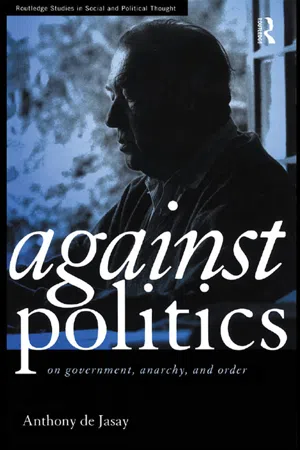
Is the state a necessity, a convenience, or neither? It enforces collective choices in which some override the preferences and dispose of the resources of others. Moreover, collective choice serves as its own source of authority and preempts the space it wishes to occupy. The morality and efficacy of the result are perennial questions central to political philosophy.
In Against Politics Jasay takes a closely reasoned stand, based on modern rational choice arguments, for rejecting much of mainstream thought about these matters. In the first part of the book, Excuses, he assesses the standard justification of government based consent, the power of constitutions to achieve limited government, and ideas for reforming politics. In the second part, Emergent Solutions , he explores the force of first principles to secure liberties and rights and some of the potential of spontaneous conventions for generating ordered anarchy.
Written with clarity and simplicity, this powerful volume represents the central part of Jasay's recent work. Fully accessible to the general reader, it should stimulate the specialist reader to fresh thought.
- 256 pages
- English
- ePUB (mobile friendly)
- Available on iOS & Android
eBook - ePub
About this book
Information
Part I
Excuses
1
Self-contradictory contractarianism*
Can it be rational to will the state?−or to will it away? Why societies need states, and if they do, what kind of state meets their need, remains an evergreen quandary that each generation has been pondering anew, often with some passion. That this should have been the case is perhaps odd, considering that societies and states live much like Siamese twins, or so we perceive them. Our current usage of the two words “society” and “state” is revealing: a society would not be fully fledged, complete, and deserving of the name if it lacked a state of its own. It is probably a sound conjecture that if we nevertheless keep questioning the nature and necessity of the link and keep producing justifications for it, it is because of the discomfort we feel in the face of two of its attributes that seem to clash.
One is that this link forces us, sometimes with great severity, to do what we would not freely choose to do and to forbear from what we would choose. It is doing so, not at some finely drawn moral margin, but over a major part of our feasible choices. In particular, it takes the lion′s share of individually earned and owned resources and uses them in ways that the individual in question would not have chosen, for otherwise there would be no call for choosing them collectively. The other is that all this seems, in some more or less obscure manner, legitimate: the state′s force weighs on us with our consent, and we could not reasonably want to have it otherwise.
One is that this link forces us, sometimes with great severity, to do what we would not freely choose to do and to forbear from what we would choose. It is doing so, not at some finely drawn moral margin, but over a major part of our feasible choices. In particular, it takes the lion′s share of individually earned and owned resources and uses them in ways that the individual in question would not have chosen, for otherwise there would be no call for choosing them collectively. The other is that all this seems, in some more or less obscure manner, legitimate: the state′s force weighs on us with our consent, and we could not reasonably want to have it otherwise.
The clash, which seems tantamount to masochism in the individual and to a dilemma of coexistence in the group, has been reconciled time and time again by successive versions of social contract theory; yet the discomfort subsists, and explanations-cum-justifications of the state are renewed in ever more sophisticated and elegant forms, lately somewhat clarified by game and decision theory.
Three main reasons tend to be invoked for why the state of nature, in the sense of an attempt by large groups of people to interact to mutual advantage without recourse to a sovereign state, is not viable or is at least wastefully inefficient.
- * This chapter was originally published in For and Against the State edited by J.T. Sanders and J.Narveson (1996) Lanham, MD: Rowman & Littlefield. Reprinted with permission.
The first is that whenever individual benefits from a common enterprise are not directly proportional to the individual contributions,1the assumption of burdens and the distribution of the resulting benefits is potentially conflictual. It is possible for some to get a better deal if others get a worse one. In such situations, the cost and incentive structure of social cooperation has the makings of a prisoner′s dilemma: it is good if all contribute and benefit, but it is better for each to benefit more and contribute less, and best of all for each to contribute nothing. Rational men dispose accordingly. They do not contribute, do not fulfill their promises to contribute, and default on agreements providing for reciprocal contributions. There will thus be no systematic cooperation among them without the systematic and putatively impartial use of force, or its threat, to enforce reciprocal promises. Any entity that has the will and the authority backed by overwhelming force to perform this function is a state. (Needless to say, the argument does not imply that a state is, nor that it can in theory or in practice possibly be, limited to this function.)
Under the same heading, it is also said that if agreements could not be enforced, then there also could be no agreement on how to divide the fruits of cooperation and division of labor. Income distribution is a function of factor ownership; unless property rights in (nonhuman) factors of production are first agreed, the distribution of the surplus because of cooperation is subject to a bargaining problem, which may not be soluble. Before cooperation, the division of labor, and “the market” become possible, therefore, the state must define property rights, that is, decide who owns what.2
The second reason calling for the state is that if, in spite of the first reason, cooperation is nevertheless possible, then so is free riding on the back of it, and both burdens and benefits will be “unfairly” distributed unless the state prevents this.
The third reason that is frequently cited, though no rigorous argument supports it, is that even assuming systematic and universal cooperation, successful bargaining about the resulting surplus, and no free riding in the ordinary sense, a distribution of net benefits could still emerge that may not be just or, since the justice of distributions is in the eye of the beholder and cannot be ascertained in the same way as matters of fact can be, would not be felt just by a substantial part of society. This would put sustained cooperation in jeopardy. To save it, the state must−and only it can −bring about the redistribution that engenders the required degree of social cohesion.
Only the first of these reasons is really decisive. The case for the necessity of the state, derived from rational-choice theory alone, stands or falls with it. The others, and their numerous progeny that crop up in political agendas, are either derivatives of it or, if they have independent status (e. g., problems of fairness), are not intersubjectively valid. If the first reason for the state does not hold, it must generally at least be possible, though not assured, to realize mutual advantage and overcome social dilemmas (nperson games whose dominant equilibrium is Pareto-inferior, for example, the “war of all against all,” or the “tragedy of the commons”) by agreement. For the divergence between what is rational for any individual player and for all the players taken collectively springs from the irrationality of relying on mutually beneficial reciprocal promises if it is indeed the case that breaking the promise secures a better outcome (“payoff) for any party, whatever the other parties to an agreement may choose to do. Contracts, then, are never willingly honored. Now, if promises are kept and agreements do bind, any collectively rational outcome, that is, any interaction whose effect, including any negotiable externalities, is at least weakly Pareto-superior to its next-best alternative, can ultimately always be brought about by a contract whose execution is assured, that is, one which it is individually rational to conclude.
The only interactions that could not be contracted for and required the intervention of the state would be ones whose effects on the parties were Pareto-noncomparable, good for some but bad for others. Here, the state would be needed, not because contracts do not bind, but because if they do bind, the prospective losers would refuse to enter them. Imposing the Pareto-noncomparable solution just the same by the threat of force is to be deemed good, to be carried out and commended, if the bad of the losers is deemed smaller than the good of the gainers from the interaction.
This is, of course, not a question of fact, but a value judgment calling for, and intended to justify, controversial political action. It may have merit, but it is not intersubjectively defensible.
This is, of course, not a question of fact, but a value judgment calling for, and intended to justify, controversial political action. It may have merit, but it is not intersubjectively defensible.
If contracts do bind, however, it is never very obvious why any change that is Pareto-superior should not become the equilibrium solution of a cooperative game, why the costliness (“transactions cost”) of such solutions should be an obstacle as long as they still yield a net benefit that is divisible, and why coercive arrangements requiring the maintenance of a state are expected to be, all in all, less costly and more efficient than voluntary ones. Whichever way we turn the various supports that have been provided for the body of theories that explain why it is rational to have the state, only the problem of keeping promises is crucial and indispensable.
Thus bridges are built; harbours open′d; ramparts rais′d; canals form′d; fleets equip′d; and armies disciplined; every where, by the care of government, which, tho’ composed of men subject to all human infirmities, becomes, by one of the finest and most subtle inventions imaginable, a composition, that is, in some measure, exempted from all these infirmities.3
In thus ending the famous passage of the Treatise where two neighbors agree to drain a meadow, Hume certainly does not seek to belittle the blessings of government, nor does he directly rule out the idea that its invention, even if in historical fact it was not, could have been inspired by the good its subjects expected to reap from their subjection to it and the harm they trusted it to protect them against. His “Of the Original Contract”4 is not really concerned with what could or could not have been agreed, but rather with what was not−a flank attack to which contractarianism, with its “as if” reasoning, is arguably not vulnerable. More central and more deadly to the theory of the state as an instrument that rational men would have chosen is his account of what comes first, the possibility of binding agreements or the state as their enforcer.
This is the parting of the ways between Hobbes and Hume. The latter is categorical in asserting that the great enabling conditions of civilization are prior to the state, rather than being interdependent with it, let alone being brought about by it: “the stability of possession, its translation by consent, and the performance of promises…are, therefore, antecedent to government.”5Nothing in Hume suggests that political authority, however fine and subtle an invention it may be, is one that rational men would will and could not reject on pain of ceasing to be rational. On the contrary, he has no doubt that obedience to the government is the effect, and not the cause, of justice, where justice is defined as the due performance of promises,6 yet, if agreements bind prior to the state, how can the imperative need for it arise?−as distinct from the question of how states in history actually arose, and why they are obeyed once they have arisen.
For Hume, the evidence shows state power to be exogenous to society, springing “from quarrels, not among men of the same society, but among those of different societies,”7it originates “in usurpation or conquest,”18 is obeyed by habit and domesticated by continuity. There is evidence to show neither that it is endogenous nor that it is an indispensable element of any viable society. If there were evidence, or if deductive proof were possible, social contract theory would long ago have become uncontroversial, a stagnant backwater.
In fact, we have no firm clue to what good the state is a necessary condition of. If, for rational men, keeping onerous promises is dominated by breaking them, it could follow that some kind of protostatal authority is needed for a benign social order, but the premise of promise breaking is neither a conceptual truth residing in the nature of promises nor entailed in expected utility maximization or any other, perhaps less demanding, form of rationality. It is contingent on the facts of the case, and inferences from it may grossly fail to hold in the most prevalent and important social settings. It is an empirical fact that the state does stand ready to enforce onerous promises of a certain (“legal”) kind; hence, the question of “anarchic” compliance does not arise, and if hypothetically it did, it could not be answered. It cannot sensibly be argued that the reason why the state
enforces certain promises is that otherwise they would be broken, for we can only speculate about what would happen if there were no state (or, as in certain societies where it has recently collapsed, there were just the memory of one, preserved in broken-down institutions, lost virtues, and perverted social habits). We do see a historical regularity−one state to one society most of the time−but it would be abject functionalism to believe that this proves anything about the necessity or efficiency of the link between them. It is on the strength of this historical conjunction that many inductive claims about the state as a defining feature of civilization have been advanced. They are worth what induction is worth. Failing a more compelling deductive ground, Hume′s step of conceding legitimacy to the state on conventional grounds is conceding plenty.
Contractarian theory is vastly more ambitious, seeking as it does to find a ground for legitimacy that, if established, would be nearly unassailable, without having to concede anything to resigned acquiescence, unthinking convention, and force of habit. Its ground is that since a possible society endowed with a state can be shown, on commonly agreed criteria of rationality, to be preferable to all other possible ones that lack a state, it is as if the society-cum-state had been chosen by unanimous rational agreement. If this argument stands up, it is of course immaterial that it has not in fact been chosen, but by courtesy of exogenous events has helpfully arisen in time, without having to be chosen in the first place.
To sustain such an audacious argument is to go out on a long limb. Attempts to see whether it will break have not, I think, been well fitted to the purpose. Such attempts have tended to find that it will bear, variously, a liberal, a Lockean, or a minimal state. These findings presuppose the possibility of agreement and then find a plausible set of terms on which to agree. To presuppose the possibility, however, is to suppose the hardest logical test already withstood. Testing the limb one more time, without this tacit presupposition, is the main object of the present chapter.
Curiously enough, at the base of contractarian theory we find no such presupposition. On the contrary, it is the very impossibility of agreement that creates the need for agreement−a paradox whose putative resolution along the road bears watching. The base is formed by Hobbes′s two cardinal propositions. The first asserts that though it is better for all to have peace, it is better still for each to invade the property of the other with the result that all will be at war−a recognizable prisoner′s dilemma situation, where the individually rational choice leads to a collectively irrational outcome. The second proposition is that mutually contingent promises are irrelevant and might as well not be made: “covenants… are vain breath.” Without the second proposition, the first would lose its effect, for prisoners’ dilemmas could always be evaded by mutually agreeable binding agreements.
Since all are aware of the force of the second proposition, and since the outcome, peace, which it renders inaccessible, is at least weakly preferred by each (i.e., “collectively rational”) to the accessible equilibrium outcome, war, it is individually rational for all to reach for what appears to be an obvious instrument obviously within reach that will render accessible the peace that is collectively rational.
This instrument, the sovereign state, may be specified in the Hobbesian or the Lockean manner; the former deals with the necessary and the possible, the latter with the desirable and the commendable. These differences need not concern us at our level of inquiry. Whichever specification is adopted, enough features remain in common for the instrument to qualify as a state−to put it briefly, the common consent to found one if it does not yet exist, and to accept it as legitimate if it does.
This argument is going too well and too fast for its own lasting good and could do with a mild challenge and a brief halt before proceeding. For it may be questioned whether, in the Hobbesian paradigm and its diverse formulations, it is really individual rationality that opposes the collective one and must be overridden or rather its lack or its submersion under the weakness of will and the strength of the passions. The latter, in particular, is a widely favored reading of Hobbes.9 Like many of the other classics, Hobbes′s theory contains inconsistent elements. His reasoning exposing the “Foole,” in particular, thoroughly undercuts the whole case he makes for wanting and accepting a sovereign. Since the Foole is demonstrably irrational or at least a fool, and since it is demonstrably best for each, individually, to respect “covenants without the sword,” rational men can freely covenant with one another to keep the peace or jointly to adopt any other cooperative strategy they see fit; they have no use for the Leviathan unless it is to protect them from irrational ones and fools; but wouldn′t that be cracking nuts with a steam hammer? I shall leave this question to one side for now.
Other inconsistencies, though of lesser import, are more obscure. Jean Hampton painstakingly explores most of them.10 One, the role Hobbes sometimes assigns to the passions, however, can bear some further observation. It seems to me a mistake to equate the Hobbesian “passions” of fractiousness, eminence, and glory seeking with irrationality and to oppose them to the other, presumably rational, Hobbesian project of preemptively invading another′s property as the best strategy for selfpreservation. Glory, eminence, and self-preservation are alike in that they all function as final, noninstrumental ends. (If they could be shown not to be final, we could always put in their place the even more final ends with respect to which they were ...
Table of contents
- COVER PAGE
- TITLE PAGE
- COPYRIGHT PAGE
- INTRODUCTION
- PART I EXCUSES
- PART II EMERGENT SOLUTIONS
Trusted by 375,005 students
Access to over 1.5 million titles for a fair monthly price.
Study more efficiently using our study tools.
Frequently asked questions
Yes, you can cancel anytime from the Subscription tab in your account settings on the Perlego website. Your subscription will stay active until the end of your current billing period. Learn how to cancel your subscription
No, books cannot be downloaded as external files, such as PDFs, for use outside of Perlego. However, you can download books within the Perlego app for offline reading on mobile or tablet. Learn how to download books offline
Perlego offers two plans: Essential and Complete
- Essential is ideal for learners and professionals who enjoy exploring a wide range of subjects. Access the Essential Library with 800,000+ trusted titles and best-sellers across business, personal growth, and the humanities. Includes unlimited reading time and Standard Read Aloud voice.
- Complete: Perfect for advanced learners and researchers needing full, unrestricted access. Unlock 1.5M+ books across hundreds of subjects, including academic and specialized titles. The Complete Plan also includes advanced features like Premium Read Aloud and Research Assistant.
We are an online textbook subscription service, where you can get access to an entire online library for less than the price of a single book per month. With over 1.5 million books across 990+ topics, we’ve got you covered! Learn about our mission
Look out for the read-aloud symbol on your next book to see if you can listen to it. The read-aloud tool reads text aloud for you, highlighting the text as it is being read. You can pause it, speed it up and slow it down. Learn more about Read Aloud
Yes! You can use the Perlego app on both iOS and Android devices to read anytime, anywhere — even offline. Perfect for commutes or when you’re on the go.
Please note we cannot support devices running on iOS 13 and Android 7 or earlier. Learn more about using the app
Please note we cannot support devices running on iOS 13 and Android 7 or earlier. Learn more about using the app
Yes, you can access Against Politics by Anthony De Jasay in PDF and/or ePUB format, as well as other popular books in Politics & International Relations & Political Philosophy. We have over 1.5 million books available in our catalogue for you to explore.