- 272 pages
- English
- ePUB (mobile friendly)
- Available on iOS & Android
eBook - ePub
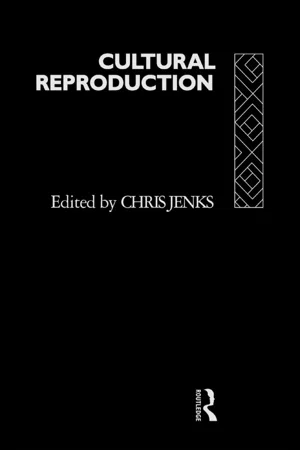
Cultural Reproduction
About this book
The idea of cultural reproduction was first developed by Bourdieu (1973) who sees the function of the education system as being to reproduce the culture of the dominant classes, thus helping to ensure their continued dominance. Through his concepts of cultural capital' and habitus' Bourdieu's influence spread into other areas of socialization and high culture. However, despite the complex of influences that contribute to Bourdieu's method, sociologists of culture and students of cultural studies seem to have picked up on the negative and critical elements in the work. In particular, they developed the metaphor of reproduction as copy or imitation rather than reproduction as regeneration and synthesis. As a consequence cultural reproduction' has become part of the orthodoxy of studies in the theory of ideology and neo-Marxisms. While still addressing this well established theme of ideology and structural determinacy in cultural reproduction theory, this collection of original essays seeks also to explore other possibilities, in terms of ethnomethodology, Durkheimianism, structuralism and post-structuralism. Many of the arguments put forward also confront the most contemporary challenges presented by postmodernism. The papers address an unusually wide spectrum of cultural formations including gender roles, fine art, film, journalism, education, consumerism, style, language and sociology itself. The introduction discusses the origin and development of the concept of cultural reproduction and shows the variety of analytic possibilities within several traditions of social theorizing, all later expanded in the body of the text. Most of the contributors are academics working in the area of sociology of communication studies. All of them have taught in and have continuing research interests in the sociology of culture and cultural studies.
Information
1
INTRODUCTION
The analytic bases of cultural reproduction theory
Chris Jenks
‘Cultural reproduction’, though currently not a fashionable concept, is a particularly fertile area for social theory which this volume seeks to revivify. The idea of cultural reproduction makes reference to the emergent quality of experience of everyday life-albeit through a spectrum of interpretations. That is to say that the concept serves to articulate the dynamic process that makes sensible the utter contingency of, on the one hand, the stasis and determinacy of social structures and, on the other, the innovation and agency inherent in the practice of social action. Cultural reproduction allows us to contemplate the necessity and complementarity of continuity and change in social experience.
Although this zone of concern has been a permanent preoccupation of social theorising since its inception the modern critical conceptualisation of the problem, around the concept of cultural reproduction, was first developed by the French sociologist and cultural theorist Pierre Bourdieu in the early 1970s. The initial empirical context of Bourdieu’s work was education in modern society: he saw the function of the education system being to ‘reproduce’ the culture of the dominant classes, thus helping to ensure their continued dominance and to perpetuate their covert exercise of power. Such ideas resonated with Althusser’s notions of ‘ideological state apparatuses’ which were emerging about the same period. Through his central concepts of ‘cultural capital’ and ‘habitus’ Bourdieu’s own work and his influence upon the research of others spread into an examination of other areas of concern such as socialisation, high culture and artistic practice, and style and mannerism in social relations. I will expand on these and other of Bourdieu’s ideas later in this chapter.
At this stage, in terms of the history of ideas, it is both interesting and important to note that despite the complex of traditions and influences which contribute to Bourdieu’s method of analysis the British tradition of the sociology of culture and cultural studies seems to have picked up on and crystallised around the largely negative and critical elements of the thesis. To this end the majority of contributions to this field have developed the metaphor of reproduction as copy or imitation rather than as regeneration or synthesis. As a consequence Cultural reproduction’ has become subsumed under the orthodoxy of studies in the theory of ideology and neo-Marxisms.1–3 Other different and significant bodies of work continued to develop the positive side, such as Bernstein’s extended studies of the role of socio-linguistic codes in revealing the character of the relation between the social structure and the symbolic order, and Cicourel’s research into cognitive sociology which revolved around the acquisition of interpretive procedures. Despite these important initiatives, and others, the central concept of cultural reproduction has become seemingly highjacked.
While still addressing the well-established theme of ideology and structural determinacy in cultural reproduction theory, the collection of essays gathered here endeavours to open up other possibilities from a variety of perspectives less familiar in this area of study like, for example, reflexive sociology, Durkheimian sociology, ethnomethodology, structuralism and post-structuralism. Inevitably, given the historical-intellectual context of our work, many of the arguments put forward also confront the most contemporary challenges presented by postmodernism.
Substantively, the chapters address an unusually broad sweep of cultural formations including gender roles, visual art, mass communication, consumerism, education, film, philosophy and language itself. All the chapters attest to the analytic character of their topic: they aim to theorise the field and not leave it to a supposed saturation by ethnography—what Parsons once referred to as an attempt to construct reality through a ‘mosaic atomism’—description serves, then, largely to adorn the work.
All sociological explanations begin with some concept of structure which, following Durkheim, appears as typical to all societal members; that is, it stands as the normal, the mundane, it has a series of taken-for-granted manifestations. Structure is also constraining upon the conduct of members either overtly or, more successfully, through a network of covert strategies. Finally,structure is to be recognised as ultimately independent of the will or caprice of particular individuals. It is, then, a determinate form, intangible but real, and always real in its consequences. Structure provides the supra-individual source of causality in sociological reasoning whether it is experienced by members (or constituted by theorists) as economic, political, moral, cognitive or even physical in its orientation. From these various conceptions (or formulations) stem the dynamics in social theory that we might call process. Culture and particularly cultural reproduction are precisely dynamics that we would gather within this notion of process. Indeed, the idea of culture emerges from the noun ‘process’, in the sense of nurture, growth and bringing into being—in fact, to cultivate in an agricultural or horticultural sense.4 Culture, as process, is emergent, it is forthcoming, it is continuous in the way of reproducing, and as all social processes it provides the grounds and the parallel context of social action itself.
Any social action, within sociology, appears not in isolation but rather depends upon its context or a sense of competence for its meaning. In this way it stands as an index of the social occasion from which it arose.5 Action therefore inevitably relates back to the original, but perhaps unspoken, social structure for its coherence and intelligibility. Two important points emerge from this exposition: firstly, that sociology has a perpetually ambivalent relationship with the centrality and efficacy of subjectivity—selves become movements within culture or parts of cultural units—and secondly, that sociology appears to generate one sense of a causal chain, but what we have essentially is a teleology, a circuit of explanation.
Perhaps the most significant analytic point is that the patterning of the modalities structure, process and social action is not descriptive, although in some epistemological guises, like, for example, positivism, it passes itself off as if it were wholly descriptive. But I repeat, this patterning is not descriptive, rather it is metaphoric. The metaphors become our analytic topic. Those cultural signs or conventions as metaphors become our topic. Our choice of metaphors and our choice through cultural metaphors expresses our interests, our intentions and our moral relation to the world. Nietzsche tells us that ‘truth is nothing but the solidification of old metaphors’. The use of different metaphors in our analysis displays our attitude to a knowledge of the social world; it reveals our vision and that also of our tradition. It is, or should be by now, commonplace to attend critically to the invocation of the masculine form ‘man’ to summon up images of all human kind in Western reason though perhaps less routine to acknowledge the empiricist legacy of the centrality of the senses, particularly vision, in much social theory that ‘looks at’, ‘sees’ and specifically ‘observes’ its phenomena. We may note further the technical and commercial metaphoricity that has permeated much contemporary sociology, even in the often bureaucratic prose of such theorists as Habermas when he is, ironically, levelling a critique at the penetration of the discourse of science and technology into the life-world thus militating against a free democracy. Therefore different metaphors unconsciously, or in the case of reflexive theorising consciously, display our varieties of moral commitment and thus our different perspectives on social life. In this gathering of ideas, in this process of signification, our central metaphors are ‘culture’ and ‘reproduction’, and to play with these metaphors, seriously, as Merleau-Ponty might recommend, is to liberate their potential into the range of interpretations that this collection of writings displays, and beyond.
We have already introduced culture in relation to process and growth—culture is becoming. But we also need to know what is culture as distinct from society, or do the terms duplicate? Malinowski6 tells us that culture is ‘…inherited artefacts, goods, technical process, ideas, habits and values’. He included within his definition a notion of social structure which, he felt, could not be understood apart from culture. He further states that culture ‘… obviously is the integral whole consisting of the implements and consumer goods, of constitutional charters for the various social groupings, of human ideas and crafts, beliefs and customs’, and he continues that ‘…the essential fact of culture as we live it and experience it, as we observe it scientifically, is the organisation of human beings into permanent groups’.
Firth,7 another eminent anthropologist, distinguishes firmly between social structure and culture and defines the latter as ‘… the component of accumulated resources, immaterial as well as material, which a people inherit, employ, transmute, add to and transmit; it is all learned behaviour which has been socially acquired’.
Bottomore8 concludes my inventory of definitions with the proposition that ‘By culture we mean the ideational aspects or social life, as distinct from the actual relations and forms ofrelationship between individuals; and by a culture the ideational aspects of a particular society’.
The concept of culture, then, implies a relationship with the accumulated shared symbols representative of and significant within a particular community—a context-dependent semiotic system. Culture, however, is not simply a residue, it is in progress; it processes and reveals as it structures and contains. Culture is the way of life and the manner of living of a people. It is often conflated with the idea of high culture, but this is an understanding both too restrictive and too exclusive, yet high culture is our topic also.
What now can we make of this concept ‘reproduction’? A phenotypical reading of the term, or what I have previously referred to as a ‘negative’ definition, invokes all of the modern and sterile resonances of mechanicism and technicism, it speaks of a crafted or rather fashioned reproduction. At its strongest we have a copy or repeat, whereas at its most dilute an imitation or a likeness—throughout this reading we are presented with reproduction as replication, this is a metaphor of constraint. In relation to the social, such reproduction must be an affirmation of the ‘ancien régime’, a system which extols a symbolic violence through its containment of choice in the present9 The symbolism of such an order is condensed, opaque and referential of convention, form and demise.
A genotypical reading of reproduction is, in juxtaposition, positive and vibrant—it brings to mind the excitement and newness of sexual and biological reproduction. Here the image is generative rather than replicative and it offers the possibilities of change and new combinations. The very idea of birth that stems from such a formulation is innovative and necessarily creative. Here is the theorising of the new or coming order and the social is conceived of through change, reformation or even revolution. The symbolism is diffuse and elusive, it lives within rules-in-use as meaning is depicted in the later Wittgenstein.
These two readings, which are well rehearsed by Williams,10 can be taken to relate to other pervasive binary combinations in social theory such as continuity and change, consensus and conflict, structure and agency, and determinism and freewill. The fluidity that exists in the space between these pairs of pattern variables is itself infinitely reproductive and generative of varieties of theorising. It is also this territory left vacant amidst the avenues of post-Enlightenment dichotomies that is being colonised by the polysemy of postmodern critique.
Cultural reproduction is, then, a theme that has arisen from within a diversity of forms of contemporary social investigation, all of which variously but inevitably refer to a sense of social continuity achieved through modalities of change. Now in one dominant form this appears as a classical Marxist dichotomy between essence (continuity) and appearance (as change) and indeed, as previously suggested, much of the British work on cultural reproduction emerges from a Marxist tradition—but by no means all, as this volume shows. Our work here is, at one level, an attempt to liberate the concept back into the wider arena of sociological debate. But let us look briefly at the constitution of a Marxist method in terms of essence and appearance—an epistemology initiated in The German Ideology, refined in The Introduction to the Critique of Political Economy and The Grundrisse, and one reaching its fruition in Das Kapital A classical example of this method derives from Volume 1 of the latter source in the section on ‘Wages’. Wages, Marx argues, produce a distorted and distorting image of the relationship between people in the market place. One group, the owners of the means of production, appears to offer wages to the working group in return for the exercise of its labour—labour, then, is treated as if it were like any other commodity: it is objective and it can be assigned an exchange value. Labour, however, is unlike any other commodity: it is subjective, it is part of our species being Homo laborens, and its consumption generates a value in excess of its original unmobilised state. This property of labour is called ‘labour power’.
Thus despite the appearance of wages as fair exchange for the consumption of labour what is actually being appropriated is ‘labour power’; it is generating a ‘surplus value’ or profit for its consumer. The essence of the wages relation is, then, the true relation of ‘exploitation’ and whatever changes occur in the appearance of wages (Trade Union bargaining, pay increases, improved conditions of service). The mechanism of exploitation, as the essence, is always reproduced. So in Marxist terms we have an elementary example of how components of a market culture are reproduced such that the real relations that befit the old order remain intact and hidden. The linking concept for this contradiction or discrepancy between appearance and essence is, of course, ideology. Ideology becomes the process both conscious, but largely unconscious, through which a distortion, blurring, generalising and decontextualising of realities occurs.
This model provides a pattern and a battery of concepts for the analysis of any cultural phenomenon from the material, like property, artefacts or commodities (things in themselves), to the ideational, like language, knowledge and subjectivity itself. Indeed, Althusser’s concept of ‘interpellation’ provides precisely the possibility of identity and subjectivity emerging from the ideological process. Ideology being a constant variable in social life, it hails and elects individuals, it incorporates them and provides them with purpose and a sense of self. The determinacy of distortion is complete; the realm of the private is invaded and inhabited by the grinding inevitability of ideological necessity.
Although, as we have become even more poignantly aware due to recent events in Eastern Europe, Marxism as a concrete economic and political policy has generated a series of social structures which manifest oppression and, at the personal level, despair, in the context of Western theorising the tradition has always provided for the possibility of freedom, emancipation and authenticity as intellectual principles. Nevertheless, in the context of cultural analysis in terms of cultures’ reproducibility, such work provides a vision of pessimism, of regret and of fallenness. Thus its often unspoken recommendations provide the grounds for upheaval and conflict. As a form of analysis, Marxist theory espouses a democracy which is, however, overseen and directed by the hidden expert, the defiler of reified images and the revealer of distortions.
Cultural reproduction theory finds another, relatively underexercised, resource in Durkheimian sociology. This tradition centres on an unashamed expert who wishes to ‘speak louder than common sense’.11 Indeed, at an early stage of The Rules of Sociological Method Durkheim tells us that we must ‘eradicate all preconceptions’, which Hirst12 has interpreted as an assault on the ideology of common sense; it is without question a demand for a form of discourse that is disciplined, unconventional and reflexive upon the commonplace. Durkheim directs us to proceed from the local and the particular experience of everyday life, the individual manifestation, to the real, the typical, the collective representation. From this realm of phenomena we can generate an altruistic commitment to the development of a truly moral science. Morality in Durkheim refers to that which binds people together, the essential adhesion or ...
Table of contents
- Cover Page
- Title Page
- Copyright Page
- Contributors
- 1: Introduction: The analytic bases of cultural reproduction theory
- 2: Economy and Strategy: The possibility of feminism
- 3: The Natural Man and the Virtuous Woman: Reproducing citizens
- 4: Yes-but Logic: The quasi-science of cultural reproduction
- 5: A Report on the Western Front: Postmodernism and the ‘polities’ of style
- 6: Culture Made, Found and Lost: The cases of climbing and art
- 7: The Necessity of Tradition: Sociology or the postmodern?
- 8: Snapshots: Notes on Myth, Memory and Technology: Short fictions concerning the camera
- 9: Everyday Life, Technoscience and Cultural Analysis: A one-sided conversation
- 10: Unfixing the Subject: Viewing Bad Timing
- 11: Going Shopping: Markets, crowds and consumption
- 12: Manet and Durkheim: Images and theories of re-production
- 13: The Role of Ideology in Cultural Reproduction
Trusted by 375,005 students
Access to over 1.5 million titles for a fair monthly price.
Study more efficiently using our study tools.
Frequently asked questions
Yes, you can cancel anytime from the Subscription tab in your account settings on the Perlego website. Your subscription will stay active until the end of your current billing period. Learn how to cancel your subscription
No, books cannot be downloaded as external files, such as PDFs, for use outside of Perlego. However, you can download books within the Perlego app for offline reading on mobile or tablet. Learn how to download books offline
Perlego offers two plans: Essential and Complete
- Essential is ideal for learners and professionals who enjoy exploring a wide range of subjects. Access the Essential Library with 800,000+ trusted titles and best-sellers across business, personal growth, and the humanities. Includes unlimited reading time and Standard Read Aloud voice.
- Complete: Perfect for advanced learners and researchers needing full, unrestricted access. Unlock 1.5M+ books across hundreds of subjects, including academic and specialized titles. The Complete Plan also includes advanced features like Premium Read Aloud and Research Assistant.
We are an online textbook subscription service, where you can get access to an entire online library for less than the price of a single book per month. With over 1.5 million books across 990+ topics, we’ve got you covered! Learn about our mission
Look out for the read-aloud symbol on your next book to see if you can listen to it. The read-aloud tool reads text aloud for you, highlighting the text as it is being read. You can pause it, speed it up and slow it down. Learn more about Read Aloud
Yes! You can use the Perlego app on both iOS and Android devices to read anytime, anywhere — even offline. Perfect for commutes or when you’re on the go.
Please note we cannot support devices running on iOS 13 and Android 7 or earlier. Learn more about using the app
Please note we cannot support devices running on iOS 13 and Android 7 or earlier. Learn more about using the app
Yes, you can access Cultural Reproduction by Chris Jenks in PDF and/or ePUB format, as well as other popular books in Social Sciences & Gender Studies. We have over 1.5 million books available in our catalogue for you to explore.