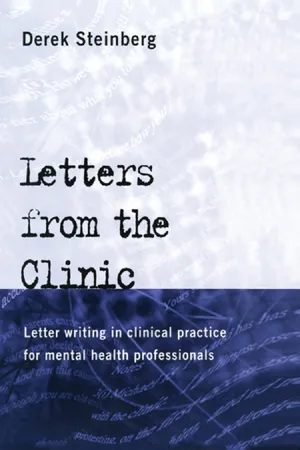
In every field of therapeutic practice a significant amount of time is spent writing letters about and to patients. In Letters From the Clinic Derek Steinberg applies detailed literary and psychological analysis to over 40 letters, highlighting why certain words or phrases were used, how they could have been put better, and builds around them principles and theoretical positions based on narrative therapy, consultative approaches and the psychological impact of words and phrases.
Using the context of child, adolescent and family psychiatry, while also applicable to all therapeutic work, the book deals with issues such as
* explaining clinical conditions and treatments
* confirming clinical contracts
* conveying difficult advice and painful news
* missed appointments and other practicalities
Each letter is followed by detailed annotations and discussion.
Letters From the Clinic will prove a valuable tool to all those working in clinical and therapeutic practice.
eBook - ePub
Letters From the Clinic
Letter Writing in Clinical Practice for Mental Health Professionals
- 132 pages
- English
- ePUB (mobile friendly)
- Available on iOS & Android
eBook - ePub
Letters From the Clinic
Letter Writing in Clinical Practice for Mental Health Professionals
About this book
Information
Chapter 1
Introduction
Reasons for Writing
Why Write?
First, because finding the right words is a good exercise, and committing them to paper adds to the responsibility to get it right; when you get it wrong it will in due course stare you in the face without the option of retrospective falsification or fudge about what you believed you made clear. So putting it in writing self-critically is good practice, whatever the reason for doing so.
Second, and to turn to the most important reason as far as this book is concerned, because of the importance of words in therapy; any therapy, not just psychotherapy. The right words capture or convey a feeling or an attitude in a way that contributes to the therapeutic process, just as the wrong words can undermine it. This applies as much to the clinical relationship in general (for example, a surgeon explaining about an operation, or a physician advising about medication) as it does to psychodynamic psychotherapy; arguably more so, because in the latter there is more going on and over a longer period, and there is a dynamic, too, in getting it right, and in the therapist finding out what getting it right is going to entail. The clinician hoping to be therapeutic outside the quite tight rules and regime of formal psychotherapy might have only one opportunity, even an unanticipated one, to capture the clinical moment helpfully in the right words. It is this, sometimes transient, even fleeting opportunity in general clinical work that can be grasped and used therapeutically; an extreme example might be saying goodbye helpfully to an angrily departing patient. When writing it down—authoritatively, thus assuming responsibility as its author—we take quite a chance, not least because the words can be reread, for example, in moments when the patient, not the therapist, is managing the Gestalt —the whole picture.
The ability to find the right word is a clinical and therapeutic skill and, like all such skills, can be developed. What is needed is to be truthful without being hurtful, discourteous or undermining therapy. One should avoid jargon—but what is jargon? Some dictionary definitions describe it as specialised language, in which case it is not only discourteous but inefficient to use it in attempts at communication with a non-specialist audience. (On the subject of words I would say communication is a good example of a word borrowed from ordinary language for use as jargon, and is now half-way back into everyday language to identify something with which many people are preoccupied these days; so where does that leave it?) Other definitions give pretentiousness as a characteristic of jargon, which implies flawed communication, because if a word is used to demonstrate how much more the speaker or writer knows than the reader, the word is falling short in its prime purpose of conveying meaning. My impression is that most users of jargon intend neither to impress nor confuse, but simply forget that useful technical shorthand within a specialised group can be meaningless and apparently pretentious outside it. But ignorance is no excuse. I suppose jargon becomes psychobabble (itself jargon) when psychological concepts are used to impress, divert, confuse, or amaze; or as a form of surfing, the speaker or babbler jumping euphorically from technical term to technical term too fast for the listener to grasp (or criticise) either the general drift or the precise meaning of each word. None the less we all have our preferences, and one person’s plain English might seem like jargon to another. Some people whose care with language I respect are baffled by my own dislike of ‘ongoing’ and ‘meaningful’, words which I will take great detours to avoid, and scratch out aggressively when entrusted with editing. Political correctness is a grisly area too, and one which I will try to tackle later.
Using euphemistic words and phrases is another tricky area; no doubt many examples are to be found in this book. One might report, for example, that what Mr X says he did is quite different from what he said last week, or how others regularly describe his behaviour, all of which is a little on the weaselly side; or one might say Mr X is a liar. The latter may help the exasperated observer to feel better, but the former construction is more likely to provide something to work on. Nor is it necessarily less accurate.
Then there is the simpler matter—simpler conceptually, but every bit as difficult linguistically—of speaking your mind in a direct and spontaneous way and contributing helpfully at the same time. Much is made of speaking one’s mind, indeed as if it is a moral duty, though it is quite possible to speak one’s mind and still talk nonsense.
A third reason for writing is because a letter can take the form of an agreed treatment plan, an aide-mémoire, an informal contract between therapist, patient and family, and the beginnings of an agenda for the next meeting. It thus provides affirmation of what has happened so far, the opportunity to reconsider or challenge what has been set down as ‘agreed’, as well as continuity. Life goes on in the 167 hours or more between, say, weekly sessions, and the letter, even if it is only vaguely recalled rather than a constant source of interest, can help keep up the momentum of treatment. Writing it down reveals fudges or ambiguities which need clarifying, though ambiguity can be useful (see p. 117); thus an ambiguity stated clearly in writing can be a useful launching pad to dealing with it. Another advantage of a letter is that it can refer to or be addressed to people who can help but who weren’t present at the session.
Fourth, there is magic in the written or spoken word; this is discussed below. Even modern, computer-printed prescription forms sometimes begin with the magic symbol Rx,1 though I believe it is more potent when handwritten.
Fifth, everyone has a right to know what is being said or written about them in a potentially public (i.e. shared) document, although I believe that this needs to be set against another right: that of keeping one’s own personal thoughts in note form. However, this too has been disputed, on the grounds that if a professional thought X at a particular time, even if it was written only in his or her private diary (e.g. ‘check dose of Z’), in some circumstances this could be of wider significance.
Sixth, moral and ethical issues apart, patients do have an increasing right to see their own notes (Bernadt et al., 1991; Brahams, 1994; Gauthier, 1999; McLaren, 1991; Parrott et al., 1988) and are increasingly likely to exercise it. Why not write all notes in the expectation that, at some point, they may be read? Writing letters is good practice for this.
Seventh, because every sort of professional worker can learn from other experts’ and specialists’ letters. General practitioners sometimes point out how useful a contribution to postgraduate training a good letter from a specialist can be. Might clear, jargon-free letters about problems, aims and methods present the ‘psychosocial’ professions and our clientele in a more positive light?
Finally, although careful writing can be time-consuming, it speeds up with practice, and in any case pausing to think about our clientele and their problems does us and them no harm, and letter writing provides a framework for this. A steady improvement in the ratio of thinking time to writing time should be anticipated, with both steadily diminishing, and writing notes and dictating letters might become less of a chore and even interesting. If writing notes is boring, we may be writing the wrong sort of notes.
A study of psychiatrists’ letters to general practitioners showed that the writing improved after the introduction of a departmental auditing procedure focusing on guidelines for letter writing; this followed the implementation of the 1990 Access to Health Records Act (Shah and Pullen, 1995). It seemed there was less use of jargon, value judgements and pejorative remarks following the audit, though the amount of information in the letters remained the same and they were of much the same length.
Auditing procedures can be perceived as intrusive and even threatening, but if conducted sensibly, by which I would mean in a consultative rather than supervisory way, they can make a valuable contribution to peer-peer teaching. One of the attractions of the consultative approach is its reciprocity: peer-peer discussion of a problem or piece of work along consultative lines is also, by definition—i.e. in the very nature of consultation—a learning exercise, while conversely, a learning or audit exercise can be built on consultative discussion of a piece of work (Steinberg, 1989, 1993). Letter writing is ideal as a focus for such teaching.
What do the Recipients of Letters Think?
Thus the writing of such letters is a very good thing. But what do their recipients think? Curiously enough little seems to have been reported about this, particularly in psychiatry (Pierides, 1999). It is discussed in Chapter 9.
The Magic of Words
It comes as something of a surprise to discover that glamour means spelling. The word, which in modern usage conveys all sorts of wonder, splendour, authority and prestige, both spurious and real, derives from the words grimoire and grammaire, twelfth- or thirteenth-century Old French for a book of spells. Thus glamour means grammar, and this means getting the words right if you want the spell (or prescription) to work, which after all is largely what this book is about.
While playing with words, an activity I want to encourage, the relationship between author and authority is interesting, though perhaps not immediately obvious. The pathway from an author’s mind through the marks he or she makes on paper to the images they create in the reader’s head represents a most extraordinary alchemy, in whatever detail we try to track the sociocultural, technical and neural pathways for the process. It takes an extraordinary sort of authority, and acceptance of that authority, for a fiction writer to establish, often in the first few phrases, interest, curiosity and even concern about a character or situation woven in only a handful of tiny printed squiggles. Many such characters are more real to us than historical figures, although the latter have also benefited significantly from the attentions of writers of fantasy and fiction, and still do. A large literature has grown up which relates narrative—fact or fiction— to psychological development at every level, from the sociocultural to the personal. The writing of letters is not part of narrative psychology, but there are important areas of overlap, where the patient’s tale, so to speak (and indeed the wife’s tale, and the daughter’s tale, and the general practitioner’s tale, and so on), is compared on paper with the therapist’s tale. It is therefore worth looking briefly at some of the concepts of narrative— story-telling—in relation to psychotherapy.
Narrative and Mythology
Myths are cultural stories which provide a background, frame of reference and therefore guide to how life is to be handled and how decisions are to be made; for example, such basic things as what is ‘good’ or ‘bad’, acceptable or unacceptable. The word ‘myth’ is often used disparagingly, for example, in dismissing classical psychoanalytical writings as merely mythology, yet myths are powerfully influential, and we should be interested in such powerful influences on human psychology. Civilisations rise and fall on the backs of myths, and it seems inherently unlikely that major wars would start without a foundation in mythology; indeed, military strategists talk of the importance of generating a ‘war psychosis’ as soon as politicians think a war is needed, so that the appropriate stories can begin to be told. Thus myths may not always be nice, but they are very powerful (can they be more destructive than nuclear weapons?) and should not be underestimated at any level of human activity (Steinberg, in press).
Myths are not all bad. We need them anyway, like food, and they can supply the essential, the nutritious, the non-nutritious and the frankly poisonous. Campbell (1973) provides a monumental account of the place of myths in human culture, poetically describing myths as public dreams, and dreams as private myths. Bettelheim’s The Uses of Enchantment (1976) describes how fairy-tales help children to grow up, and Dwivedi and Gardner (1997) describe story-making in terms of developmental psychology and therapy, namely as an activity central to organising and structuring experience.
Narrative as Clinical History
Traditionally, the clinician ‘takes a history’; in other words, he or she writes the patient’s story. It is likely to be part fact, part fiction, part autobiography, part biography, and in any case partial. The clinician is likely to be guided by the story he or she likes to write (for example, about psychoneurology, developmental psychology, social relationships or psychoanalysis); the eclectic practitioner writes a book of short stories. We cannot help being influenced by the conceptual models in our heads (Tyrer and Steinberg, 1998) and, while it is right to strive to be objective (including being objective about our subjective impressions, if we can), on philosophical or neuropsychological grounds it seems inherently unlikely that we can be completely objective. Many psychotherapists of course are less inclined to ‘take (i.e. write) a history’, and more inclined to simply let the client talk and thus assume responsibility and authority for his or her own story.
It does seem likely, on the face of it, that people have more than one story to tell, all different and all true. Individual lives and relationships are immensely complex, and what is remembered at any given time, or given significance at any given time, and the ambiguities and range of both feelings and thoughts about these kaleidoscopic experiences, are likely to produce a subtly or grossly different tale depending on the time and circumstance in which it is requested. It will also vary according to state of mind; brain chemistry and structural change, with or without effects on memory, will profoundly influence the story. It will also be affected by what the speaker makes of the listener, and what he or she wants the other person to hear. Finally, of course, all these influences on the clinical interview are no more than a sample of the influences of daily life, which proceeds within a matrix of self-image and the perceptions and expectations of others. Thus whatever else is going on in terms of neurochemistry or social change, the individual is perpetually trying and sometimes failing to piece it all together, adding, editing, filling and making gaps, in a continuous process of attempting to make sense of it all, and in a way which underpins consciousness and psychological existence. I take it that it isn’t controversial to describe one strand of human development in this way.
But, to move from the individual to the family model, the individual as autobiographical writer is not alone in his or her task. Relatives and acquaintances are busily writing too, producing scripts for (for example) the teenager as failure, or as success and scholar, for the good mother, the bad father, the efficient sibling and so on.
The narrative perspective of the client’s history is that he or she may need editorial help; thus: the therapist as editor. (Even, in the case of a really odd manuscript, a good agent?)
Narrative in Therapy
Dwivedi and Gardner (1997), Frank (1993), Roberts and Holmes (1999) and White and Epston (1990) provide excellent and comprehensive reviews of the relationships between story-telling, psychological development and therapy, with the individual’s development of a personal mythology (and the power of other people’s attributed mythologies) as common themes. Another important theme is the role of the narrative in providing distance between the individual and a painful event (for example, bereavement or other trauma), yet without compromising involvement (Ayalon, 1990; Shiryon, 1978), the story thus acting as a medium for creating both enough involvement and distance for the necessary work to be done in terms of personal development or therapeutic work. ‘Distancing’ in terms of story-telling is understandable enough as a powerful device, even bordering, constructively, on denial (as when an injured or abused child is helped to talk about what happened to Teddy), but conversely the powerful capacity of reading, and imagination generally, to involve a child should not be underestimated. Winnicott (1972) has discussed the importance, as a process but also as an indicator of maturation, for the child to be securely ‘alone’ and lost in play, a phenomenon which Nell (1988) relates to people of all age groups in their experience of reading: ‘lost in a book’. He quotes Gass’ poetic words (1972) that ‘it seems incredible, the ease with which we sink through books quite out of sight, pass clamorous pages into soundless dreams.’ Holmes (1994) and Roberts and Holmes (1999) relate the experience of being able to be lost in this way—i.e. it is a strength and a capacity—to the attachment theory dynamic for there being someone holding the individual child (or vulnerable person of any age) securely enough in the personal environment for such exploration to be feasible. At another level the spellbinding story-teller does the same.
Can a letter achieve this? No doubt some can, but the sorts of everyday letters described in this book, largely to do with the initiation and maintenance of clinical engagement rather than psychotherapy, borrow from concepts of narrative therapy rather than represent it. In an equivalent way I would say that much in traditional psychotherapy and cognitive behaviour therapy uses, or is illuminated by, notions of narrative therapy: as aphorisms, vignettes or self-contained and focused episodes, rather than the full story.
White and Epston (1990) give a comprehensive account of the use of narratives in therapy, and in which they include letter writing and ‘certification’, that is, giving an individual who has made an achievement a document or declaration to that effect. They construct their approach around the political philosophy of Michel Foucault, which is essentially about the hidden power in social institutions and groups to affect members of those groups, something which Foucault has expounded upon in a particular way (e.g. Foucault, 1980), linking it to the need for comprehensive revolution (e.g. a new form of proletarian justice which does without a judiciary). Unless I have missed something, I am not convinced that White and Epston’s adaptation of Foucault to therapy does more than point out that individuals can be trapped in power structures that include their own and others’ knowledge (ideas, assumptions, attributions) as an integral part, and that the point of therapy is to enable them to see this and adopt alternatives. What this leads to, however, is the use of what they term externalisation, that is, externalisation of the problem, thereby giving the ‘victim’ (to stay with the model for the moment) the opportunity, authority and vantage point to look at the problem from outside and join in the process of deciding who is doing what to whom. Thus the patient sees the story and has the opportunity to rewrite it. Using the concepts of psychodrama and role play, I would say that the patient is reminded, or informed, that he or she has a part in a play, and they might like to help rewrite the script, the description of their role and the way the performance is being directed.
Whatever the process of stepping out of the frame, one way of doing so is by writing. The authors provide a valid enough model, but I would place Foucault, despite his distinction as a political philosopher, simply among the many other theorists and practitioners who, so to speak, discovered ‘society’ (and prototype societies like groups and families) as somewhere to look ...
Table of contents
- Cover
- Half Title
- Title Page
- Copyright
- Contents
- Foreword
- Preface
- 1. Introduction: reasons for writing
- 2. Letters: benefits, risks and side-effects
- 3. Beginnings: invitations to the clinic
- 4. Writing for referrer and patient
- 5. Work in progress I: starting, negotiating, renegotiating
- 6. Work in progress II: general maintenance
- 7. Some special situations
- 8. Endings
- 9. What recipients think of letters
- 10. Conclusions
- Epilogue
- References
- General index
- Clinical index
Trusted by 375,005 students
Access to over 1.5 million titles for a fair monthly price.
Study more efficiently using our study tools.
Frequently asked questions
Yes, you can cancel anytime from the Subscription tab in your account settings on the Perlego website. Your subscription will stay active until the end of your current billing period. Learn how to cancel your subscription
No, books cannot be downloaded as external files, such as PDFs, for use outside of Perlego. However, you can download books within the Perlego app for offline reading on mobile or tablet. Learn how to download books offline
Perlego offers two plans: Essential and Complete
- Essential is ideal for learners and professionals who enjoy exploring a wide range of subjects. Access the Essential Library with 800,000+ trusted titles and best-sellers across business, personal growth, and the humanities. Includes unlimited reading time and Standard Read Aloud voice.
- Complete: Perfect for advanced learners and researchers needing full, unrestricted access. Unlock 1.5M+ books across hundreds of subjects, including academic and specialized titles. The Complete Plan also includes advanced features like Premium Read Aloud and Research Assistant.
We are an online textbook subscription service, where you can get access to an entire online library for less than the price of a single book per month. With over 1.5 million books across 990+ topics, we’ve got you covered! Learn about our mission
Look out for the read-aloud symbol on your next book to see if you can listen to it. The read-aloud tool reads text aloud for you, highlighting the text as it is being read. You can pause it, speed it up and slow it down. Learn more about Read Aloud
Yes! You can use the Perlego app on both iOS and Android devices to read anytime, anywhere — even offline. Perfect for commutes or when you’re on the go.
Please note we cannot support devices running on iOS 13 and Android 7 or earlier. Learn more about using the app
Please note we cannot support devices running on iOS 13 and Android 7 or earlier. Learn more about using the app
Yes, you can access Letters From the Clinic by Derek Steinberg in PDF and/or ePUB format, as well as other popular books in Psychology & Psychiatry & Mental Health. We have over 1.5 million books available in our catalogue for you to explore.