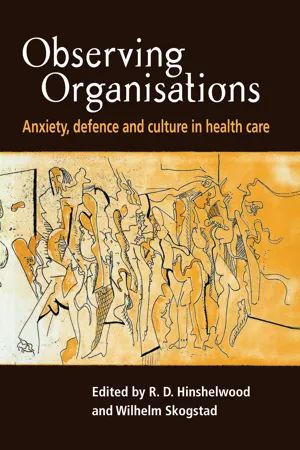
Observing Organisations presents a unique approach derived from direct participant observation of small units within institutions, all in the health and social services sector.
A range of contributors bring together the results of their own observational projects to show how they were able to come to a psychoanalytically informed understanding of the cultures that arise within healthcare organisations, and how this understanding can be used to overcome difficulties that arise.
eBook - ePub
Observing Organisations
Anxiety, Defence and Culture in Health Care
- 191 pages
- English
- ePUB (mobile friendly)
- Available on iOS & Android
eBook - ePub
Observing Organisations
Anxiety, Defence and Culture in Health Care
About this book
Information
Part I
General introduction
Chapter 1
The dynamics of health care institutions
R.D. Hinshelwood and Wilhelm Skogstad
This book is about an attempt to understand health care institutions through the eyes and mind of a participant observer. The approach adopted by the authors is based on psychoanalytic thinking and ideas, and has developed under the influence of the tradition of the Tavistock Clinic and the Tavistock Institute of Human Relations.
Various trends have developed there for applying psychoanalytic ideas outside the consulting room. In the 1940s Esther Bick pioneered infant observation (Bick 1964), and this is now a customary method used in the training of psychoanalysts, psychotherapists and child psychotherapists.
The Tavistock Institute, a branch that grew out of and later separated from the Tavistock Clinic (Trist and Murray 1990), then established a tradition of applying psychoanalytic ideas to commercial and government organisations. Increasingly they deployed those ideas within the context of an overall framework from systems theory (Rice 1963; Miller 1993). This conceptual complex is widely used in consultancy work with large and small industrial and other commercial companies, government organisations, small temporary conferences (the Group Relations Training Programme), and applied to society at large (Khaleelee and Miller 1985). This tradition now has a strong influence in this field of work (de Board 1978; Palmer 2000).
Obholzer and Roberts (1994) from the Clinic have produced a body of work, which we shall refer to later, that seeks to redress the balance and to give psychoanalytic ideas a greater part to play. Their work has been largely directed at particularly anxious institutions in the health and social service organisations.
The present book also deals with health and social service organisations, but more specifically we have reinforced the psychoanalytically oriented method further, and started from Bick’s original observation method for the mother–infant organisation. Therefore, it harks back to the founding ideas of the Tavistock tradition (Trist [1950] 1990; Jaques 1953; Menzies [1959] 1988).
The adaptation of this method to the observation of large organisations which form the basis of the studies in this book, will be described in Chapter 2. In this chapter we will give an outline of some of this tradition of work on institutions, and especially health care organisations.
SOCIAL DEFENCE SYSTEM
Fundamental to psychoanalysis is the anxiety–defence model according to which an individual has conscious and unconscious anxieties and conflicts which are dealt with by developing psychological defence mechanisms. This is first of all a model of individual psychology.
Broadening it to understand the functioning of groups, organisations and institutions in terms of anxiety and defence developed during the 1950s, when Jaques (1953) proposed that a social system can support the individual’s own psychological defences. His core idea is that, unconsciously, individuals can use the social system to help defend themselves against their anxieties. Although it is the individuals who feel anxiety and operate defences, a defensiveness can also be locked into the social system. As a whole, the system then operates in a way that allows the individuals to avoid certain anxieties and conflicts, in particular those which the institution’s primary task provokes (Menzies [1959] 1988). Individuals co-operate in shared aspects of the social system to support more rigid and primitive defence mechanisms in the individuals. These unconscious defence mechanisms are reflected in shared, socially required defensive attitudes and in particular ways in which the work is performed. The standard forms of practices which develop within an organisation for defensive purposes are referred to by Menzies ([1959] 1988) as ‘defensive techniques’. Though the practices themselves are social and overt, what drives them is personal and unconscious and can only be inferred. This divergence between the individual’s own system and the system of the organisation was first recognised by Trist ([1950] 1990), who sought ways of bridging conceptually between the social and the personal.
In any work enterprise, individuals will experience anxieties from various sources. Some will be work-specific anxieties and some individual-specific. In most organisations these tend to combine. Firstly, any work situation can cause work-specific anxiety – the work may be a dangerous activity such as digging coal, or guilt-inducing if it is work in a factory for weapons. This is a specific anxiety that is generated by the work and concerns everybody.
The particular kind of work also shapes and limits the cultural forms of defences, because the nature of the work influences what defences can be employed. The defensive techniques in the mental health professions are, therefore, quite different from, for example, those in prison staff (Hinshelwood 1993) on both counts – the work-specific anxiety and the selective effect of individual-specific anxiety.
Another, less psychoanalytic, way of looking at such differences is the concept of the sociotechnical system which was developed by the Tavistock Institute (Trist et al. 1963). This concept implies that the practical requirements of the particular type of work on the particular raw material (the technical aspects) have a strong determining effect on how the social system (including its defensive attitudes) grows up.
This approach was worked out at the Tavistock Institute in consulting work with the manufacturing industry. When we come to health care organisations the work and therefore the technology are likely to be vastly different. Health care organisations operate upon persons and not upon the qualities and behaviour of material things. The interaction between care workers (people with particular sets of attitudes about their kind of work) and their ‘raw material’ of other persons (patients or clients also with attitudes towards this work) is more complex, subtle and subjective than the cultural attitudes of an industrial manufacturing enterprise. The scope for mutual impact between one set of attitudes and emotional experiences and the other is obviously great – and is missing from work with inanimate raw material.
However, secondly, individuals bring certain concerns, anxieties and conflicts that are specific to them. They may be drawn into particular work or particular organisations because their defences match aspects of the social defence system of an organisation (Dartington 1994; Roberts 1994b).
Of course, many other factors shape the working techniques. These will arise from economic, social and historical sources, but these are not the primary focus of this study.
HEALTH CARE INSTITUTIONS AS SOCIAL DEFENCE SYSTEMS
In the 1950s, Menzies carried out an extensive study of the nursing service of a general hospital, using an interview and questionnaire method. She described in detail how the social system was influenced to support psychological defences against the anxieties of the primary task (Menzies [1959] 1988).
Menzies’ classic study is the reference point for most later psychoanalytically oriented work in health care organisations. She took a specific view of the anxiety that drove the defensive systems. There are deeply unconscious phantasies concerned with human aggression, and the damage done, in phantasy, by that aggression. She spoke of the unconscious level of those phantasies, and how the real existence of damaged and dying people in beds in hospital could seem to confirm those phantasies as real. This uses Freud’s notion of the omnipotence of phantasy (1909) – the idea being that if the phantasies of aggression are unconscious it is very difficult for the person to test in reality, if they have actually done what they unconsciously think of doing. In the unconscious, to think is to have already done the deed. These phantasies then add to the real responsibility and guilt, leading to extreme and unrealistic anxiety. Caring for the extreme cases of people dying can then act to confirm that inward feeling of burdensome responsibility. As a further step the person is then driven to repair the phantastical damage and to restore the damaged person to full health.
The closeness to suffering and death in the nursing work, the intimate physical contact with patients, brings up various anxieties connected with the burden of responsibility for illness, suffering and death. Many features of the nursing service that Menzies studied seemed to be aimed at helping the individual to avoid the conscious experience of anxiety, guilt and uncertainty, and achieved this by eliminating situations, tasks and relationships that caused the anxieties. For example, nurses were frequently moved from ward to ward, and various tasks in the care of patients were broken up between a number of nurses, so that no emotional closeness could develop between nurses and their patients. The depersonalisation and detachment was accompanied by a denial of feelings in nurses or patients. The processes of splitting and projection were seen as central to understanding the defensive system. For example, conflicts inherent in the responsibility were avoided by attributing all irresponsible impulses to the junior nurses and strictness and harsh discipline to the seniors. The crucial significance for the dynamics of an institution is that such projective processes do not remain on the psychic level, but become a reality within the organisation ‘since people act objectively on the roles assigned to them’, as Menzies put it ([1959] 1988: 57) –what we would now call ‘projective identification’.
Menzies showed that the defensive systems interfered with the ordinary way in which people might process all this: firstly, by ensuring that all these feelings remained unconscious and therefore were not available to be tested in the reality; secondly, by disrupting the relationship between patients and staff so that staff never follow through the care they offer. This also prevents them from mitigating the phantasised guilt and demand to repair.
The externalisation of conflicts through the projection of different aspects into different groups within an organisation, which Menzies showed, for example, in relation to responsibility, is a common factor in the dynamics of institutions. In this way, what could be an internal conflict becomes an external one instead; this reduces the anxiety in the individual but leads to tensions between different groups and, because of the polarisation resulting from projections, often prevents appropriate solutions to the task.
Such a spreading of conflicts inherent to the task was found by Bott (Bott 1976; Bott-Spillius 1990), who carried out an extensive study of a mental hospital in the 1960s, using an anthropological fieldwork method. She described the mental hospital as being at the centre of a number of conflicting aims and intentions:
- the need to keep under control the madness which relatives and society in general find too difficult to tolerate and want to get rid of into the institution;
- the need to provide care for people who are looking for retreat and respite from the intolerable difficulties of their lives; and
- the wish to offer treatment, and even cure, to patients suffering from illnesses.
These different aims are often incompatible and come into conflict with each other. Bott found in her study, however, that such conflicts were not expressed or even directly recognised by the staff of the hospital. Instead, the conflicting aspects were spread between patients, doctors, nurses, relatives and representatives of society and thus prevented from becoming a difficult and painful conscious tension within individual staff members (or patients).
Miller and Gwynne (1972), using an action research method in a study of institutions for the care of the severely physically handicapped, also found social defence systems that support the primitive defences of denial, splitting and projection to deal with the conflicts inherent in their task, although here the division developed between different institutions. On the one hand, they found homes with a liberal attitude where inmates were regarded as having full human potential and were put under considerable pressure to develop whatever skills they might have. Miller and Gwynne called this the ‘horticultural model’ and contrasted it with the ‘warehousing model’ of other homes with a more paternalistic attitude. In the latter, inmates were seen as deeply damaged, with little chance of achieving any human characteristics and in need of total care. Facing the severe damage that makes normal life impossible for these inmates, recognising their surviving skills and potentials, and assessing both aspects individually and repeatedly over time, would involve anxiety and pain for both patients and staff. These were avoided by splitting and division across a fracture line which then had the effect that separate yet complementary attitudes could not be brought together. For those who failed the expectations in the ‘horticultural model’ this polarisation meant a denial of their full damage and distress, and for many in the ‘warehousing model’ a denial of their potential, leading to unnecessarily restricted lives.
A similar dynamic was found by Roberts (1994a) in a hospital for severely impaired elderly people, results which derived from a consultation method. There, a division between wards for rehabilitation and others for continuing care without the aim of rehabilitation led to a strict divide between hopefulness and therapeutic zeal in the first and a hopeless, devalued attention to the physical care and safety of patients in the other.
These are just a few examples of the organisation of health care institutions into social defence systems. These social defence systems coordinate the individual defences in which, at the unconscious level, the individuals bury their anxieties and conflicts. An allegiance to these defences within a collective work setting has an impact on the individuals’ personal sense of identity. The denial of aspects of themselves through splitting and projective identification is more than an individual mechanism, but becomes, in a collective setting, coordinated between the intra-psychic states to employ such defences jointly. Each person gives unconscious support to similar kinds of defences in others and thereby contributes to a strong harmonisation within different groups. The insertion of individual people into the social structure is, therefore, a two-way relationship.
For example, in a mental hospital the fear of being taken over by madness and violence as well as the individuals’ reparative wishes towards their primary objects can be kept safely controlled by projection into others. But this is co-ordinated by a social defence system, in which madness is kept in patients and sanity in staff and rigid barriers are created to prevent contamination (Bott-Spillius 1990; Hinshelwood 1987a; Main 1975). This, however, leads to severe problems in restoring patients to a degree of health in which they can re-own some sane parts of themselves.
Alternatively, the fear of madness in each person may reach the level of a joint, though unconscious, assumption that any liveliness between people might result in madness (Hinshelwood 1987a), which results in a specific culture of deadness and dampening of any liveliness (see Chapters 3 and 4). This leads us to a different concept: that of culture and its underlying unconscious assumptions.
UNCONSCIOUS CULTURE
‘Culture’ is an elusive term, difficult to define and yet an important concept when thinking about the dynamic of an organisation. The notion of the ‘culture’ was introduced by Trist ([1950] 1990) and strongly influenced Menzies’ ideas about roles and work techniques in the practice of an institution. Menzies Lyth saw culture linked with
such things as attitudes and beliefs, patterns of relationships, traditions, the psychosocial context in which work is done and how people collaborate in doing it.
(Menzies Lyth 1990: 466–467)
When Trist ([1950] 1990) introduced his concept of ‘culture as a psycho-social process’, he wanted to relate these external aspects, of roles and practices at work, to the internal states of mind of the individuals who take the roles and perform the practices. Attitudes and sets of beliefs are cultivated partly as rationalisations for the defensive techniques and the schismatic projections described above, and they form part of the specific culture of the organisation or one of its sub-groups.
Culture, Trist claims, bridges the psyche and the social; it refers to the structural and instrumental aspects of social life as well as reaching down to ‘emotional phenomena at the deeper levels of the personality’ ([1950] 1990: 540). It encompasses techniques such as rituals, skills, customs, systems of strategy and tactics, and many of these techniques may appear as defence mechanisms against anxiety, i.e. what Menzies ([1959] 1988) later called ‘defensive techniques’. But it also includes ‘cultural patterns’, which Trist located within the person. Some of the latter relate more to the external world, such as knowledge, skill, language, beliefs, values, prejudices and social attitudes; others are primarily internal, such as internal objects in the psychoanalytic sense. While the features of an institutional culture are carried by the individual members, they cannot be reduced to individual psychology; they exist within the reality of the whole organisation. The individual, however, has his or her own objectives, conscious and unconscious, for taking part in it.
In our thinking, we have tried to clarify this by focusing on one specific relevant element of culture. That element is the set of unconscious assumptions, attitudes and beliefs about the work task and how to perform it. To claim this as cultural, this set of mental objects must be collectively held within the team of staff and patients – or by some identifiable sub-group of them. This collectivisation leads to characteristic work practices, but also to less tangible phenomena which can be best described as the ‘atmosphere’ – or the ‘emotional atmosphere’. Human beings tend to be very receptive to an ‘atmosphere’, and respond often unthinkingly but emotionally and unconsciously to it. Our focus is therefore on this collectively generated and sustained atmosphere into which people come.
Though many things belong to culture, a psychoanalytic view directs attention to those that are unconscious– the unspoken shared attitudes, the unacknowledged anxieties and conflicts, as well as the quality of the atmosphere and its unconscious aspects. The social defence system is thus, in Trist’s sense, a psychosocial process – sets of cultural attitudes which reach down to the depths of the individual personalities. This adds a distinctly personal dimension to the more social foci of attention such as task, role, authority and leadership. Unconscious defences generate implicit sets of attitudes which therefore form a palpable aspect of culture. Despite being unconscious, those aspects are quite dominant and remain influential because they are not recognised and accounted for consciously.
ANXIETY AND THE MANAGEMENT SYSTEM
When Miller and Rice (1967) at the Tavistock Institute embraced a systems theory approach, there developed a particular emphasis on the system itself and on the processes of system maintenance, in line with the current stress on management in organisational studies. Through this shift, particular issues within an organisation that are linked with the management of the system, such as task, role, authority, leadership and boundary, have become major foci. Their function within a system and the distortions and contradictions of these aspects in an institution are particularly looked at. One reason for this shift may have been the demand on the Tavistock Institute for consultancy work whose aim was to bring about actual organisational change, and thus led to an emphasis on the leadership and authority which must sanction and support, if not initiate, change. This different emphasis has, however, had the effect that the anxieties and conflicts that drive the distortions may not have such a central place, and are sometimes regarded simply as a category of obstacles to change.
Consultancy has also been the method employed by a group at the Tavistock Clinic in looking at the problems of health care institutions and other human services (Obholzer and Roberts 1994). They too have tended to stress the importance of leadership and authority in the work, while to varying degrees addressing the underlying anxieties.
In the studies described in that Obholzer and Roberts compilation, the consultant works with the staff, usually in a single weekly or fortnightly staff group meeting, or a ‘sensitivity group’. This approach is based largely on the idea that those who work with people need to be sensitised to the emotional atmosphere and to the subtle non-verbal communications of feelings in their clients. The foundation of the work is that there are specific reasons why people’s access to their own emotional states of mind are hindered. These hindering factors are sought within the unconscious of the team members, assumed to be collectively shared.
This workable and successful paradigm is based on the idea that someone from outside the team will have a vantage point not affected by these unconscious blocks. However, the illustrating case studies in the Obholzer and Roberts work convey an inconsistent view of the source of the unconscious ‘blockages’. There are competing assumptions...
Table of contents
- Cover
- Half Title
- Title
- Copyright
- Contents
- List of contributors
- Foreword
- Preface
- Acknowledgements
- Part I General introduction
- Part II Observations in mental health care
- Part III Observations in general health care
- Part IV Conclusions
- Bibliography
- Index
Trusted by 375,005 students
Access to over 1.5 million titles for a fair monthly price.
Study more efficiently using our study tools.
Frequently asked questions
Yes, you can cancel anytime from the Subscription tab in your account settings on the Perlego website. Your subscription will stay active until the end of your current billing period. Learn how to cancel your subscription
No, books cannot be downloaded as external files, such as PDFs, for use outside of Perlego. However, you can download books within the Perlego app for offline reading on mobile or tablet. Learn how to download books offline
Perlego offers two plans: Essential and Complete
- Essential is ideal for learners and professionals who enjoy exploring a wide range of subjects. Access the Essential Library with 800,000+ trusted titles and best-sellers across business, personal growth, and the humanities. Includes unlimited reading time and Standard Read Aloud voice.
- Complete: Perfect for advanced learners and researchers needing full, unrestricted access. Unlock 1.5M+ books across hundreds of subjects, including academic and specialized titles. The Complete Plan also includes advanced features like Premium Read Aloud and Research Assistant.
We are an online textbook subscription service, where you can get access to an entire online library for less than the price of a single book per month. With over 1.5 million books across 990+ topics, we’ve got you covered! Learn about our mission
Look out for the read-aloud symbol on your next book to see if you can listen to it. The read-aloud tool reads text aloud for you, highlighting the text as it is being read. You can pause it, speed it up and slow it down. Learn more about Read Aloud
Yes! You can use the Perlego app on both iOS and Android devices to read anytime, anywhere — even offline. Perfect for commutes or when you’re on the go.
Please note we cannot support devices running on iOS 13 and Android 7 or earlier. Learn more about using the app
Please note we cannot support devices running on iOS 13 and Android 7 or earlier. Learn more about using the app
Yes, you can access Observing Organisations by R. D. Hinshelwood, Wilhelm Skogstad, R. D. Hinshelwood,Wilhelm Skogstad in PDF and/or ePUB format, as well as other popular books in Medicine & Health Care Delivery. We have over 1.5 million books available in our catalogue for you to explore.